
Chef Fai
Southern Cucumber Relish (Ajad)
The one Thai condiment where vinegar replaces lime as the sour pillar, and the system still holds. Palm sugar for sweet, nam pla for salt, prik for heat. Ajad is the four pillars in a jar.
A cooking platform built around craft, culture, and the stories behind what we eat.
Created by
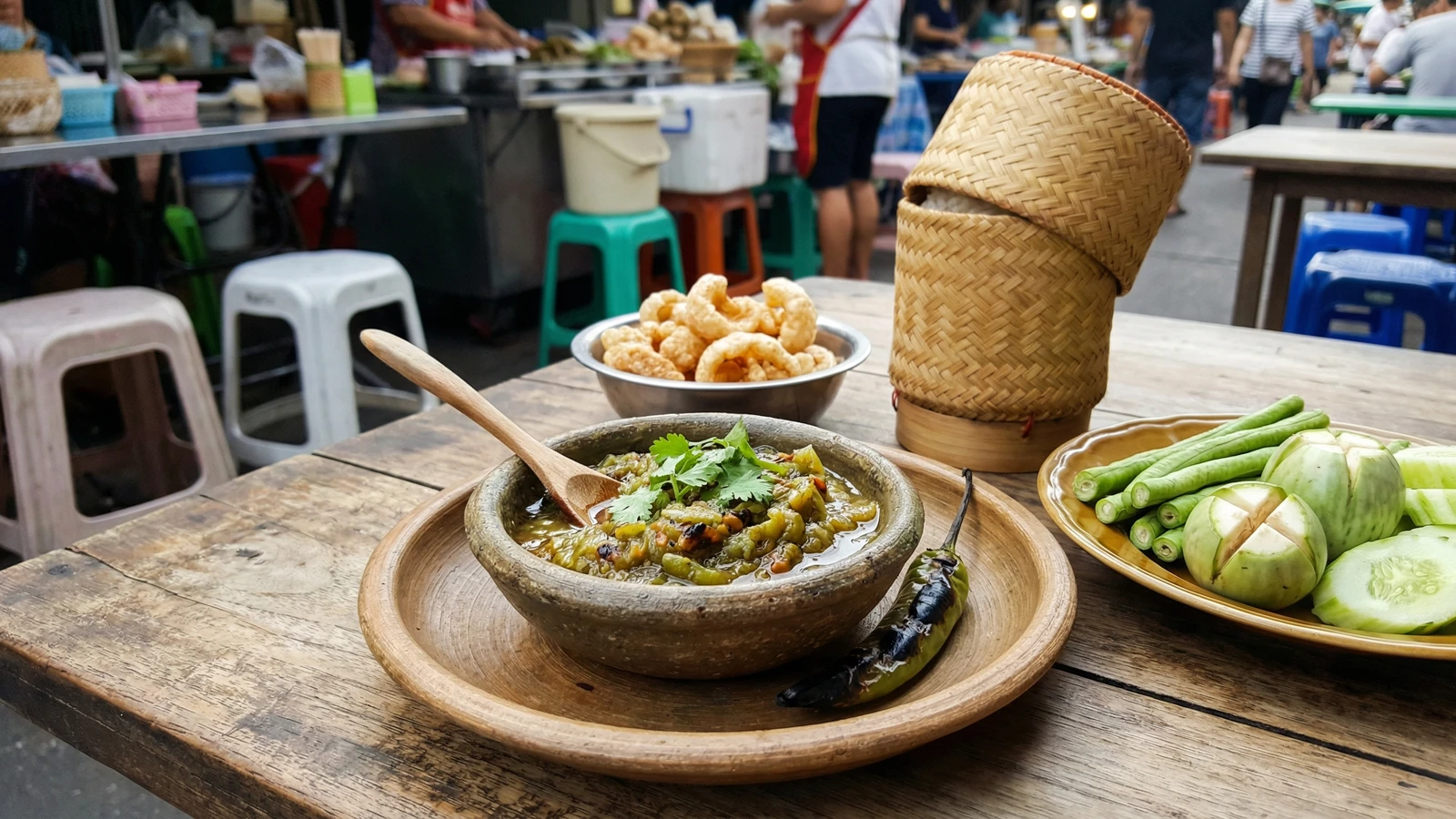
Fire transforms what the mortar finishes. Roast the prik num over charcoal until the skins blister, pound them in the krok with garlic and shallots, season with nam pla. Northern Thai food at its most elemental.
Nam prik is the soul of the Northern Thai table. Not curry. Not stir-fry. Nam prik. A pounded chili relish that sits at the center of the khantoke tray and ties every other dish together. If you understand nam prik, you understand how Lanna people eat.
Nam prik num is the kreung tam stripped to its essence: roasted green chilies, garlic, and shallots, charred black over coals, then pounded in the krok until they become something entirely new. Fire first, then the mortar. That's the Lanna method. In Central Thai cooking, you pound raw aromatics into paste. In the North, you roast them. The charcoal does half the work before the pestle ever touches the ingredients. Those blistered chili skins carry a smokiness that raw chilies will never give you. The garlic turns sweet and mellow after fifteen minutes over flame. The shallots caramelize inside their papery husks. This is heat transforming ingredients at the molecular level, the Maillard reaction doing what no amount of pounding alone can replicate.
Ajarn always said the four pillars hold every Thai dish together. In nam prik num, the pillars show up differently than you'd expect. Salt comes from nam pla. Heat comes from the prik num themselves, fierce and green and relentless. Sweetness? You don't add palm sugar here. The roasted garlic and shallots provide it naturally, caramelized by the fire. Sour comes from a squeeze of lime. The system adapts. The principles hold. That's what makes it a system and not a set of rules.
You eat this with sticky rice (khao niew), kab moo (pork rinds), and a spread of raw vegetables: long beans, round Thai eggplant, cucumber, maybe some blanched pak wan (sweet leaf). You tear the kab moo, scoop the nam prik, take a pinch of sticky rice. That's a complete bite. That's how the khantoke works. Every element on the tray exists for a reason. Nam prik num is the anchor.
Nam prik num is native to Chiang Mai and the broader Lanna region of Northern Thailand, where the long green chili (prik num) grows prolifically during the cool season from November through February. "Num" (หนุ่ม) means "young" in Northern Thai dialect, referring to the green, unripe state of the chili. The dish is a cornerstone of the khantoke (ขันโตก), the traditional Lanna low round tray where shared relishes, curries, and vegetables surround a central sticky rice basket, a communal dining format that predates Central Thai table service and remains the daily standard for Northern Thai family meals.
Quantity
15 (about 300g)
Quantity
1 whole head
unpeeled
Quantity
5
unpeeled
Quantity
3
Quantity
2 tablespoons, plus more to taste
Quantity
1 tablespoon (about 1 lime)
Quantity
1 small handful
roughly chopped
Quantity
for serving
Quantity
for serving
Quantity
for serving
| Ingredient | Quantity |
|---|---|
| long green Northern Thai chilies (prik num) | 15 (about 300g) |
| garlicunpeeled | 1 whole head |
| shallots (hom daeng)unpeeled | 5 |
| small tomatoes (makeua thet) | 3 |
| fish sauce (nam pla) | 2 tablespoons, plus more to taste |
| lime juice (nam manao) | 1 tablespoon (about 1 lime) |
| fresh cilantro (pak chi)roughly chopped | 1 small handful |
| sticky rice (khao niew) | for serving |
| kab moo (pork rinds) | for serving |
| raw vegetables: long beans, round Thai eggplant, cucumber, blanched pak wan | for serving |
Set the prik num, whole garlic head, unpeeled shallots, and tomatoes directly on a charcoal grill or over an open gas flame. The chilies go on first because they need the most time. Roast them, turning with tongs, until every surface is blistered and blackened. The skin should be charred and papery, the flesh underneath soft and collapsed. This takes 10 to 15 minutes depending on your heat. You want genuine char, not a light toast. The garlic and shallots roast in their skins until they're completely soft when squeezed, about 15 minutes. The skins protect the flesh inside while the sugars caramelize. The tomatoes need only 5 to 8 minutes, just until the skin splits and they soften through. The kitchen (or your balcony, or your backyard) should smell like a Chiang Mai street at dusk: smoky, green, sweet.
Let everything cool just enough to handle. Peel the blackened skins off the chilies. Some charred bits will cling to the flesh. Leave them. That's flavor, not debris. Split the chilies and scrape out the seeds if you want less heat, but traditional nam prik num keeps most of them in. Squeeze the garlic cloves out of their skins. They should be golden, soft, and sweet-smelling, completely different from raw garlic. Peel the shallots, discarding the charred outer layers but keeping any caramelized flesh. Peel the tomatoes (the skins will slide right off after roasting).
Start with the roasted garlic and shallots in the granite mortar. Pound them to a rough paste. Not smooth. You want texture, little pieces that give the dip body. Add the roasted chilies a few at a time and pound, incorporating them into the garlic-shallot base. The chilies should break down into a chunky, fibrous mass with visible green and charred flecks. Now add the roasted tomatoes and pound just enough to crush them in. They add moisture and a slight acidity that balances the smoke. The final texture should be rough, uneven, and full of character. This isn't a puree. It's a pounded relish. Every bite should have a slightly different balance of chili, garlic, and char.
Add the fish sauce (nam pla) and lime juice directly into the mortar. Stir with the pestle or a spoon to incorporate. Taste. The balance should be: smoky first, then salty, with heat building and a bright lift of lime at the end. If it needs more salt, add fish sauce a teaspoon at a time. More brightness? A squeeze of lime. Don't overthink it. Pound, taste, adjust. That's the method. Fold in the chopped cilantro (pak chi) at the end. Transfer to a small bowl and set it on the khantoke with a basket of sticky rice (khao niew), a bowl of kab moo (pork rinds), and a plate of raw vegetables: long beans, round Thai eggplant quartered, cucumber slices, and blanched pak wan. The kab moo is non-negotiable. Its crunch and fat against the smoky, salty nam prik is the whole point.
1 serving (about 110g)
Culinary guides, cultural storytelling, and the editorial depth that makes cooking meaningful.
Discover Culinary ExplorerChef Fai
The one Thai condiment where vinegar replaces lime as the sour pillar, and the system still holds. Palm sugar for sweet, nam pla for salt, prik for heat. Ajad is the four pillars in a jar.

Chef Fai
Every grilled dish in Isan answers to this dip. Roasted dried chilies, nam pla, manao, khao khua, and shallots: the four pillars in a condiment that's structural, not optional.
Chef Fai
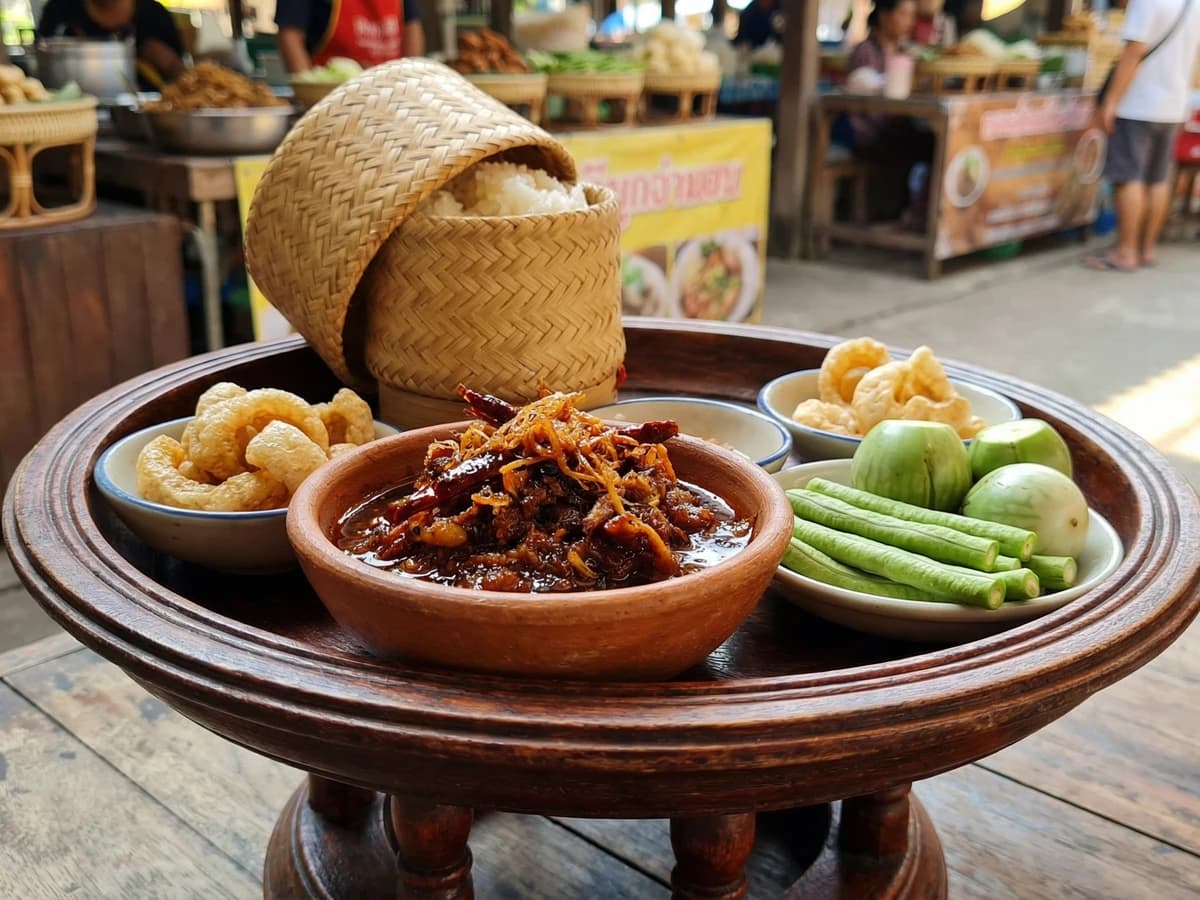
Roasted dried chilies and galangal pounded to a rough paste, folded with shredded pork skin and palm sugar until it becomes something sweet, smoky, and chewy that belongs on every khantoke tray in Chiang Mai.

Chef Fai
The kreung tam that proves the system adapts. Ginger instead of galangal, cumin and star anise alongside lemongrass. Lanna's mortar holds the whole Burma-to-Chiang Mai trade route in a single paste.