
Chef Fai
Southern Cucumber Relish (Ajad)
The one Thai condiment where vinegar replaces lime as the sour pillar, and the system still holds. Palm sugar for sweet, nam pla for salt, prik for heat. Ajad is the four pillars in a jar.
A cooking platform built around craft, culture, and the stories behind what we eat.

Created by
The four pillars reduced to their rawest form: roasted kapi pounded with dried chilies, garlic, lime, and palm sugar in the granite mortar. Every bite is the Thai flavor system in miniature, eaten with sticky rice on the Lanna khantoke.
Nam prik is where Thai food begins. Not green curry. Not a stir-fry. Nam prik. A paste of chilies, aromatics, and seasoning pounded in a mortar and eaten with rice and vegetables. Ajarn always said that if you want to understand Thai cuisine as a system, start with nam prik. It's the kreung tam in its most naked form: every ingredient earns its place, every flavor is exposed, and there's nowhere to hide.
Nam prik kapi takes the four pillars and puts them in a single bowl. Kapi (กะปิ, fermented shrimp paste) provides deep, funky salinity alongside nam pla. Palm sugar gives sweetness. Lime gives sourness. Chilies give heat. That's the whole system. No coconut milk to soften it. No broth to dilute it. Just the principles, pounded together, daring you to taste every one.
The critical move is roasting the kapi before it goes into the mortar. Wrap it in banana leaf or foil and hold it over a flame until it smells toasty and the raw funk transforms into something smoky and complex. The garlic and shallots get the same treatment: charred on the outside, sweet and soft on the inside. In Lanna, charcoal is traditional. A gas flame works. A microwave does not. The roasting isn't a shortcut. It's chemistry. Heat drives off volatile sulfur compounds in the raw paste and triggers Maillard reactions that deepen the umami. Skip it and your nam prik tastes like the ocean floor. Roast it and it tastes like the ocean at sunset.
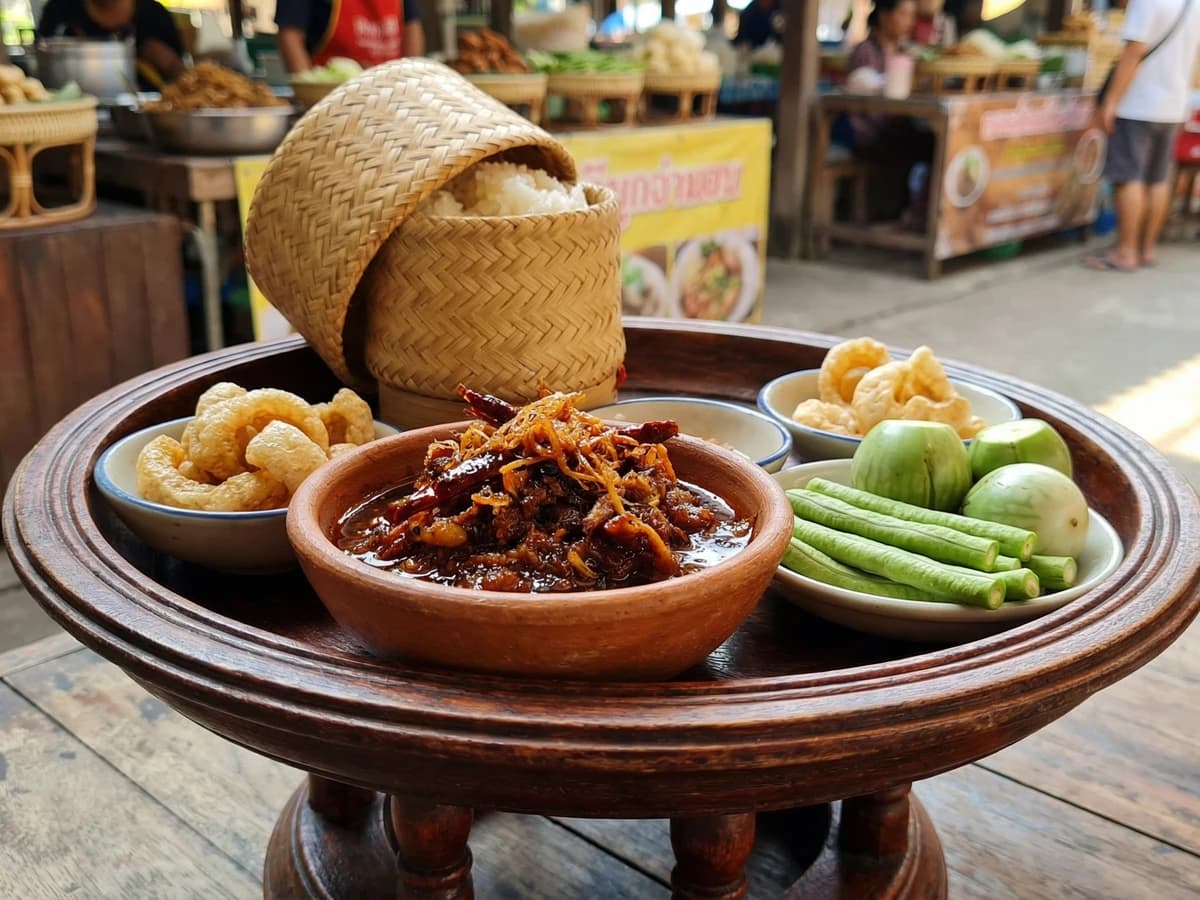
On the khantoke, nam prik kapi sits in a small bowl surrounded by khao niew (sticky rice), raw vegetables, and kab moo (pork rinds). You tear off a piece of sticky rice, pinch some nam prik onto it, add a bite of cucumber or long bean, and that's a complete mouthful. The dish isn't a condiment. It's the center of the meal. Everything else orbits around it. This is how Lanna families have eaten for generations: small bowls of pounded relish on a low tray, everyone's hands reaching for the same basket of rice. The simplicity is the point. The principles do the work.
Nam prik is considered the oldest category of Thai cuisine, predating curry pastes and stir-fries by centuries. The word 'nam prik' (น้ำพริก) translates literally to 'chili water,' though the modern form is a thick, pounded paste rather than a liquid. Kapi-based nam prik appears across every Thai region, but on the Lanna khantoke (the traditional Northern Thai low dining tray), it holds a specific place alongside regional specialties like nam prik num and nam prik ong, forming part of a composed meal designed around communal sticky rice. While some Lanna nam priks replace kapi with tua nao (fermented soybean discs) for a different fermented depth, nam prik kapi remains the pan-Thai constant that ties the northern table to the rest of the country.
Quantity
2 tablespoons
wrapped in banana leaf or foil for roasting
Quantity
7
soaked in warm water 10 minutes, drained
Quantity
5
Quantity
6 cloves
unpeeled, for roasting
Quantity
4 small
unpeeled, for roasting
Quantity
3 tablespoons (about 2-3 limes)
Quantity
1 tablespoon
Quantity
1 tablespoon
shaved or grated
Quantity
for serving
Quantity
for serving
Quantity
1
sliced into spears
Quantity
4-5
quartered
Quantity
1 handful
cut into 3-inch lengths
Quantity
1 bunch
blanched or steamed
| Ingredient | Quantity |
|---|---|
| shrimp paste (kapi)wrapped in banana leaf or foil for roasting | 2 tablespoons |
| dried red chilies (prik haeng)soaked in warm water 10 minutes, drained | 7 |
| bird's eye chilies (prik khi nu) | 5 |
| garlicunpeeled, for roasting | 6 cloves |
| shallots (hom daeng)unpeeled, for roasting | 4 small |
| lime juice (nam manao) | 3 tablespoons (about 2-3 limes) |
| fish sauce (nam pla) | 1 tablespoon |
| palm sugar (nam tan pip)shaved or grated | 1 tablespoon |
| sticky rice (khao niew) | for serving |
| kab moo (pork rinds) | for serving |
| cucumbersliced into spears | 1 |
| round Thai eggplant (makeua puang)quartered | 4-5 |
| long beans (thua fak yao)cut into 3-inch lengths | 1 handful |
| morning glory (pak bung) or sweet leaf (pak wan) (optional)blanched or steamed | 1 bunch |
Take the shrimp paste and wrap it tightly in a piece of banana leaf or aluminum foil, forming a flat packet about half a centimeter thick. Place it directly over charcoal or hold it over a gas flame with tongs. Roast each side for about 2 minutes. You'll know it's ready when the raw fishy smell transforms into something toasty, nutty, almost smoky. The packet should feel firm and dry to the touch. Unwrap it carefully. The paste inside should be darker, drier, and smell completely different from what you started with. That transformation is the whole point.
Place the unpeeled garlic cloves and unpeeled shallots directly on the charcoal or in a dry pan over high heat. Turn them occasionally. The skins will blacken and char. That's fine. You want the outside burned and the inside soft, sweet, and yielding. The garlic takes about 5 minutes, the shallots closer to 8. Squeeze one: if it gives easily under your thumb, it's done. Peel off the charred skins. At the same time, dry-roast the soaked and drained prik haeng in a pan or over the coals for 30 seconds per side until they darken slightly and smell fragrant. Don't burn them. Burned chilies taste bitter and acrid. There's a line between toasted and ruined, and it's about ten seconds wide.
Start with the garlic cloves and a pinch of salt in the granite mortar. Pound to a rough paste. The salt acts as an abrasive, gripping the garlic against the stone. Add the bird's eye chilies and the roasted dried chilies. Pound again until everything is broken down into a coarse, fibrous paste. Not smooth. You want texture. You want to see flecks of red chili skin and crushed garlic. The aroma should be sharp and immediate: if your eyes aren't stinging a little, you need more force.
Add the peeled roasted shallots to the mortar. Pound them into the chili-garlic paste until they break down and their sweetness merges with the heat. Now add the roasted kapi. Pound firmly to incorporate it fully. The paste should become cohesive, slightly sticky, and darker from the shrimp paste. Keep going until there are no distinct lumps of kapi left. The mortar will smell incredible at this stage: smoky, funky, spicy, all at once. That's the kreung tam doing its work.
Add the palm sugar to the mortar and pound it in to dissolve. Add the fish sauce. Squeeze in the lime juice last. Stir with the pestle to combine. Now taste. This is the moment that matters. The balance should read: salty and funky first (from the kapi and nam pla), then sour (the lime cutting through the richness), then sweet (the palm sugar rounding the edges), then heat building at the back of your throat. If it's too salty, more lime. If it's too sour, a pinch more sugar. If it tastes flat, it needs fish sauce. Ajarn always said: 'Add sour last, add sour slowly.' He was right. You can always squeeze more lime. You can't take it back.
Transfer the nam prik to a small bowl. Arrange it on the khantoke tray alongside the kratip (sticky rice basket), a plate of raw vegetables (cucumber spears, quartered round Thai eggplant, long bean lengths), blanched morning glory or steamed pak wan, and a pile of kab moo. The sticky rice is the only starch. Not jasmine rice. Khao niew. You tear off a piece, press it flat with your fingers, scoop some nam prik, add a bite of vegetable or a shard of kab moo. That one mouthful contains every principle of Thai food: the fermented depth, the salt, the sour, the sweet, the heat, the crunch. That's the system at work.
1 serving (about 50g)
Culinary guides, cultural storytelling, and the editorial depth that makes cooking meaningful.
Discover Culinary ExplorerChef Fai
The one Thai condiment where vinegar replaces lime as the sour pillar, and the system still holds. Palm sugar for sweet, nam pla for salt, prik for heat. Ajad is the four pillars in a jar.

Chef Fai
Every grilled dish in Isan answers to this dip. Roasted dried chilies, nam pla, manao, khao khua, and shallots: the four pillars in a condiment that's structural, not optional.
Chef Fai
Roasted dried chilies and galangal pounded to a rough paste, folded with shredded pork skin and palm sugar until it becomes something sweet, smoky, and chewy that belongs on every khantoke tray in Chiang Mai.

Chef Fai
The kreung tam that proves the system adapts. Ginger instead of galangal, cumin and star anise alongside lemongrass. Lanna's mortar holds the whole Burma-to-Chiang Mai trade route in a single paste.