
Chef Fai
Southern Cucumber Relish (Ajad)
The one Thai condiment where vinegar replaces lime as the sour pillar, and the system still holds. Palm sugar for sweet, nam pla for salt, prik for heat. Ajad is the four pillars in a jar.
A cooking platform built around craft, culture, and the stories behind what we eat.
Created by
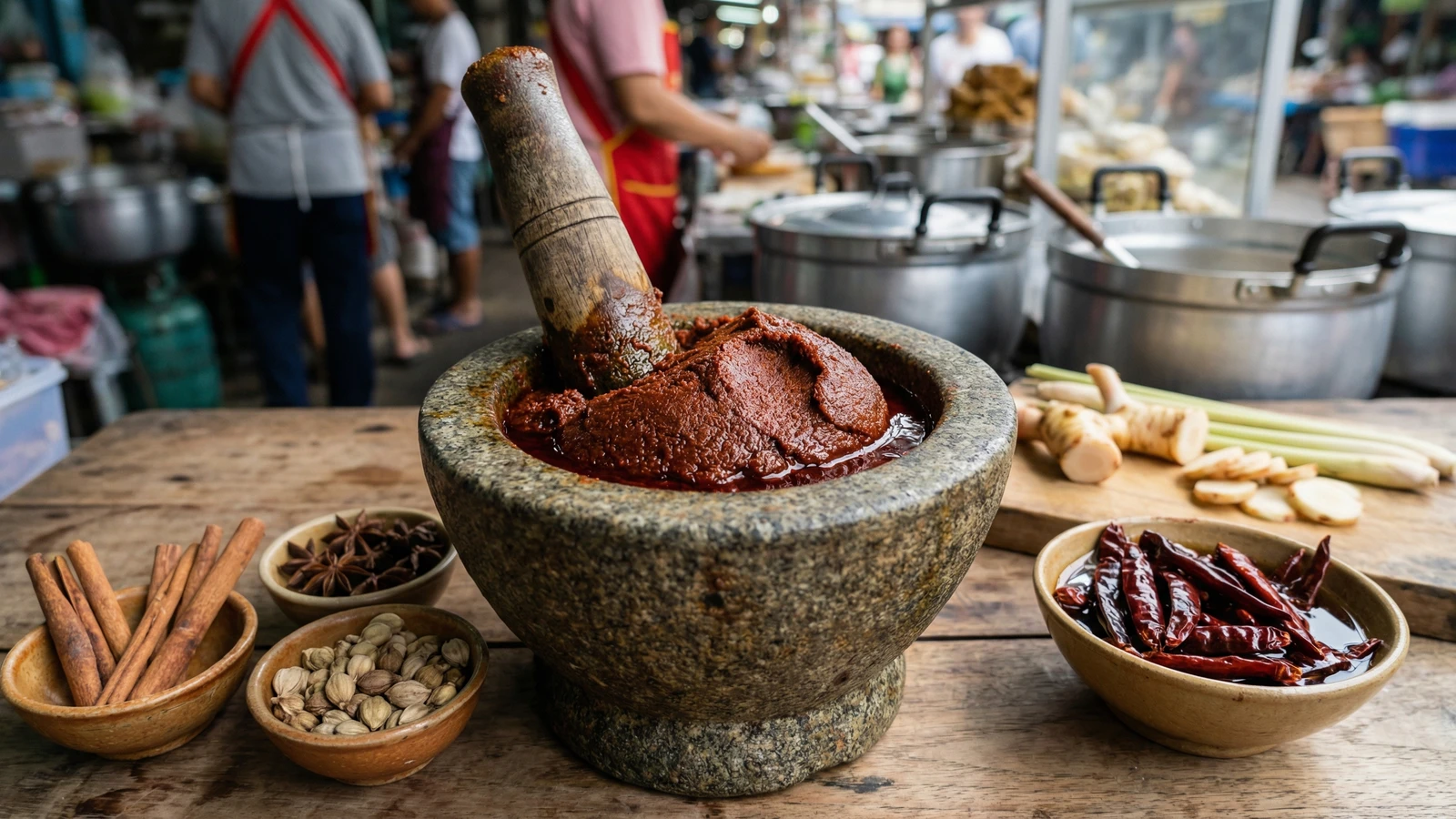
Where Indian spice meets the Thai mortar. Cinnamon, cardamom, cumin, and star anise entered the kreung tam through trade routes and became Thai. The system absorbed them. The principles held.
Massaman paste is the proof that Thai cuisine is a living system, not a frozen tradition.
Ajarn always said the kreung tam is the foundation of Thai cooking. Every curry, every stir-fry sauce, every nam prik starts in the mortar. But he also said the system isn't rigid. It absorbs. It adapts. It takes what arrives on a trade ship and makes it Thai. Massaman is the ultimate example. Cinnamon, cardamom, cumin, star anise, cloves, nutmeg: none of these are native Thai ingredients. They arrived from India, from Persia, from the spice routes that ran through the Malay Peninsula and into the ports of Southern Thailand. And the Thai kreung tam swallowed them whole.
Here's the principle: the paste foundation doesn't change. You still pound. You still start with the hardest ingredients and work toward the most delicate. You still finish with kapi (shrimp paste). The mortar still transforms. What changes is what goes into it. In a green curry paste, you pound fresh green chilies and fresh herbs. In massaman, you pound dried spices alongside your lemongrass, galangal, shallots, and garlic. The technique is identical. The ingredients shift. That's the system at work.
The order matters more in this paste than almost any other. You dry-roast the whole spices first to wake them up, then pound them to powder in the krok before a single wet ingredient goes in. If you throw cinnamon bark into the mortar alongside shallots, you'll be pounding for an hour and the shallots will be liquid before the cinnamon breaks down. Hardest first. Most delicate last. Krok ก่อน, krok ก่อน. The mortar knows.
The word 'massaman' almost certainly derives from 'Mussulman,' an older term for Muslim, pointing to the dish's origins in the Muslim communities of Southern Thailand and the Malay Peninsula. Persian and Indian traders brought dried spices to these ports as early as the 16th century, and local cooks integrated them into the existing kreung tam framework rather than adopting Indian curry methods wholesale. Massaman curry appeared in Thai court poetry as early as the reign of King Rama II (1809-1824), who wrote a famous verse praising the dish, making it one of the few Thai curries with a documented literary lineage from the royal court.
Quantity
15
seeded, soaked in warm water for 20 minutes, squeezed dry
Quantity
1 tablespoon
Quantity
1 teaspoon
Quantity
5
Quantity
5
seeds extracted, pods discarded
Quantity
1 pod
Quantity
one 2-inch piece
broken into small pieces
Quantity
1/2 teaspoon
Quantity
1/4 teaspoon
freshly grated
Quantity
1/4 teaspoon
Quantity
8
roughly sliced
Quantity
10 cloves
roughly sliced
Quantity
3 stalks
outer layers removed, bottom 3 inches thinly sliced
Quantity
one 2-inch piece
thinly sliced
Quantity
zest of 1 fruit
finely sliced
Quantity
4
scraped clean and chopped
Quantity
1 tablespoon
Quantity
1 teaspoon
| Ingredient | Quantity |
|---|---|
| dried large red chilies (prik chi fa haeng)seeded, soaked in warm water for 20 minutes, squeezed dry | 15 |
| coriander seeds (met pak chi) | 1 tablespoon |
| cumin seeds (yira) | 1 teaspoon |
| whole cloves (kanphlu) | 5 |
| green cardamom pods (luk krawan)seeds extracted, pods discarded | 5 |
| star anise (poy kak) | 1 pod |
| cinnamon stick (ob choei)broken into small pieces | one 2-inch piece |
| whole black peppercorns (prik thai dam) | 1/2 teaspoon |
| nutmeg (luk chan)freshly grated | 1/4 teaspoon |
| mace (dok chan) | 1/4 teaspoon |
| shallots (hom daeng)roughly sliced | 8 |
| garlic (kratiam)roughly sliced | 10 cloves |
| lemongrass (takhrai)outer layers removed, bottom 3 inches thinly sliced | 3 stalks |
| galangal (kha)thinly sliced | one 2-inch piece |
| kaffir lime zest (phiew makrut)finely sliced | zest of 1 fruit |
| cilantro roots (rak pak chi)scraped clean and chopped | 4 |
| shrimp paste (kapi) | 1 tablespoon |
| salt | 1 teaspoon |
Remove the stems and shake out most of the seeds from the dried prik chi fa. Soak them in warm water for 20 minutes until they're pliable and soft. Squeeze them dry. Really squeeze. Excess water in the mortar turns your paste into a watery mess that won't fry properly later. These are large, mild dried chilies, not bird's eye. They give the paste its deep red color and a gentle, rounded heat. If you use small hot chilies, you'll make a paste nobody can eat.
Set a dry pan (no oil) over medium-low heat. Add the coriander seeds, cumin seeds, cloves, cardamom seeds, star anise, cinnamon pieces, peppercorns, and mace. Toast them gently, shaking the pan every 15 seconds, for about 3-4 minutes. You'll know they're ready when the coriander and cumin darken a shade and the kitchen smells like a spice market. Don't rush this. High heat burns the volatile oils and turns everything bitter. Low and slow. The moment you smell smoke, pull them off.
Transfer the roasted spices to your granite mortar (krok hin) while they're still warm. Warm spices crack more easily. Pound them to a fine powder. This takes 3-5 minutes of focused pounding. The cinnamon will be the last thing to break down. Keep going until you can rub the powder between your fingers and feel no grit. Then add the freshly grated nutmeg and pound it in. Nutmeg doesn't need roasting because grating it fresh already releases its oils. Scrape the spice powder out of the mortar and set it aside. You'll add it back later.
Add the salt to the empty mortar. Then the lemongrass slices. Pound until the lemongrass is completely broken down into a fibrous mash, about 3-4 minutes. The salt acts as an abrasive, helping shred the tough lemongrass fibers. This is why salt goes in first. It's not just seasoning; it's a tool. Next, add the galangal slices. Pound until they integrate fully with the lemongrass. Galangal is hard. Harder than ginger. Don't get discouraged when it resists. It will break down. Keep pounding.
Add the kaffir lime zest (phiew makrut) and cilantro roots (rak pak chi). Pound them in. The zest provides a sharp citrus perfume that cuts through the heaviness of the dried spices. Cilantro root gives the earthy, anchoring flavor that the leaves can never provide. If someone tells you to substitute cilantro stems for cilantro root, they're wrong. The root has a different chemical profile: more concentrated, more pungent, less bright. It's a kreung tam essential. Pound until everything is a homogeneous paste, another 2-3 minutes.
Now the garlic. Add the sliced garlic and pound it into the paste. It'll break down fast compared to the fibrous stuff you've been fighting. Then the shallots, a few at a time. Shallots release water, so add them gradually. If you dump all eight in at once, the paste gets soupy and the mortar can't grip. Three or four at a time. Pound each addition until it's fully absorbed before adding more. The paste should be getting smoother now, cohesive, fragrant. You're building layers.
Squeeze the soaked chilies one more time. Add them to the mortar a few at a time. Pound each batch in completely. The paste will turn deep red-brown, almost mahogany. The color is gorgeous. That's the prik chi fa doing its work: pigment and gentle warmth without scorching heat. Keep pounding until the chili skins are fully integrated and you can't see distinct pieces anymore.
Scrape the reserved spice powder back into the mortar. Pound it into the wet paste. This is the moment when massaman becomes massaman. The cinnamon, the cardamom, the cumin, the star anise, the cloves, all those warm, sweet, deep aromatics merging with the bright Thai herbs. Pound for another 2-3 minutes. The paste should be smooth, thick, and intensely aromatic. Your kitchen will smell like nothing else you've ever cooked.
The kapi goes in last. Always last. Shrimp paste is the most delicate element in terms of how it interacts with the other flavors. A tablespoon. Pound it in until the paste is completely uniform, no streaks of dark kapi visible. Take a moment. Smell the mortar. You should get waves of aroma: the warm spices first, then the citrus of makrut, the sharpness of lemongrass, the deep funk of kapi underneath. That's your kreung tam. That's what no jar, no can, no factory will ever give you.
Take a small spoonful of paste and fry it in a splash of coconut cream oil in a hot pan for 30 seconds. Taste it. The fried paste should have warmth from the spices, a gentle chili heat, the brightness of makrut and lemongrass, and a savory depth from kapi. If any element is missing or out of balance, adjust now. More roasted cumin if it lacks earthiness. More chili if the heat is too timid. This is the cook's quality check. Pound, taste, adjust. You know the method.
1 serving (about 40g)
Culinary guides, cultural storytelling, and the editorial depth that makes cooking meaningful.
Discover Culinary ExplorerChef Fai
The one Thai condiment where vinegar replaces lime as the sour pillar, and the system still holds. Palm sugar for sweet, nam pla for salt, prik for heat. Ajad is the four pillars in a jar.

Chef Fai
Every grilled dish in Isan answers to this dip. Roasted dried chilies, nam pla, manao, khao khua, and shallots: the four pillars in a condiment that's structural, not optional.
Chef Fai
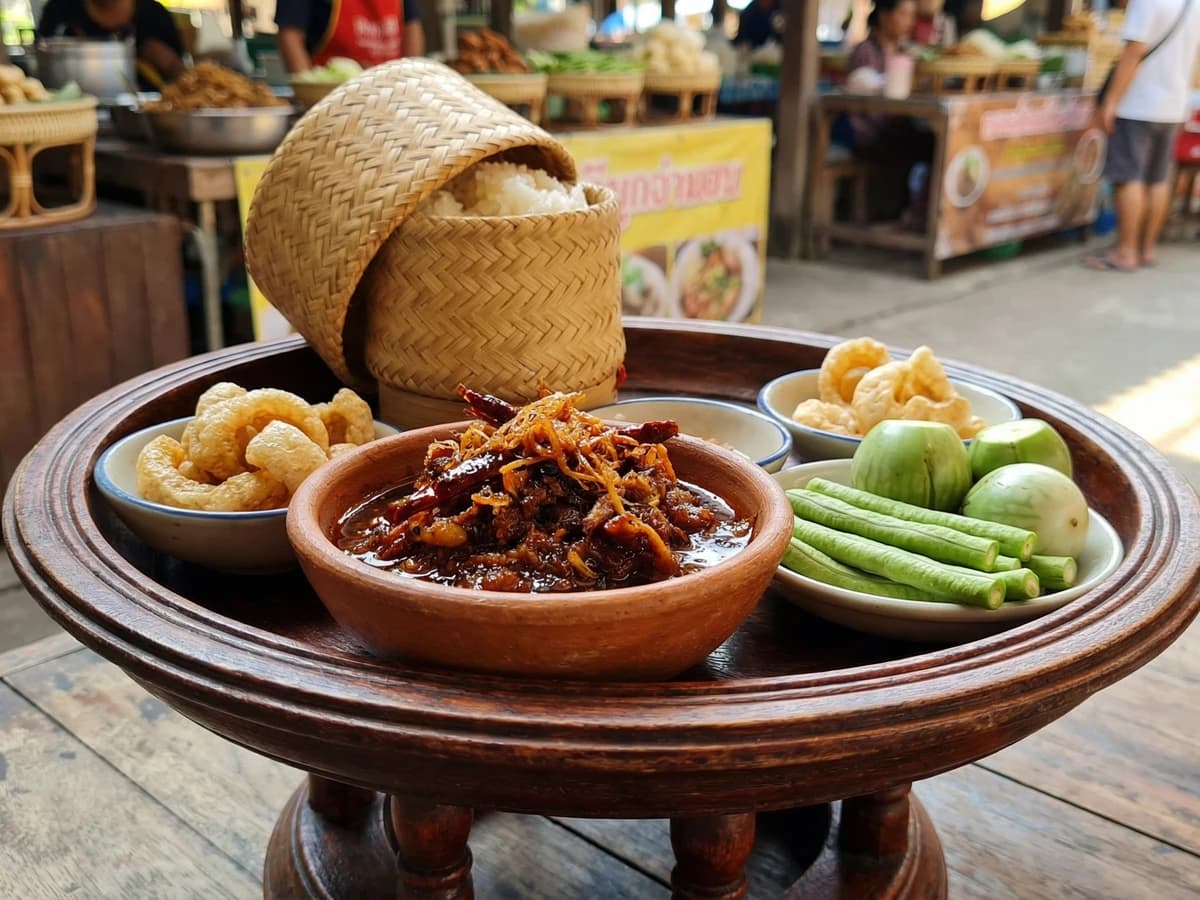
Roasted dried chilies and galangal pounded to a rough paste, folded with shredded pork skin and palm sugar until it becomes something sweet, smoky, and chewy that belongs on every khantoke tray in Chiang Mai.

Chef Fai
The kreung tam that proves the system adapts. Ginger instead of galangal, cumin and star anise alongside lemongrass. Lanna's mortar holds the whole Burma-to-Chiang Mai trade route in a single paste.