
Chef Fai
Dry Egg Noodles (Ba Mee Haeng)
The four pillars live at the bottom of the bowl before the noodles ever touch it: nam pla for salt, sugar for sweet, vinegar for sour, chili for heat. Every noodle cart in Bangkok runs on this principle.
A cooking platform built around craft, culture, and the stories behind what we eat.

Created by
Forget everything you think you know about larb. Laab khua is the North's answer: dry-fried in a wok, built on a kreung tam of makhwaen and cumin, bound with blood, and governed by fire instead of acid.
Stop right here. If you think larb is a cold salad dressed with lime juice and fresh herbs, you're thinking of Isan. This is not Isan. This is Lanna. Northern Thailand. A completely different system.
Laab khua starts with a kreung tam. Dried chilies, makhwaen (the Northern Thai peppercorn that makes your lips tingle), cumin seeds, charred shallots, charred garlic: all toasted, all pounded in the krok hin. That paste is the soul of the dish. Ajarn always said the kreung tam is everything. Laab khua proves it. The Isan version skips the paste entirely, tosses raw meat with lime and fish sauce and calls it done. The Northern version builds a spice foundation first, then cooks the meat into it. Two regions, two philosophies. Neither is wrong. But don't confuse them.
The word "khua" (คั่ว) means dry-roasting. That tells you the technique. You fry the spice paste in a dry wok, no oil, until it's fragrant and dark. Then the pork goes in, then the offal: liver, tripe, skin. Then the blood. The blood binds the dish, gives it body and richness, turns the whole thing dark and glossy. If that makes you uncomfortable, good. Sit with it. This is how the North eats. Offal isn't waste. It's the point. Every part of the animal has a texture and a flavor that the dish needs.
There's no lime in laab khua. No fresh herbs tossed in at the end. The acidity that defines Isan larb is absent here. Instead, the dish is warm, dry-spiced, earthy, with the numbing buzz of makhwaen replacing the bright punch of lime. Fish sauce for salt. A touch of sweetness from the caramelized meat and blood. Heat from the dried chilies. The four pillars are still present, but they express differently in every region. That's the system talking. Thai food adapts, but the principles hold.
Laab khua is native to the Lanna region (Northern Thailand, centered on Chiang Mai), where it predates the Isan raw-tossed version in local tradition. The use of dried spices like cumin (yira) and makhwaen (มะแขว่น, Zanthoxylum limonella, a relative of Sichuan pepper) reflects centuries of overland trade between Lanna, Myanmar, and Yunnan, China. The inclusion of blood and offal is standard in Northern Thai laab and connects to the region's tradition of whole-animal butchery, where every part of the pig is used. Unlike the Isan larb that became globally famous, laab khua remains largely unknown outside the North.
Quantity
8
seeds shaken out, dry-toasted
Quantity
1 tablespoon
dry-toasted
Quantity
1 teaspoon
dry-toasted
Quantity
5
unpeeled, charred over flame or dry pan
Quantity
8 cloves
unpeeled, charred over flame or dry pan
Quantity
1 teaspoon
Quantity
400g
not lean, you need fat
Quantity
150g
thinly sliced
Quantity
100g
cleaned, boiled until tender, thinly sliced
Quantity
80g
boiled until tender, thinly sliced into strips
Quantity
3 tablespoons
Quantity
2-3 tablespoons
Quantity
2 tablespoons
Quantity
3 stalks
sliced into rounds
Quantity
for garnish
Quantity
for serving (on the side)
Quantity
for serving
Quantity
for serving
Quantity
for serving
| Ingredient | Quantity |
|---|---|
| dried red chilies (prik haeng)seeds shaken out, dry-toasted | 8 |
| makhwaen (มะแขว่น, Northern Thai peppercorn)dry-toasted | 1 tablespoon |
| cumin seeds (yira)dry-toasted | 1 teaspoon |
| shallots (hom daeng)unpeeled, charred over flame or dry pan | 5 |
| garlicunpeeled, charred over flame or dry pan | 8 cloves |
| salt | 1 teaspoon |
| minced porknot lean, you need fat | 400g |
| pork liver (tap moo)thinly sliced | 150g |
| pork tripe (phung moo)cleaned, boiled until tender, thinly sliced | 100g |
| pork skin (nang moo)boiled until tender, thinly sliced into strips | 80g |
| fresh pork blood (lueat moo) | 3 tablespoons |
| fish sauce (nam pla) | 2-3 tablespoons |
| khao khua (toasted sticky rice powder) | 2 tablespoons |
| green onion (ton hom)sliced into rounds | 3 stalks |
| fried dried chilies | for garnish |
| fresh mint sprigs | for serving (on the side) |
| raw cabbage wedges | for serving |
| long beans | for serving |
| sticky rice (khao niew) | for serving |
Set a dry wok or small pan over medium heat. Toast the dried chilies, turning constantly, until they darken slightly and smell smoky. About 2 minutes. Pull them out. Toast the makhwaen and cumin seeds separately, 30 seconds each, just until fragrant. The makhwaen will start to smell citrusy and sharp, almost electric. That's correct. Over-toast and they go bitter. You're waking up the essential oils, not burning them.
Place the unpeeled shallots and garlic cloves directly on a gas flame, in a dry cast iron pan, or under a broiler. Char them until the skins are blackened and the flesh inside is soft and smoky. About 5-8 minutes, turning occasionally. Peel off the charred skins. The flesh should be golden-brown and smell deeply roasted. Charring before pounding is a Northern technique. It changes the flavor completely: raw shallot is sharp, charred shallot is sweet and smoky.
In a heavy granite mortar (krok hin), pound the toasted dried chilies first. They break down the fastest. Pound until they're a coarse powder, not dust. Add the makhwaen and cumin. Pound until fragrant and incorporated. Now the charred shallots and garlic with the salt. Pound everything into a rough, dark, intensely aromatic paste. The texture should be coarse, not smooth. You'll see bits of chili skin, flecks of makhwaen. That's correct. This paste is the foundation. Without it, you have stir-fried pork. With it, you have laab khua.
If you haven't already made your khao khua, do it now. Put raw sticky rice (uncooked grains) in a dry pan over medium heat. Toast, stirring constantly, until the grains are deep golden brown and smell nutty and smoky. About 5 minutes. Don't rush it. Under-toasted khao khua tastes like nothing. Properly toasted khao khua is smoky and fragrant. Pound the toasted rice in the mortar to a coarse powder. Some chunks are fine. Set aside.
Here's where the name comes from. Khua means dry-roast. Set your wok over medium-high heat. No oil. Dry wok. Add the kreung tam directly to the hot wok and stir constantly for about 1 minute. The paste will darken and the aroma will change from raw to deeply toasted. The cumin and makhwaen will bloom. Your kitchen will smell like Northern Thailand. That's the transition point. The paste is alive now.
Add the minced pork directly to the paste in the wok. Still no oil. The pork will release its own fat as it cooks. Break the meat apart with your spatula, working it into the paste so every bit of pork is coated. Cook for 2-3 minutes until the pork is no longer pink. Now add the liver slices. They cook fast, about 1 minute. They should be just set, still slightly pink inside. Overcook liver and it turns to chalk. Add the tripe and pork skin. These are already cooked from boiling, so they just need to heat through and absorb the spice paste. Another minute of tossing.
Add the pork blood to the wok. Stir it through the meat immediately. The blood will bind everything together and turn the laab dark, almost mahogany. It thickens the mixture and adds a mineral richness that nothing else can replicate. Cook for another minute, stirring constantly, until the blood is set and the mixture is dry and cohesive. Not wet, not saucy. Dry. This is laab khua, not a stew.
Season with fish sauce. Start with 2 tablespoons, taste, add more if it needs depth. The fish sauce is your salt. No lime goes in here. I'll say it again: no lime. This is not Isan. Sprinkle the khao khua over the laab and toss to incorporate. The toasted rice powder adds crunch and a smoky, nutty layer. Toss in the sliced green onions. One final stir. Taste. It should be salty, warm-spiced, earthy, with the numbing tingle of makhwaen on the back of your tongue and the slow heat of dried chilies building. Transfer to a plate.
Top with fried dried chilies. Serve with fresh mint sprigs, raw cabbage wedges, and long beans on the side. Not tossed in. On the side. You tear off a piece of sticky rice from the kratip, pinch some laab onto it, add a mint leaf if you want, and eat. The sticky rice is the starch. Always. Not jasmine rice. This is the North. Khao niew is the only answer.
1 serving (about 200g)
Culinary guides, cultural storytelling, and the editorial depth that makes cooking meaningful.
Discover Culinary ExplorerChef Fai
The four pillars live at the bottom of the bowl before the noodles ever touch it: nam pla for salt, sugar for sweet, vinegar for sour, chili for heat. Every noodle cart in Bangkok runs on this principle.

Chef Fai
The kreung tam fried in cracked coconut cream until the oil bleeds red. That's the technique. Concentrated, semi-dry, spooned thick over crispy fish. This is what happens when the four pillars meet restraint.
Chef Fai
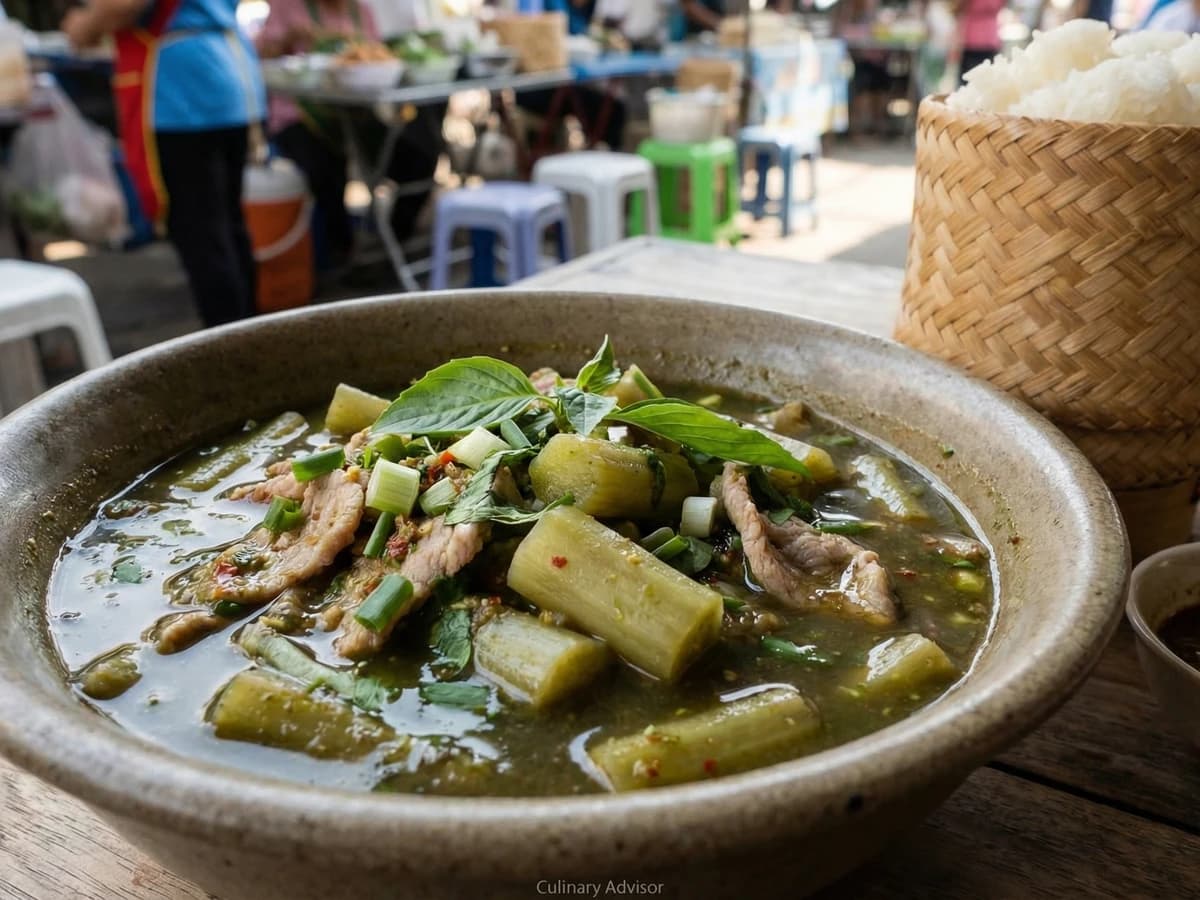
Isan foraging in a bowl: wild taro stems stripped of their sting, simmered in padaek broth with a pounded chili paste and yanang leaf extract. The land feeds you if you know the rules.

Chef Fai
Lanna's kreung tam breaks from Central Thai rules: ginger over galangal, cumin and coriander from Burmese spice routes, tamarind for sour instead of lime. The North has its own system, and this curry is its crown.