
Chef Fai
Dry Egg Noodles (Ba Mee Haeng)
The four pillars live at the bottom of the bowl before the noodles ever touch it: nam pla for salt, sugar for sweet, vinegar for sour, chili for heat. Every noodle cart in Bangkok runs on this principle.
A cooking platform built around craft, culture, and the stories behind what we eat.

Created by
Pork neck marinated in the Isan grill paste (garlic, cilantro root, white pepper, fish sauce), seared over charcoal until the fat renders and the edges blacken. Jaew is not a condiment. It's the other half of the dish.
The Isan grill paste is the kreung tam's blunt, no-nonsense cousin. Garlic, cilantro root, white pepper, fish sauce. Four ingredients. That's the formula for every grilled meat in Thailand's northeast. It's simpler than a curry paste, but don't confuse simple with careless. Every ingredient is doing work.
Garlic provides the sulfur compounds that caramelize over fire. Cilantro root, the part most people throw away, gives an earthy depth that the leaves can't touch. White pepper brings heat without the fruity sweetness of chili. And fish sauce (nam pla) does what it always does: salinity plus umami from months of protein fermentation. Palm sugar goes in too, because sugar plus high heat equals the Maillard reaction. That's the char. That's the flavor you're chasing.
Ajarn always said the four pillars govern everything: fish sauce for salt, palm sugar for sweet, tropical fruit acids for sour, chili for spice. In kor moo yang, the first two live in the marinade. The sour and the spice? They live in the jaew. That's why jaew isn't optional. It's not a dipping sauce you can skip. It's the completion of the four-pillar balance. Without jaew, you have half a dish. Salted, sweet, charred meat. With jaew, you have the full system: the roasted chili heat, the lime acid, the fish sauce depth, the toasted rice powder crunch. Kor moo yang and jaew are one unit. Period.
I learned this on a road trip through Khon Kaen with Ajarn when I was twenty-one. We pulled over at a highway rest stop because the smoke was visible from the road. An old uncle was grilling pork neck over a split oil drum filled with charcoal. No thermometer. No timer. He flipped by sound, by the way the fat sizzled when it hit the coals. His jaew was in a small clay bowl, pounded that morning. We ate it with sticky rice, standing up, not a plate in sight. That's Isan hospitality. That's kor moo yang.
Kor moo yang is a cornerstone of Isan's grilling culture (ย่าง), a tradition rooted in the northeastern Thai plateau where charcoal fuel was abundant and preservation of protein through salt and smoke was a daily necessity. Pork neck (คอหมู) became the preferred cut because its high intramuscular fat content resists drying out over direct heat, a practical adaptation to open-fire cooking without temperature control. The dish is inseparable from Thailand's drinking culture (กับแกล้ม, kap klaem), served at virtually every roadside grill stall alongside gai yang and som tam as the standard trio of Isan communal eating.
Quantity
600g
sliced into steaks about 1.5cm thick
Quantity
1 head
peeled and roughly chopped
Quantity
4
scraped clean and roughly chopped
Quantity
1 teaspoon
crushed
Quantity
3 tablespoons
Quantity
1 tablespoon
Quantity
1 tablespoon
Quantity
3 tablespoons
Quantity
3 tablespoons (about 2-3 limes)
Quantity
1 teaspoon
Quantity
1 tablespoon
Quantity
1 tablespoon
Quantity
2
thinly sliced
Quantity
2 tablespoons
chopped
Quantity
2 tablespoons
chopped
Quantity
for serving
Quantity
for serving
cut into wedges
Quantity
for serving
| Ingredient | Quantity |
|---|---|
| pork neck (kor moo)sliced into steaks about 1.5cm thick | 600g |
| garlic (kratiem)peeled and roughly chopped | 1 head |
| cilantro roots (rak pak chi)scraped clean and roughly chopped | 4 |
| white peppercorns (prik thai khao)crushed | 1 teaspoon |
| fish sauce (nam pla) | 3 tablespoons |
| palm sugar (nam tan pip) | 1 tablespoon |
| oyster sauce | 1 tablespoon |
| fish sauce (nam pla) for jaew | 3 tablespoons |
| lime juice (nam manao) for jaew | 3 tablespoons (about 2-3 limes) |
| palm sugar (nam tan pip) for jaew | 1 teaspoon |
| toasted rice powder (khao khua) | 1 tablespoon |
| dried roasted chili flakes (prik pon) | 1 tablespoon |
| shallots (hom daeng)thinly sliced | 2 |
| cilantro leaves (pak chi)chopped | 2 tablespoons |
| green onion (ton hom)chopped | 2 tablespoons |
| sticky rice (khao niew) | for serving |
| raw cabbagecut into wedges | for serving |
| fresh herbs (mint, Thai basil, saw-tooth coriander) | for serving |
In a granite mortar (krok hin), pound the garlic, cilantro roots, and crushed white peppercorns into a rough paste. Not smooth. You want chunks of garlic still visible, cilantro root fibers broken but present. The aroma should be sharp: sulfurous garlic, earthy cilantro root, the clean bite of white pepper. This takes two minutes. That's it. The Isan grill paste is not a curry paste. It's fast, direct, and unapologetic.
Transfer the paste to a bowl. Add the fish sauce, palm sugar, and oyster sauce. Stir until the sugar dissolves. Lay your pork neck steaks flat and coat them thoroughly with the marinade. Work it in with your hands. Get into every crevice. The pork neck has ribbons of fat running through it. You want the marinade in those seams. Cover and refrigerate for at least 4 hours. Overnight is better. The fish sauce needs time to penetrate. There's no shortcut for this.
If you don't have toasted rice powder, make it now. Dry-roast raw sticky rice in a pan over medium heat, shaking constantly, until the grains are deep golden brown and smell nutty and smoky. Five minutes. Transfer to a mortar and pound to a coarse powder. Not fine. You want texture. Khao khua is an Isan signature. It shows up in larb, in jaew, in nam tok. Learn to make it and keep a jar ready.
In a bowl, combine the fish sauce, lime juice, and palm sugar. Stir until the sugar dissolves. Add the toasted rice powder and dried chili flakes. Then the sliced shallots, chopped cilantro, and green onion. Stir once. Taste. It should hit you in waves: sour first from the lime, salty from the fish sauce, heat building from the chili, that smoky crunch from the khao khua underneath it all. Adjust. More lime if it's flat. More fish sauce if it needs backbone. More chili if you want it to bite. This is the other half of your dish. Don't treat it as an afterthought.
Get your charcoal burning. Real charcoal, not briquettes. You want white-hot coals with no visible flame. The grill grate should be close to the coals, about 3 inches. When you hold your hand 5 inches above the grate and can't last more than 2 seconds, you're ready. This is the heat that renders the fat, chars the edges, and creates the smoky crust that defines kor moo yang. Gas cannot do this. Gas gives you cooked pork. Charcoal gives you grilled pork. They are not the same thing.
Pull the pork from the marinade and shake off the excess. Lay the steaks on the grill directly over the hot coals. You'll hear a violent sizzle. Good. Don't touch them for 3-4 minutes. The sugar in the marinade will caramelize and threaten to burn. Let it. The line between caramelization and carbon is where the flavor lives. Flip when the underside has deep char marks and the fat is starting to render and drip. Another 3-4 minutes on the second side. The fat will flare. Move the pieces to the edge if it gets out of control, but don't run from the fire. The pork is done when the edges are blackened and crispy but the center is still juicy, yielding slightly when you press it. Rest for 5 minutes.
After resting, slice the pork against the grain into bite-sized pieces, about 1cm thick. Arrange on a plate. The cross-section should show charred edges giving way to pink-tinged, juicy interior with visible fat marbling. Serve with the jaew alongside in a small bowl, a basket of sticky rice (khao niew), raw cabbage wedges, and fresh herbs. You tear off a piece of sticky rice, pinch a slice of pork, dip it in the jaew, add a leaf of mint. That's a bite. The combination is the design. Kor moo yang is not a solo act. Fai Thai, baby.
1 serving (about 150g)
Culinary guides, cultural storytelling, and the editorial depth that makes cooking meaningful.
Discover Culinary ExplorerChef Fai
The four pillars live at the bottom of the bowl before the noodles ever touch it: nam pla for salt, sugar for sweet, vinegar for sour, chili for heat. Every noodle cart in Bangkok runs on this principle.

Chef Fai
The kreung tam fried in cracked coconut cream until the oil bleeds red. That's the technique. Concentrated, semi-dry, spooned thick over crispy fish. This is what happens when the four pillars meet restraint.
Chef Fai
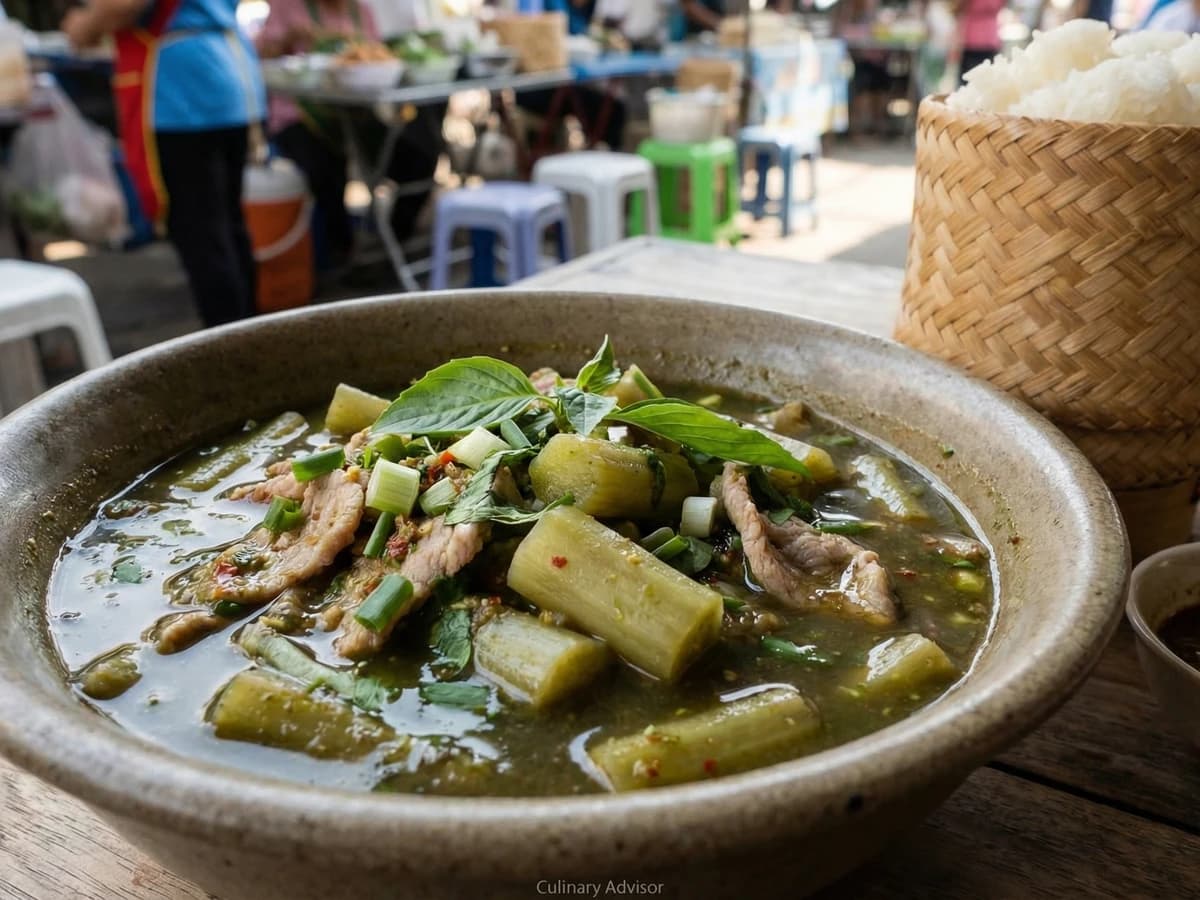
Isan foraging in a bowl: wild taro stems stripped of their sting, simmered in padaek broth with a pounded chili paste and yanang leaf extract. The land feeds you if you know the rules.

Chef Fai
Lanna's kreung tam breaks from Central Thai rules: ginger over galangal, cumin and coriander from Burmese spice routes, tamarind for sour instead of lime. The North has its own system, and this curry is its crown.