
Chef Fai
Dry Egg Noodles (Ba Mee Haeng)
The four pillars live at the bottom of the bowl before the noodles ever touch it: nam pla for salt, sugar for sweet, vinegar for sour, chili for heat. Every noodle cart in Bangkok runs on this principle.
A cooking platform built around craft, culture, and the stories behind what we eat.

Created by
Cantonese char siu crossed the sea with Chinese migrants and landed on Thai rice plates. The pork is Chinese. The gravy, the prik nam som on the side, the jasmine rice underneath: that's Thailand claiming the dish as its own.
Khao moo daeng is a Chinese dish that became Thai the moment a vendor put prik nam som (chili vinegar) on the table next to it.
Ajarn always said that Thai cuisine is a system, not a collection. When Cantonese migrants brought char siu to Bangkok, Thai cooks didn't just copy it. They ran it through the system. The pork kept its red fermented bean curd marinade, its honey glaze, its hanging-oven char. But the gravy got sweeter to match Thai palate logic. The rice became Thai jasmine, fragrant and long-grained. And the condiment caddy appeared: sliced bird's eye chilies in white vinegar, the sour-heat counterpoint that turns a Chinese roast meat plate into a Thai lunch. That condiment is the Thai flavor system asserting itself. Sour from vinegar. Heat from chili. Balance on demand.
I eat khao moo daeng at least twice a week. Yaowarat at lunch, when the vendors have been slicing pork since dawn and the gravy pot has been simmering all morning. The best stalls don't have menus. You sit down, they put a plate in front of you: sliced moo daeng fanned over rice, a ladle of sweet red gravy soaking into the grains, half a boiled egg, cucumber slices for crunch, maybe a few pieces of moo krob (crispy pork belly) if you nod when they hold up the tongs. The whole thing costs less than your morning coffee. Single-dish mastery. One plate, perfected over decades.
The gravy is where most home versions fail. Nam raat (the poured sauce) is not ketchup. It's not hoisin. It's a thin, sweet, savory glaze built from the roasting juices of the pork itself, stretched with stock, sweetened with sugar, darkened with soy, and thickened just enough to coat the rice without drowning it. Get the gravy right and you're halfway to Yaowarat. Get it wrong and you've got sliced pork on plain rice. Principles, not recipes.
Khao moo daeng traces directly to Cantonese char siu (叉燒), brought to Bangkok by Chinese migrants, primarily Cantonese and Teochew, during the late 19th and early 20th centuries. Yaowarat Road (Bangkok's Chinatown, established 1891) became the epicenter of Chinese-Thai food adaptation, where roast meat shops modeled on Hong Kong and Guangzhou originals began serving sliced char siu over jasmine rice with a Thai-sweetened gravy. The addition of prik nam som (chili vinegar) as a tableside condiment, absent from the Cantonese original, marks the dish's naturalization into the Thai street food system.
Quantity
600g
one piece, about 2 inches thick
Quantity
2 tablespoons
mashed
Quantity
2 tablespoons, plus extra for glazing
Quantity
1 tablespoon
Quantity
1 tablespoon
Quantity
1 teaspoon
Quantity
1 teaspoon
Quantity
4 cloves
minced
Quantity
1/2 teaspoon
Quantity
1 tablespoon
Quantity
1/2 teaspoon
Quantity
1 cup
Quantity
3 tablespoons
Quantity
1 tablespoon
Quantity
1 teaspoon
Quantity
1 tablespoon
Quantity
pinch
Quantity
pinch
Quantity
1 tablespoon
mixed with 2 tablespoons water
Quantity
for serving
Quantity
2
halved
Quantity
1
sliced into rounds
Quantity
for serving, store-bought
Quantity
4
sliced into rounds, for chili vinegar
Quantity
3 tablespoons
| Ingredient | Quantity |
|---|---|
| pork neck (kor moo) or pork shoulderone piece, about 2 inches thick | 600g |
| red fermented bean curd (tao hoo yi daeng / nam yoo)mashed | 2 tablespoons |
| honey | 2 tablespoons, plus extra for glazing |
| oyster sauce | 1 tablespoon |
| light soy sauce (si ew khao) | 1 tablespoon |
| dark soy sauce (si ew dam) | 1 teaspoon |
| five-spice powder (phong pha lo) | 1 teaspoon |
| garlicminced | 4 cloves |
| white pepper | 1/2 teaspoon |
| Shaoxing wine | 1 tablespoon |
| red food coloring (optional) | 1/2 teaspoon |
| pork or chicken stock | 1 cup |
| granulated sugar | 3 tablespoons |
| light soy sauce (si ew khao), for gravy | 1 tablespoon |
| dark soy sauce (si ew dam), for gravy | 1 teaspoon |
| white vinegar or red vinegar | 1 tablespoon |
| five-spice powder (phong pha lo), for gravy | pinch |
| salt | pinch |
| tapioca starchmixed with 2 tablespoons water | 1 tablespoon |
| steamed jasmine rice (khao suay) | for serving |
| hard-boiled eggshalved | 2 |
| cucumbersliced into rounds | 1 |
| crispy pork belly (moo krob) (optional) | for serving, store-bought |
| bird's eye chilies (prik khi nu)sliced into rounds, for chili vinegar | 4 |
| white vinegar, for chili vinegar condiment | 3 tablespoons |
Mash the red fermented bean curd in a bowl until it forms a smooth paste. This is the soul of moo daeng. That funky, salty, brick-red fermented curd is what separates real khao moo daeng from pork with food coloring on it. Add the honey, oyster sauce, light soy sauce, dark soy sauce, five-spice powder, white pepper, minced garlic, Shaoxing wine, and red food coloring if using. Mix everything together. The marinade should be dark red, thick, and smell like a Yaowarat roast meat shop. If it doesn't smell like anything, your bean curd is too old.
Score the pork lightly in a crosshatch pattern, about half a centimeter deep. This lets the marinade penetrate. Coat the pork completely in the marinade, working it into the cuts with your hands. Place it in a sealed container or zip-lock bag and refrigerate for at least 4 hours. Overnight is better. The fermented bean curd needs time to work its way into the meat. Patience here is what separates a good moo daeng from a great one.
Preheat your oven to 220°C (425°F). Set a wire rack over a baking tray lined with foil. Place the pork on the rack and pour a cup of water into the tray below to catch drippings and prevent smoking. Roast for 20 minutes. Pull it out, brush a thin layer of honey all over the surface, and return to the oven. Roast another 15 minutes. Pull it again, brush with honey one more time. Put it back for a final 5 to 8 minutes, watching it closely. You want the edges caramelized and slightly charred, the honey glaze tacky and dark, the surface glistening. That's the char. That's what you're here for. The internal temperature should hit 65°C (150°F).
Rest the pork for 10 minutes. Don't skip this. The juices redistribute and the meat firms up enough to slice cleanly. Collect any drippings from the pan and the resting board. Those go straight into the gravy. Slice the pork against the grain, about half a centimeter thick. You want pieces thin enough to drape over rice but thick enough to show the pink center and the red-glazed edges. If there's no pink center, you overcooked it. Next time, pull it earlier.
This is the nam raat (น้ำราด), the poured sauce. It makes or breaks the plate. In a small saucepan, combine the stock, sugar, light soy sauce, dark soy sauce, vinegar, pinch of five-spice, salt, and all the collected pork drippings. Bring to a simmer over medium heat, stirring until the sugar dissolves. Taste it. It should be noticeably sweet, lightly salty, with a whisper of vinegar sharpness. Give the tapioca starch slurry a stir and pour it in slowly, stirring constantly. The gravy should thicken to the consistency of thin maple syrup. It coats a spoon but runs off slowly. Too thick and it sits on the rice like paste. Too thin and the rice doesn't absorb it. Add red food coloring for the traditional hue if you want. Let it simmer another minute.
Slice the bird's eye chilies into thin rounds and drop them into the white vinegar in a small dish. That's it. Prik nam som (พริกน้ำส้ม). This is where the Thai flavor system enters the Chinese-origin plate. Sour from the vinegar, heat from the chili, applied by the eater at the table. This condiment is non-negotiable. Without it, you're eating char siu on rice. With it, you're eating khao moo daeng.
Pack a bowl of jasmine rice and invert it onto a melamine plate or a regular plate if you don't have melamine. Fan the sliced moo daeng alongside the rice mound, showing the red glaze and the pink center. Place a halved boiled egg next to the pork. Scatter cucumber rounds on the side. If you have moo krob, add a few pieces for crunch. Ladle the warm red gravy generously over the pork and rice. Let it soak in. The rice should turn slightly pink where the gravy pools. Serve the prik nam som on the side. Tell whoever's eating to spoon it over the pork to taste. Sit down, eat fast, get back to work. That's how Bangkok does lunch.
1 serving (about 440g)
Culinary guides, cultural storytelling, and the editorial depth that makes cooking meaningful.
Discover Culinary ExplorerChef Fai
The four pillars live at the bottom of the bowl before the noodles ever touch it: nam pla for salt, sugar for sweet, vinegar for sour, chili for heat. Every noodle cart in Bangkok runs on this principle.

Chef Fai
The kreung tam fried in cracked coconut cream until the oil bleeds red. That's the technique. Concentrated, semi-dry, spooned thick over crispy fish. This is what happens when the four pillars meet restraint.
Chef Fai
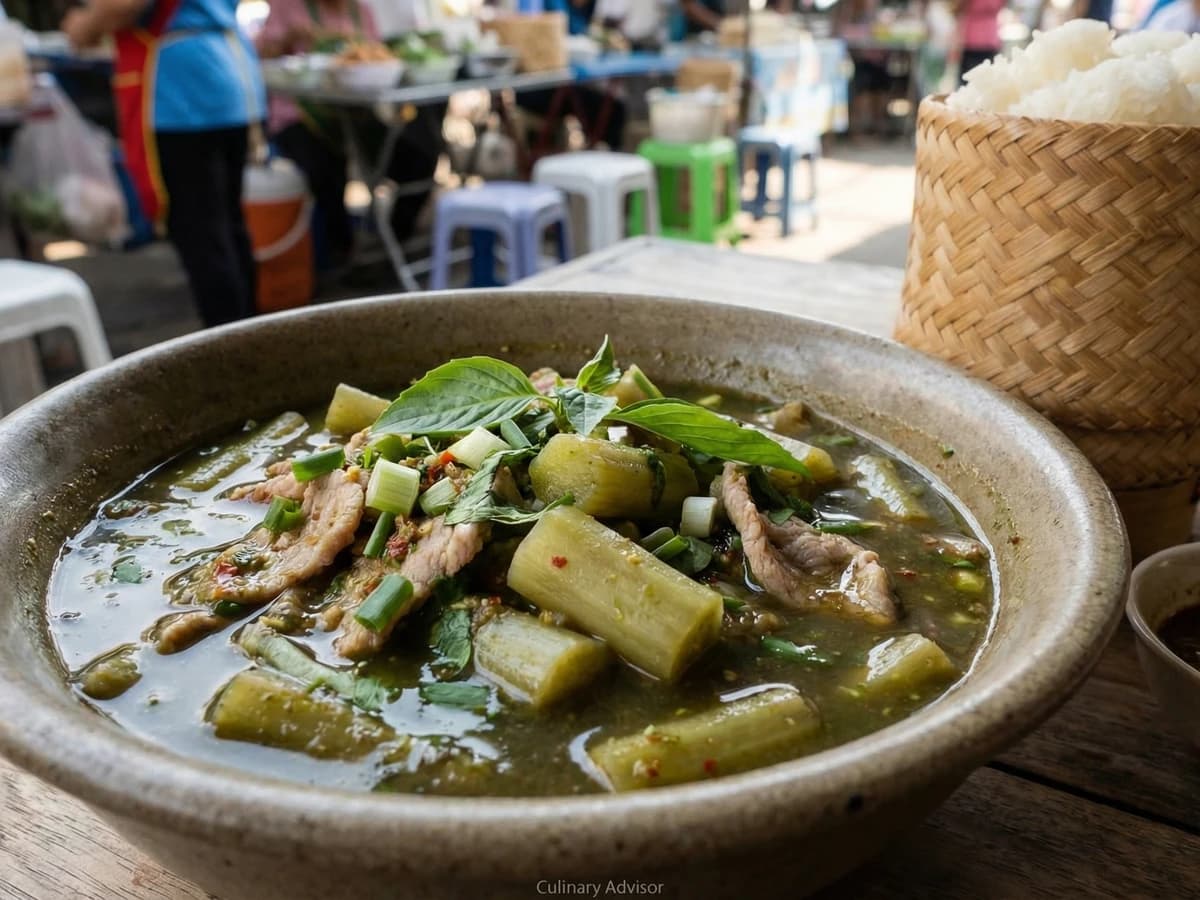
Isan foraging in a bowl: wild taro stems stripped of their sting, simmered in padaek broth with a pounded chili paste and yanang leaf extract. The land feeds you if you know the rules.

Chef Fai
Lanna's kreung tam breaks from Central Thai rules: ginger over galangal, cumin and coriander from Burmese spice routes, tamarind for sour instead of lime. The North has its own system, and this curry is its crown.