
Chef Fai
Dry Egg Noodles (Ba Mee Haeng)
The four pillars live at the bottom of the bowl before the noodles ever touch it: nam pla for salt, sugar for sweet, vinegar for sour, chili for heat. Every noodle cart in Bangkok runs on this principle.
A cooking platform built around craft, culture, and the stories behind what we eat.

Created by
Whole river prawns over white-hot charcoal, shells blistered and cracked, orange head fat melting into sweet flesh. The jaew on the side delivers the four pillars. The fire does the rest.
Sometimes the principle is restraint. Ajarn always said that a great ingredient needs a great cook to know when to leave it alone. Goong phao is that lesson.
The Isan grilling tradition runs on a simple governing formula: garlic, cilantro root, white pepper, and fish sauce. That's the Isan grill paste. It's simpler than a kreung tam, but it's just as principled. You pound those four together, rub them on the protein, and let charcoal do what charcoal does. This paste doesn't compete with the prawn. It frames it. The garlic gives depth, the cilantro root gives earthiness, the white pepper gives a clean heat that doesn't mask, and the nam pla ties everything to the Thai flavor system. Four ingredients. One mortar. Done.
River prawns (goong mae nam) are massive freshwater prawns with heads full of orange fat. That fat is the whole point. When it melts over charcoal and drips into the fire, the smoke rises back up and kisses the shell. That's flavor you can't engineer. You can't replicate it under a broiler, on a gas grill, or in an oven. Charcoal is the only acceptable heat source. I'll say it again: charcoal. Not gas. The combustion chemistry is different. Charcoal burns hotter, drier, and produces aromatic compounds from incomplete combustion that deposit on the shell. Gas burns clean. Clean is not what you want here.
The prawns themselves carry sweetness. The jaew on the side delivers everything else: fish sauce for salt, lime for sour, toasted dried chilies for smoky heat, toasted rice powder for that Isan crunch. The four pillars are split between the protein and the sauce. Together, the system is complete. Apart, each is only half the dish. That's why jaew isn't a condiment. It's structural. You don't serve goong phao without jaew any more than you serve som tam without sticky rice. They're designed as a pair.
Grilled river prawns are a staple of Central and Isan Thai riverside eating culture, particularly along the Chao Phraya, Mae Klong, and Mekong river systems where giant freshwater prawns (Macrobrachium rosenbergii) are farmed and wild-caught. Roadside grill stalls selling goong phao became a fixture of Thai highway culture in the 1980s and 1990s as weekend road trips to the provinces became popular among Bangkok's growing middle class. The dish predates these stalls by generations, rooted in the Isan and Lao tradition of grilling river catch over wood and charcoal, where the jaew dipping sauce was the universal accompaniment to any grilled protein.
Quantity
8, about 150-200g each
whole with heads intact
Quantity
4 cloves
Quantity
2
scraped clean
Quantity
1 teaspoon
Quantity
1 tablespoon
Quantity
3 tablespoons
Quantity
3 tablespoons (about 3 limes)
Quantity
1 tablespoon
Quantity
1 tablespoon
Quantity
2
sliced thin
Quantity
1 tablespoon
chopped
Quantity
1 tablespoon
chopped
Quantity
for serving
| Ingredient | Quantity |
|---|---|
| large river prawns (goong mae nam)whole with heads intact | 8, about 150-200g each |
| garlic | 4 cloves |
| cilantro roots (raak pak chi)scraped clean | 2 |
| white peppercorns (prik thai khao) | 1 teaspoon |
| fish sauce (nam pla) | 1 tablespoon |
| fish sauce (nam pla) for jaew | 3 tablespoons |
| lime juice (nam manao) | 3 tablespoons (about 3 limes) |
| toasted dried chili flakes (prik pon) | 1 tablespoon |
| toasted rice powder (khao khua) | 1 tablespoon |
| shallots (hom daeng)sliced thin | 2 |
| cilantro leaveschopped | 1 tablespoon |
| green onionchopped | 1 tablespoon |
| sticky rice (khao niew) | for serving |
In a granite mortar, pound the garlic, cilantro roots, and white peppercorns to a rough paste. Not fine. You want it coarse enough to cling to the shell. Add the fish sauce and stir it through. That's your Isan grill paste: four ingredients, one mortar, thirty seconds. This same formula works on chicken (gai yang), pork neck (kor moo yang), and fish. Learn it once, use it forever. That's what principles do.
Rinse the prawns and pat them dry. Using kitchen scissors, cut along the top of the shell from behind the head to the tail and pull out the vein. Don't peel them. The shell is your armor against the fire. It protects the flesh from drying out and chars into a smoky, salty crust. Rub the grill paste over the prawns, working it into the cut along the back and under the shell edges. Let them sit for 15 minutes at room temperature while your charcoal heats.
Light your charcoal and let it burn until the coals are white-hot and covered in grey ash. No flames. Flames char the outside before the inside cooks. You want radiant heat, intense and even. Spread the coals in a single layer. Your grate should be about 4 inches above the coals. Hold your hand at grate level. If you can't keep it there for more than two seconds, the temperature is right.
Place the prawns on the grate, cut-side down first. Don't touch them. Let the fire do its work. After 3 to 4 minutes, the shells will start to blister and turn orange-red. Flip them. The head fat will start to bubble and melt, running down into the flesh. Another 3 to 4 minutes on the second side. The shells should be charred in spots, cracked, and pulling away from the flesh slightly. The flesh inside should be white and opaque, firm but not rubbery. If you press the thickest part and it springs back, they're done. If it feels mushy, give it another minute.
While the prawns grill, make the jaew. This isn't cooking. It's mixing. Combine the fish sauce, lime juice, toasted chili flakes, toasted rice powder, sliced shallots, cilantro, and green onion in a bowl. Stir once. Taste. It should hit you in this order: sour first from the lime, salty second from the nam pla, smoky heat from the toasted chilies, then that nutty crunch of khao khua at the finish. Adjust the lime and fish sauce until the balance feels aggressive. Jaew is not subtle. It's designed to punch through charred, smoky, fatty prawn meat.
Pull the prawns off the grill and pile them on a plate. Put the jaew in a small bowl alongside. Sticky rice in a kratip basket. That's it. No garnish needed. No fuss. You peel the prawns with your hands, the shell crackles, the head fat coats your fingers, you dip the flesh in jaew, you pinch sticky rice. Every bite is fire, fat, salt, sour, heat, crunch. The system is complete.
1 serving (about 350g)
Culinary guides, cultural storytelling, and the editorial depth that makes cooking meaningful.
Discover Culinary ExplorerChef Fai
The four pillars live at the bottom of the bowl before the noodles ever touch it: nam pla for salt, sugar for sweet, vinegar for sour, chili for heat. Every noodle cart in Bangkok runs on this principle.

Chef Fai
The kreung tam fried in cracked coconut cream until the oil bleeds red. That's the technique. Concentrated, semi-dry, spooned thick over crispy fish. This is what happens when the four pillars meet restraint.
Chef Fai
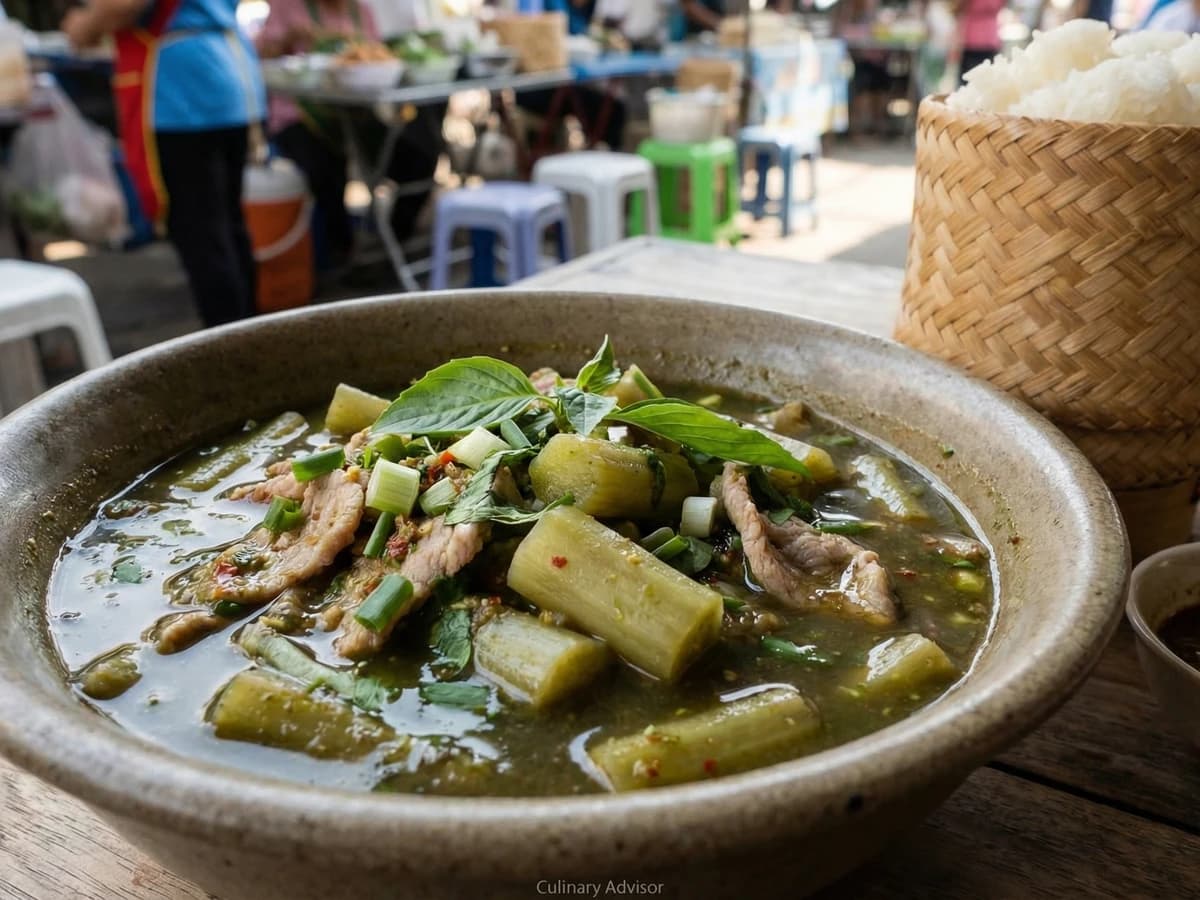
Isan foraging in a bowl: wild taro stems stripped of their sting, simmered in padaek broth with a pounded chili paste and yanang leaf extract. The land feeds you if you know the rules.

Chef Fai
Lanna's kreung tam breaks from Central Thai rules: ginger over galangal, cumin and coriander from Burmese spice routes, tamarind for sour instead of lime. The North has its own system, and this curry is its crown.