
Chef Fai
Dry Egg Noodles (Ba Mee Haeng)
The four pillars live at the bottom of the bowl before the noodles ever touch it: nam pla for salt, sugar for sweet, vinegar for sour, chili for heat. Every noodle cart in Bangkok runs on this principle.
A cooking platform built around craft, culture, and the stories behind what we eat.

Created by
The Southern kreung tam is a turmeric bomb: dried chilies, fresh kamin, shrimp paste, and nothing else to hide behind. The broth is thin, the sour is aggressive, the sweet barely exists. This is how the south eats.
The kreung tam tells you exactly where you are in Thailand. One look at the mortar and you know. Central Thai pastes lean on fresh green chilies, cilantro root, galangal. Northern pastes bring dried spices. And Southern Thai? Turmeric. So much turmeric your granite mortar turns golden for a week. Your fingernails. Your cutting board. Everything it touches.
Gaeng som is the perfect case study. Central Thailand has its own version: milder, sweeter, tamarind-forward with a polite little kick. The Southern version doesn't do polite. The kreung tam is pounded from dried long chilies (prik haeng) in quantities that would scare a Central Thai cook, a fistful of fresh turmeric (kamin), shallots, garlic, and a generous smear of kapi. That's it. Five ingredients. No lemongrass, no galangal, no cilantro root. The South strips the paste down to its essentials and cranks up the volume on each one.
Ajarn always said: the four pillars hold every Thai dish together. Fish sauce for salt. Palm sugar for sweet. Tropical acid for sour. Chili for heat. But the balance shifts by region. In the south, sour and spicy run the show. Sweet retreats to a whisper, barely a pinch of palm sugar, just enough to round the edge of the tamarind. The broth is thin because there's no coconut here. Just water, paste, tamarind, fish sauce, and the fish itself releasing its oils into the liquid. What you get is clean, sharp, turmeric-golden, and so sour it wakes you up.
I spent a week in Nakhon Si Thammarat eating gaeng som from market stalls where the aunties kept their paste in a jar by the wok, scooped a spoonful into boiling water, dropped in whatever fish came off the boats that morning, threw in the vegetables, and had a bowl ready in ten minutes. No recipe. No measuring. Just the principles, internalized over decades. The kreung tam is everything. The rest follows.
Gaeng som is one of Thailand's oldest curry forms, predating coconut-based curries and likely originating in the southern coastal communities along the Gulf of Thailand and Andaman Sea where fresh fish was abundant and turmeric grew wild. The Southern version (gaeng som pak tai) diverges sharply from the Central Thai adaptation: it uses far more turmeric in the paste, a higher dried chili load, and omits the sweeter, gentler profile that Central Thai cooks later developed. The heavy turmeric reflects Malay culinary influence from across the border, where kunyit (turmeric) dominates curry bases throughout the peninsula. In Nakhon Si Thammarat and Songkhla provinces, gaeng som remains a daily staple, with the specific vegetables and fish varying by whatever the morning market and fishing boats provide.
Quantity
12
seeded, soaked in warm water for 15 minutes, drained
Quantity
5
Quantity
50g (about 3 inches)
roughly sliced
Quantity
8
roughly chopped
Quantity
6 cloves
Quantity
1 tablespoon
Quantity
1 teaspoon
Quantity
500g
cut into large pieces, about 2 inches
Quantity
4 cups
Quantity
3 tablespoons
dissolved in 1/4 cup warm water, strained
Quantity
2 tablespoons, plus more to taste
Quantity
1 teaspoon
Quantity
150g
sliced thin
Quantity
100g
cut into 2-inch pieces
Quantity
100g
cut into rough wedges
Quantity
100g
in 2-inch lengths
| Ingredient | Quantity |
|---|---|
| dried long chilies (prik haeng)seeded, soaked in warm water for 15 minutes, drained | 12 |
| bird's eye chilies (prik khi nu) | 5 |
| fresh turmeric (kamin)roughly sliced | 50g (about 3 inches) |
| shallots (hom daeng)roughly chopped | 8 |
| garlic (kratiam) | 6 cloves |
| shrimp paste (kapi) | 1 tablespoon |
| sea salt | 1 teaspoon |
| firm white fish steaks (sea bass, snapper, or short mackerel/pla tu)cut into large pieces, about 2 inches | 500g |
| water | 4 cups |
| tamarind pulp (makham piak)dissolved in 1/4 cup warm water, strained | 3 tablespoons |
| fish sauce (nam pla) | 2 tablespoons, plus more to taste |
| palm sugar (nam tan pip) | 1 teaspoon |
| fresh bamboo shoots (no mai)sliced thin | 150g |
| long beans (thua fak yao)cut into 2-inch pieces | 100g |
| white cabbagecut into rough wedges | 100g |
| acacia shoots (cha om)in 2-inch lengths | 100g |
Drain the soaked dried chilies and squeeze out the water. In a heavy granite mortar (krok hin), start with the sea salt, dried chilies, and bird's eye chilies. Pound to a rough paste. The salt acts as an abrasive, breaking down the chili skins. Now add the shallots and garlic. Pound again until they're crushed into the chili. Finally, the fresh turmeric. This is where it gets serious. Turmeric is fibrous. It fights you. Pound hard, scraping down the sides of the mortar, until the paste is a deep golden-orange and the fibers have broken down. Finish with the kapi. Pound until everything is integrated, a thick, fragrant, violently yellow paste. Your mortar will be stained. Good. That's Southern Thai claiming its territory.
While you're pounding, or before you start, soak the tamarind pulp in warm water. Use your fingers to squeeze and dissolve the pulp, then strain through a fine sieve, pressing out every drop. Discard the seeds and fiber. What you have is concentrated sour liquid, the backbone of this curry. Taste it. It should be aggressively tart, almost uncomfortably sour on its own. That's correct. It'll mellow in the broth.
Bring the water to a rolling boil in a pot. Spoon in the kreung tam and stir to dissolve. The water will turn golden almost immediately. That's the turmeric doing its work. Let it boil for 2 to 3 minutes so the paste opens up and releases its oils. You'll smell the dried chili and kapi first, then the turmeric, earthy and warm. The broth should look like liquid gold with red-orange chili flecks suspended in it.
Add the bamboo shoots first. They take the longest to soften, about 3 minutes. Then the long beans and cabbage wedges. Let them cook for another 2 minutes. The cabbage should still have structure, not collapse into mush. Hold the cha om back. It goes in at the very end.
Slide the fish pieces into the broth gently. Don't stir. Don't prod. The fish will cook in 3 to 4 minutes depending on thickness. You'll see the flesh turn opaque from the outside in. When it flakes easily if you press the edge with a spoon, it's done. Overcook the fish and it disintegrates into the broth. Southern cooks want the pieces intact, each one holding together when you ladle it into a bowl.
Remove from heat. Add the tamarind water, fish sauce, and palm sugar. Stir gently. Taste. This is the moment that matters. Sour should hit first, dominant and sharp. Salty comes second from the fish sauce. Heat builds in the back of your throat. Sweet? Barely there. If you can taste the palm sugar as sweet, you've added too much. It should only round the tamarind's edge, nothing more. Adjust: more tamarind if it needs sourness, more fish sauce if it needs depth, another half teaspoon of sugar at most. Now scatter in the cha om. It wilts in seconds. Ladle into bowls immediately. Serve with steamed jasmine rice.
1 serving (about 500g)
Culinary guides, cultural storytelling, and the editorial depth that makes cooking meaningful.
Discover Culinary ExplorerChef Fai
The four pillars live at the bottom of the bowl before the noodles ever touch it: nam pla for salt, sugar for sweet, vinegar for sour, chili for heat. Every noodle cart in Bangkok runs on this principle.

Chef Fai
The kreung tam fried in cracked coconut cream until the oil bleeds red. That's the technique. Concentrated, semi-dry, spooned thick over crispy fish. This is what happens when the four pillars meet restraint.
Chef Fai
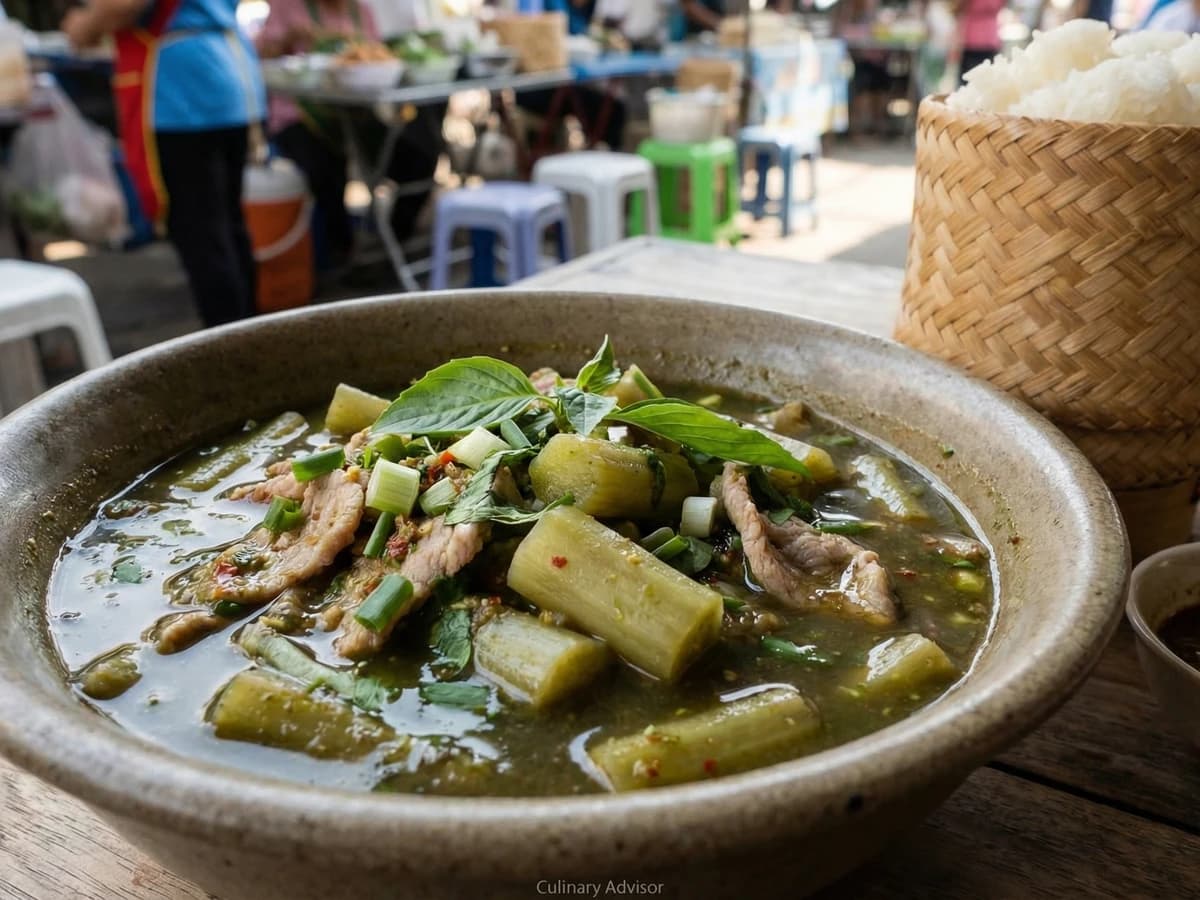
Isan foraging in a bowl: wild taro stems stripped of their sting, simmered in padaek broth with a pounded chili paste and yanang leaf extract. The land feeds you if you know the rules.

Chef Fai
Lanna's kreung tam breaks from Central Thai rules: ginger over galangal, cumin and coriander from Burmese spice routes, tamarind for sour instead of lime. The North has its own system, and this curry is its crown.