
Chef Fai
Dry Egg Noodles (Ba Mee Haeng)
The four pillars live at the bottom of the bowl before the noodles ever touch it: nam pla for salt, sugar for sweet, vinegar for sour, chili for heat. Every noodle cart in Bangkok runs on this principle.
A cooking platform built around craft, culture, and the stories behind what we eat.

Created by
No coconut. No complexity to hide behind. Just a pounded paste dissolved in water, shrimp, vegetables, and the sour pillar turned up to full volume. Gaeng som is where tamarind runs the show.
Gaeng som is the truth test. No coconut cream to round the edges. No rich paste to carry the flavor. Just water, a simple kreung tam, and the sour pillar doing all the heavy lifting. If your balance is off, there's nowhere to hide.
Ajarn always said that the four pillars of Thai cuisine are fish sauce for salt, palm sugar for sweet, tropical fruit acids for sour, and chili for heat. Most dishes balance all four roughly equally. Gaeng som doesn't. Gaeng som puts sour in the driver's seat and makes everything else ride along. The tamarind is the backbone. Fish sauce provides depth. Palm sugar smooths the sharp edges. Chili gives warmth. But the sour note hits first, stays longest, and defines the dish. Understanding gaeng som means understanding that the four pillars aren't always equal. Sometimes one leads.
The kreung tam here is stripped down compared to a green or red curry. Dried chilies, shallots, kapi (shrimp paste), and just a touch of turmeric for color. That's it. No galangal, no lemongrass, no kaffir lime. Central Thai gaeng som doesn't need them. The paste provides the base, the tamarind provides the soul. This simplicity is deceptive. Fewer ingredients means each one has to be right.
I make gaeng som when I want to eat like my parents ate on a Tuesday night. It's not a celebration dish. It's a Wednesday-at-six dish. Rice on the table, a bowl of gaeng som with whatever vegetables looked good at the market, shrimp because we lived near the river. The kind of food that nobody photographs but everybody finishes. That's comfort food in a Thai kitchen: the principles working quietly, without spectacle.
Gaeng som is among the oldest curry forms in Central Thai cooking, predating the introduction of coconut-based curries. The name means "sour curry" (som = sour), and its simplicity reflects an era when the defining technique was dissolving a pounded paste into plain water or stock. The Southern Thai cousin, gaeng leuang (yellow curry), uses significantly more turmeric and is often spicier, while the Central version keeps turmeric subtle, letting tamarind and the kreung tam define the flavor. Gaeng som appears in some of the earliest Thai culinary manuscripts as a foundational household preparation.
Quantity
7
soaked in warm water 15 minutes, seeded
Quantity
5
roughly sliced
Quantity
1 tablespoon
Quantity
1 teaspoon
sliced (or 1/2 teaspoon powder)
Quantity
1 teaspoon
Quantity
400g
peeled and deveined, tails on
Quantity
4 cups
Quantity
3 tablespoons
dissolved in 1/4 cup warm water, strained
Quantity
2 tablespoons
Quantity
1 tablespoon
Quantity
150g
cut into 2-inch pieces
Quantity
100g
cut into 2-inch pieces
Quantity
100g
peeled, cut into 1/2-inch half-moons
Quantity
for serving
| Ingredient | Quantity |
|---|---|
| dried red chilies (prik chi fa haeng)soaked in warm water 15 minutes, seeded | 7 |
| shallots (hom daeng)roughly sliced | 5 |
| shrimp paste (kapi) | 1 tablespoon |
| fresh turmeric (kha min)sliced (or 1/2 teaspoon powder) | 1 teaspoon |
| salt | 1 teaspoon |
| medium shrimppeeled and deveined, tails on | 400g |
| water | 4 cups |
| tamarind paste (nam makham piak)dissolved in 1/4 cup warm water, strained | 3 tablespoons |
| fish sauce (nam pla) | 2 tablespoons |
| palm sugar (nam tan pip) | 1 tablespoon |
| white cabbagecut into 2-inch pieces | 150g |
| green beans (thua fak yao)cut into 2-inch pieces | 100g |
| daikon radish (hua chai tao)peeled, cut into 1/2-inch half-moons | 100g |
| steamed jasmine rice | for serving |
Drain the soaked chilies and squeeze out excess water. In a heavy granite mortar (krok), start with the salt and chilies. Pound to a rough paste. Add the shallots and pound until they break down into the chili paste. Add the turmeric and pound until integrated. Finally, add the kapi and pound everything together until you have a uniform, slightly coarse paste. It should be vibrant orange-red with flecks of shallot still visible. The smell should hit you: fermented, sharp, alive. That's the kapi doing its work.
Bring the water to a boil in a medium pot. Spoon the kreung tam into the boiling water and stir to dissolve completely. The water will turn a warm orange, cloudy and fragrant. Let it simmer for 3 to 4 minutes so the paste releases its full flavor into the broth. This is not a coconut curry. There's no cream to crack, no oil to separate. You're building flavor in water alone, which means the paste has to be properly pounded to dissolve and infuse.
Add the daikon first. It's the densest and needs the most time. Simmer for 3 minutes. Then add the green beans and cabbage. Another 3 minutes. The vegetables should be cooked through but still have structure. Not crunchy, not collapsing. Thai sour curry vegetables have a specific texture: tender enough to absorb the broth, firm enough to hold their shape against rice.
Add the strained tamarind water, fish sauce, and palm sugar. Stir once and taste. This is the moment that matters. Sour should hit first, that tangy tamarind pucker. Salty should follow, supporting the sour without overtaking it. Sweet should be barely perceptible, just enough to take the harsh edge off the tamarind. If the sour isn't loud enough, add more tamarind. If it's too sharp, a pinch more palm sugar. Gaeng som is a sour curry. Don't be afraid of the sour.
Add the shrimp to the simmering broth. They cook in 2 minutes. The moment they curl and turn pink, you're done. Pull the pot off the heat. Overcooked shrimp in a thin broth is unforgivable because there's nothing to mask the rubbery texture. Taste the broth one more time. Adjust. Ladle over jasmine rice in a bowl. The broth should pool around the rice, orange and fragrant, vegetables and pink shrimp scattered through it. That's gaeng som.
1 serving (about 425g)
Culinary guides, cultural storytelling, and the editorial depth that makes cooking meaningful.
Discover Culinary ExplorerChef Fai
The four pillars live at the bottom of the bowl before the noodles ever touch it: nam pla for salt, sugar for sweet, vinegar for sour, chili for heat. Every noodle cart in Bangkok runs on this principle.

Chef Fai
The kreung tam fried in cracked coconut cream until the oil bleeds red. That's the technique. Concentrated, semi-dry, spooned thick over crispy fish. This is what happens when the four pillars meet restraint.
Chef Fai
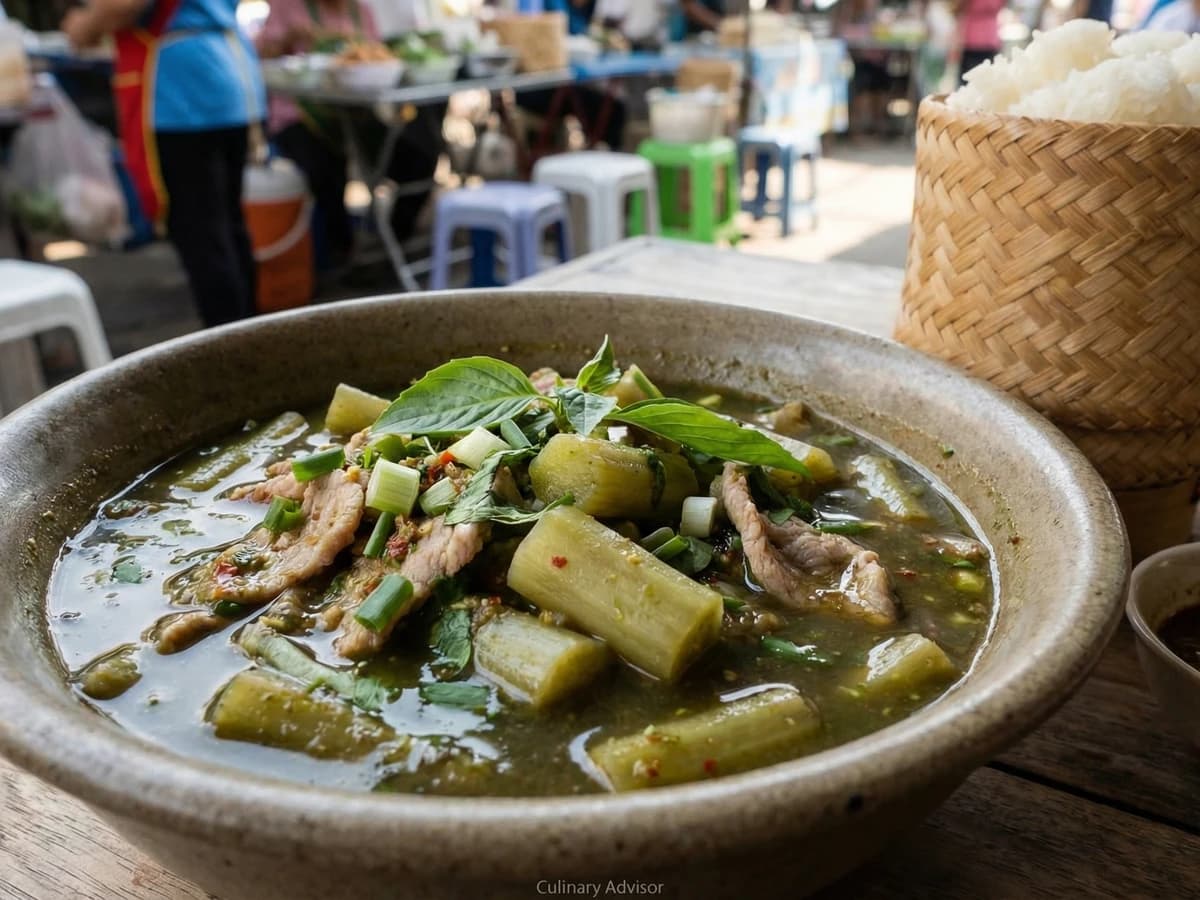
Isan foraging in a bowl: wild taro stems stripped of their sting, simmered in padaek broth with a pounded chili paste and yanang leaf extract. The land feeds you if you know the rules.

Chef Fai
Lanna's kreung tam breaks from Central Thai rules: ginger over galangal, cumin and coriander from Burmese spice routes, tamarind for sour instead of lime. The North has its own system, and this curry is its crown.