
Chef Fai
Dry Egg Noodles (Ba Mee Haeng)
The four pillars live at the bottom of the bowl before the noodles ever touch it: nam pla for salt, sugar for sweet, vinegar for sour, chili for heat. Every noodle cart in Bangkok runs on this principle.
A cooking platform built around craft, culture, and the stories behind what we eat.

Created by
Southern red curry isn't Central red curry with a new name. The kreung tam is heavier on dried chili and turmeric, lighter on sweet, and built for a palate that doesn't flinch. The south doesn't hold back.
The kreung tam tells you everything. Crack open a Southern red curry paste and a Central one side by side, and you'll think they're from different countries. Central Thai gaeng phet is balanced, polished, diplomatic. Southern gaeng phet is a fist. More dried chili. Fresh turmeric staining your mortar yellow. Kapi (shrimp paste) so pungent it clears the room. This is where the principles stay the same but the ratios shift hard, and those ratios are what make regional Thai food regional.
Ajarn always said: the system is the system. Fish sauce for salt. Palm sugar for sweet. Tropical fruit acids for sour. Chili for heat. But the south tilts the whole balance toward heat and salt. Palm sugar barely shows up. The sweetness comes from the coconut cream cracking in the wok, and that's it. If you add sugar like you would in a Central curry, you've lost the dish. Southern food is lean, aggressive, and unapologetically spicy.
The turmeric is non-negotiable. Fresh kamin (ขมิ้น), the fat, orange-fleshed rhizome that grows everywhere in the southern provinces, goes into the kreung tam in quantities that would terrify a Central Thai cook. It stains your mortar, your hands, your cutting board, your clothes. Good. That golden color is the signature of Southern Thai food. Ifyour curry isn't turning your kitchen yellow, you're not using enough.
This curry needs sataw (สะตอ), the stink bean. I'm not going to lie to you about what it smells like. It's sulfuric, bitter, and intense. It's also completely addictive once you accept it. Sataw is to Southern Thai food what pla ra is to Isan: the ingredient that separates the people who grew up eating it from the people who didn't. But if you're here, you're learning. Throw them in. Let the south teach you something new.
Southern Thai cuisine (อาหารปักษ์ใต้) reflects the culinary geography of the Malay Peninsula, where Thai Buddhist, Thai Muslim, Malay, and Indian food traditions overlap. Gaeng phet pak tai evolved in the provinces of Nakhon Si Thammarat, Songkhla, and Surat Thani, where fresh turmeric and dried chilies are abundant year-round and the local kapi (shrimp paste) is fermented longer and more aggressively than Central Thai varieties. The heavy use of turmeric in Southern curry pastes may trace to Indian spice trade influence along the Andaman coast, distinguishing these curries from their Central counterparts, which favor galangal and lemongrass as dominant aromatics.
Quantity
400g
cut into 1-inch pieces
Quantity
400ml
Quantity
200ml
Quantity
3 tablespoons
Quantity
1 teaspoon
Quantity
150g
peeled and halved lengthwise
Quantity
100g
stems removed
Quantity
5
torn
Quantity
3
bruised
Quantity
1 handful
Quantity
15
seeded and soaked 15 minutes
Quantity
5
Quantity
50g
peeled and sliced
Quantity
30g
sliced
Quantity
3 stalks
tender part only, sliced thin
Quantity
8
sliced
Quantity
10 cloves
Quantity
1 tablespoon
scraped and chopped
Quantity
1 teaspoon
Quantity
1 tablespoon
Quantity
1 teaspoon
| Ingredient | Quantity |
|---|---|
| pork belly, skin oncut into 1-inch pieces | 400g |
| coconut cream (hua kati), thick first pressing | 400ml |
| coconut milk (hang kati), thin pressing | 200ml |
| fish sauce (nam pla) | 3 tablespoons |
| palm sugar (nam tan pip) | 1 teaspoon |
| sataw (stink beans)peeled and halved lengthwise | 150g |
| Thai pea eggplant (makhuea phuang)stems removed | 100g |
| kaffir lime leaves (bai makrut)torn | 5 |
| bird's eye chilies (prik khi nu)bruised | 3 |
| Thai sweet basil leaves (horapha) (optional) | 1 handful |
| dried long red chilies (prik haeng)seeded and soaked 15 minutes | 15 |
| dried bird's eye chilies (prik khi nu haeng) | 5 |
| fresh turmeric (kamin)peeled and sliced | 50g |
| galangal (kha)sliced | 30g |
| lemongrass (takhrai)tender part only, sliced thin | 3 stalks |
| shallotssliced | 8 |
| garlic | 10 cloves |
| coriander roots (rak pak chi)scraped and chopped | 1 tablespoon |
| white peppercorns | 1 teaspoon |
| shrimp paste (kapi) | 1 tablespoon |
| sea salt | 1 teaspoon |
Dry-toast the dried long red chilies and dried bird's eye chilies in a wok over medium heat, pressing them flat against the surface, for about 2 minutes. They'll darken slightly and the kitchen will smell sharp and smoky. Don't let them blacken. Transfer them to a bowl of warm water and soak for 15 minutes until they're pliable. Squeeze out the excess water before pounding. The ratio here matters: fifteen dried long chilies plus five dried bird's eye gives you heat with depth. The long chilies build color and a roasted sweetness. The bird's eye brings the sting. That combination is the Southern signature.
Start with the salt, peppercorns, and coriander roots in the granite mortar (krok hin). Pound to a powder. This grit acts as an abrasive that breaks down everything that follows. Add the garlic and pound to a rough paste. Then the soaked chilies, pounding and scraping down the sides until you have a thick, red-orange mass. Now the lemongrass, then galangal, then shallots, adding each one only after the previous ingredient is incorporated. The fresh turmeric goes in last before the kapi. Pound it until the paste turns a deep, golden red and the turmeric has stained everything it touches. Finally, work in the shrimp paste. The finished kreung tam should be thick, fragrant, and slightly oily from the released chili and turmeric oils. It should smell like the south: sharp, earthy, and aggressive.
Pour about half the coconut cream into a wok or heavy pot over medium-high heat. Stir occasionally and let it reduce. You're waiting for the fat to separate from the solids. This is called cracking (แตกมัน). The cream will go from white to oily, with clear coconut oil pooling on the surface and the solids turning slightly golden. This takes 5 to 8 minutes. Don't rush it. If you skip this step, the curry tastes flat and the paste never fries properly.
Add 4 to 5 tablespoons of the Southern curry paste to the cracked coconut oil. Stir constantly. The paste will sizzle and darken as it fries in the coconut fat. You'll see the oil turn deep red-orange from the chilies and golden from the turmeric. The raw shrimp paste smell will cook off and be replaced by something toasty, complex, and fiercely aromatic. This takes about 3 to 4 minutes. If the paste sticks and scorches, your heat is too high. If it's not sizzling at all, it's too low. Find the middle. The paste should be fragrant and glistening in its own oil when it's ready.
Add the pork belly pieces to the fried paste. Toss to coat every piece in the golden-red kreung tam. Let the pork sear in the paste for 2 to 3 minutes, turning the pieces so all sides get contact. The skin on the pork belly is intentional. It renders and softens in the curry, adding body and richness. You want skin-on for this.
Add the remaining coconut cream and the thin coconut milk. Stir to combine. Add the torn kaffir lime leaves and bruised bird's eye chilies. Bring to a gentle boil, then reduce to a simmer. Let the pork cook for 15 to 20 minutes until the meat is tender and the skin is soft but not falling apart. The broth should be rich, slightly oily on the surface, and deeply colored: red from the chili, gold from the turmeric.
Add the pea eggplant and sataw (stink beans). The pea eggplant goes in first because it needs a few minutes to soften slightly while keeping its pop. The sataw goes in a minute later. Don't overcook the sataw. It should be firm with a slight bite, bright green, and yes, it will smell sulfuric and vegetal. That's correct. That's the flavor. Two to three minutes total for the vegetables. No more.
Add the fish sauce and palm sugar. One teaspoon of sugar, that's all. This is Southern food. It doesn't lean sweet. The fish sauce is doing the heavy lifting: salt and umami in one ingredient. Taste the curry. It should hit you in this order: heat first (the chilies should register immediately), then salt and umami (the fish sauce and kapi working together), then a round coconut richness, with barely a whisper of sweetness at the end. If it's too mild, you didn't use enough paste. Add more. If it's too salty, a small squeeze of lime at serving corrects it. Tear the basil leaves in at the last second. Kill the heat. Serve over jasmine rice.
1 serving (about 350g)
Culinary guides, cultural storytelling, and the editorial depth that makes cooking meaningful.
Discover Culinary ExplorerChef Fai
The four pillars live at the bottom of the bowl before the noodles ever touch it: nam pla for salt, sugar for sweet, vinegar for sour, chili for heat. Every noodle cart in Bangkok runs on this principle.

Chef Fai
The kreung tam fried in cracked coconut cream until the oil bleeds red. That's the technique. Concentrated, semi-dry, spooned thick over crispy fish. This is what happens when the four pillars meet restraint.
Chef Fai
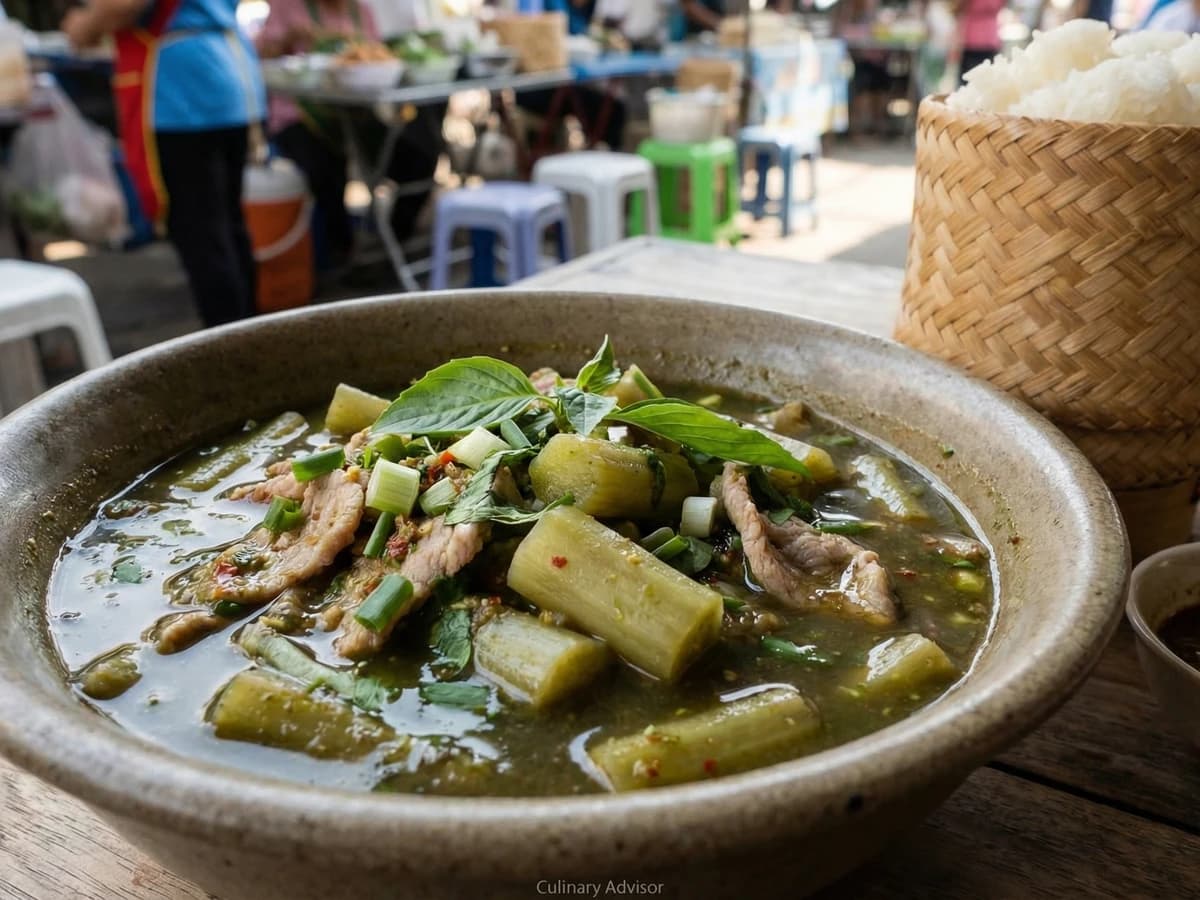
Isan foraging in a bowl: wild taro stems stripped of their sting, simmered in padaek broth with a pounded chili paste and yanang leaf extract. The land feeds you if you know the rules.

Chef Fai
Lanna's kreung tam breaks from Central Thai rules: ginger over galangal, cumin and coriander from Burmese spice routes, tamarind for sour instead of lime. The North has its own system, and this curry is its crown.