
Chef Fai
Dry Egg Noodles (Ba Mee Haeng)
The four pillars live at the bottom of the bowl before the noodles ever touch it: nam pla for salt, sugar for sweet, vinegar for sour, chili for heat. Every noodle cart in Bangkok runs on this principle.
A cooking platform built around craft, culture, and the stories behind what we eat.
Created by
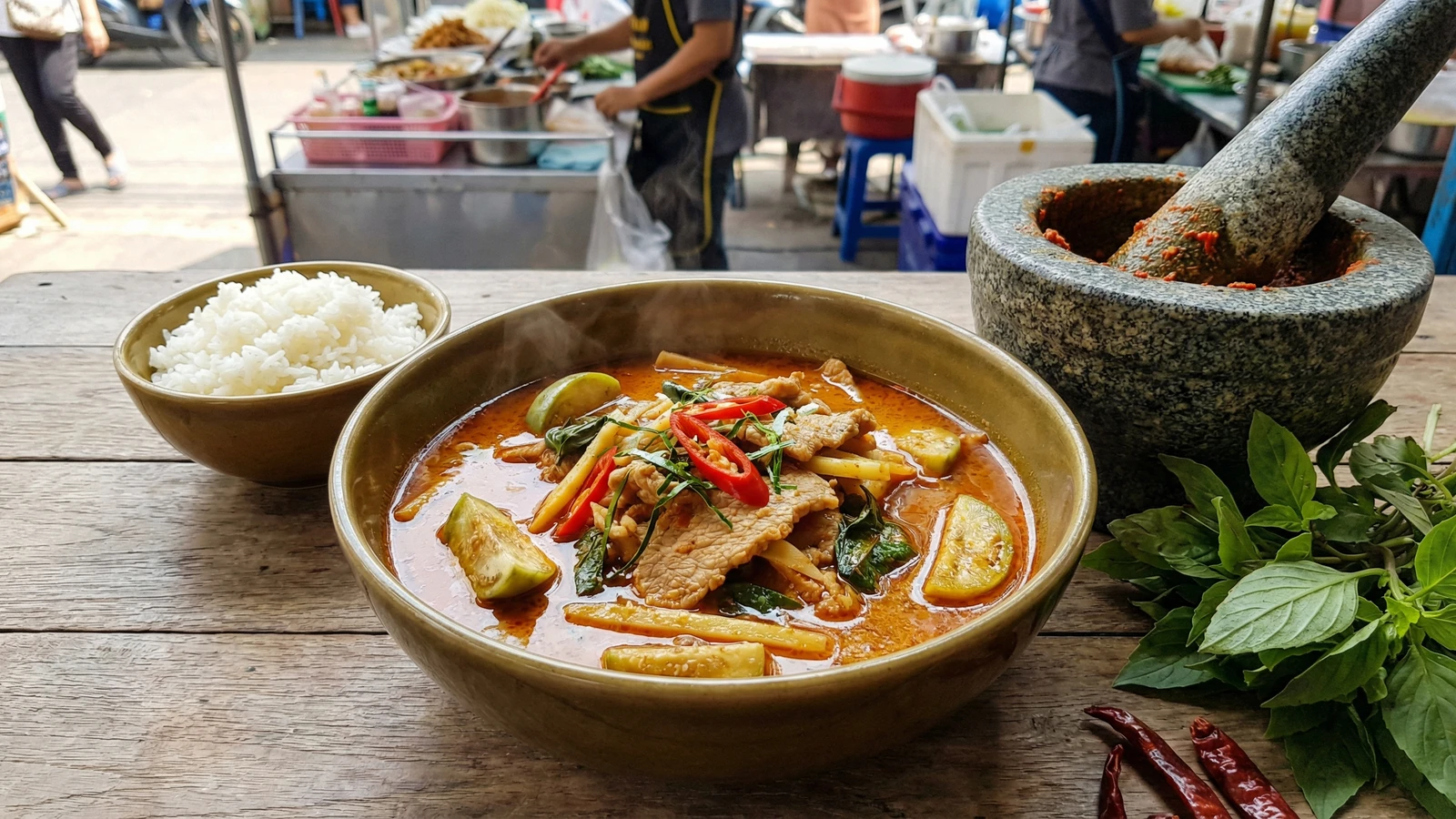
The mother curry of Central Thai cooking. Dried red chilies pounded into a kreung tam with galangal, lemongrass, and kapi, then fried in cracked coconut cream until the oil runs red. Every coconut curry you've ever eaten descends from this one.
Every Thai coconut curry you've ever eaten starts here. Green curry, panang, massaman: they're all variations on a theme. Gaeng phet is the theme. The original. The mother curry of Central Thailand. If you understand this dish, you understand how Thai curries work.
The kreung tam is everything. Twelve dried red chilies, soaked until soft, pounded with garlic, shallots, lemongrass, galangal, cilantro roots, kaffir lime zest, peppercorns, coriander, cumin, and kapi. That's the full blueprint. Nine of the nine essential ingredients Ajarn McDang identifies as the base of Thai cooking are in that mortar. When you pound them, the cell walls shatter, the essential oils merge, the shrimp paste binds everything into a single coherent paste that smells like Thailand compressed into a fist-sized ball of fire. A blender chops these ingredients. A krok transforms them. That's not poetry. That's physics.
Here's the technique that makes a Thai curry a Thai curry: cracking the coconut cream. You take the thick head of the coconut milk (hua kathi), put it in a hot wok, and stir until the fat separates from the solids. The oil pools on the surface, clear and shimmering. Then you fry the paste in that oil. The chili pigments dissolve into the fat. The raw edges of the shrimp paste cook off. The lemongrass and galangal mellow into something rounded and deep. That moment when the oil turns red-orange and the paste smells rich instead of raw? That's the curry being born. Skip this step and you get paste floating in coconut soup. Do it right and you get gaeng phet.
Ajarn always said: "Fish sauce for salt. Palm sugar for sweet. Lime for sour. That's the law." In gaeng phet, the sour note comes not from lime but from the Thai eggplant's gentle bitterness and the natural tang of the coconut itself. The four pillars don't always announce themselves equally. Sometimes one whispers. The principle still holds.
Gaeng phet (literally "spicy curry") is the foundational coconut curry of Central Thai cuisine, with roots tracing to the early Rattanakosin period when coconut palms were abundant in the Chao Phraya basin. Dried red chilies (introduced to Thailand via Portuguese traders in the 16th century) replaced the native peppercorn-based heat that defined earlier Thai curries. The technique of cracking coconut cream to fry curry paste is a distinctly Central Thai method that defines the entire gaeng kathi (coconut curry) family; green curry uses fresh green chilies in the same framework, panang reduces the liquid for concentration, and massaman adds Persian-influenced dry spices. All descend from gaeng phet's template.
Quantity
12
seeded, soaked in warm water 15 minutes
Quantity
1 tablespoon
Quantity
4
roughly sliced
Quantity
8 cloves
Quantity
2 stalks
tender inner core only, thinly sliced
Quantity
1 tablespoon
sliced thin
Quantity
1 tablespoon
scraped and chopped
Quantity
1 teaspoon
Quantity
1 teaspoon
Quantity
1 teaspoon
toasted
Quantity
1/2 teaspoon
toasted
Quantity
1 teaspoon
Quantity
400ml
thick head only
Quantity
300ml
thin tail
Quantity
400g
sliced 1/4 inch thick against the grain
Quantity
200g
quartered
Quantity
100g
sliced thin
Quantity
5
torn, central vein removed
Quantity
1 large handful
Quantity
3 tablespoons
Quantity
1 tablespoon
Quantity
2
sliced on the bias
Quantity
for serving
| Ingredient | Quantity |
|---|---|
| dried red chilies (prik chi fa haeng)seeded, soaked in warm water 15 minutes | 12 |
| shrimp paste (kapi) | 1 tablespoon |
| shallotsroughly sliced | 4 |
| garlic | 8 cloves |
| lemongrass (takhrai)tender inner core only, thinly sliced | 2 stalks |
| galangal (kha)sliced thin | 1 tablespoon |
| cilantro roots (rak phak chi)scraped and chopped | 1 tablespoon |
| kaffir lime zest (phew makrut) | 1 teaspoon |
| white peppercorns (prik thai khao) | 1 teaspoon |
| coriander seeds (luk phak chi)toasted | 1 teaspoon |
| cumin seeds (yira)toasted | 1/2 teaspoon |
| salt | 1 teaspoon |
| coconut cream (hua kathi)thick head only | 400ml |
| coconut milk (hang kathi)thin tail | 300ml |
| pork shoulder (mu saparot)sliced 1/4 inch thick against the grain | 400g |
| Thai eggplant (makhuea phuang)quartered | 200g |
| bamboo shoots (no mai)sliced thin | 100g |
| kaffir lime leaves (bai makrut)torn, central vein removed | 5 |
| Thai basil leaves (bai horapha) | 1 large handful |
| fish sauce (nam pla) | 3 tablespoons |
| palm sugar (nam tan pip) | 1 tablespoon |
| fresh red chilies (prik chi fa)sliced on the bias | 2 |
| steamed jasmine rice | for serving |
In a dry pan over medium heat, toast the coriander seeds and cumin seeds until fragrant and slightly darkened, about 2 minutes. Shake the pan constantly. The moment you smell them, they're done. Grind to a powder in the mortar. Set aside. This is the only toasting step. The dried chilies are soaked, not toasted. Toasting them makes them bitter. Soaking them makes them pliable and sweet.
Start with the hard ingredients. Add the salt and white peppercorns to the mortar and pound to a powder. Then the drained, dried chilies. Pound until they break into a fibrous paste, no large pieces remaining. Next, lemongrass and galangal. These are woody and stubborn. Pound them until the fibers break down and the paste is smooth. Then cilantro roots and kaffir lime zest. Then garlic and shallots. Finally, the toasted coriander and cumin powder and the shrimp paste. Pound everything together until the paste is uniform, smooth, and the color of terracotta. Your arm will hurt. The kitchen will smell like Thailand. That's how you know you're doing it right.
This is the step that separates real Thai curry from everything else. Spoon the thick coconut cream (hua kathi) into a wok or heavy pan over medium-high heat. No oil. Just the cream. Stir it continuously. After 5 to 7 minutes, the fat will separate from the solids. You'll see clear, shimmering oil pooling on the surface and the cream will look broken, grainy almost. That's cracked coconut cream. It should sizzle, not simmer. If it's just bubbling gently, your heat is too low.
Add 4 tablespoons of the kreung tam to the cracked coconut cream. Fry the paste in the separated oil, stirring constantly, for 3 to 4 minutes. The paste will darken slightly, the raw shrimp paste smell will mellow into something rich and rounded, and the oil will turn red-orange as the chili pigments release into the fat. This is the moment the curry is born. If you smell something sharp and acrid, the heat is too high. If the paste still smells raw and wet, you haven't fried it long enough. The aroma should be deep, fragrant, and make you hungry.
Add the sliced pork to the wok and toss it through the fried paste. Coat every piece. Let the pork cook for 3 minutes, turning occasionally, until the outside is no longer pink and the meat has absorbed the red paste. The pork should look stained, almost lacquered, with the curry paste clinging to every surface.
Pour in the thin coconut milk (hang kathi). Stir once. Bring to a gentle simmer, not a rolling boil. Boiling coconut milk makes it grainy and breaks the emulsion. Add the bamboo shoots and Thai eggplant. Simmer for 8 to 10 minutes until the eggplant is just tender but still holds its shape. The pork will be silky by now, infused with the paste.
Add the fish sauce and palm sugar. Stir. Taste. The curry should be: rich and creamy first, salty second, mildly sweet third, with chili heat building underneath. The coconut carries the flavor. The fish sauce defines the seasoning. The palm sugar rounds the edges. Adjust until it's right. Add the torn kaffir lime leaves and sliced fresh red chilies. Stir once. The lime leaves release their citrus oil on contact. That brightness on top of the rich coconut is what makes gaeng phet sing.
Kill the heat. Drop in the Thai basil (horapha). Push it under the surface and let it wilt in the residual heat for ten seconds. The leaves should be bright green and just barely softened. If they're dark and limp, they're overdone. Ladle into a bowl immediately. Serve alongside steamed jasmine rice. The curry goes next to the rice, not over it. You spoon curry onto rice a bite at a time. That's the Thai way.
1 serving (about 375g)
Culinary guides, cultural storytelling, and the editorial depth that makes cooking meaningful.
Discover Culinary ExplorerChef Fai
The four pillars live at the bottom of the bowl before the noodles ever touch it: nam pla for salt, sugar for sweet, vinegar for sour, chili for heat. Every noodle cart in Bangkok runs on this principle.

Chef Fai
The kreung tam fried in cracked coconut cream until the oil bleeds red. That's the technique. Concentrated, semi-dry, spooned thick over crispy fish. This is what happens when the four pillars meet restraint.
Chef Fai
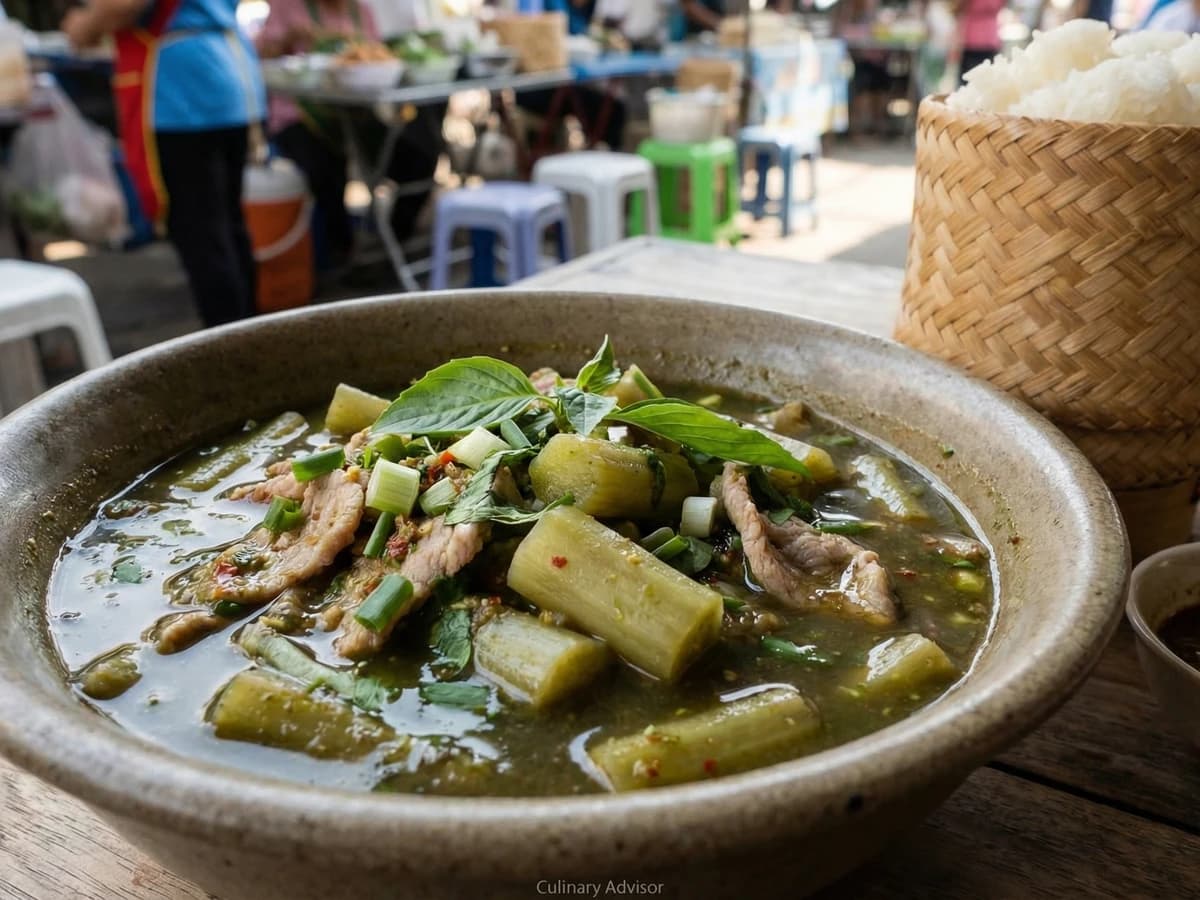
Isan foraging in a bowl: wild taro stems stripped of their sting, simmered in padaek broth with a pounded chili paste and yanang leaf extract. The land feeds you if you know the rules.

Chef Fai
Lanna's kreung tam breaks from Central Thai rules: ginger over galangal, cumin and coriander from Burmese spice routes, tamarind for sour instead of lime. The North has its own system, and this curry is its crown.