
Chef Fai
Dry Egg Noodles (Ba Mee Haeng)
The four pillars live at the bottom of the bowl before the noodles ever touch it: nam pla for salt, sugar for sweet, vinegar for sour, chili for heat. Every noodle cart in Bangkok runs on this principle.
A cooking platform built around craft, culture, and the stories behind what we eat.

Created by
No coconut. No compromise. Lanna's jungle curry is built on a kreung tam of dried spices and ginger, simmered in water, and loaded with wild herbs your grandmother foraged from the mountain. The paste is the principle. The herbs are the land.
Coconut palms don't grow in the northern highlands. That single fact rewrites everything you think you know about Thai curry.
Ajarn always said: the kreung tam is everything. But he also said: the kreung tam changes depending on where you are. In Central Thailand, galangal drives the paste. In the North, ginger takes over. In Central, kapi (shrimp paste) is the fermented backbone. In Lanna, tua nao (fermented soybean discs) often steps in, carrying a funky, savory depth that's completely different from the sea. Dried spices from the old Burmese trade routes enter the mortar: coriander seed, cumin, sometimes a cracked star anise. This is what centuries of mountain trade did to a cuisine. The principles are the same. The ingredients shift with the geography.
Gaeng khae is the curry that proves this. No coconut milk. The broth is water, flavored entirely by the kreung tam and the herbs. Without coconut fat to carry flavor, the paste has to work harder. Every ingredient in the mortar earns its place. And then the greens go in: phak khae (wild betel leaf), cha-om (climbing wattle shoots), phak wan (sweet leaf), bai yanang if you can get it. Handfuls of them. This isn't a garnish situation. The herbs are half the dish. They're the mountain in your bowl.
I learned this curry in Chiang Mai from a woman named Yai Bua who cooked it over charcoal in her teak house near the Ping River. She didn't measure the herbs. She grabbed them by the fistful from a basket her neighbor brought from the hillside that morning. When I asked her how she knew the curry was done, she said: "When it smells like the forest after rain." That's not poetry. That's a sensory instruction. When the wild herbs hit the broth and the kitchen fills with that green, bitter, alive smell, you're there. Principles, not recipes.
Gaeng khae belongs to the Lanna culinary tradition of northern Thailand, a cuisine shaped more by Myanmar, Yunnan, and Laos than by Bangkok. The word "khae" refers to the wild herbs and greens foraged from the mountains surrounding the Chiang Mai valley, and the curry predates the arrival of coconut-based curries from the Central plains. It is a survival dish at its root: protein simmered with whatever the forest offered that day. The specific greens vary by season and village, making gaeng khae one of the most variable curries in the Thai repertoire.
Quantity
500g
cut into pieces through the bone
Quantity
4 cups
Quantity
2 tablespoons
plus more to taste
Quantity
1 teaspoon
Quantity
1 cup
roughly torn
Quantity
1 cup
picked into 2-inch sprigs
Quantity
1 cup
leaves picked from stems
Quantity
1 cup
leaves picked
Quantity
5
quartered
Quantity
1 cup
cut into bite-sized pieces
Quantity
7
soaked 15 minutes, seeded
Quantity
1 tablespoon or 1 disc
Quantity
5
sliced
Quantity
8 cloves
Quantity
2-inch piece
sliced
Quantity
2 stalks
lower 3 inches, sliced thin
Quantity
1 teaspoon
dry-toasted
Quantity
1/2 teaspoon
dry-toasted
Quantity
1/2 teaspoon
Quantity
1 teaspoon
| Ingredient | Quantity |
|---|---|
| bone-in chicken thighs or drumstickscut into pieces through the bone | 500g |
| water | 4 cups |
| fish sauce (nam pla)plus more to taste | 2 tablespoons |
| palm sugar (nam tan pip) | 1 teaspoon |
| phak khae (wild betel leaves)roughly torn | 1 cup |
| cha-om (climbing wattle shoots)picked into 2-inch sprigs | 1 cup |
| phak wan (sweet leaf)leaves picked from stems | 1 cup |
| lemon basil (bai maenglak)leaves picked | 1 cup |
| Thai eggplant (makhuea phuang)quartered | 5 |
| young pumpkin or chayotecut into bite-sized pieces | 1 cup |
| dried long red chilies (prik haeng)soaked 15 minutes, seeded | 7 |
| shrimp paste (kapi) or tua nao (fermented soybean disc) | 1 tablespoon or 1 disc |
| shallots (hom daeng)sliced | 5 |
| garlic (kratiam) | 8 cloves |
| ginger (khing)sliced | 2-inch piece |
| lemongrass (takhrai)lower 3 inches, sliced thin | 2 stalks |
| coriander seeds (met phak chi)dry-toasted | 1 teaspoon |
| cumin seeds (yira)dry-toasted | 1/2 teaspoon |
| black peppercorns (prik thai dam) | 1/2 teaspoon |
| salt | 1 teaspoon |
Set a dry pan over medium heat. Add the coriander seeds, cumin seeds, and black peppercorns. Toast them, shaking the pan, for about 2 minutes until fragrant and just starting to darken. You'll smell them before you see the color change: warm, earthy, almost smoky. This is the Burmese trade route in your mortar. Central Thai pastes don't use these. Lanna does. The difference matters. Let them cool for a minute before pounding.
Start in the granite mortar with the toasted spices and salt. Pound to a powder. This is your foundation layer. Add the soaked, seeded dried chilies and pound until they break down into the spice powder, forming a rough, fibrous mass. Next: the lemongrass, then the ginger, then the garlic, then the shallots. Each goes in only after the previous ingredient is incorporated. You're building the paste in layers, hardest to softest. The kapi or tua nao goes in last: pound it in until the paste is cohesive, fragrant, and slightly oily. It won't be smooth like a Central Thai paste. Lanna kreung tam has more texture, more body. That's correct.
Bring the water to a boil in a pot. This is where gaeng khae departs from every Central Thai curry you've ever made. No coconut cream to crack. No oil separation. You're dissolving the paste directly into water. Drop all the kreung tam into the boiling water and stir until it dissolves and the broth turns ochre-brown and aromatic. Let it boil for 3 to 4 minutes so the paste fully infuses. The kitchen should smell like ginger, dried spice, and fermented depth. If it just smells like hot water, you didn't pound the paste hard enough.
Add the chicken pieces to the broth. Bone-in is non-negotiable here. The bones release collagen and flavor into the water-based broth over time, giving it body that coconut cream would otherwise provide. Simmer, not boil, for about 12 to 15 minutes until the chicken is cooked through and the broth has taken on a richer color. Skim any foam that rises. Season with the fish sauce and palm sugar. Taste. It should be savory and aromatic first, with just a whisper of sweetness to round the edges. Not sweet. Round.
Add the pumpkin or chayote and the quartered eggplant. These need about 5 minutes to cook through. The pumpkin should be tender but not falling apart. The eggplant softens and absorbs the broth. Stir gently. This is a curry, not a stir-fry. Respect the pace.
Kill the heat. Now the herbs go in. All of them. Phak khae, cha-om, phak wan, lemon basil. A massive handful of each, torn and dropped into the hot broth. Stir once to submerge them. They wilt in the residual heat but should not cook. The herbs are alive in this curry: bitter, green, vegetal, aromatic. If you boil them, they go dark and lose everything that makes them special. Thirty seconds in the hot broth. That's your window. Taste the broth one final time. Adjust fish sauce if needed. Ladle into bowls. The surface should be crowded with herbs, the broth underneath dark and fragrant. Serve immediately with sticky rice (khao niew). Not jasmine. Sticky rice. Always.
1 serving (about 420g)
Culinary guides, cultural storytelling, and the editorial depth that makes cooking meaningful.
Discover Culinary ExplorerChef Fai
The four pillars live at the bottom of the bowl before the noodles ever touch it: nam pla for salt, sugar for sweet, vinegar for sour, chili for heat. Every noodle cart in Bangkok runs on this principle.

Chef Fai
The kreung tam fried in cracked coconut cream until the oil bleeds red. That's the technique. Concentrated, semi-dry, spooned thick over crispy fish. This is what happens when the four pillars meet restraint.
Chef Fai
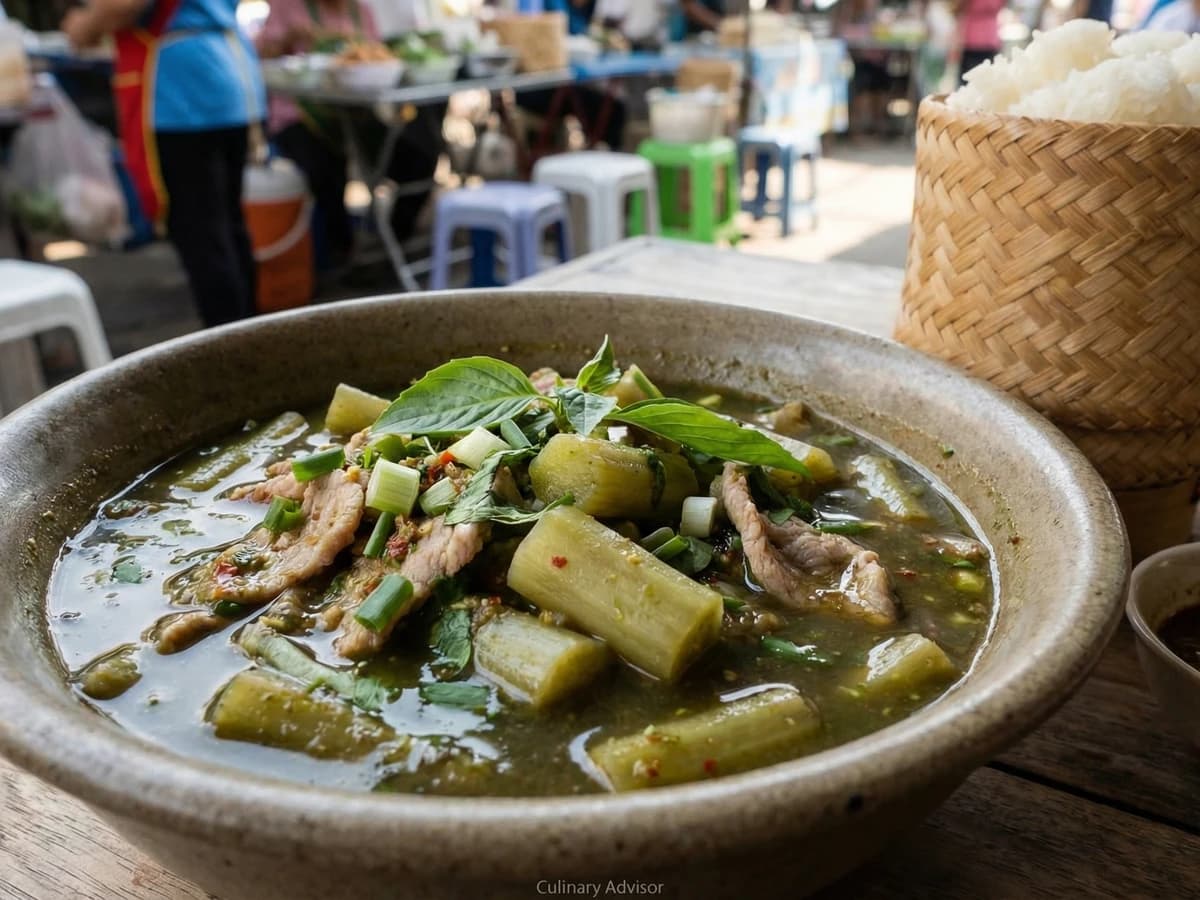
Isan foraging in a bowl: wild taro stems stripped of their sting, simmered in padaek broth with a pounded chili paste and yanang leaf extract. The land feeds you if you know the rules.

Chef Fai
Lanna's kreung tam breaks from Central Thai rules: ginger over galangal, cumin and coriander from Burmese spice routes, tamarind for sour instead of lime. The North has its own system, and this curry is its crown.