
Chef Juliette
John Dory (St. Pierre)
John Dory has the delicacy of sole and the firmness of turbot. A light flouring, a quick butter sauté, and nut-brown beurre noisette show exactly why looks never mattered.
A cooking platform built around craft, culture, and the stories behind what we eat.
Created by Chef Juliette
Based on No. 965, Langouste à la Russe, from Le Guide Culinaire (1907) by Auguste Escoffier
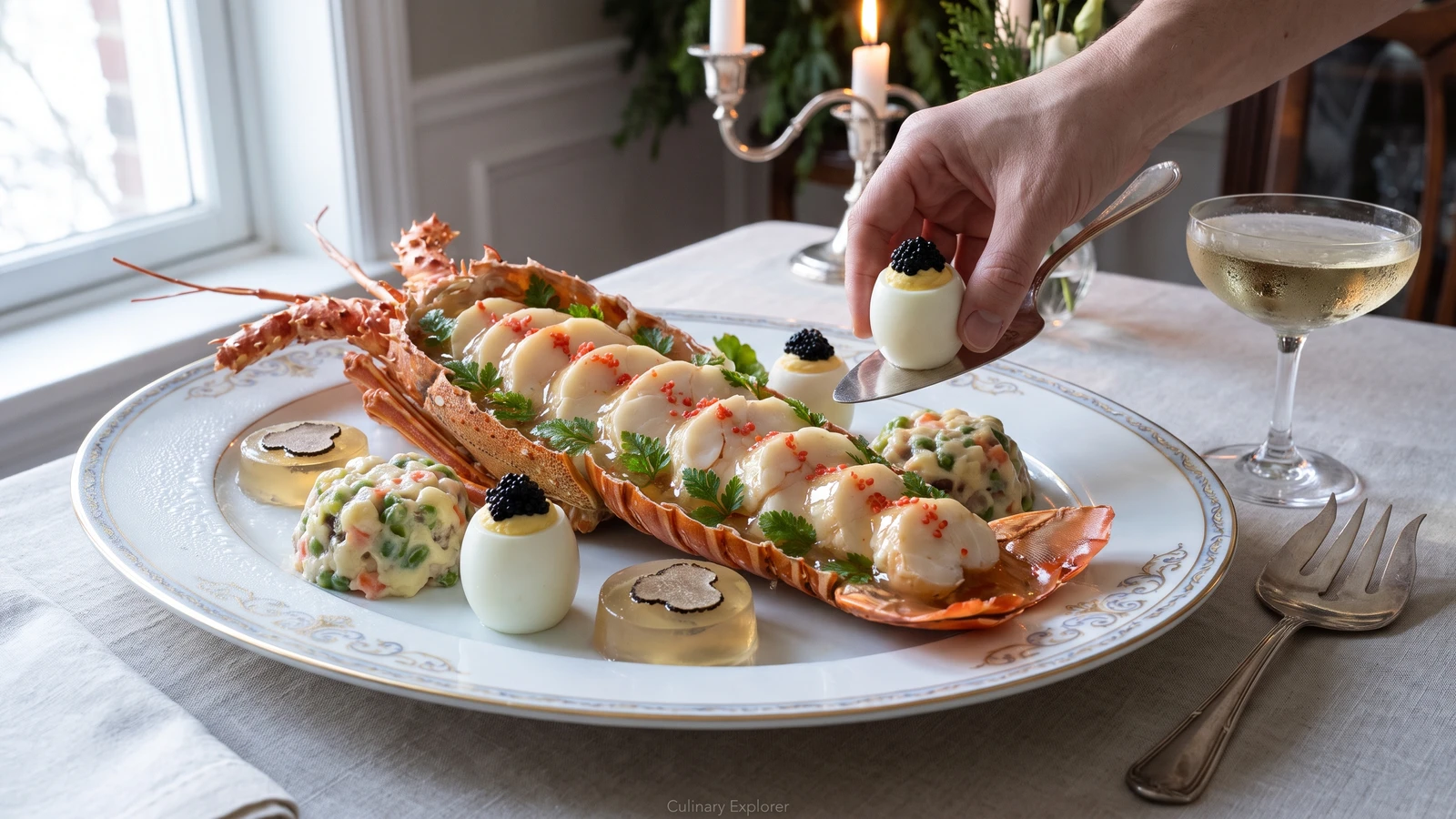
A cold celebration platter of spiny lobster collops lacquered with white chaud-froid and clear aspic, surrounded by moulded salade russe, caviare-filled eggs, truffle, and chervil, scaled with discipline for four.
Langouste à la Russe (spiny lobster glazed cold in white sauce and aspic) teaches the discipline of cold coating. Before you touch a pan, know this: the lobster and its tray must be thoroughly cold, while the chaud-froid and aspic must remain fluid enough to settle in thin, even layers. The white sauce supplies flavour and opacity; repeated coats of clear aspic give the collops their glassy sheen.
The original assumed a saucier with white fish chaud-froid and clear aspic ready from stock never off the fire, plus a garde-manger arranging ten dariole moulds and ten caviare-filled eggs. It needed no salamander, because all its finishing work is cold. Your honest equivalent is one complete home-scale Homard à la Russe (No. 961), made with a single langouste, four small moulds, four eggs, a refrigerator, and a chilled oval platter. One cook, one stove, one evening.
A langouste has no claws, so its tail must provide both the graduated collops and the diced meat for the Salade Russe. Reserve the broad, handsome slices first. The towering display cushion and tenfold repetition were brigade scaffolding and may go; the white chaud-froid, coral and chervil decoration, repeated aspic coats, moulded salad, caviare eggs, and clear jelly border are the dish and must stay. The step that decides everything is the glazing, thin coat by thin coat, with patience between them.
Langouste à la Russe belongs to the Parisian grand cold-service repertory, where shellfish was returned to its shell and dressed with chaud-froid, aspic, truffle, and moulded garnishes for a celebration table. Its name points to the Salade Russe and caviare in the garnish, not to a Russian household origin, and the spiny-lobster form is explicitly a species change from Homard à la Russe rather than a separate sauce. The canon also circulated names such as à la Néva and à la Moscovite, but treated them as variable presentations without fixed classical principles.
Quantity
1 complete home-scale preparation of Homard à la Russe (No. 961), scaled to 4 servings and prepared from 1 whole raw spiny lobster, 3 to 3½ lb (1.35 to 1.6 kg), in place of clawed lobster
Use langouste as the crustacean throughout the referenced preparation
| Ingredient | Quantity |
|---|---|
| Homard à la Russe finished component, prepared with spiny lobsterUse langouste as the crustacean throughout the referenced preparation | 1 complete home-scale preparation of Homard à la Russe (No. 961), scaled to 4 servings and prepared from 1 whole raw spiny lobster, 3 to 3½ lb (1.35 to 1.6 kg), in place of clawed lobster |
Prepare one complete home-scale Homard à la Russe (No. 961), using the linked preparation's cooking, extraction, white fish chaud-froid, Salade Russe, egg garnish, aspic glazing, and dishing instructions as written. Replace only the clawed lobster with one whole langouste. This entry changes the species, not the formula, so add no new flavouring and remove none.
Scale the linked preparation to four servings. The original ten dariole moulds and ten hard-boiled eggs become four of each, and the single langouste replaces the banquet-sized lobster quantity; keep the proportions among mayonnaise, chaud-froid, aspic, and Salade Russe unchanged. Use four 4 fl oz (120 ml) moulds or straight-sided ramekins. Reduction in repetition is home-kitchen scaffolding, not a change to the dish.
Follow the referenced cooking and extraction directions, taking particular care to draw the tail meat from its shell in one piece. Cut the broad central meat into enough graduated collops to cover the back of the shell, then dice only the narrow ends and remaining trimmings for the salad. If a collop splits, fit the pieces together on the cold rack and let the first aspic coat bind them; once glazed, the join disappears. Ça se rattrape.
At the repeated aspic-coating stage of the cited preparation, keep the decorated chaud-froid-coated collops on a rack over a shallow tray. The collops must be cold and the aspic cool, clear, and slightly syrupy. Apply thin coats, chilling each until set before adding the next, until the surface has an even cold sheen. If the aspic beads and runs away, either the collops are too warm or the jelly is too loose; chill both briefly and try again. If the aspic sets rubbery in the bowl, stand it over barely warm water and stir only until fluid.
Dip each filled salad mould in hot water for two seconds, dry its outside, and invert it onto a chilled oval platter. If it refuses to release, warm it for one second more; don't force a knife down the side and scar the surface. Omit the high exhibition cushion and set the cleaned shell directly on the platter, arranging the graduated collops along its back. Alternate the four moulded salads with the four upright caviare-filled eggs, then border the platter with clear jelly roundels topped with truffle. A plain 1¼-inch (3 cm) round cutter honestly replaces the old fancy cutter.
Return the finished platter to the refrigerator for twenty minutes so every element settles, then serve it directly from the cold while the aspic is bright and the caviare tastes fresh. Keep the platter below 40°F (4°C) until serving and don't leave it at the table for more than two hours. Bring it out whole, with a broad server for the salad and collops. À table!
1 serving (about 260g)
Culinary guides, cultural storytelling, and the editorial depth that makes cooking meaningful.
Discover Culinary ExplorerChef Juliette
John Dory has the delicacy of sole and the firmness of turbot. A light flouring, a quick butter sauté, and nut-brown beurre noisette show exactly why looks never mattered.

Chef Juliette
Fresh haddock proves its delicacy in the meunière pan: a fine flour crust, moist pearly flakes, and beurre noisette sharpened with lemon and parsley, ready from one skillet in half an hour.

Chef Juliette
Éperlans à l’Anglaise turns small fish into a lesson in disciplined coating: boned smelts under a close, crisp crumb, pan-fried in clarified butter and finished with bright, half-melted maître d’hôtel butter.

Chef Juliette
Tiny smelts, shallot, mushrooms, white wine, gratin sauce, and fine bread raspings meet a fierce oven, where the fish must turn tender in the same breath the buttered crust bronzes.