
Chef Juliette
John Dory (St. Pierre)
John Dory has the delicacy of sole and the firmness of turbot. A light flouring, a quick butter sauté, and nut-brown beurre noisette show exactly why looks never mattered.
A cooking platform built around craft, culture, and the stories behind what we eat.
Created by Chef Juliette
Based on No. 960, Homard à la Parisienne, from Le Guide Culinaire (1907) by Auguste Escoffier
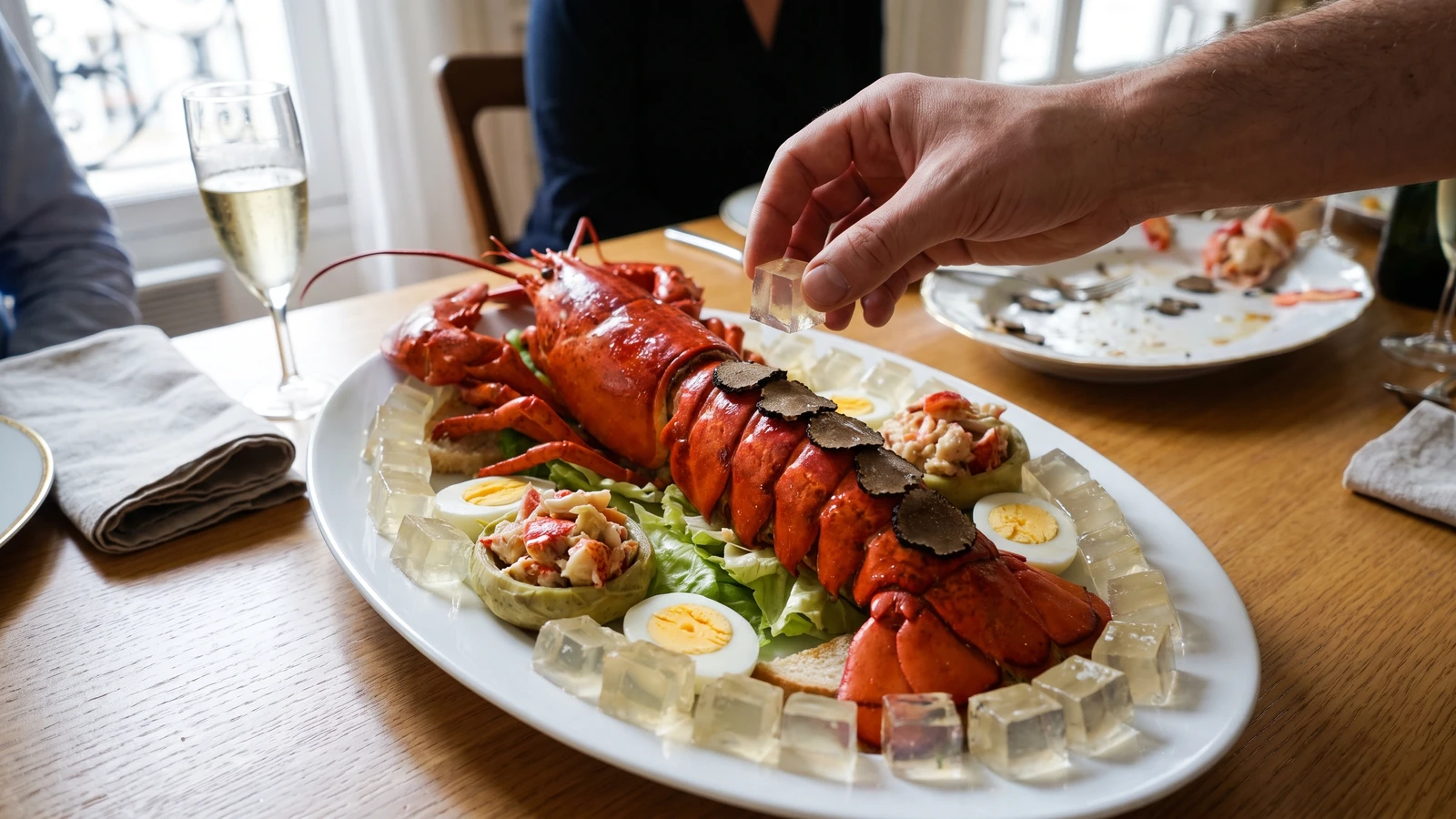
Homard à la Parisienne turns one whole lobster into a cold celebration platter of truffle-glazed collops, set lobster salad, artichoke bottoms, eggs, lettuce, and clear aspic, with every slice arranged to be seen.
Homard à la Parisienne (cold Parisian dressed lobster) teaches the architecture of cold presentation. Know this before you touch a pan: the aspic must be cold enough to cling, yet fluid enough to flow. Too warm and it slips from the lobster; too firm and it lands in lumps. Hold that narrow middle and every collop shines beneath a clear, delicate glaze.
The original preparation assumed a saucier on staff, clear fish stock never off the fire, a garde-manger glazing beside ice, fancy cutters, and spare hands to carve a rice plinth. Your kitchen gets a concentrated fish-stock aspic set with measured gelatin, a chilled sheet pan, a piping tip for the truffle roundels, and a buttered bread wedge beneath one large lobster. One cook, one stove, one evening, four generous celebration servings.
The carved rice and ornamental cutter were brigade scaffolding, so they can go. The careful opening of the shell, graduated tail collops, truffle, glossy artichoke salad, eggs, lettuce, and clear jelly are the dish, so they stay. Chill every component thoroughly, then watch the aspic as it approaches the texture of light oil. That is the step that decides the whole platter.
Homard à la Parisienne belongs to the grand cold buffet tradition of Paris, where the garde-manger turned whole fish and shellfish into architectural centerpieces for celebration tables. The lobster came from Atlantic ports, but Parisienne names a manner of presentation rather than a coastal recipe: aspic, truffle, vegetable salad, eggs, and a raised plinth made abundance visible before carving. As the dish moved onto bourgeois tables, buttered bread often replaced elaborately carved rice while the dressed shell and graduated tail slices remained.
Quantity
4 cups (960 ml / 960 g)
Quantity
3 packets, about 2 tablespoons plus ¾ teaspoon (34 ml / 21 g)
Quantity
4 quarts (3.8 L / 3.8 kg)
Quantity
2 cups (480 ml / 480 g)
Quantity
½ cup (120 ml / 120 g)
Quantity
2 medium (300 g)
sliced
Quantity
2 medium (180 g)
sliced
Quantity
2 stalks (100 g)
sliced
Quantity
1
Quantity
1 tablespoon (15 ml / 8 g)
Quantity
3 tablespoons (45 ml / 54 g)
Quantity
1, about 3 to 3½ pounds (1.4 to 1.6 kg)
dispatched immediately before cooking
Quantity
3
Quantity
⅔ cup (160 ml / 100 g)
peeled and cut into 5 mm dice
Quantity
½ cup (120 ml / 65 g)
peeled and cut into 5 mm dice
Quantity
½ cup (120 ml / 75 g)
cut into 5 mm pieces
Quantity
½ cup (120 ml / 70 g)
Quantity
1
Quantity
1 teaspoon (5 ml / 5 g)
Quantity
1 tablespoon (15 ml / 15 g)
Quantity
⅔ cup (160 ml / 145 g)
Quantity
1 teaspoon (5 ml / 6 g)
divided
Quantity
¼ teaspoon (1.25 ml / 0.5 g)
Quantity
Up to 2 tablespoons (30 ml / 30 g)
pressed through a fine sieve
Quantity
12, about 14 ounces (400 g) drained weight
rinsed and thoroughly dried
Quantity
1, about 1 ounce (28 g)
drained and dried
Quantity
2, about 4 cups (1 L / 180 g)
cut julienne-fashion
Quantity
½ loaf, about 1 pound (450 g)
Quantity
4 tablespoons (60 ml / 57 g)
softened
| Ingredient | Quantity |
|---|---|
| clear unsalted fish stock | 4 cups (960 ml / 960 g) |
| unflavored powdered gelatin | 3 packets, about 2 tablespoons plus ¾ teaspoon (34 ml / 21 g) |
| water | 4 quarts (3.8 L / 3.8 kg) |
| dry white wine | 2 cups (480 ml / 480 g) |
| white wine vinegar | ½ cup (120 ml / 120 g) |
| yellow onionssliced | 2 medium (300 g) |
| carrots for the court-bouillonsliced | 2 medium (180 g) |
| celerysliced | 2 stalks (100 g) |
| bouquet garni of parsley stems, thyme, and bay | 1 |
| black peppercorns | 1 tablespoon (15 ml / 8 g) |
| fine sea salt for the court-bouillon | 3 tablespoons (45 ml / 54 g) |
| live hard-shell lobsterdispatched immediately before cooking | 1, about 3 to 3½ pounds (1.4 to 1.6 kg) |
| large eggs | 3 |
| waxy potatopeeled and cut into 5 mm dice | ⅔ cup (160 ml / 100 g) |
| carrot for the vegetable saladpeeled and cut into 5 mm dice | ½ cup (120 ml / 65 g) |
| haricots vertscut into 5 mm pieces | ½ cup (120 ml / 75 g) |
| frozen peas | ½ cup (120 ml / 70 g) |
| pasteurized large egg yolk | 1 |
| Dijon mustard | 1 teaspoon (5 ml / 5 g) |
| white wine vinegar for the mayonnaise | 1 tablespoon (15 ml / 15 g) |
| neutral oil | ⅔ cup (160 ml / 145 g) |
| fine sea salt for seasoningdivided | 1 teaspoon (5 ml / 6 g) |
| finely ground white pepper | ¼ teaspoon (1.25 ml / 0.5 g) |
| cooked lobster coral or tomalley (optional)pressed through a fine sieve | Up to 2 tablespoons (30 ml / 30 g) |
| small cooked artichoke bottomsrinsed and thoroughly dried | 12, about 14 ounces (400 g) drained weight |
| preserved whole black truffledrained and dried | 1, about 1 ounce (28 g) |
| romaine heartscut julienne-fashion | 2, about 4 cups (1 L / 180 g) |
| unsliced Pullman loaf or firm sandwich loaf | ½ loaf, about 1 pound (450 g) |
| unsalted buttersoftened | 4 tablespoons (60 ml / 57 g) |
Reserve ½ cup of the cold fish stock and sprinkle the gelatin evenly over it. Leave it for 5 minutes to bloom. Bring the remaining stock to a gentle simmer and reduce it from 3½ cups to about 3 cups, concentrating the foundation without making it salty. Pass it through a damp coffee filter or several layers of damp muslin without pressing. Off the heat, whisk in the bloomed gelatin until completely dissolved, then taste and add a little of the seasoning salt if needed. Never boil the gelatin. Pour 1¼ cups into a shallow dish to a depth of about 1.5 cm for the final cubes, and chill it with the remaining aspic until firm, at least 2 hours.
Combine the water, wine, ½ cup vinegar, sliced onions, carrots, celery, bouquet garni, peppercorns, and 3 tablespoons salt in a fish poacher or stockpot large enough to hold the lobster straight. Simmer uncovered for 20 minutes so the vegetables and aromatics season the liquid. Meanwhile, secure the dispatched lobster belly-down to the poacher insert with cotton twine, or brace the fully extended tail between two long stainless-steel skewers. The old board existed to prevent the tail curling; the rack and skewers perform the same honest work.
Lower the lobster into the court-bouillon and bring the liquid back only to a bare simmer. Cover and poach for 18 to 22 minutes, beginning to check early. Insert an instant-read thermometer through the soft underside into the thickest part of the tail. Take the pot off the heat at 60°C, then leave the lobster submerged until it reaches 63°C. A hard boil tightens the flesh, while the gentle poach keeps the tail supple enough to remove whole.
Transfer the lobster on its insert to a deep roasting pan and strain enough court-bouillon around it to cover or nearly cover. Set the roasting pan into an ice bath, with the ice outside the pan rather than in the liquor, and turn the lobster once as it cools. Refrigerate it in the court-bouillon until both shell and flesh are thoroughly cold, at or below 4°C, completing the cooling within 2 hours. Cooling in its liquor is part of the dish because it protects the meat from drying; the ice bath is the home equivalent of the cold garde-manger bench.
Lower the eggs into simmering water and cook for 9 minutes, then chill, peel, and quarter them lengthwise. In the same saucepan of fresh salted water, cook the potato dice until just tender, about 4 minutes; add the carrot for the final 3 minutes, then the haricots verts and peas for the final 90 seconds. Drain the macédoine, the small even vegetable dice, and spread it on a clean cloth-lined tray. Chill it until completely cold and dry. Wet vegetables thin the mayonnaise and make the artichoke pyramids slump.
Drain and dry the cold lobster. Remove the twine or skewers. With sturdy kitchen shears, make two parallel cuts about 2.5 cm apart down the center of the back, beginning behind the head and continuing through the tail shell to the fan. Lift out the resulting strip in one piece. Ease the tail meat out whole, fill the empty tail with some of the lettuce cut julienne-fashion, then replace the shell strip upside down to form a shallow support for the collops. Crack the claws and knuckles, remove their meat with any sound meat from the carapace, and cut it into small dice. If local shellfish guidance permits eating the creamy coral or tomalley, press up to 2 tablespoons through a fine sieve; otherwise omit it. Keep everything cold.
Whisk the pasteurized yolk with the Dijon mustard, 1 tablespoon vinegar, half the remaining seasoning salt, and the white pepper. Add the neutral oil first drop by drop, then in a fine thread, whisking until the mayonnaise is thick and glossy. If it splits, don't discard it. Ça se rattrape: place a teaspoon of cold water in a clean bowl and whisk in the broken mayonnaise one spoonful at a time. Gently melt about ⅓ cup of the aspic, cool it until fluid but no longer warm, then whisk it gradually into the mayonnaise with the sieved creamy parts, if using. Fold in the cold macédoine and diced lobster meat. Set the bowl over ice until the salad begins to hold a mound. If it firms too quickly, stir it briefly over barely warm water until supple again.
Cut the tail crosswise into 10 to 12 even collops, keeping their natural progression from the small tapered end to the broad end. Arrange them on a chilled sheet pan and blot the surfaces dry. Cut 10 to 12 thin truffle roundels with a small plain cutter or the wide end of a piping tip, reserving the trimmings. Melt about 1 cup of aspic over barely warm water and cool it until it flows like light oil. Dip each truffle roundel in the half-melted aspic and center it on a collop. Spoon over a thin coat, chill for 3 minutes, then repeat until each slice has a smooth, clear casing. If the aspic slides off, it or the lobster is too warm. Blot the collops, chill them for 5 minutes, and try again with cooler aspic. Ça se rattrape.
Stand the thoroughly dried artichoke bottoms on a chilled tray. Divide the lobster salad among them, shaping each portion into a compact pyramid with two teaspoons. Set a small piece of reserved truffle on every peak and spoon over a fine coat of fluid, cool aspic for gloss. Chill until set. The salad must mound rather than spread; if it softens while you work, return it to the cold for 5 minutes.
Cut the half loaf into a long wedge, low at the tail end and high beneath the head, so the lobster will rest at roughly a 45° angle. Trim it to fit the platter, coat it thinly with the softened butter, and press most of the remaining lettuce julienne into the butter. Place the wedge on a chilled oval platter and settle the lobster shell over it, head raised. Use two hidden wooden picks if it needs securing. Cooking well is not cooking fancy; the bread is structural, edible, and far kinder to one cook than carved rice.
Lay the glazed collops in a slightly overlapping line along the lobster's back, beginning behind the head with the smallest and increasing toward the tail. Alternate the twelve filled artichoke bottoms with twelve egg quarters around the lobster, keeping the yolks facing outward. Unmold the reserved firm aspic and cut it into generous cubes or triangles, then border the platter with them and tuck in only enough remaining lettuce to conceal the bread. Keep the platter chilled until serving and leave it at room temperature for no more than 2 hours. Carry it whole to the table, then serve each guest lobster, an artichoke bottom, egg, lettuce, and clear jelly. À table!
1 serving (about 595g)
Culinary guides, cultural storytelling, and the editorial depth that makes cooking meaningful.
Discover Culinary ExplorerChef Juliette
John Dory has the delicacy of sole and the firmness of turbot. A light flouring, a quick butter sauté, and nut-brown beurre noisette show exactly why looks never mattered.

Chef Juliette
Fresh haddock proves its delicacy in the meunière pan: a fine flour crust, moist pearly flakes, and beurre noisette sharpened with lemon and parsley, ready from one skillet in half an hour.

Chef Juliette
Éperlans à l’Anglaise turns small fish into a lesson in disciplined coating: boned smelts under a close, crisp crumb, pan-fried in clarified butter and finished with bright, half-melted maître d’hôtel butter.

Chef Juliette
Tiny smelts, shallot, mushrooms, white wine, gratin sauce, and fine bread raspings meet a fierce oven, where the fish must turn tender in the same breath the buttered crust bronzes.