
Chef Juliette
John Dory (St. Pierre)
John Dory has the delicacy of sole and the firmness of turbot. A light flouring, a quick butter sauté, and nut-brown beurre noisette show exactly why looks never mattered.
A cooking platform built around craft, culture, and the stories behind what we eat.

Created by Chef Juliette
Based on No. 942, Homard à la Broche, from Le Guide Culinaire (1907) by Auguste Escoffier
One lobster, one fierce oven, and a Champagne-butter baste: Homard à la Broche teaches the discipline of keeping shellfish glossy, succulent, and generous enough for a celebration table.
Homard à la Broche (lobster roasted before fierce heat on a turning spit) teaches basting as temperature control. Champagne and butter carry flavour, certainly, but their first job is to keep the shell glossy and temper the fierce heat before it tightens the meat. The one true thing is simple: once the lobster meets the fire, you baste without pause.
The entry assumed a broche turning before a red fire, not a salamander, a saucier waiting to degrease and mount the sauce, and glace de viande ready from a stockpot that never went cold. At home, a wire rack over a heavy dripping pan, deliberate quarter-turns in a 450°F oven, a fat separator, and a small saucepan do the same honest work. Constant mechanical turning is brigade scaffolding and can go; the Champagne-butter bath and repeated basting are the dish and must stay. The book's hour becomes 28 to 35 minutes because an enclosed oven cooks more directly, and holding to the old clock would dry the lobster. One cook, one stove, one evening.
The book offers two finishes. Hot Sauce Ravigote (a sharp herb-and-vinegar sauce) makes the brighter plate; the reduced pan glaze with glace de viande (meat glaze), Worcestershire, parsley, butter, and lemon is darker and richer. Choose before you cook, set the baster, tongs, and mitts within reach, then stay beside the oven. That four-minute basting rhythm decides the dish.
Homard à la Broche belongs to the grand Parisian treatment of Atlantic lobster arriving from Brittany and Normandy, where a spit more familiar beneath poultry held the shellfish before fierce live fire. Champagne made the service celebratory, but did not make the dish a regional specialty of Champagne; city kitchens paired the lobster with Sauce Ravigote or a meat-glaze-enriched reduction sharpened by Worcestershire and lemon. The shell was working armour rather than decoration, protecting the flesh while repeated basting and radiant heat roasted it.
Quantity
1 lobster, 3 lb (1.36 kg)
or fishmonger-dispatched immediately before cooking
Quantity
¾ cup (170 g / 6 oz)
for basting
Quantity
1½ cups (375 ml / about 375 g), half a 750 ml bottle
Quantity
1 teaspoon (5 ml / 6 g)
Quantity
1 teaspoon (5 ml / 3 g)
Quantity
1 cup (240 ml / about 240 g)
for the Sauce Ravigote service
Quantity
3 tablespoons (45 ml / about 60 g)
for the reduced glaze
Quantity
2 tablespoons (30 ml / about 34 g)
for the reduced glaze
Quantity
2 tablespoons (30 ml / 8 g)
finely chopped, for the reduced glaze
Quantity
6 tablespoons (90 ml / 85 g / 3 oz)
cubed, for finishing the reduced glaze
Quantity
¼ teaspoon (1¼ ml / about 1 g), plus a few drops if needed
for the reduced glaze
| Ingredient | Quantity |
|---|---|
| live hard-shell lobsteror fishmonger-dispatched immediately before cooking | 1 lobster, 3 lb (1.36 kg) |
| unsalted butterfor basting | ¾ cup (170 g / 6 oz) |
| brut Champagne | 1½ cups (375 ml / about 375 g), half a 750 ml bottle |
| fine sea salt | 1 teaspoon (5 ml / 6 g) |
| whole black peppercorns | 1 teaspoon (5 ml / 3 g) |
| prepared hot Sauce Ravigote (optional)for the Sauce Ravigote service | 1 cup (240 ml / about 240 g) |
| glace de viande (meat glaze) (optional)for the reduced glaze | 3 tablespoons (45 ml / about 60 g) |
| Worcestershire sauce (optional)for the reduced glaze | 2 tablespoons (30 ml / about 34 g) |
| flat-leaf parsley (optional)finely chopped, for the reduced glaze | 2 tablespoons (30 ml / 8 g) |
| cold unsalted butter (optional)cubed, for finishing the reduced glaze | 6 tablespoons (90 ml / 85 g / 3 oz) |
| fresh lemon juice (optional)for the reduced glaze | ¼ teaspoon (1¼ ml / about 1 g), plus a few drops if needed |
Choose one of the book's two accompaniments, not both. For the Sauce Ravigote service, have the prepared Sauce Ravigote ready to reheat gently. For the reduced glaze, keep the cubed finishing butter cold and measure the glace de viande, Worcestershire, parsley, and lemon before the lobster goes near the oven. The sauce moves quickly once the pan liquor is ready.
Heat the oven to 450°F (230°C) with a rack in the upper third. Put the basting butter, Champagne, salt, and peppercorns into the heavy roasting pan, set the wire rack over it, and warm the pan in the oven for about 5 minutes, just until the butter melts. Stir once. The liquid should be hot and golden, never browned.
The cleanest home arrangement is to ask the fishmonger to dispatch the lobster immediately before collection, then keep it very cold and cook it promptly. If dispatching it yourself, chill it in the freezer for about 20 minutes until insensible. Lay it belly-down on a nonslip towel with the claw bands still secured, set the point of a heavy chef's knife at the cross immediately behind the eyes, and cut decisively through the head toward the front; turn the blade and complete the cut back through the centre of the head. Remove the bands, tie the claws close to the body with cotton kitchen twine, and run two sturdy metal skewers lengthwise through the lobster so the tail remains straight.
Set the lobster belly-down on the rack over the Champagne-butter bath. Roast for 4 minutes, pull the rack forward only far enough to work safely, and baste the entire shell and every joint generously. Turn the lobster onto one side, return it for 4 minutes, then baste and turn again, moving from side to back to the other side and finally belly-down. Continue this rhythm for 28 to 35 minutes. Begin checking at 28 minutes: the shell should be deeply vermilion and glossy, and a thermometer inserted through the thin underside of the thickest tail section should register 145°F (63°C). If the pan develops dry patches or the butter solids begin to scorch, add ¼ cup (60 ml) boiling water and move the pan one rack lower. If the tail is ready before a large claw, detach that claw and return it to the oven for 3 to 5 minutes while the tail rests.
Transfer the lobster to a board, remove the skewers and twine, and rest it for 8 minutes. Strain the contents of the dripping pan and any resting juices through a fine sieve into a fat separator. Let it stand for 2 minutes, then separate every visible trace of fat from the lobster liquor. This degreasing matters: grease would blunt the Sauce Ravigote and make the reduced glaze difficult to mount. The removed lobster-scented butter can dress plain potatoes, but none goes back into the sauce.
For the first accompaniment, bring the Sauce Ravigote to a gentle simmer in a small saucepan. Whisk in the degreased lobster liquor and let the combined sauce simmer only until it again nappes, or coats, the back of a spoon. Taste before adding any salt; the roasting liquor has already been seasoned. Keep it hot without boiling while the lobster is carved.
For the second accompaniment, pour the strained, degreased pan liquor into a small saucepan and note its depth against a wooden skewer. Boil briskly until its volume has fallen by one quarter, then add the glace de viande, Worcestershire, and chopped parsley. Simmer for 30 seconds and take the pan off the heat. Whisk in the cold butter a few cubes at a time until the sauce is glossy and thick enough to coat a spoon, then add the lemon juice drop by drop. If the sauce turns oily, stop. Ça se rattrape: put 1 teaspoon (5 ml) cold water in a fresh bowl and whisk the broken sauce into it gradually until the emulsion returns. Do not boil the mounted sauce.
Bring the burnished lobster to the table whole if you want the proper moment, then carve without ceremony. Twist off and crack the claws, remove the knuckle meat, cut through the soft underside of the tail with kitchen shears, and lift out the tail meat. Slice the tail across into four thick portions and share the claw and knuckle meat between the plates. Spoon over a little of the chosen sauce and serve the rest hot alongside. À table!
1 serving (about 180g)
Culinary guides, cultural storytelling, and the editorial depth that makes cooking meaningful.
Discover Culinary ExplorerChef Juliette
John Dory has the delicacy of sole and the firmness of turbot. A light flouring, a quick butter sauté, and nut-brown beurre noisette show exactly why looks never mattered.

Chef Juliette
Fresh haddock proves its delicacy in the meunière pan: a fine flour crust, moist pearly flakes, and beurre noisette sharpened with lemon and parsley, ready from one skillet in half an hour.
Chef Juliette
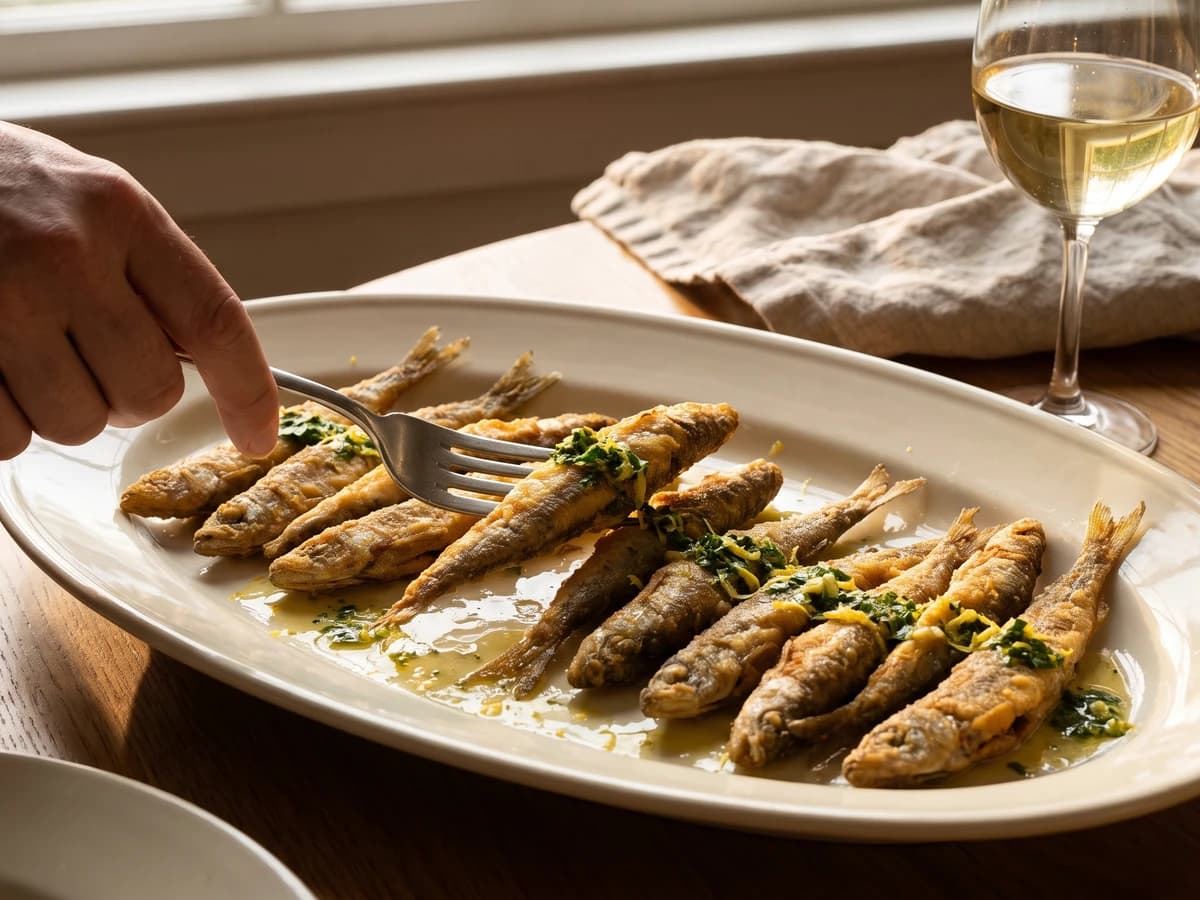
Éperlans à l’Anglaise turns small fish into a lesson in disciplined coating: boned smelts under a close, crisp crumb, pan-fried in clarified butter and finished with bright, half-melted maître d’hôtel butter.

Chef Juliette
Tiny smelts, shallot, mushrooms, white wine, gratin sauce, and fine bread raspings meet a fierce oven, where the fish must turn tender in the same breath the buttered crust bronzes.