
Chef Juliette
John Dory (St. Pierre)
John Dory has the delicacy of sole and the firmness of turbot. A light flouring, a quick butter sauté, and nut-brown beurre noisette show exactly why looks never mattered.
A cooking platform built around craft, culture, and the stories behind what we eat.

Created by Chef Juliette
Based on No. 929, Turbotin Commodore, from Le Guide Culinaire (1907) by Auguste Escoffier
Whole young turbot, gently poached and circled with five precise garnishes, served with sauce Normande sharpened by anchovy butter: a celebration dish whose grandeur comes from timing.
Turbotin Commodore (whole young turbot with its five-part garnish) teaches orchestration. Every element is manageable alone, but the dish lives or dies by whether the turbot, potatoes, crayfish, quenelles, croquettes, oysters, and sauce arrive together. The one true thing to know before touching a pan is this: prepare everything before the fish begins to poach.
The original service assumed a poissonnier at the turbot kettle, a saucier with fish stock never off the fire, another pair of hands at the frying pan, and a salamander ready for dishes that needed its fierce top heat. This one does not, so we won't invent a gratin. At home, an oval roasting pan becomes the fish kettle, a heavy saucepan becomes the frying station, and one fish velouté foundation divides into three distinct finishes. Separate saucepots and formal crayfish trussing were brigade scaffolding; the salted-water poach, five garnishes per person, oyster à la Villeroy, and sauce Normande finished with anchovy butter are the dish, and they stay.
Four naturally curled cooked crayfish replace the banquet trussing, and the garnish is scaled exactly to four diners: three potato balls, one crayfish, one fish quenelle, one lobster croquette, and one Villeroy oyster each. Once the breaded garnishes are chilled, the velouté is divided, and the potatoes are cut, the final service becomes one cook, one stove, one evening. Don't lower the turbot into its water before you reach that point.
Turbotin Commodore belongs to the grand-kitchen repertoire practiced in Paris, where a named garnish functioned as precise culinary vocabulary; in this formula, Commodore means crayfish, fish quenelle, lobster croquette, oyster Villeroy, and potatoes à l'anglaise surrounding a small whole turbot. Turbotin means a young, table-sized turbot, while the old market term chicken-turbot describes its size and tenderness, not poultry. Sauce Normande carries Normandy's marine larder of fish stock, mushrooms, oysters, cream, and butter into the composition, but the crowded Commodore arrangement belongs to ceremonial dining rather than the Norman household table.
Quantity
1 whole, 3 to 3½ pounds (1.35 to 1.6 kg)
gutted, with gills removed and fins trimmed
Quantity
3 quarts (2.8 L / 2.8 kg)
or enough to cover the fish by ½ inch
Quantity
2 quarts (1.9 L / 1.9 kg)
Quantity
3 tablespoons (45 ml / 54 g)
divided
Quantity
2 medium (about 12 ounces / 340 g)
peeled
Quantity
4 medium (about 10 ounces / 280 g total)
shells intact and tails naturally curled
Quantity
¾ cup diced (4 ounces / 115 g)
kept very cold
Quantity
1
Quantity
¼ cup (60 ml / 60 g)
very cold
Quantity
¼ teaspoon (1.25 ml / 1.5 g)
Quantity
to taste
Quantity
4 (about 4 ounces / 115 g shucked)
liquor reserved
Quantity
3 cups (720 ml / 720 g)
Quantity
½ cup (120 ml / 120 g)
Quantity
1½ cups sliced (4 ounces / 115 g)
Quantity
4 tablespoons (60 ml / 56 g)
Quantity
⅓ cup (80 ml / 40 g)
Quantity
¾ cup finely chopped (4 ounces / 115 g)
Quantity
¾ cup (180 ml / 180 g)
divided
Quantity
3
divided
Quantity
2 tablespoons (30 ml / 28 g)
diced
Quantity
2 tablespoons (30 ml / 28 g)
Quantity
4 fillets (about ½ ounce / 14 g)
drained and mashed
Quantity
½ cup (120 ml / 60 g)
Quantity
2
Quantity
1 tablespoon (15 ml / 15 g)
Quantity
1½ cups (360 ml / 150 g)
Quantity
4 cups (960 ml / 880 g)
Quantity
to taste
| Ingredient | Quantity |
|---|---|
| whole young turbotgutted, with gills removed and fins trimmed | 1 whole, 3 to 3½ pounds (1.35 to 1.6 kg) |
| water for the turbotor enough to cover the fish by ½ inch | 3 quarts (2.8 L / 2.8 kg) |
| water for the garnishes | 2 quarts (1.9 L / 1.9 kg) |
| fine sea salt for the poaching watersdivided | 3 tablespoons (45 ml / 54 g) |
| waxy potatoespeeled | 2 medium (about 12 ounces / 340 g) |
| whole cooked crayfishshells intact and tails naturally curled | 4 medium (about 10 ounces / 280 g total) |
| firm skinless white fishkept very cold | ¾ cup diced (4 ounces / 115 g) |
| large egg white | 1 |
| heavy cream for the fish quenellesvery cold | ¼ cup (60 ml / 60 g) |
| fine sea salt for the fish quenelles | ¼ teaspoon (1.25 ml / 1.5 g) |
| ground white pepper | to taste |
| large oystersliquor reserved | 4 (about 4 ounces / 115 g shucked) |
| unsalted fish stock | 3 cups (720 ml / 720 g) |
| dry white wine | ½ cup (120 ml / 120 g) |
| button mushrooms | 1½ cups sliced (4 ounces / 115 g) |
| unsalted butter for the roux | 4 tablespoons (60 ml / 56 g) |
| all-purpose flour for the roux | ⅓ cup (80 ml / 40 g) |
| cooked lobster meat | ¾ cup finely chopped (4 ounces / 115 g) |
| heavy cream for the saucesdivided | ¾ cup (180 ml / 180 g) |
| large egg yolksdivided | 3 |
| cold unsalted butter for sauce Normandediced | 2 tablespoons (30 ml / 28 g) |
| softened unsalted butter for anchovy butter | 2 tablespoons (30 ml / 28 g) |
| oil-packed anchovy filletsdrained and mashed | 4 fillets (about ½ ounce / 14 g) |
| all-purpose flour for breading | ½ cup (120 ml / 60 g) |
| large eggs for breading | 2 |
| water for breading | 1 tablespoon (15 ml / 15 g) |
| fine dry breadcrumbs | 1½ cups (360 ml / 150 g) |
| neutral frying oil | 4 cups (960 ml / 880 g) |
| fine sea salt | to taste |
Mash the softened butter and anchovies into a smooth anchovy butter, then keep it cold. Put the oysters in a small saucepan with 2 tablespoons (30 ml) each of the wine and fish stock. Bring the liquid just to a tremble and cook for 30 to 45 seconds, until the oyster edges tighten; lift them out, blot them dry, and chill them. Add their cooking liquid and reserved liquor to the remaining stock and wine with the mushrooms. Boil until reduced to 2 cups (480 ml), then strain. Melt the 4 tablespoons butter without browning, stir in the ⅓ cup flour, and cook this roux for 2 minutes. Whisk in the hot reduction gradually and simmer for 6 to 8 minutes, until the velouté coats a spoon. If it catches a few lumps, strain it while hot. Ça se rattrape. Reserve ⅓ cup (80 ml) for the croquettes, ½ cup (120 ml) for the Villeroy oysters, and the remainder for sauce Normande.
Mix the chopped lobster with the reserved ⅓ cup velouté and a touch of white pepper. Spread the mixture on a cold plate and refrigerate for 20 to 30 minutes, until firm enough to handle. Divide it into four portions and shape each into a small oval croquette. If the mixture clings to your fingers, chill it longer rather than packing it with breadcrumbs; cold gives structure without dulling the lobster.
Warm the reserved ½ cup velouté over gentle heat. Whisk 1 egg yolk with 2 tablespoons (30 ml) of the sauce cream, temper it with a spoonful of hot velouté, then whisk it into the pan. Stir over low heat until the Villeroy coating is thick enough to leave the pan floor visible for a moment behind the spoon. Coat each chilled oyster completely and place it on parchment. If the coating slides away, reduce it for another minute, cool it slightly, and coat again. Chill until firm.
Process the cold white fish with the egg white, ¼ teaspoon salt, and a little white pepper until sticky and smooth. With the machine running, add the ¼ cup cold cream in a thin stream. Scrape the mixture into a bowl set over ice and chill for 10 minutes, then shape four small quenelles between two wet teaspoons. If the mixture turns loose or looks oily, stop and chill it thoroughly before pulsing again. Warmth is the culprit, and cold is the rescue.
Set the ½ cup flour, the 2 eggs beaten with 1 tablespoon water, and the breadcrumbs in three shallow dishes. Coat the four lobster croquettes and four Villeroy oysters first in flour, then egg, then breadcrumbs, pressing gently so no bare patches remain. Place them on a parchment-lined tray and chill for at least 20 minutes. This rest fixes the coating to the soft centres, so the frying fat browns the outside instead of finding a seam and emptying the garnish.
Cut twelve hazelnut-sized balls from the potatoes with a small melon baller and keep them in cold water. Rinse the turbot inside and out, then set it white-side down in an oval roasting pan or fish kettle. Add 3 quarts water, or enough to cover it by ½ inch, and 2 tablespoons (36 g) of the poaching salt. At this point every garnish should be shaped, breaded, and cold, with the sauce portions waiting. Only now does the fish meet the heat.
Warm the turbot gradually until the water reaches 170 to 175°F (77 to 80°C), then hold it there without boiling. If the roasting pan cannot sit safely over two low burners, cover it and transfer it to a 300°F (150°C) oven once hot water has been added. Poach for 18 to 25 minutes, depending on thickness, until the flesh beside the backbone is opaque, releases cleanly from the cartilage, and reaches about 140°F (60°C); carryover heat will finish it. If the water begins to boil, lower the heat and add a cup of cold water at the edge. A quiet poach keeps the flesh in broad, moist flakes.
While the turbot poaches, bring the remaining 2 quarts water and 1 tablespoon salt to a bare simmer. Cook the potato balls à l'anglaise, plainly in salted water, for 7 to 9 minutes until a knife enters cleanly but the balls still hold their shape. Lift them out and keep them covered. Poach the quenelles in the same barely trembling water for about 6 minutes, turning once, until they feel lightly springy. Lift them out, then warm the cooked crayfish for 2 minutes. Keep every garnish covered and warm, never boiling.
Warm the reserved velouté with ½ cup (120 ml) of the remaining sauce cream and simmer gently for 3 minutes. Whisk the last 2 egg yolks with the final 2 tablespoons (30 ml) cream, temper them with hot sauce, and return everything to the pan. Stir over very low heat until sauce Normande naps the back of a spoon, but never let it boil. Off the heat, whisk in the cold diced butter and then the anchovy butter. Taste before adding salt. If the sauce splits, put 1 tablespoon cold water in a clean bowl and whisk in the broken sauce a spoonful at a time. Ça se rattrape. Hold it over warm water.
Heat the oil in a deep, heavy saucepan to 350°F (175°C). Fry the lobster croquettes first, turning them until evenly golden, about 2 minutes, then drain on a rack and season lightly. Fry the Villeroy oysters for 60 to 90 seconds, just until their coating is crisp and bronze. Keep the oil near 350°F between batches; cooler oil soaks into the crumbs, while excessive heat colours them before the centres are warm.
Lift the turbot carefully with two broad spatulas, let it drain for a minute, and settle it on a warmed oval platter. Surround it with four repeating arrangements, each holding three potato balls, one crayfish, one quenelle, one lobster croquette, and one oyster Villeroy, alternating pale poached pieces with the bronze fried garnishes and coral shells. Bring sauce Normande to the table separately in a warmed sauceboat so each diner receives it at the last moment. À table!
1 serving (about 625g)
Culinary guides, cultural storytelling, and the editorial depth that makes cooking meaningful.
Discover Culinary ExplorerChef Juliette
John Dory has the delicacy of sole and the firmness of turbot. A light flouring, a quick butter sauté, and nut-brown beurre noisette show exactly why looks never mattered.

Chef Juliette
Fresh haddock proves its delicacy in the meunière pan: a fine flour crust, moist pearly flakes, and beurre noisette sharpened with lemon and parsley, ready from one skillet in half an hour.
Chef Juliette
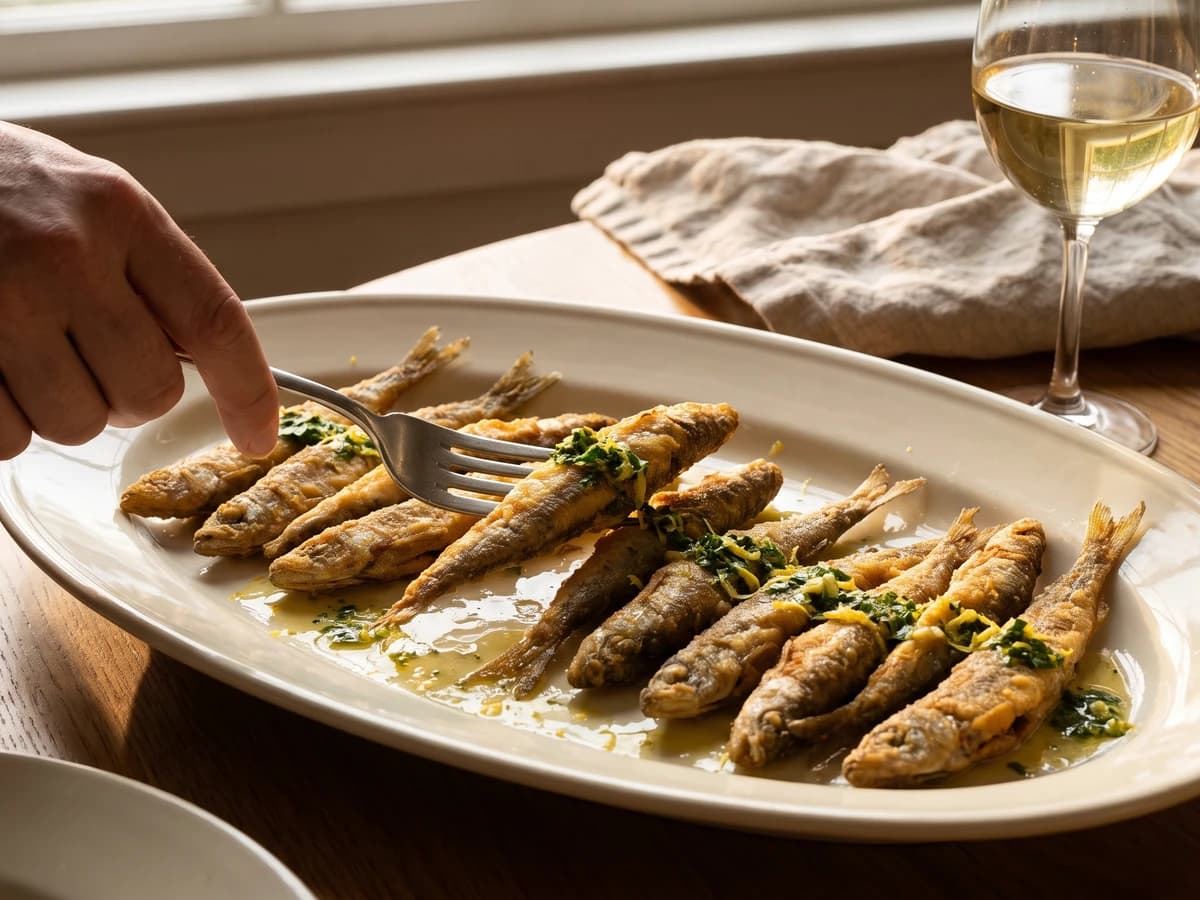
Éperlans à l’Anglaise turns small fish into a lesson in disciplined coating: boned smelts under a close, crisp crumb, pan-fried in clarified butter and finished with bright, half-melted maître d’hôtel butter.

Chef Juliette
Tiny smelts, shallot, mushrooms, white wine, gratin sauce, and fine bread raspings meet a fierce oven, where the fish must turn tender in the same breath the buttered crust bronzes.