
Chef Juliette
John Dory (St. Pierre)
John Dory has the delicacy of sole and the firmness of turbot. A light flouring, a quick butter sauté, and nut-brown beurre noisette show exactly why looks never mattered.
A cooking platform built around craft, culture, and the stories behind what we eat.

Created by Chef Juliette
Based on No. 913, Timbale de Filets de Soles Marquise, from Le Guide Culinaire (1907) by Auguste Escoffier
A hot fluted pastry shell filled at the last moment with sole, oysters, salmon quenelles, and truffle, all glossed in paprika white-wine sauce: a lesson in timing several delicate elements as one dish.
Timbale de Filets de Soles Marquise (a Marquise-style pastry timbale of sole fillets) teaches synchronization. The crust is not a casserole, and the seafood is not meant to cook inside it. Each element is cooked separately, joined under just enough paprika white-wine sauce, then put into a very hot shell and carried straight to the table. That last five minutes is the dish.
The original recipe assumed a saucier on staff, fish fumet never off the fire, a pastry section turning out a ten-person shell, and a salamander waiting to restore its heat. Here, one deep 7-inch mold, one sauté pan, one small saucepan, and the ordinary oven take those jobs. The ten-person garnish becomes five sole fillets, five oysters, ten salmon quenelles, eight truffle slices, and a scant half cup of sauce for four, with indivisible pieces rounded to the nearest whole. The brigade handoffs were scaffolding, so they go. The separate poaching, the paprika sauce, the hot empty crust, and the immediate filling are the dish, so they stay. One cook, one stove, one evening.
Make the shell first, then work backward from the moment you intend to serve. The seafood must remain tender, the sauce must only bind it, and the crust must still be crisp when the spoon breaks through. Before you touch a pan, know this one true thing: the final assembly waits for nobody.
Timbale de Filets de Soles Marquise belongs to the Parisian grand kitchen, where raised pastry cases inherited from pie-making became edible vessels for finely assembled hot garnishes. Its sole, oysters, salmon quenelles, truffle, and paprika-scented sauce were cooked separately because the classical method protected each texture rather than baking delicate seafood inside the crust. Marquise is a codified garnish title, not proof of origin in a marquise's household; the lasting principle is the very hot shell filled only at the moment of service.
Quantity
2 cups (475 ml / 250 g)
Quantity
10 tablespoons (150 ml / 140 g)
cubed
Quantity
1 tablespoon (15 ml / 14 g)
Quantity
1
Quantity
1
separated, yolk for the pastry and white for the salmon quenelles
Quantity
2 to 3 tablespoons (30 to 45 ml / 30 to 45 g)
Quantity
1¼ teaspoons (6 ml / 7 g)
divided
Quantity
¼ teaspoon (1.25 ml / 0.5 g)
divided
Quantity
½ cup diced (120 ml / 115 g)
thoroughly chilled
Quantity
¼ cup (60 ml / 60 g)
thoroughly chilled and divided
Quantity
5 (about 1 pound / 450 g total)
trimmed
Quantity
2 cups (475 ml / 475 g)
preferably unsalted
Quantity
5 (about 4½ ounces / 125 g)
shucked with their liquor reserved
Quantity
¼ cup (60 ml / 60 g)
Quantity
1½ tablespoons (22 ml / 12 g)
Quantity
2 tablespoons (30 ml / 28 g)
divided
Quantity
½ teaspoon (2.5 ml / 1 g)
Quantity
8 thin slices (about ½ ounce / 15 g)
cut from 1 small preserved or fresh truffle
| Ingredient | Quantity |
|---|---|
| all-purpose flour, for the timbale crust | 2 cups (475 ml / 250 g) |
| cold unsalted butter, for the timbale crustcubed | 10 tablespoons (150 ml / 140 g) |
| softened unsalted butter, for the mold | 1 tablespoon (15 ml / 14 g) |
| large egg | 1 |
| large eggseparated, yolk for the pastry and white for the salmon quenelles | 1 |
| ice water | 2 to 3 tablespoons (30 to 45 ml / 30 to 45 g) |
| fine sea saltdivided | 1¼ teaspoons (6 ml / 7 g) |
| ground white pepperdivided | ¼ teaspoon (1.25 ml / 0.5 g) |
| skinless, boneless salmonthoroughly chilled | ½ cup diced (120 ml / 115 g) |
| heavy creamthoroughly chilled and divided | ¼ cup (60 ml / 60 g) |
| small skinless sole filletstrimmed | 5 (about 1 pound / 450 g total) |
| fish fumet (concentrated fish essence)preferably unsalted | 2 cups (475 ml / 475 g) |
| large oystersshucked with their liquor reserved | 5 (about 4½ ounces / 125 g) |
| dry white wine | ¼ cup (60 ml / 60 g) |
| all-purpose flour, for the sauce roux | 1½ tablespoons (22 ml / 12 g) |
| unsalted butter, for the saucedivided | 2 tablespoons (30 ml / 28 g) |
| sweet paprika | ½ teaspoon (2.5 ml / 1 g) |
| black trufflecut from 1 small preserved or fresh truffle | 8 thin slices (about ½ ounce / 15 g) |
Make the pâte à timbale, the sturdy pastry that must stand without its mold. Mix the 2 cups flour with ½ teaspoon salt, then cut in the cold butter until the largest pieces are the size of peas. Beat the whole egg with the reserved yolk and 2 tablespoons ice water, pour this over the flour, and toss until the dough gathers when squeezed. If dry crumbs remain, add the last tablespoon of water one teaspoon at a time. Do not knead harder to force a dry dough together. Ça se rattrape with water, not punishment. Press into a thick disc, wrap, and chill for 45 minutes.
Butter a deep 7-inch fluted timbale, brioche, or charlotte mold thoroughly. Roll the dough about 3/16 inch thick and large enough to cover the bottom and sides with a little overhang. Lower it into the mold without stretching, press it firmly into every flute, and trim the rim level. Patch any tear with a thin scrap of dough pressed over the gap. Do not dock the base, since the finished shell must hold sauce. Line the pastry with parchment or heavy foil, fill it completely to the rim with baking weights or dry rice, and chill for 20 minutes.
Heat the oven to 400°F (200°C). Bake the weighted shell for 22 to 25 minutes, until the exposed rim is set and pale gold. Lift out the weights and lining, reduce the oven to 375°F (190°C), and bake for another 12 to 15 minutes, until the interior is dry, deep butter-gold, and rigid. If removing the weights reveals a crack, press a scrap of raw dough over it while the shell is warm and return it to the oven. Let the shell stand for 5 minutes, then unmold it carefully onto a baking sheet. Once cool, hold it uncovered so it stays crisp.
Chill the food processor bowl and blade. Pulse the cold salmon with ¼ teaspoon salt and a small pinch of white pepper until it becomes smooth and tacky. Add the reserved egg white and pulse only until absorbed. With the machine running briefly, trickle in 2 tablespoons of the cold cream to make a glossy mousseline, a chilled cream-enriched forcemeat. Stop as soon as it is smooth. If cream begins pooling instead of disappearing, the mixture is warming; chill the bowl for 15 minutes, stir gently, and continue only when cold. Refrigerate the mousseline for 20 minutes.
Pour 1½ cups of the fish fumet into a wide sauté pan and reserve the rest. Bring it to the barest tremble. Using two wet teaspoons, shape one test quenelle and lower it into the fumet. Poach for about 4 minutes, turning once. It should swell slightly, hold a neat oval, and feel gently springy. If it frays, lower the heat and chill the mousseline again before continuing. Shape and poach 10 small quenelles in batches, never letting the fumet boil. Lift them out with a slotted spoon and keep them covered.
Strain the fumet back into the sauté pan. Season the sole lightly with ¼ teaspoon salt and another small pinch of white pepper. Roll each fillet from the narrow tail toward the thicker end, or fold very thin fillets neatly into three. Arrange them seam-side down in the pan. The fumet should come about halfway up their sides, so add some of the reserved fumet if necessary. Cover with a parchment round and poach at a bare tremble for 6 to 8 minutes, until the fillets are opaque but still flexible. Lift them out carefully and cover.
Pass the oyster liquor through a fine sieve into a small pan so no shell follows it. Bring the liquor to a bare simmer, add the oysters, and poach for 45 to 60 seconds, until they plump and their fringes begin to curl. Lift them out immediately. When cool enough to handle, trim away only any coarse dark fringe or fibrous beard, leaving each oyster whole. Strain the poaching liquor into the fish fumet, tasting first because oyster liquor can be salty.
Reduce the white wine in a small saucepan until 2 tablespoons remain, then pour it into a cup. In the same pan, melt 1 tablespoon of the sauce butter, stir in the 1½ tablespoons flour, and cook this pale roux for 90 seconds without letting it color. Gradually whisk in ½ cup strained poaching fumet and the reduced wine. Simmer gently for 8 minutes, whisking often, then add the remaining 2 tablespoons cream and the paprika. Reduce until the sauce nappes, coats the back of a spoon, and measures a scant ½ cup. Take it off the heat and whisk in the final tablespoon of butter. If it tightens too far, loosen it with fumet by the teaspoon. If butter streaks appear, whisk in a teaspoon of cold fumet away from the heat. Taste before adding the remaining salt and pepper.
About 10 minutes before serving, return the empty pastry shell to a 375°F (190°C) oven. Meanwhile, arrange the sole, quenelles, oysters, and truffle slices in the clean sauté pan. Add 2 teaspoons of fumet, cover, and warm over the lowest heat for 2 to 3 minutes, turning the pieces with a spoon rather than shaking the pan. Spoon in the hot paprika white-wine sauce and fold it through just until every piece gleams. Do not boil. If the sauce tightens while the garnish warms, add another teaspoon of fumet.
Set the very hot pastry shell on a warmed platter lined with a folded napkin. Spoon in the bound garnish at once, distributing the sole, oysters, quenelles, and truffle so each serving receives some of everything. Bring it straight to the table while the crust is crisp and the sauce still glistens. No waiting, no elaborate decoration. À table!
1 serving (about 340g)
Culinary guides, cultural storytelling, and the editorial depth that makes cooking meaningful.
Discover Culinary ExplorerChef Juliette
John Dory has the delicacy of sole and the firmness of turbot. A light flouring, a quick butter sauté, and nut-brown beurre noisette show exactly why looks never mattered.

Chef Juliette
Fresh haddock proves its delicacy in the meunière pan: a fine flour crust, moist pearly flakes, and beurre noisette sharpened with lemon and parsley, ready from one skillet in half an hour.
Chef Juliette
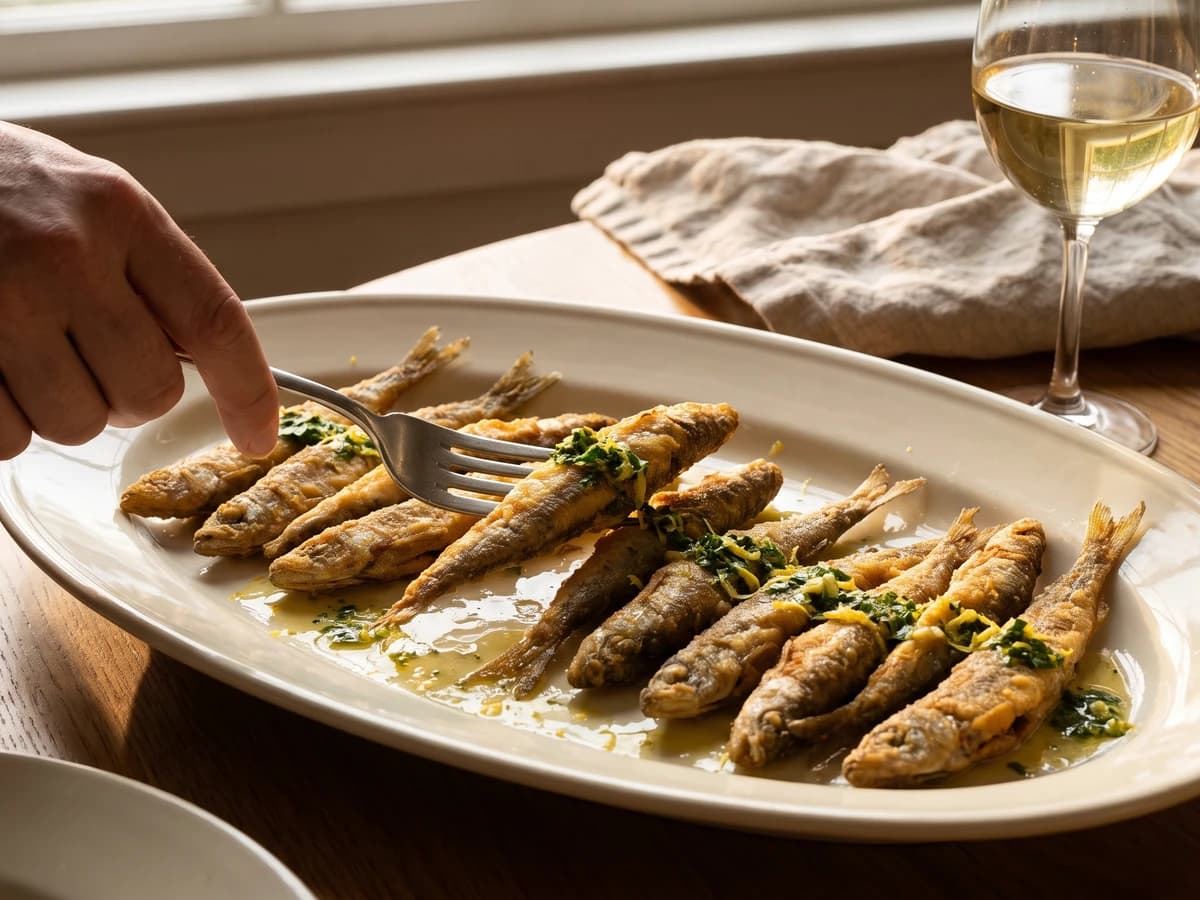
Éperlans à l’Anglaise turns small fish into a lesson in disciplined coating: boned smelts under a close, crisp crumb, pan-fried in clarified butter and finished with bright, half-melted maître d’hôtel butter.

Chef Juliette
Tiny smelts, shallot, mushrooms, white wine, gratin sauce, and fine bread raspings meet a fierce oven, where the fish must turn tender in the same breath the buttered crust bronzes.