
Chef Juliette
John Dory (St. Pierre)
John Dory has the delicacy of sole and the firmness of turbot. A light flouring, a quick butter sauté, and nut-brown beurre noisette show exactly why looks never mattered.
A cooking platform built around craft, culture, and the stories behind what we eat.
Created by Chef Juliette
Based on No. 903, Filets de Soles Véronique, from Le Guide Culinaire (1907) by Auguste Escoffier
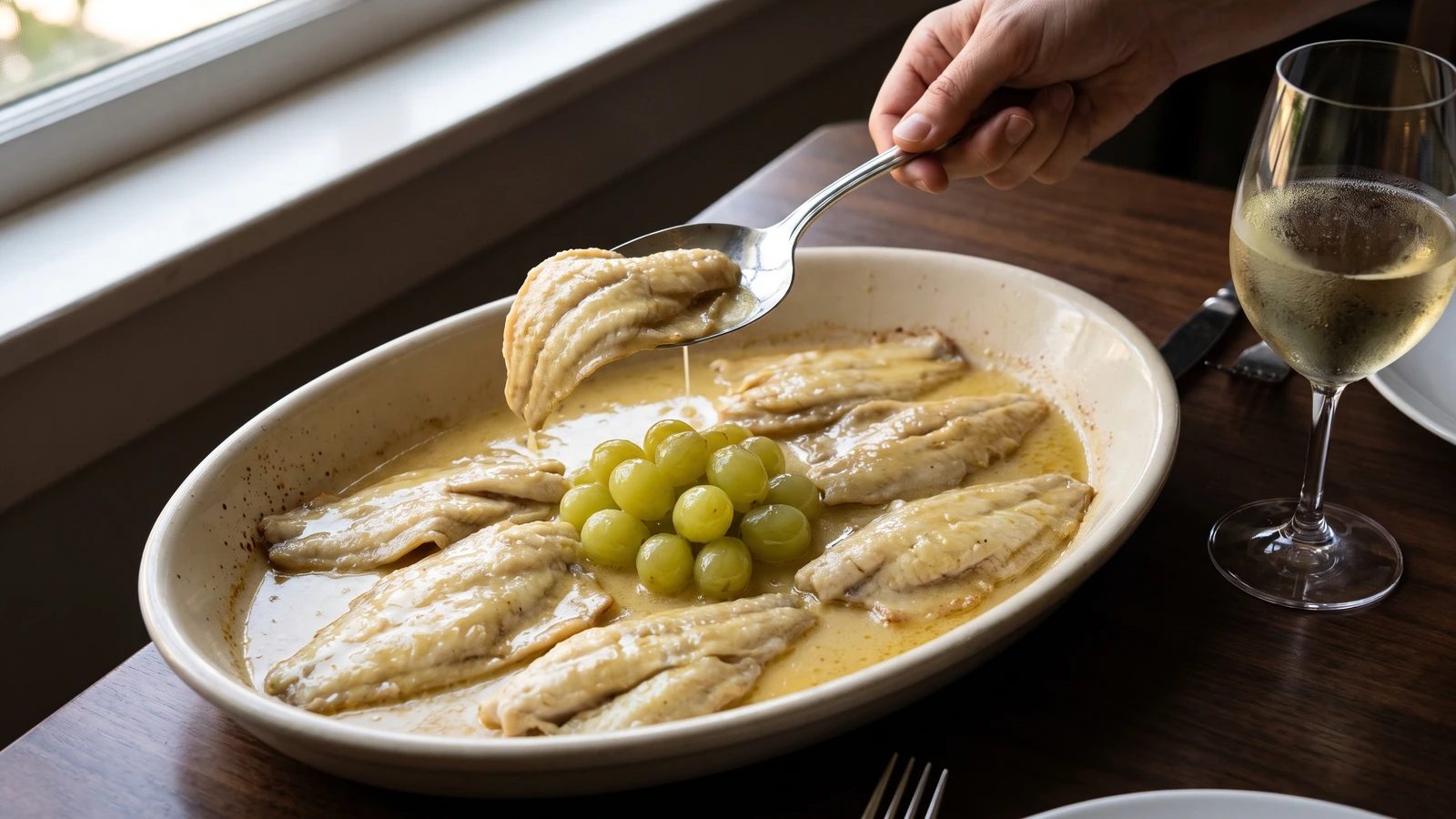
Delicate sole, its bones turned into fumet, its poaching liquor reduced to syrup and mounted with butter, then glazed bright beneath a crown of cold peeled grapes.
Filets de Soles Véronique (sole fillets with cold grapes) teaches the discipline of reduction. Its fumet, a quick fish essence drawn from the sole's own bones, must be reduced until each spoonful carries the whole fish, then mounted with butter without becoming greasy or harsh. Beneath that glossy glaze, the folded fillets stay tender; the peeled grapes arrive very cold, sweet and firm against the warm sauce.
The original formula assumes a fish cook to raise the fillets, a saucier on staff, a stock never off the fire, a special earthenware dish, and a salamander waiting to glaze the sauce. Here the standing stockpot can go because the entry makes its fumet directly from the sole's bones. A fishmonger, a small saucepan, a shallow ovenproof dish, and a fierce household broiler do the rest. For four diners, two whole soles replace the brigade platter. The covered journey from kitchen to dining room is scaffolding too; your table is only a few steps away. What stays is the dish itself: the bones, the syrupy reduction, real butter, quick glazing, and cold peeled grapes.
Keep the seasoning restrained until the fumet has reduced, because reduction magnifies salt as faithfully as flavor. If the sauce tightens or separates, don't pour it out. Ça se rattrape, and the method gives you the way back. Watch the saucepan closely during its final spoonfuls; that reduction is the step that decides the Véronique.
Filets de Soles Véronique belongs to the Parisian grand-kitchen table, where delicate sole and concentrated fish essence met the dining room's taste for fruit used in a savory preparation. The name is generally linked to the Parisian opéra comique Véronique, although the exact naming of the dish remains disputed. Unlike later versions enriched with cream or warmed grapes, this classical formula glazes the fish with buttered fumet and places the peeled grapes cold at the center.
Quantity
2, each 1¼ to 1½ pounds (570 to 680 g)
skinned and filleted, with bones and clean trimmings reserved
Quantity
1¼ cups (300 ml / 200 g)
seedless
Quantity
4 tablespoons (60 ml / 56 g)
divided: 1 tablespoon softened and 3 tablespoons very cold and diced
Quantity
2 tablespoons (30 ml / 20 g)
finely minced
Quantity
6
Quantity
½ cup (120 ml / 120 g)
Quantity
½ cup (120 ml / 120 g)
Quantity
½ teaspoon (2.5 ml / 2.5 g)
Quantity
¾ teaspoon (3.75 ml / 4.5 g)
divided
Quantity
¼ teaspoon (1.25 ml / 0.5 g)
finely ground
| Ingredient | Quantity |
|---|---|
| whole Dover solesskinned and filleted, with bones and clean trimmings reserved | 2, each 1¼ to 1½ pounds (570 to 680 g) |
| small pale Muscadel grapesseedless | 1¼ cups (300 ml / 200 g) |
| unsalted butterdivided: 1 tablespoon softened and 3 tablespoons very cold and diced | 4 tablespoons (60 ml / 56 g) |
| yellow onionfinely minced | 2 tablespoons (30 ml / 20 g) |
| flat-leaf parsley stalks | 6 |
| dry white wine | ½ cup (120 ml / 120 g) |
| cold water | ½ cup (120 ml / 120 g) |
| fresh lemon juice | ½ teaspoon (2.5 ml / 2.5 g) |
| fine sea saltdivided | ¾ teaspoon (3.75 ml / 4.5 g) |
| white pepperfinely ground | ¼ teaspoon (1.25 ml / 0.5 g) |
Bring a small pan of water to a boil and prepare a bowl of very cold water. Lower the grapes into the boiling water six or eight at a time for 6 to 8 seconds, then transfer them immediately to the cold water. Slip off each skin from the stem end without crushing the flesh. If a skin clings, give that grape another 2 seconds in the boiling water; longer cooking softens the fruit. Dry the peeled grapes thoroughly, cover, and refrigerate for at least 30 minutes. They must be cold when they meet the warm fish.
Rinse the sole bones and clean trimmings briefly under cold water, then cut the frames into pieces that fit snugly in a 1½-quart (1.4 L) saucepan. Add the minced onion, parsley stalks, white wine, cold water, and lemon juice. Bring slowly to the gentlest simmer, skim away any grey foam, and cook uncovered for 15 minutes. The surface should barely tremble. A hard or prolonged boil clouds the fumet and draws a chalky bitterness from the bones. Strain it through a fine-mesh sieve without pressing the solids; you should have about ¾ to 1 cup (180 to 240 ml) of clear, fragrant fumet.
Heat the oven to 350°F (180°C). Lay the eight fillets on a board and lightly flatten only their thickest ends between two sheets of parchment, bringing the flesh to an even thickness without pounding it thin. Season both sides with about ½ teaspoon of the salt and all the white pepper. Fold each fillet in half with its narrow tail tucked inside, making eight neat packets. Coat a shallow oval ovenproof dish with the softened tablespoon of butter and arrange the fillets in a single layer.
Pour the hot fumet around and over the folded fillets. Press a sheet of parchment directly onto the surface to hold moisture close to the fish, then place the dish in the oven. Poach for 7 to 10 minutes, until the fumet barely moves at the edge and the flesh has turned opaque but remains pearly and yielding. An instant-read thermometer inserted into the thickest fold should register about 140°F (60°C); the final glazing will carry it to 145°F (63°C). Hold the fillets in place with a wide fish spatula and carefully pour the poaching liquor through the fine sieve into the clean saucepan. Transfer the fish to a warm plate and cover it loosely with the parchment.
Bring the strained poaching liquor to a brisk boil and reduce it to about 2 tablespoons (30 ml). Near the end, the bubbles will become small and glossy, and the fumet will coat the base of the pan like a light syrup. Taste before adding more salt. If it has gone slightly too far but does not smell scorched, add a teaspoon of cold water and bring it back to the syrup stage. Remove the pan from the heat. Monter au beurre, mounting with butter, by whisking in the three tablespoons of very cold diced butter one piece at a time. Add each piece only after the last has disappeared. The sauce should become smooth, pale gold, and glossy. If oily beads appear, stop. Put a teaspoon of cold water in a clean bowl, whisk in one spoonful of the broken sauce until smooth, then incorporate the remainder gradually. Ça se rattrape.
Set the broiler to high and position a rack about 6 inches (15 cm) below it. Return the fillets to their original dish, arranging them in an oval with an open center. Spoon the buttered fumet evenly over them. Place the dish beneath the broiler for 20 to 45 seconds, just until the glaze shines and shows a few fine bubbles at the rim. This household broiler replaces the salamander, and its work is glazing, not cooking the sole a second time. Watch without turning away. If the sauce separates, lift the fillets to the warm plate, whisk the sauce off the heat with a teaspoon of cold water, coat the fish again, and skip a second broiling.
Pile the cold peeled grapes in a compact pyramid at the center of the oval, keeping them out of the hot sauce as much as possible. The source sends the dish under a cover because it had a dining room to cross. At home that cover is service scaffolding, and trapping the grapes under foil only warms them. Carry the dish straight from broiler to table and serve immediately. À table!
1 serving (about 185g)
Culinary guides, cultural storytelling, and the editorial depth that makes cooking meaningful.
Discover Culinary ExplorerChef Juliette
John Dory has the delicacy of sole and the firmness of turbot. A light flouring, a quick butter sauté, and nut-brown beurre noisette show exactly why looks never mattered.

Chef Juliette
Fresh haddock proves its delicacy in the meunière pan: a fine flour crust, moist pearly flakes, and beurre noisette sharpened with lemon and parsley, ready from one skillet in half an hour.
Chef Juliette
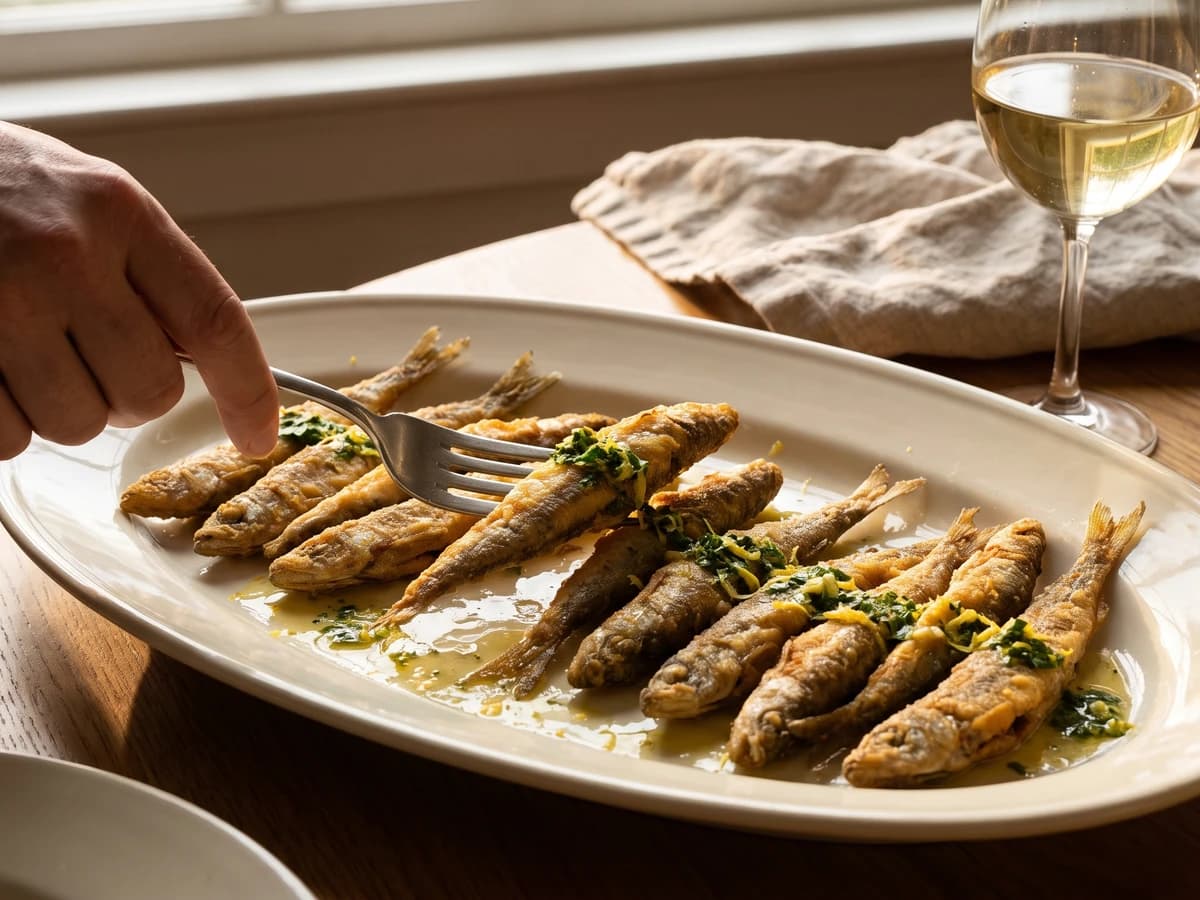
Éperlans à l’Anglaise turns small fish into a lesson in disciplined coating: boned smelts under a close, crisp crumb, pan-fried in clarified butter and finished with bright, half-melted maître d’hôtel butter.

Chef Juliette
Tiny smelts, shallot, mushrooms, white wine, gratin sauce, and fine bread raspings meet a fierce oven, where the fish must turn tender in the same breath the buttered crust bronzes.