
Chef Juliette
John Dory (St. Pierre)
John Dory has the delicacy of sole and the firmness of turbot. A light flouring, a quick butter sauté, and nut-brown beurre noisette show exactly why looks never mattered.
A cooking platform built around craft, culture, and the stories behind what we eat.

Created by Chef Juliette
Based on No. 900, Filets de Soles Vénitienne, from Le Guide Culinaire (1907) by Auguste Escoffier
Folded sole, concentrated fumet, green herb butter, and crisp heart croutons: Filets de Soles Vénitienne teaches the quiet discipline of poaching gently, reducing honestly, and finishing a sauce without losing its freshness.
Filets de Soles Vénitienne (folded sole fillets with green-herb sauce) teaches a small but essential piece of sauce grammar: the liquid that cooks the fish must come back to season the sauce. Pour it away and the two parts merely share a plate; reduce it properly and the sauce tastes unmistakably of sole. C'est la même grammaire: poach gently, concentrate honestly, finish away from the heat.
The classical entry assumed a saucier holding sauce Vénitienne, a stockpot of fumet (concentrated fish essence) never off the fire, and spare hands to cut heart croutons while the fish cooked. Here, two cups of fumet become both poaching bath and reduction, a small roux blanc gives the sauce its body, and a mini processor replaces the mortar-and-sieve work of beurre vert. A salamander contributes nothing here; the croutons take their gold in a skillet. The brigade's separate pots and broad quantities were scaffolding, so they go. The folded fillets, reduced liquor, herb-green butter, and heart croutons are the dish, so they stay. One cook, one stove, one evening.
At the table, the ivory packets form a circle with butter-gold hearts between them, all caught by a glossy green sauce smelling of chervil and tarragon. The one step that decides the dish is the reduction: bring the poaching liquor to full flavor before the beurre vert enters, then never boil the sauce again.
Filets de Soles Vénitienne belongs to the formal Parisian classical table, where folded sole fillets were arranged in ordered patterns and sauces were named for places, colors, or their finishing garnish. Despite its title, this is not a Venetian regional fish preparation: in French sauce grammar, Vénitienne denotes a pale fish sauce refreshed and colored with green herbs, especially chervil and tarragon. The alternating butter-fried heart croutons come from grand service practice, but their purpose is practical as well as decorative, giving the tender fish a crisp companion and something to catch the reduced fumet.
Quantity
8 fillets (about 1½ lb / 680 g total)
skinless; pin bones removed
Quantity
2 cups (480 ml / 480 g)
unsalted or lightly salted
Quantity
10 tablespoons (150 ml / 142 g)
divided; 3 tablespoons softened
Quantity
8 thin slices (about 5½ oz / 160 g total)
crusts removed
Quantity
1 packed cup (240 ml / 30 g)
Quantity
½ cup loosely packed (120 ml / 15 g)
Quantity
2 tablespoons loosely packed (30 ml / 4 g)
Quantity
1 tablespoon (15 ml / 2 g)
Quantity
1 small shallot (about 1 oz / 30 g)
finely minced
Quantity
¼ cup (60 ml / 60 g)
Quantity
1 tablespoon (15 ml / 15 g)
Quantity
2 tablespoons (30 ml / 16 g)
Quantity
¼ cup (60 ml / 60 g)
Quantity
2 teaspoons (10 ml / 10 g)
Quantity
1 teaspoon (5 ml / 6 g)
divided
Quantity
¼ teaspoon (1.25 ml / 0.6 g)
| Ingredient | Quantity |
|---|---|
| sole filletsskinless; pin bones removed | 8 fillets (about 1½ lb / 680 g total) |
| fish fumetunsalted or lightly salted | 2 cups (480 ml / 480 g) |
| unsalted butterdivided; 3 tablespoons softened | 10 tablespoons (150 ml / 142 g) |
| pain de miecrusts removed | 8 thin slices (about 5½ oz / 160 g total) |
| baby spinach | 1 packed cup (240 ml / 30 g) |
| flat-leaf parsley leaves | ½ cup loosely packed (120 ml / 15 g) |
| chervil leaves | 2 tablespoons loosely packed (30 ml / 4 g) |
| tarragon leaves | 1 tablespoon (15 ml / 2 g) |
| shallotfinely minced | 1 small shallot (about 1 oz / 30 g) |
| dry white wine | ¼ cup (60 ml / 60 g) |
| tarragon vinegar | 1 tablespoon (15 ml / 15 g) |
| all-purpose flour | 2 tablespoons (30 ml / 16 g) |
| heavy cream | ¼ cup (60 ml / 60 g) |
| fresh lemon juice | 2 teaspoons (10 ml / 10 g) |
| fine sea saltdivided | 1 teaspoon (5 ml / 6 g) |
| ground white pepper | ¼ teaspoon (1.25 ml / 0.6 g) |
Bring a small saucepan of water to a boil and prepare a bowl of ice water. Blanch the spinach and parsley for 15 seconds, then drain and chill them immediately. Squeeze them in a clean towel until no water remains. Chop finely, then process with the chervil, tarragon, and 3 tablespoons of softened butter until vividly green and nearly smooth. Press the beurre vert, green herb butter, through a fine sieve and refrigerate it. If the paste releases green water, squeeze it again before adding the butter; water left in the herbs weakens the final emulsion.
Cut one neat heart from each slice of pain de mie using a 5 cm / 2-inch cutter or a paper template and sharp knife. Melt 4 tablespoons of butter in a wide skillet over medium heat. When the foam subsides, fry the eight hearts in one layer until evenly butter-gold, about 60 to 90 seconds per side. Transfer them to a rack and season with a small pinch of salt. If the butter begins to darken before the bread colors, lift the pan from the heat briefly and lower the flame.
Pat the sole fillets thoroughly dry. Season both sides with about half the remaining salt and half the white pepper. Lay each fillet with its smoother presentation side down, fold the thin tail inward, then bring the broad end over it to make a compact packet of even thickness. Set each one seam-side down. Even folding matters because a loose tail cooks before the thick end and breaks when lifted.
Coat a 30 cm / 12-inch lidded sauté pan with 1 tablespoon of butter and arrange the folded fillets in one snug layer. Warm the fish fumet separately, then pour it around the fish until it reaches roughly halfway up their sides. Cover with a round of parchment and the lid. Hold the liquid at the barest tremble for 5 to 7 minutes, until the centers are opaque, resilient under light pressure, and reach 145°F / 63°C. Never let the fumet boil. If it does, slide the pan completely off the heat until the bubbling stops, then continue over a lower flame. Lift the fillets carefully to a warm plate and cover loosely with parchment.
Strain the poaching liquor into a measuring jug, then return it to the sauté pan. Boil briskly until reduced to ¾ cup (180 ml / 180 g), skimming away any pale foam, about 6 to 8 minutes. Taste as it concentrates. The reduction should be distinctly fish-scented and savory without becoming salty; if it goes too far, add a spoonful of hot water to restore the volume. This reduced liquor is the bridge between the sole and its sauce.
Simmer the shallot, wine, and tarragon vinegar in a small saucepan until only about 1 tablespoon remains. Add the reduced poaching liquor, simmer for 1 minute, then strain and keep hot. In the clean saucepan, melt 2 tablespoons of butter, stir in the flour, and cook this roux blanc, a white roux, for 90 seconds without allowing it to color. Add the hot flavored liquor gradually, whisking after each addition, then simmer gently for 3 minutes. Whisk in the cream. Before the herbs enter, the sauce must napper, coat, the back of a spoon; reduce it if thin or loosen it with a spoonful of hot water if too thick. Remove from the heat for 30 seconds, then whisk in the cold beurre vert a little at a time and finish with the lemon juice. Do not boil it again. If an oily ring appears, stop. Ça se rattrape: place 1 tablespoon of cold water in a clean saucepan and whisk in the broken sauce one spoonful at a time until smooth, keeping it away from direct heat.
Warm and dry an oval serving platter. Arrange the eight sole packets in a circle, alternating each one with a heart crouton and turning the points outward. Taste the sauce for salt and white pepper, then spoon it generously over the fillets and into the center, allowing it to pool around the bases of the croutons while leaving their upper faces crisp. Serve at once. À table!
1 serving (about 330g)
Culinary guides, cultural storytelling, and the editorial depth that makes cooking meaningful.
Discover Culinary ExplorerChef Juliette
John Dory has the delicacy of sole and the firmness of turbot. A light flouring, a quick butter sauté, and nut-brown beurre noisette show exactly why looks never mattered.

Chef Juliette
Fresh haddock proves its delicacy in the meunière pan: a fine flour crust, moist pearly flakes, and beurre noisette sharpened with lemon and parsley, ready from one skillet in half an hour.
Chef Juliette
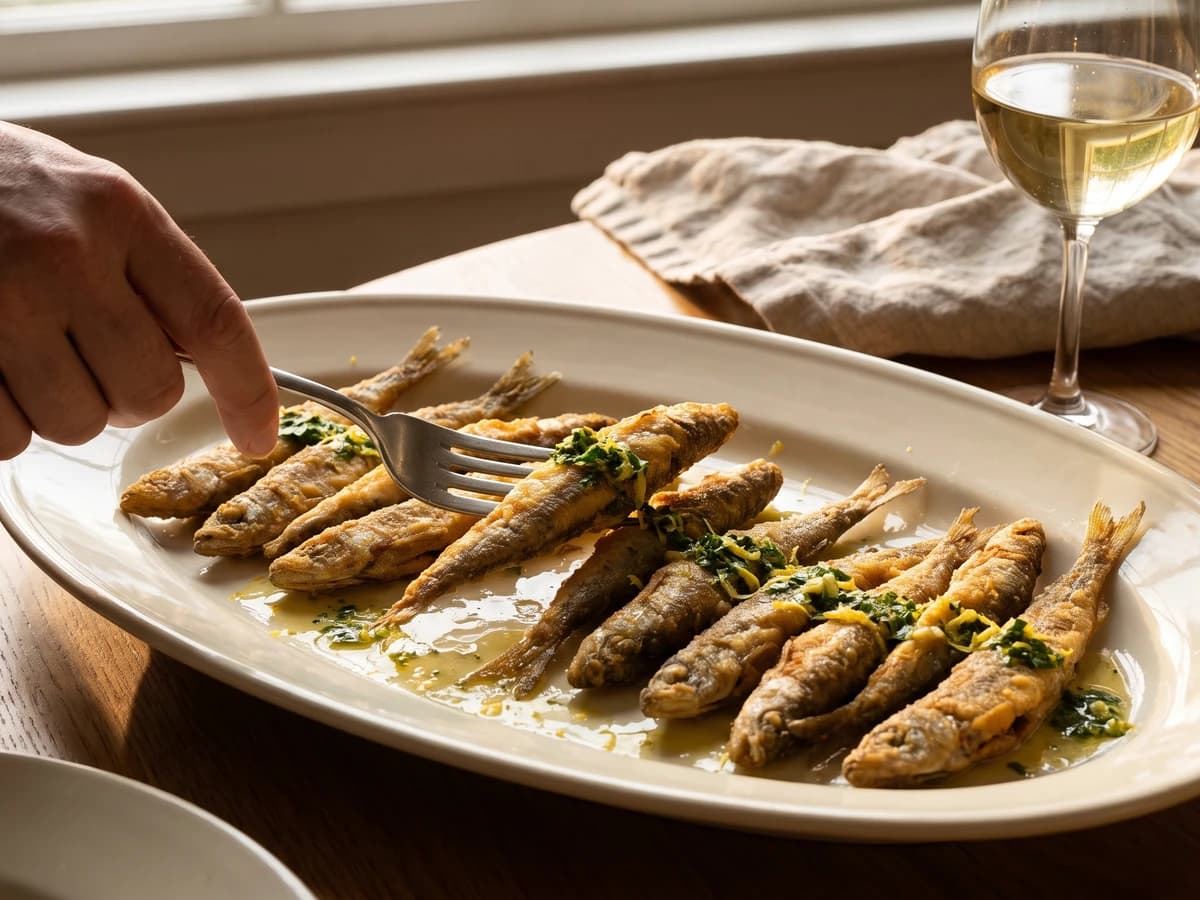
Éperlans à l’Anglaise turns small fish into a lesson in disciplined coating: boned smelts under a close, crisp crumb, pan-fried in clarified butter and finished with bright, half-melted maître d’hôtel butter.

Chef Juliette
Tiny smelts, shallot, mushrooms, white wine, gratin sauce, and fine bread raspings meet a fierce oven, where the fish must turn tender in the same breath the buttered crust bronzes.