
Chef Juliette
John Dory (St. Pierre)
John Dory has the delicacy of sole and the firmness of turbot. A light flouring, a quick butter sauté, and nut-brown beurre noisette show exactly why looks never mattered.
A cooking platform built around craft, culture, and the stories behind what we eat.
Created by Chef Juliette
Based on No. 893, Filets de Soles Orly, from Le Guide Culinaire (1907) by Auguste Escoffier
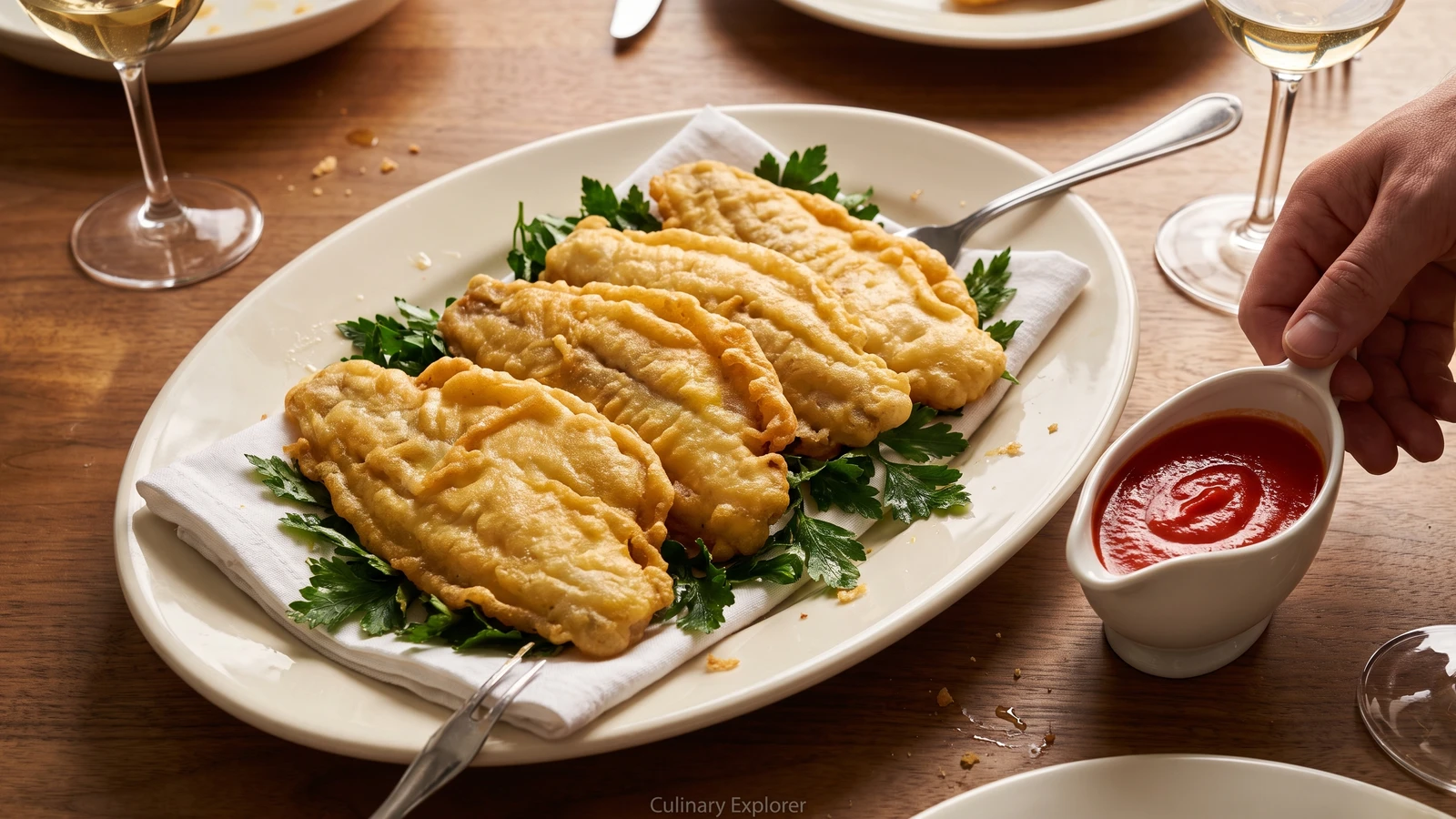
Filets de Soles Orly proves that deep-frying is controlled heat, not bravado: delicate sole inside a crisp golden batter, fried parsley beneath, and sauce tomate waiting beside it, because that sauce is essential.
Filets de Soles Orly (batter-fried sole with tomato sauce) teaches the first law of frying: hot fat must set the coating before it can absorb the oil. The fillet is delicate, but the pâte à frire (frying batter) gives it a crisp golden shell without burying it. Know this before touching the pan: the oil must reach 365°F (185°C), and it must recover between batches.
The brigade entry assumed batter waiting on the bench, a deep-fat stove, a saucier holding sauce tomate, the smooth tomato sauce built from a stockpot that never went cold, and another pair of hands to fry the parsley. A salamander belongs elsewhere in the canon; Orly is fried, not gratinéed. At home, one small saucepan makes the sauce first, one deep pot and a thermometer manage the frying, and a wire rack replaces the brigade's draining station. One cook, one stove, one evening.
The hatelet, an ornamental skewer used for one alternate presentation, is scaffolding and can go. The last-minute frying and the separate tomato sauce are the dish and must stay. When Orly is right, the parsley crackles under the fillets, the batter is dry and crisp beneath your fork, and the scarlet sauce waits beside it without softening a single edge. Guard the oil temperature; everything else follows.
In classical Parisian nomenclature, à l'Orly identifies fish fillets coated and fried, presented with fried parsley and sauce tomate served apart; the place-name is Orly, just south of Paris. The formula moved readily from grand service to bourgeois tables because the batter and sauce could wait while the fish was fried at the final moment. It is not a generic name for any fried sole: the separate tomato sauce completes the garnish and remains essential.
Quantity
8 fillets (about 1½ lb / 680 g)
pin bones removed and fish patted very dry
Quantity
2 teaspoons (10 ml / 12 g)
divided
Quantity
½ teaspoon (2.5 ml / 1 g)
divided
Quantity
1 cup (240 ml / 125 g)
Quantity
¾ cup (180 ml / 180 g)
Quantity
1
separated
Quantity
1 tablespoon (15 ml / 14 g)
Quantity
2 tablespoons (30 ml / 28 g)
Quantity
½ cup (120 ml / 80 g)
finely chopped
Quantity
⅓ cup (80 ml / 50 g)
finely chopped
Quantity
1 tablespoon (15 ml / 8 g)
Quantity
1 tablespoon (15 ml / 16 g)
Quantity
1⅔ cups (400 ml / 400 g)
crushed
Quantity
½ cup (120 ml / 120 g)
Quantity
1 clove
lightly crushed
Quantity
1 small bouquet garni
Quantity
½ teaspoon (2.5 ml / 2 g)
Quantity
2 quarts (1.9 L / 1.75 kg), or enough to fill the pot no more than one-third
Quantity
1 small bunch (about 1 oz / 30 g)
divided into sprigs and dried completely
Quantity
1 cup (240 ml / 245 g) Cooked Marinade for Venison (No. 168)
fully cooled
Quantity
¾ cup (180 ml / 180 g) Anglaise (for Egg-and-bread-crumbing) (No. 174)
Quantity
1½ cups (360 ml / 150 g)
Quantity
½ cup (120 ml / 120 g)
Quantity
½ cup (120 ml / 63 g)
| Ingredient | Quantity |
|---|---|
| skinless sole filletspin bones removed and fish patted very dry | 8 fillets (about 1½ lb / 680 g) |
| fine sea saltdivided | 2 teaspoons (10 ml / 12 g) |
| ground white pepperdivided | ½ teaspoon (2.5 ml / 1 g) |
| all-purpose flour for the pâte à frire | 1 cup (240 ml / 125 g) |
| cold sparkling water | ¾ cup (180 ml / 180 g) |
| large eggseparated | 1 |
| neutral oil for the pâte à frire | 1 tablespoon (15 ml / 14 g) |
| unsalted butter | 2 tablespoons (30 ml / 28 g) |
| yellow onionfinely chopped | ½ cup (120 ml / 80 g) |
| carrotfinely chopped | ⅓ cup (80 ml / 50 g) |
| all-purpose flour for the sauce | 1 tablespoon (15 ml / 8 g) |
| tomato paste | 1 tablespoon (15 ml / 16 g) |
| canned whole peeled tomatoescrushed | 1⅔ cups (400 ml / 400 g) |
| unsalted fish stock | ½ cup (120 ml / 120 g) |
| garliclightly crushed | 1 clove |
| bouquet garni of parsley stems, thyme, and bay | 1 small bouquet garni |
| granulated sugar (optional) | ½ teaspoon (2.5 ml / 2 g) |
| neutral frying oil | 2 quarts (1.9 L / 1.75 kg), or enough to fill the pot no more than one-third |
| flat-leaf parsleydivided into sprigs and dried completely | 1 small bunch (about 1 oz / 30 g) |
| Cooked Marinade for Venison (optional)fully cooled | 1 cup (240 ml / 245 g) Cooked Marinade for Venison (No. 168) |
| Anglaise (for Egg-and-bread-crumbing) (optional) | ¾ cup (180 ml / 180 g) Anglaise (for Egg-and-bread-crumbing) (No. 174) |
| fine dry breadcrumbs (optional) | 1½ cups (360 ml / 150 g) |
| whole milk (optional) | ½ cup (120 ml / 120 g) |
| all-purpose flour for dredging (optional) | ½ cup (120 ml / 63 g) |
Melt the butter in a small saucepan over medium-low heat. Add the onion, carrot, and a pinch of the salt, then cook for 6 to 8 minutes until supple and lightly golden, without scorching. Stir in the tomato paste for 1 minute, add the flour, and cook for another minute to make the roux, the butter-and-flour foundation. Whisk in the fish stock gradually, then add the tomatoes, garlic, bouquet garni, a pinch of white pepper, and the sugar only if the tomatoes taste sharply acidic. Simmer gently for 20 minutes, stirring along the bottom, then discard the bouquet garni and garlic. Blend until smooth and pass through a fine sieve. Hold the sauce hot enough to gleam but below a boil.
Whisk the cup of flour with ¼ teaspoon of the salt. In another bowl, whisk the egg yolk with the sparkling water and tablespoon of oil, then pour this into the flour and mix only until no dry pockets remain. A few small lumps are harmless; beating the batter smooth develops gluten and makes the coating tough. Rest it for 15 minutes. Just before frying, beat the egg white to soft peaks and fold it gently into the batter so the pâte à frire stays light.
Set a wire rack over a rimmed tray for draining. Warm an oval platter and a small sauceboat, then line the platter with a clean folded cotton napkin. The rack does the real draining; the napkin belongs to the classical presentation and should arrive clean, not soaked with fat. Pour the sauce tomate into the sauceboat only when the fish is ready.
For the principal Orly preparation, continue with the pâte à frire. The source also preserves two alternate forms. For the first, dip the fillets in milk, dredge them with the reserved flour, and thread them loosely on plain metal skewers in place of the ornamental hatelet. For the second, marinate the fillets for 10 minutes in fully cooled Cooked Marinade for Venison (No. 168), drain and dry them thoroughly, coat them with Anglaise (for Egg-and-bread-crumbing) (No. 174), cover with fine breadcrumbs, and twist them into loose corkscrews secured with wooden picks. Fry either alternate form at the same temperature used below. These are separate routes, not extra layers beneath the batter.
Pour the frying oil into a deep, heavy pot, filling it no more than one-third, and heat it to 365°F (185°C). Keep a thermometer clipped where it measures the oil rather than the pot floor. Season the dry sole fillets with the remaining salt and white pepper only when the oil is ready. Very hot fat is the principle of Orly: it sets the coating instantly, protects the fish, and prevents the batter from drinking oil.
Dip four fillets into the pâte à frire, coating them completely, and let the excess fall back into the bowl. Lower them into the oil one at a time, away from you, and fry for 2 to 3 minutes, turning once, until the batter is evenly golden and crisp and the fish inside is opaque. Lift them onto the rack and let the oil recover fully before frying the second batch. Never crowd the pot; too many fillets collapse the temperature and turn a clean crust heavy.
Skim loose batter from the oil and return it to 355°F (180°C). Make certain the parsley is completely dry. Lower a few sprigs at a time with a long-handled skimmer, stand back from the crackling, and set a splatter screen over the pot until it subsides. Fry for 5 to 10 seconds, just until the leaves turn crisp and deep green, then drain them on the rack and season with a small pinch of salt. Damp parsley and hot fat are a dangerous quarrel, so never put a wet bunch into the pot.
Spread the fried parsley across the napkin-lined platter and arrange the fillets over it in a generous overlapping row. Bring the sauce tomate beside the fish, never poured over it in advance. The contrast is the dish: crisp batter, tender sole, brittle parsley, and smooth tomato sauce added by each person at the table. À table!
1 serving (about 350g)
Culinary guides, cultural storytelling, and the editorial depth that makes cooking meaningful.
Discover Culinary ExplorerChef Juliette
John Dory has the delicacy of sole and the firmness of turbot. A light flouring, a quick butter sauté, and nut-brown beurre noisette show exactly why looks never mattered.

Chef Juliette
Fresh haddock proves its delicacy in the meunière pan: a fine flour crust, moist pearly flakes, and beurre noisette sharpened with lemon and parsley, ready from one skillet in half an hour.

Chef Juliette
Éperlans à l’Anglaise turns small fish into a lesson in disciplined coating: boned smelts under a close, crisp crumb, pan-fried in clarified butter and finished with bright, half-melted maître d’hôtel butter.

Chef Juliette
Tiny smelts, shallot, mushrooms, white wine, gratin sauce, and fine bread raspings meet a fierce oven, where the fish must turn tender in the same breath the buttered crust bronzes.