
Chef Juliette
John Dory (St. Pierre)
John Dory has the delicacy of sole and the firmness of turbot. A light flouring, a quick butter sauté, and nut-brown beurre noisette show exactly why looks never mattered.
A cooking platform built around craft, culture, and the stories behind what we eat.

Created by Chef Juliette
Based on No. 877, Filets de Soles Joinville, from Le Guide Culinaire (1907) by Auguste Escoffier
White sole, coral-ivory Sauce Joinville, and a precise salpicon of shrimp, mushroom, and black truffle: a grand platter translated for four without surrendering its generosity.
Filets de Soles Joinville (folded sole with shrimp, mushroom, truffle, and shellfish-rich Sauce Joinville) teaches pocher à blanc, gentle poaching without color, and the control of a sauce built from its own cooking liquor. The one true thing to know before touching a pan is this: the sole must never brown. If the butter colors or the liquor boils, the fish tightens and the quiet ivory frame of the dish is lost.
The original platter assumed a saucier on staff, a stockpot never off the fire for meat-glaze, and a salamander waiting whenever color was wanted. Joinville wants no browning, so the home equivalent is cleaner: one covered sauté pan for poaching, one small saucepan for a roux blanc, shrimp shells turned into beurre de crevettes, and concentrated demi-glace standing in for the great pot of meat-glaze. The crayfish carapaces are brigade scaffolding and go; the exact salpicon (a neat dice bound with sauce), mushroom liquor, shellfish butter, truffle, and white fillets stay because they are the dish. One cook, one stove, one evening.
The finished sauce should be pale coral and glossy, rich enough to cling but loose enough to settle around the fillets. Keep your attention on the poach: barely trembling liquor, butter that only melts, and sole lifted the moment its folded center turns opaque.
Filets de Soles Joinville belongs to the Parisian grand-kitchen canon, not to a regional fisherman's table. Its name honors the Prince de Joinville, while the preparation displays the saucier's grammar through white-poached sole, mushroom liquor, shellfish butter, cream, shrimp, and black truffle. It passed from banquet platters to formal home tables, where the ornamental crayfish shells became negotiable but the pale fish, bound salpicon, and coral-tinted sauce remained the dish's identity.
Quantity
8 fillets, about 3 ounces each (1½ pounds / 680 g total)
Quantity
½ cup (120 ml / 85 g)
peeled and deveined, shells reserved
Quantity
¾ cup (180 ml / 60 g)
cut into ¼-inch dice
Quantity
1 small truffle, about 1½ tablespoons (22 ml / 21 g)
drained, with 14 g finely diced and the remainder cut into 8 slices
Quantity
9 tablespoons (135 ml / 128 g)
divided
Quantity
1½ cups (360 ml / 360 g)
Quantity
2 teaspoons (10 ml / 10 g)
divided
Quantity
1¼ teaspoons (6 ml / 7 g)
divided
Quantity
⅛ teaspoon (0.6 ml / 0.3 g)
Quantity
2½ tablespoons (37 ml / 20 g)
Quantity
1 cup (240 ml / 240 g)
divided
Quantity
1
Quantity
½ teaspoon (2.5 ml / 3 g)
the home equivalent of meat-glaze
| Ingredient | Quantity |
|---|---|
| skinless sole fillets | 8 fillets, about 3 ounces each (1½ pounds / 680 g total) |
| raw small shell-on shrimppeeled and deveined, shells reserved | ½ cup (120 ml / 85 g) |
| small white button mushroomscut into ¼-inch dice | ¾ cup (180 ml / 60 g) |
| preserved whole black truffledrained, with 14 g finely diced and the remainder cut into 8 slices | 1 small truffle, about 1½ tablespoons (22 ml / 21 g) |
| unsalted butterdivided | 9 tablespoons (135 ml / 128 g) |
| water | 1½ cups (360 ml / 360 g) |
| fresh lemon juicedivided | 2 teaspoons (10 ml / 10 g) |
| fine sea saltdivided | 1¼ teaspoons (6 ml / 7 g) |
| finely ground white pepper | ⅛ teaspoon (0.6 ml / 0.3 g) |
| all-purpose flour | 2½ tablespoons (37 ml / 20 g) |
| cold heavy creamdivided | 1 cup (240 ml / 240 g) |
| large egg yolk | 1 |
| concentrated veal demi-glacethe home equivalent of meat-glaze | ½ teaspoon (2.5 ml / 3 g) |
Peel the raw shrimp and reserve every shell, then devein the tails. Drain the truffle and cut 1 tablespoon (15 ml / 14 g) into fine salpicon dice; cut the remaining truffle into eight thin slices. Pat the sole dry, season it lightly with about ½ teaspoon of the salt and half the white pepper, then fold each fillet into thirds with the skinned side inward and the narrow tail flap uppermost. Keep the folded fillets cold while you build their cooking liquor.
Put the diced mushrooms, water, 1 tablespoon of the butter, 1 teaspoon of the lemon juice, and ¼ teaspoon of the salt in a small saucepan. Cover and hold at a bare simmer for 7 minutes, then strain the mushrooms over a bowl without pressing them. Measure 3 tablespoons (45 ml / 42 g) of cooked mushroom dice for the salpicon. Return the liquor to the pan and simmer uncovered until about 1¼ cups (300 ml) remain. Lower the heat, add the peeled shrimp, and poach for 60 to 90 seconds, just until opaque and curled but still tender. Lift them out, measure ¼ cup (60 ml / 42 g) for the salpicon, and strain the liquor again.
Wipe out the saucepan and melt 4 tablespoons of the butter over medium-low heat. Add the reserved shrimp shells and cook for 6 to 8 minutes, pressing them firmly with a wooden spoon until the shells turn coral and the butter takes their color and scent. The butter may foam, but it must not brown. Strain this beurre de crevettes (shrimp butter) through a fine sieve, pressing the shells well, then keep it warm without letting it fry.
Rub a wide sauté pan with 1 tablespoon of the butter and arrange the folded fillets in one snug layer, tail flaps uppermost. Pour in enough mushroom-shrimp liquor to stand about ¼ inch deep, reserving the remainder, then dot the fish with another tablespoon of butter. Cover with a cartouche (parchment lid) and the pan lid. Bring the liquor only to a faint movement at the edge, lower the heat, and poach for 5 to 8 minutes, until the thickest folds are opaque and reach 145°F (63°C). If the liquor begins to boil, pull the pan from the heat and add a spoonful of cold reserved liquor at once. Ça se rattrape if you catch it before the edges curl. Transfer the sole carefully to a warm tray, cover with the damp cartouche, and strain the poaching liquor.
Melt the remaining 2 tablespoons plain butter in the cleaned saucepan over low heat. Stir in the flour and cook this roux blanc for 2 minutes without allowing it to color. Gradually whisk in 1 cup (240 ml) of the hot poaching liquor, adding each splash only after the last has become smooth. Simmer gently for 4 minutes, then whisk in ½ cup (120 ml) of the cream and cook until the sauce lightly coats the back of a spoon. If small flour lumps remain, strain the sauce now; forcing it to behave with harder boiling only makes it gluey.
Whisk the egg yolk with ¼ cup (60 ml) of the cold cream. Whisk in a ladleful of hot sauce to temper it, then return the mixture to the saucepan. Cook over the gentlest heat, whisking, until the sauce reaches about 165°F (74°C) and holds a smooth ribbon; never let it boil. Remove it from the heat and whisk in the warm beurre de crevettes a spoonful at a time, followed by the remaining teaspoon of lemon juice, the remaining white pepper, and enough of the remaining salt to bring the shellfish forward. If the sauce turns oily or separates, stop. Ça se rattrape: put 1 tablespoon of the reserved cold cream in a clean bowl and whisk in the broken sauce gradually until it reforms. Thin an over-tight sauce with reserved poaching liquor; enrich a thin one with a little of the remaining cream.
Combine exactly 3 tablespoons (45 ml / 42 g) cooked mushroom, ¼ cup (60 ml / 42 g) cooked shrimp tails, and 1 tablespoon (15 ml / 14 g) diced truffle. Fold in 3 to 4 tablespoons of warm Sauce Joinville, just enough to cohere the dice into a spoonable salpicon. It should hold a low mound without swimming; if it loosens, add a little more mushroom and shrimp in equal weights so the book's three-to-one-to-three proportion remains intact.
Warm an oval serving platter and spoon the salpicon into a low dome at its center. Arrange the sole around it in an overlapping oval, keeping the narrow tail flaps uppermost, then coat the fish and garnish with the remaining Sauce Joinville without burying their shape. Loosen the concentrated demi-glace with ½ teaspoon of hot poaching liquor, brush it sparingly over the eight truffle slices, and set one slice on each fillet. Bring the platter straight to the table while the sole is tender and the sauce still gleams. À table!
1 serving (about 310g)
Culinary guides, cultural storytelling, and the editorial depth that makes cooking meaningful.
Discover Culinary ExplorerChef Juliette
John Dory has the delicacy of sole and the firmness of turbot. A light flouring, a quick butter sauté, and nut-brown beurre noisette show exactly why looks never mattered.

Chef Juliette
Fresh haddock proves its delicacy in the meunière pan: a fine flour crust, moist pearly flakes, and beurre noisette sharpened with lemon and parsley, ready from one skillet in half an hour.
Chef Juliette
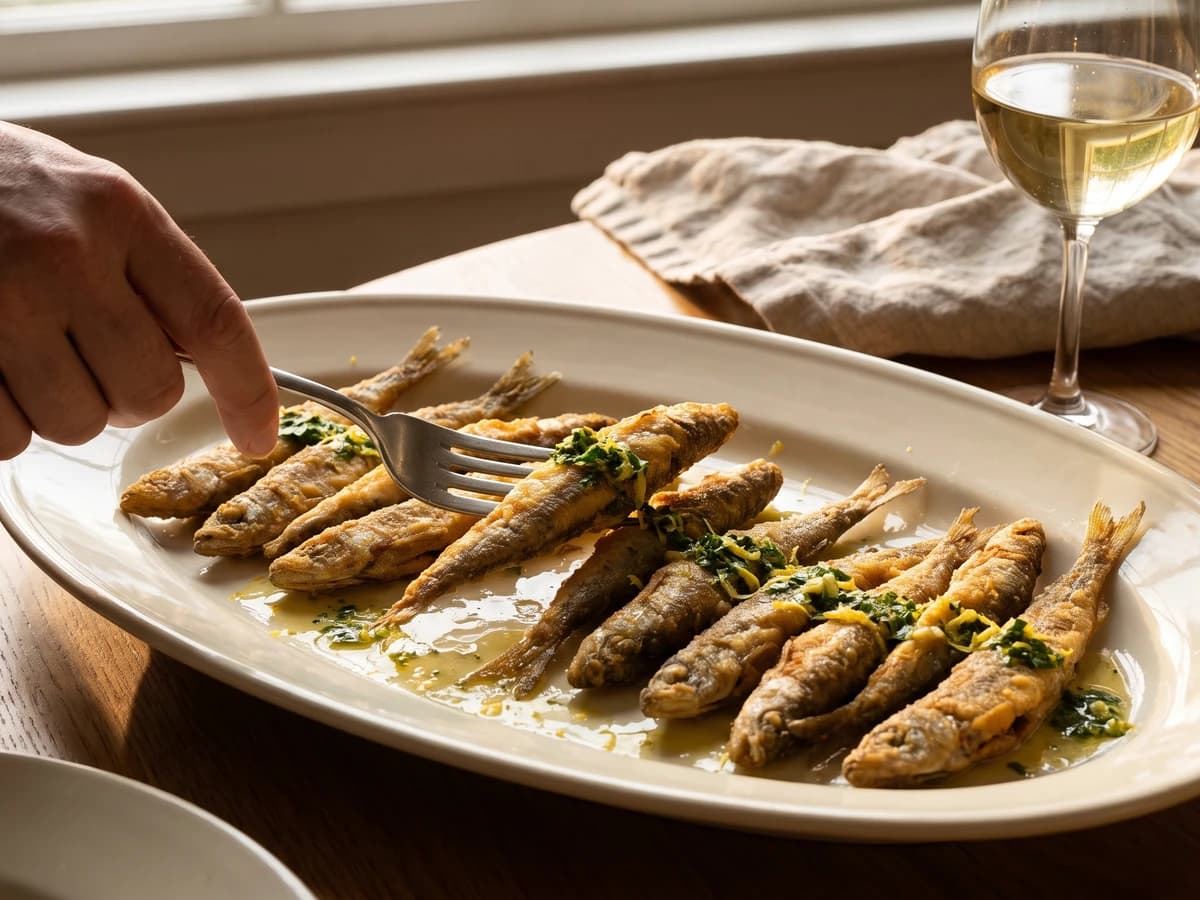
Éperlans à l’Anglaise turns small fish into a lesson in disciplined coating: boned smelts under a close, crisp crumb, pan-fried in clarified butter and finished with bright, half-melted maître d’hôtel butter.

Chef Juliette
Tiny smelts, shallot, mushrooms, white wine, gratin sauce, and fine bread raspings meet a fierce oven, where the fish must turn tender in the same breath the buttered crust bronzes.