
Chef Juliette
John Dory (St. Pierre)
John Dory has the delicacy of sole and the firmness of turbot. A light flouring, a quick butter sauté, and nut-brown beurre noisette show exactly why looks never mattered.
A cooking platform built around craft, culture, and the stories behind what we eat.

Created by Chef Juliette
Based on No. 857, Sole Marguery, from Le Guide Culinaire (1907) by Auguste Escoffier
Sole Marguery turns a gentle poach into its own sauce: tender sole, mussels, and shrimp under an ivory coat of wine, fumet, cream, and butter, flashed to gold at the finish.
Sole Marguery (sole poached with shellfish and glazed white-wine sauce) teaches the quiet chain at the heart of classical fish cookery: the poaching liquor becomes the sauce, and the sauce must taste of the fish rather than simply cover it. The one true thing to know before touching the pan is this: poach gently. A boil tightens sole and clouds the liquor that must later turn ivory and glossy.
The original entry assumed a saucier with white wine sauce at hand, fumet from a stockpot never off the fire, brigade portions ready for a dining room, and a salamander waiting to glaze the dish. At home, prepared fish fumet, a small roux blanc enriched with the sole's own liquor, and a fierce household broiler do the same work for four. Eight evenly sized fillets replace the large service presentation because one cook can poach and arrange them without damage; what changed is scale and equipment, not the book's flavor or sequence.
Making sauce by the gallon and passing every plate through separate stations were brigade scaffolding, so they go. The dish itself stays: white wine and fumet for the poach, a border of mussels and shrimp, white wine sauce finished generously with real butter, and a quick glaze. The single decisive step is the sauce finish. Keep it below a boil, add the butter off the heat, and if the emulsion turns oily, ça se rattrape right there in the method. One cook, one stove, one evening.
Sole Marguery belongs to the named-dish repertoire of Paris, where the Marguery restaurant made poached sole with mussels, shrimp, and glazed white wine sauce its calling card. It traveled from that dining room into the classical canon because its shellfish border and butter-finished glaze identify the dish as precisely as its name. Despite the seafood, this is not a regional fisherman's preparation; it is Parisian grand-kitchen fish cookery built from fumet, reduction, and exact timing.
Quantity
8 fillets (about 1½ pounds / 680 g total)
pin bones removed
Quantity
24 mussels (about 1 pound / 450 g)
scrubbed and debearded
Quantity
16 shrimp (about 6 ounces / 170 g)
peeled and deveined
Quantity
¾ cup (180 ml / 180 g)
divided
Quantity
1 cup (240 ml / 240 g)
Quantity
½ cup (120 ml / 113 g)
divided, with 5 tablespoons chilled and cubed
Quantity
2 tablespoons (30 ml / 16 g)
Quantity
½ cup (120 ml / 120 g)
cold and divided
Quantity
2
Quantity
1 teaspoon (5 ml / 6 g)
divided
Quantity
¼ teaspoon (1.25 ml / 0.6 g)
| Ingredient | Quantity |
|---|---|
| skinless sole filletspin bones removed | 8 fillets (about 1½ pounds / 680 g total) |
| live musselsscrubbed and debearded | 24 mussels (about 1 pound / 450 g) |
| small raw shrimppeeled and deveined | 16 shrimp (about 6 ounces / 170 g) |
| dry white winedivided | ¾ cup (180 ml / 180 g) |
| fish fumet | 1 cup (240 ml / 240 g) |
| unsalted butterdivided, with 5 tablespoons chilled and cubed | ½ cup (120 ml / 113 g) |
| all-purpose flour | 2 tablespoons (30 ml / 16 g) |
| heavy creamcold and divided | ½ cup (120 ml / 120 g) |
| large egg yolks | 2 |
| fine sea saltdivided | 1 teaspoon (5 ml / 6 g) |
| ground white pepper | ¼ teaspoon (1.25 ml / 0.6 g) |
Tap any open mussel against the counter and discard it if it does not close. Put the mussels in a lidded saucepan with ¼ cup (60 ml / 60 g) of the wine. Cover and cook over medium-high heat, shaking the pan once, until the shells open, 3 to 5 minutes. Discard any that remain closed. Lift out the mussels, remove the meats from their shells, and strain the released liquor through a fine sieve lined with damp cheesecloth or a coffee filter. Bring that liquor to a bare simmer, add the shrimp, and cook for 45 to 60 seconds, just until their edges turn opaque while the centers remain slightly translucent. Lift them out immediately; the final glaze will finish them. Reserve the shellfish and up to ½ cup (120 ml / 120 g) of the strained liquor.
Melt 2 tablespoons (30 ml / 28 g) of the butter in a small saucepan over medium-low heat. Stir in the flour and cook for 2 minutes, stirring constantly, until the paste looks ivory and no longer smells raw but has taken no brown color. This is a roux blanc, a white roux, and it gives the finished sauce its quiet body. Take it off the heat and leave it in the saucepan.
Heat the oven to 375°F (190°C). Butter a shallow 9 by 13-inch (23 by 33 cm) poaching dish and one side of a sheet of parchment with 1 tablespoon (15 ml / 14 g) of the butter. Season the fillets lightly with about half the salt and white pepper, then fold each loosely in half so its thin tail is protected inside. Arrange them in a snug single layer. Pour over the remaining ½ cup (120 ml / 120 g) wine, the fish fumet, and up to ½ cup (120 ml / 120 g) reserved mussel liquor. Cover directly with the buttered parchment. Bake for 7 to 10 minutes, until the liquid barely trembles and the fish is almost opaque but still supple at its center. A hard boil tightens the fish and muddies the liquor, so lower the oven at once if the liquid bubbles vigorously. The brief glaze will complete the cooking.
Lift the sole carefully with a fish spatula and arrange it in a warm, broiler-safe oval serving dish. Place the mussels and shrimp in a generous border around the fish, exactly as the source directs, then cover the dish loosely with parchment while you make the sauce. Strain the fish poaching liquor into a wide saucepan. Handle the fillets from underneath, never with tongs; properly poached sole is tender enough to split under pressure.
Boil the strained poaching liquor steadily until it measures about 1½ cups (360 ml / 360 g), usually 6 to 10 minutes. Taste as it reduces. If the mussel liquor has made it sufficiently seasoned before it reaches that volume, stop reducing rather than chasing the measuring mark. Reserve ¼ cup (60 ml / 60 g) of the reduction for adjusting the sauce, and keep the remainder hot. Position an oven rack about 6 inches (15 cm) below the broiler and heat the broiler to high.
Set the roux blanc over low heat and whisk in 1¼ cups (300 ml / 300 g) of the hot reduced liquor a little at a time, making each addition smooth before adding the next. Bring it to a gentle simmer and whisk for 3 minutes, until it coats the back of a spoon. In a bowl, whisk the yolks with 7 tablespoons (105 ml / 105 g) of the cold cream, holding back 1 tablespoon. Whisk about ½ cup (120 ml / 120 g) of the hot sauce into this liaison, a cream-and-yolk thickener, then return it to the saucepan. Cook over the lowest heat, stirring constantly, until the sauce becomes nappé, thick enough to leave a clean line when you draw a finger across the coated spoon. Do not let it boil. If the first fine grains appear, take the pan off the heat, whisk firmly, and pass the sauce through the fine sieve. Ça se rattrape before those yolks become a full scramble.
Take the sauce completely off the heat. Monter au beurre means whisking in cold butter to give the sauce its final gloss and richness. Add the remaining 5 tablespoons (75 ml / 71 g) chilled butter one cube at a time, whisking each nearly smooth before adding the next. If the sauce tightens too far, loosen it with the reserved poaching reduction. If it turns oily, put the reserved tablespoon of cold cream in a clean bowl and whisk in the broken sauce one spoonful at a time until it comes together again. Never pour it out. Taste before adding the remaining salt or pepper, since the mussels have already spoken.
Spoon the white wine sauce over the sole, mussels, and shrimp, covering everything in an even ivory coat. Set the dish under the fully heated broiler for 45 to 90 seconds, watching without interruption, until the sauce gleams, its edges bubble, and a few pale butter-gold freckles appear on top. This household broiler is the honest equivalent of the salamander. Do not chase a dark crust; glazing is a quick finish, and another minute only overcooks the sole. Bring the dish straight to the table. À table!
1 serving (about 315g)
Culinary guides, cultural storytelling, and the editorial depth that makes cooking meaningful.
Discover Culinary ExplorerChef Juliette
John Dory has the delicacy of sole and the firmness of turbot. A light flouring, a quick butter sauté, and nut-brown beurre noisette show exactly why looks never mattered.

Chef Juliette
Fresh haddock proves its delicacy in the meunière pan: a fine flour crust, moist pearly flakes, and beurre noisette sharpened with lemon and parsley, ready from one skillet in half an hour.
Chef Juliette
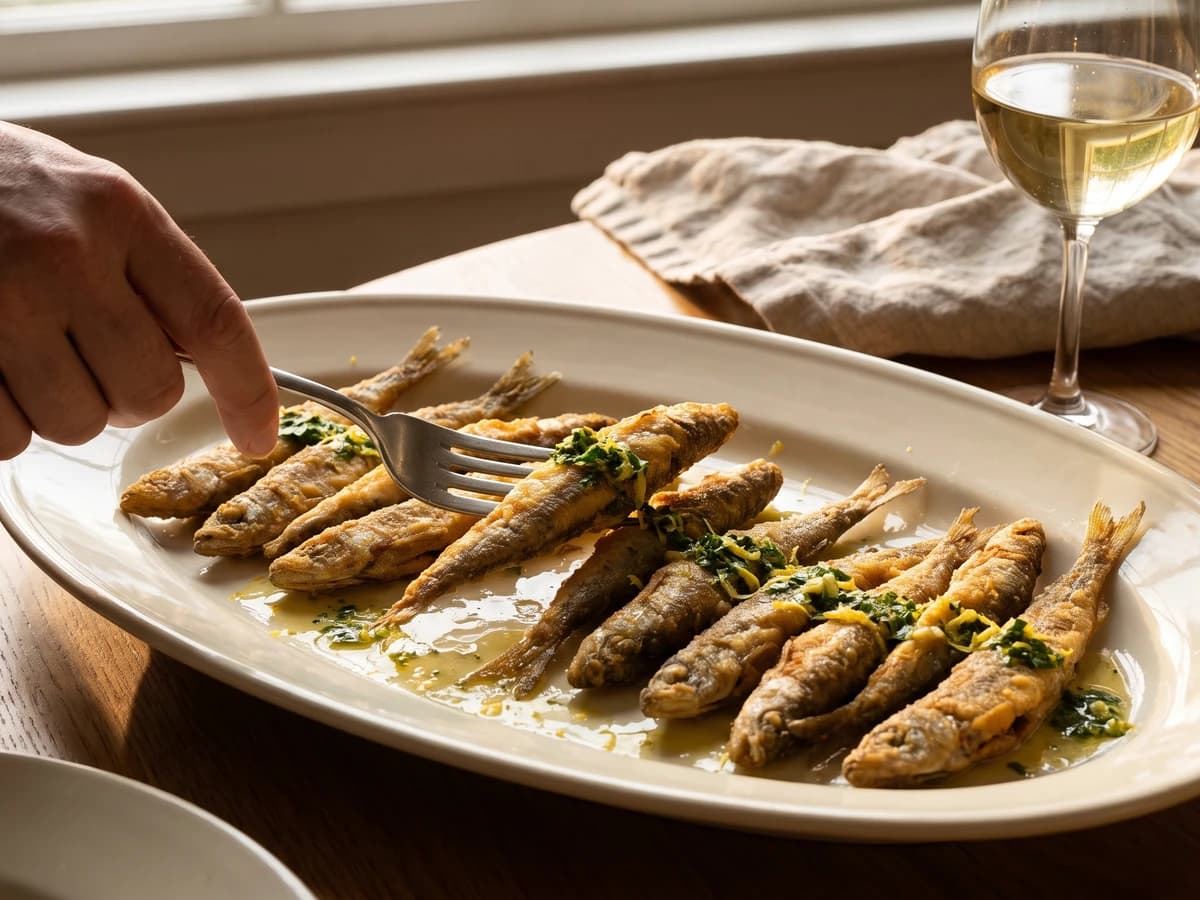
Éperlans à l’Anglaise turns small fish into a lesson in disciplined coating: boned smelts under a close, crisp crumb, pan-fried in clarified butter and finished with bright, half-melted maître d’hôtel butter.

Chef Juliette
Tiny smelts, shallot, mushrooms, white wine, gratin sauce, and fine bread raspings meet a fierce oven, where the fish must turn tender in the same breath the buttered crust bronzes.