
Chef Juliette
John Dory (St. Pierre)
John Dory has the delicacy of sole and the firmness of turbot. A light flouring, a quick butter sauté, and nut-brown beurre noisette show exactly why looks never mattered.
A cooking platform built around craft, culture, and the stories behind what we eat.
Created by Chef Juliette
Based on No. 846, Sole Meunière aux Morilles, from Le Guide Culinaire (1907) by Auguste Escoffier
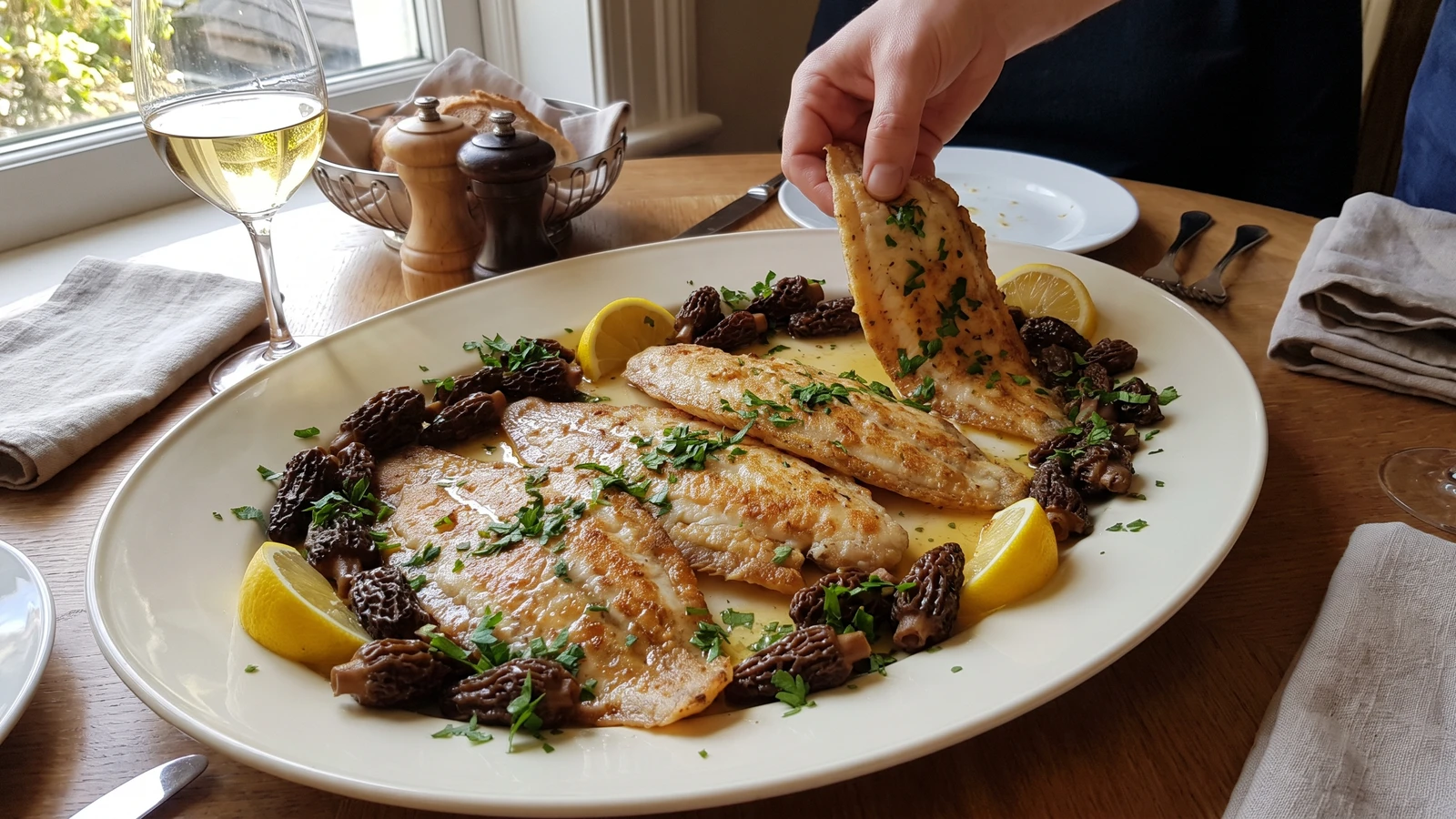
Sole Meunière aux Morilles teaches the discipline of dry fish and watched butter: golden fillets, earthy fresh morels, parsley, and lemon, brought to the table while the gloss is still alive.
Sole Meunière aux Morilles (flour-dusted sole with fresh morels) teaches restraint. The one true thing to know before touching the pan is that everything must be dry. Dry sole takes a fine golden crust, and dry morels drink in butter instead of flooding it. From there, the cook's work is simply to watch: a veil of flour, steady heat, and beurre noisette, butter cooked until hazelnut-colored and nutty-smelling.
The book could dispatch the garnish in one line because it assumed a fish cook at one pan, another hand at the mushrooms, and a hot pass ready to receive both. It needs neither a saucier, a stock never off the fire, nor a salamander. Here, four broad fillets pass through one wide skillet in two quick batches, while a warmed platter and low oven replace the pass. That is brigade scaffolding removed. The salted-water cooking, the last-minute butter toss, the parsley, and the meunière technique stay, because they are the dish. One cook, one stove, one evening.
Fresh morels are not negotiable here. Split them, rinse their folds until the water shows no grit, cook them thoroughly in salted water as the entry directs, then dry them before their final turn in butter. The step that decides everything comes just before frying: blot the sole until the paper comes away clean, then flour it lightly and send it straight to the pan.
Sole meunière belongs to the classical French table rather than one province, though Channel sole and northern butter made it especially natural in Parisian dining rooms and the kitchens of Normandy. Meunière means "in the manner of the miller's wife": the flour is not a heavy coating but a thin veil that colors in butter and catches the lemon. Surrounding the fish with fresh morels is a grande cuisine garnish, joining that plain pan technique to mushrooms prized in the Jura and Savoy; cooking them first in salted water is the book's deliberate method, not an invitation to replace them with a cream sauce.
Quantity
4, each 5 to 6 ounces (140 to 170 g)
pin bones removed
Quantity
4 loosely packed cups (950 ml / 225 g)
Quantity
6 cups (1.4 L / 1.4 kg)
for cooking the morels
Quantity
1 tablespoon plus 1 teaspoon (20 ml / 24 g)
divided
Quantity
1/2 cup (120 ml / 60 g)
Quantity
1/2 teaspoon (2.5 ml / 1 g)
Quantity
1 cup (240 ml / 227 g)
divided, with 2 tablespoons held cold in reserve
Quantity
2
1 juiced to yield 3 tablespoons (45 ml / 45 g), 1 cut into wedges
Quantity
3 tablespoons (45 ml / 12 g)
finely chopped
| Ingredient | Quantity |
|---|---|
| skinless Dover sole filletspin bones removed | 4, each 5 to 6 ounces (140 to 170 g) |
| very fresh morels | 4 loosely packed cups (950 ml / 225 g) |
| cold waterfor cooking the morels | 6 cups (1.4 L / 1.4 kg) |
| fine sea saltdivided | 1 tablespoon plus 1 teaspoon (20 ml / 24 g) |
| all-purpose flour | 1/2 cup (120 ml / 60 g) |
| finely ground white pepper | 1/2 teaspoon (2.5 ml / 1 g) |
| unsalted butterdivided, with 2 tablespoons held cold in reserve | 1 cup (240 ml / 227 g) |
| lemons1 juiced to yield 3 tablespoons (45 ml / 45 g), 1 cut into wedges | 2 |
| flat-leaf parsleyfinely chopped | 3 tablespoons (45 ml / 12 g) |
Trim the dry ends from the morel stems and split each mushroom lengthwise. Swish them gently in a deep bowl of cold water, wait for the grit to settle, then lift the mushrooms out instead of pouring them through the dirty water. Repeat with fresh water until no sand remains in the bowl. Bring the measured 6 cups (1.4 L / 1.4 kg) water and 1 tablespoon (15 ml / 18 g) salt to a boil, add the morels, and cook at a steady simmer for 6 minutes. Drain, discard the cooking water, and spread the morels on a clean towel until thoroughly dry.
Heat the oven to 200°F (95°C) and warm a large oval platter inside. Melt 6 tablespoons (90 ml / 85 g) of the butter over gentle heat, skim away the foam, and pour the clear golden fat into a cup, leaving the milky sediment behind. This clarified butter gives two batches of fish the same clean heat. Blot the sole firmly with paper, season with the remaining 1 teaspoon (5 ml / 6 g) salt and the white pepper, then dust each fillet with the flour and shake away every excess. Flour only as the skillet heats; left waiting, the coating turns damp and pasty.
Heat a 12-inch (30 cm) skillet over medium-high heat and add half the clarified butter. When it shimmers, lay in 2 fillets, smooth side down, lowering them away from you. Cook without shifting for 2 to 3 minutes, until the underside is evenly golden with fine bronze edges. Turn with a wide fish spatula and cook for another 1 1/2 to 2 1/2 minutes, until the flesh is opaque, separates in moist flakes, and reaches 145°F (63°C) at its thickest point. Transfer to the warm platter and repeat with the remaining fillets and clarified butter. Hold the first batch in the low oven for no more than 8 minutes.
Pour the used frying fat from the skillet and wipe away any black flour crumbs, leaving the pale fish fond behind. Add 6 tablespoons (90 ml / 85 g) butter and cook over medium heat, swirling often. It will foam, quieten, and show hazelnut-brown flecks at the bottom. The instant it smells nutty, pull the pan from the heat and add the 3 tablespoons (45 ml / 45 g) lemon juice carefully. Stir in 2 tablespoons (30 ml / 8 g) parsley and spoon the beurre noisette over the warm sole.
Melt the remaining 2 tablespoons (30 ml / 28 g) butter in a 10-inch (25 cm) skillet over medium heat. Add the cooked, well-dried morels and toss for 4 to 5 minutes, until they are thoroughly hot, glossy, and lightly caught at the edges. If they release water, lift them out, let the liquid cook away, then return them to the butter. Arrange the morels in a generous ring around the sole and sprinkle the remaining 1 tablespoon (15 ml / 4 g) parsley over the mushrooms, exactly where it belongs.
Set the platter down at once, with the lemon wedges alongside and a wide fish slice for serving. Meunière does not improve under a cover or beside a warming lamp; its pleasure is the meeting of crisp flour, tender fish, glossy butter, and morels still firm under the teeth. À table!
1 serving (about 235g)
Culinary guides, cultural storytelling, and the editorial depth that makes cooking meaningful.
Discover Culinary ExplorerChef Juliette
John Dory has the delicacy of sole and the firmness of turbot. A light flouring, a quick butter sauté, and nut-brown beurre noisette show exactly why looks never mattered.

Chef Juliette
Fresh haddock proves its delicacy in the meunière pan: a fine flour crust, moist pearly flakes, and beurre noisette sharpened with lemon and parsley, ready from one skillet in half an hour.
Chef Juliette
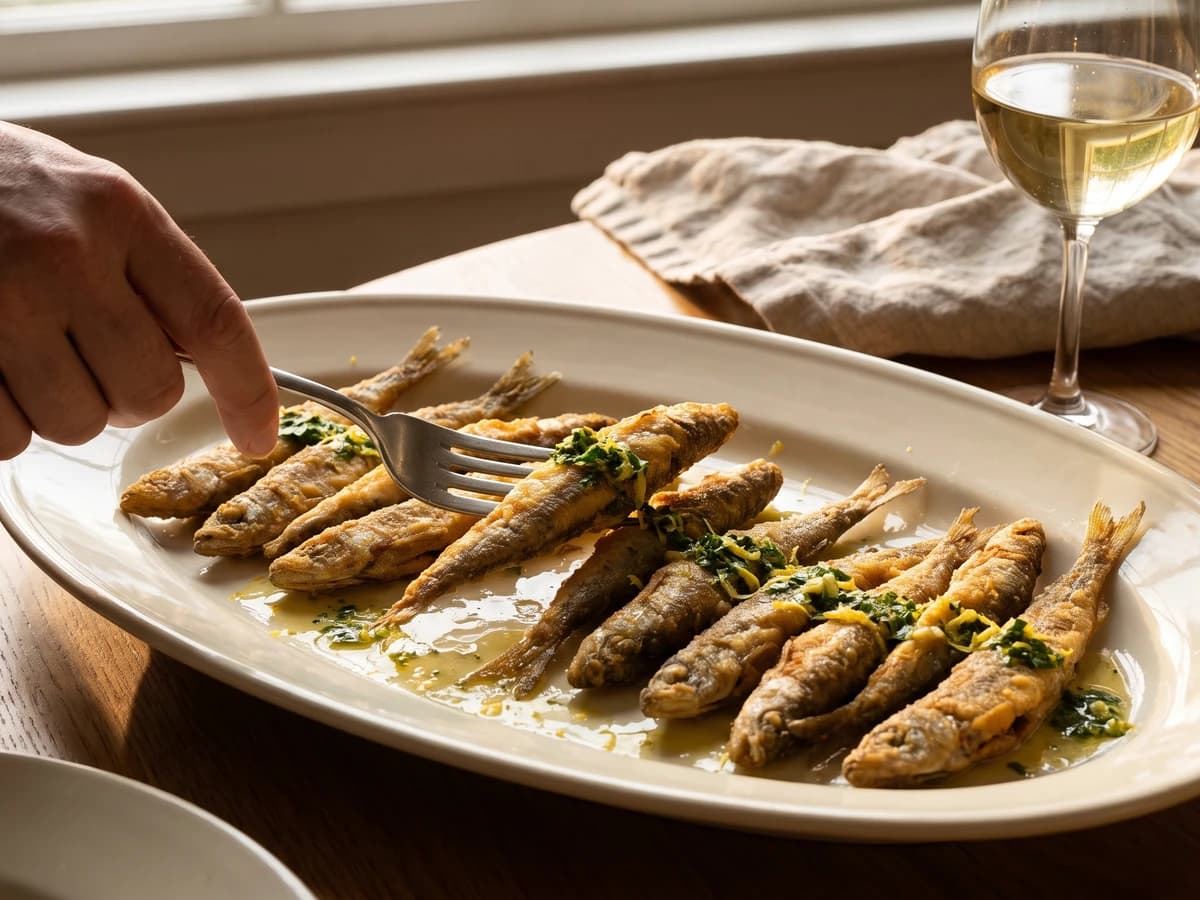
Éperlans à l’Anglaise turns small fish into a lesson in disciplined coating: boned smelts under a close, crisp crumb, pan-fried in clarified butter and finished with bright, half-melted maître d’hôtel butter.

Chef Juliette
Tiny smelts, shallot, mushrooms, white wine, gratin sauce, and fine bread raspings meet a fierce oven, where the fish must turn tender in the same breath the buttered crust bronzes.