
Chef Juliette
John Dory (St. Pierre)
John Dory has the delicacy of sole and the firmness of turbot. A light flouring, a quick butter sauté, and nut-brown beurre noisette show exactly why looks never mattered.
A cooking platform built around craft, culture, and the stories behind what we eat.

Created by Chef Juliette
Based on No. 812, Truite à la Cambacérès, from Le Guide Culinaire (1907) by Auguste Escoffier
Whole trout becomes a generous celebration dish: crayfish Mousseline held inside, truffle and carrot stitched across its flank, Sauternes beneath, and crayfish-butter Béchamel served from the side.
Truite à la Cambacérès (whole trout with crayfish Mousseline) teaches the architecture of a grand whole fish: keep the forcemeat cold, keep the braise gentle, and every rich element remains distinct. The one true thing to know before touching a pan is this: a warm Mousseline turns loose and grainy, while an ice-cold one swells tenderly inside the trout.
The original entry assumed a saucier beside you, a stockpot never off the fire, a fish kettle with its fitted drainer, a larding needle, and a salamander ready to glaze. This version needs no stock because the trout's own Sauternes braising liquor is the foundation. A food processor and fine sieve replace pounding, a close-fitting roasting pan and parchment sling replace the fish kettle, a metal skewer replaces the larding needle, and your broiler does the final glazing. The extra hands were scaffolding, so they go. The boning, crayfish Mousseline, truffle and red-carrot larding, bacon-covered Sauternes braise, Béchamel, crayfish butter, morels, and milt à la Meunière are the dish, so they stay, scaled for four. One cook, one stove, one evening.
When it reaches the table, the trout should still look whole and proud, its bared flank lacquered over black truffle and orange carrot, with ivory-coral sauce waiting beside it. Do the crayfish work first, then keep that Mousseline over ice until the instant you stuff the fish. That cold emulsion is the step that decides everything.
Truite à la Cambacérès belongs to the Parisian grand-service table, not to a provincial repertory, and its name honors Cambacérès, the Montpellier-born statesman whose dinners became a measure of ceremonial abundance. The Sauternes points to Bordeaux, but the dish is not Bordelais: truffle larding, crayfish Mousseline, morels, milt à la Meunière, and Béchamel gather several prized elements into one codified showpiece. Its real subject is service itself, a whole fish reconstructed so skill disappears into generosity when the platter reaches the table.
Quantity
1 fish, 3½ to 4 pounds (1.6 to 1.8 kg)
scaled with fins trimmed, belly unopened and gills intact
Quantity
8 ounces (225 g)
thoroughly chilled
Quantity
12 ounces (340 g)
rinsed and roughly crushed
Quantity
½ cup (120 ml / 120 g)
thoroughly chilled
Quantity
1
Quantity
2 tablespoons of batons (30 ml / 28 g)
cut into slender rods
Quantity
1 medium (about 4 ounces / 115 g)
bright outer flesh cut into slender rods, pale core discarded
Quantity
10 to 12 slices (8 ounces / 225 g)
Quantity
1½ cups (360 ml / 360 g)
Quantity
1 cup (240 ml / 225 g)
divided
Quantity
1¼ cups (300 ml / 310 g)
warmed
Quantity
¼ cup (60 ml / 30 g)
Quantity
2 loosely packed cups (475 ml / 30 g)
Quantity
6 cups (1.4 L / 1.4 kg)
divided
Quantity
8 ounces (225 g)
separated into intact lobes
Quantity
⅓ cup (80 ml / 40 g)
Quantity
2 teaspoons (10 ml / 12 g)
divided
Quantity
½ teaspoon (2.5 ml / 1 g)
divided
| Ingredient | Quantity |
|---|---|
| whole trout, preferably malescaled with fins trimmed, belly unopened and gills intact | 1 fish, 3½ to 4 pounds (1.6 to 1.8 kg) |
| raw crayfish tail meatthoroughly chilled | 8 ounces (225 g) |
| clean crayfish shellsrinsed and roughly crushed | 12 ounces (340 g) |
| heavy creamthoroughly chilled | ½ cup (120 ml / 120 g) |
| large egg white | 1 |
| black trufflecut into slender rods | 2 tablespoons of batons (30 ml / 28 g) |
| carrotbright outer flesh cut into slender rods, pale core discarded | 1 medium (about 4 ounces / 115 g) |
| thinly sliced bacon | 10 to 12 slices (8 ounces / 225 g) |
| Sauternes wine | 1½ cups (360 ml / 360 g) |
| unsalted butterdivided | 1 cup (240 ml / 225 g) |
| whole milkwarmed | 1¼ cups (300 ml / 310 g) |
| all-purpose flour for the Béchamel | ¼ cup (60 ml / 30 g) |
| dried morels | 2 loosely packed cups (475 ml / 30 g) |
| cold waterdivided | 6 cups (1.4 L / 1.4 kg) |
| trout or carp milt, also called soft roeseparated into intact lobes | 8 ounces (225 g) |
| all-purpose flour for the milt à la Meunière | ⅓ cup (80 ml / 40 g) |
| fine sea saltdivided | 2 teaspoons (10 ml / 12 g) |
| ground white pepperdivided | ½ teaspoon (2.5 ml / 1 g) |
Melt ½ cup (120 ml / 115 g) of the butter in a small heavy saucepan. Add the crushed crayfish shells and cook over low heat for about 20 minutes, stirring and pressing them often, until the shells are vivid red and the butter has turned deep coral. Keep the heat low enough that the milk solids never scorch. Strain through a fine sieve, pressing hard, and chill the resulting crayfish butter until cool but still pliable. You need about 4 tablespoons (60 ml / 55 g) for the sauce.
Chill the food-processor bowl and blade, then process the raw crayfish meat with ¾ teaspoon of the salt and a pinch of white pepper until it becomes a sticky, smooth paste. Add the egg white and process only until absorbed. Press the paste through a fine sieve into a bowl set over ice, then fold or pulse in the cold cream in three additions, stopping as soon as the Mousseline looks smooth, light, and firm enough to hold a soft peak. Poach a teaspoon-sized quenelle (oval dumpling) in barely simmering water for 3 minutes; cut it open to confirm it is opaque, then taste and correct the seasoning. Mousselines depend on cold. If yours becomes glossy, slack, or grainy, stop adding cream and spread it in a chilled bowl over ice until nearly stiff, then pulse it briefly until smooth. Ça se rattrape. Cover and keep over ice.
Cover the dried morels with 3 cups (710 ml / 710 g) of the cold water and leave them for 30 minutes. Lift them from the water rather than pouring them out with the grit, rinse each hollow cap carefully, and trim any tough stems. Simmer them in fresh water for 10 minutes, then drain and press them gently in a clean towel. Morels must be cooked thoroughly; their final turn in butter is for browning, not for making raw mushrooms safe.
Blanch the carrot rods in simmering water for 1 minute, drain them, and cool them completely. Remove the trout's gills through the gill openings without cutting the belly. On one flank, score the skin 1 inch (2.5 cm) behind the head and 2½ inches (6 cm) before the tail, then ease away the broad panel of skin between those marks. With a thin skewer, make shallow diagonal channels nearly parallel to the surface and insert alternating rods of black truffle and the bright outer carrot flesh. Lay the trout belly-down on a damp towel. Cut along each side of the backbone from head toward tail, working the knife against the bones to free both fillets from above. Snip the spine near the head and tail, lift it out with the rib bones, remove the intestines through the back opening, and pull any remaining pin bones. Wipe the cavity scrupulously clean. If a fillet tears, lay it back in place; the twine and bacon will support it during the braise.
Season the inner faces of the trout with about ¾ teaspoon of the remaining salt and a little white pepper. Spoon the cold crayfish Mousseline evenly into the cavity, using only enough to restore the trout's natural rounded shape. Do not pack it hard, because the forcemeat expands as it cooks. Draw the fillets together over the filling and tie the fish crosswise with kitchen twine at 2-inch (5 cm) intervals. Drape the bacon over the back opening and across the exposed flank so the flesh is completely protected.
Heat the oven to 325°F (165°C). Make a broad sling from doubled baking parchment and lay it inside a close-fitting roasting pan, or set a narrow rack in the pan if you have one. Place the trout belly-down on the sling, pour the Sauternes around it, and cover first with parchment and then tightly with foil. Braise for 35 to 45 minutes, basting once, until the liquor scarcely trembles, the fish is just opaque beside the backbone, and the centre of the Mousseline reaches 145°F (63°C). A hard boil squeezes moisture from both fish and filling. If the liquor begins bubbling fiercely, lower the oven at once and add 2 tablespoons (30 ml / 30 g) of water around the fish.
While the trout braises, melt 2 tablespoons (30 ml / 28 g) of the butter in a saucepan. Stir in the ¼ cup (60 ml / 30 g) flour and cook the roux gently for 2 minutes without letting it color. Add the warm milk a little at a time, whisking each addition completely smooth before adding the next. Simmer gently for 10 minutes, stirring often, until the Béchamel is silken and thick enough to coat a spoon. Cover its surface directly and hold it warm.
Lift the cooked trout from the pan with its sling and keep it in a warm place. Strain the Sauternes braising liquor into a clean saucepan, skim away bacon fat, and reduce it to ¾ cup (180 ml / 180 g). Reserve 2 tablespoons (30 ml / 30 g) for glazing the fish. Whisk the rest gradually into the Béchamel, then simmer until the sauce is nappant (coating), meaning it covers the back of a spoon while leaving a clean trail under your finger. Remove it from the heat and whisk in 4 tablespoons (60 ml / 55 g) crayfish butter a little at a time. Do not boil after the butter goes in. If orange droplets collect on the surface, lift the pan from the heat and whisk in 1 tablespoon (15 ml / 15 g) cold milk until the emulsion returns. Strain the sauce, correct the salt and white pepper, and keep it warm for serving separately.
Melt 2 tablespoons (30 ml / 28 g) butter in a wide skillet. Add the drained morels with a small pinch of salt and toss them over medium heat for 6 to 8 minutes, until their moisture has cooked away, their edges have taken a little bronze, and every hollow cap wears a clean butter sheen. Hold them warm.
Pat the milt completely dry and season it lightly with salt and white pepper. Spread the ⅓ cup (80 ml / 40 g) flour on a plate, coat each lobe thinly, and tap away every excess speck. Melt 3 tablespoons (45 ml / 42 g) butter in a skillet until its foam subsides, then cook the milt à la Meunière, lightly floured and sautéed in butter, for about 2 to 3 minutes per side. It should be pale gold outside, opaque within, and just firm enough to lift intact. If the flour blackens before the centre cooks, lower the heat and add a small piece of fresh butter.
Heat the broiler. Remove the bacon and twine carefully, then blot the trout's surface without disturbing the truffle and carrot rods. Warm the reserved reduced braising liquor with 2 teaspoons (10 ml / 10 g) butter and brush this glaze over the fish. Set the trout under the broiler for 30 to 60 seconds, watching without looking away, until the surface turns lacquered and lightly golden. The glaze needs shine and color, not another round of cooking.
Transfer the whole trout to a warmed oval platter, belly-down, with its decorated flank facing the table. Arrange alternating generous mounds of buttered morels and milt à la Meunière along both sides. Bring the fine Béchamel enriched with reduced Sauternes and crayfish butter in a warmed sauceboat, exactly as a separate sauce. Carve the trout crosswise so each serving receives fish, coral Mousseline, and a little of the larded flank. Spoon the sauce at the table. À table!
1 serving (about 650g)
Culinary guides, cultural storytelling, and the editorial depth that makes cooking meaningful.
Discover Culinary ExplorerChef Juliette
John Dory has the delicacy of sole and the firmness of turbot. A light flouring, a quick butter sauté, and nut-brown beurre noisette show exactly why looks never mattered.

Chef Juliette
Fresh haddock proves its delicacy in the meunière pan: a fine flour crust, moist pearly flakes, and beurre noisette sharpened with lemon and parsley, ready from one skillet in half an hour.
Chef Juliette
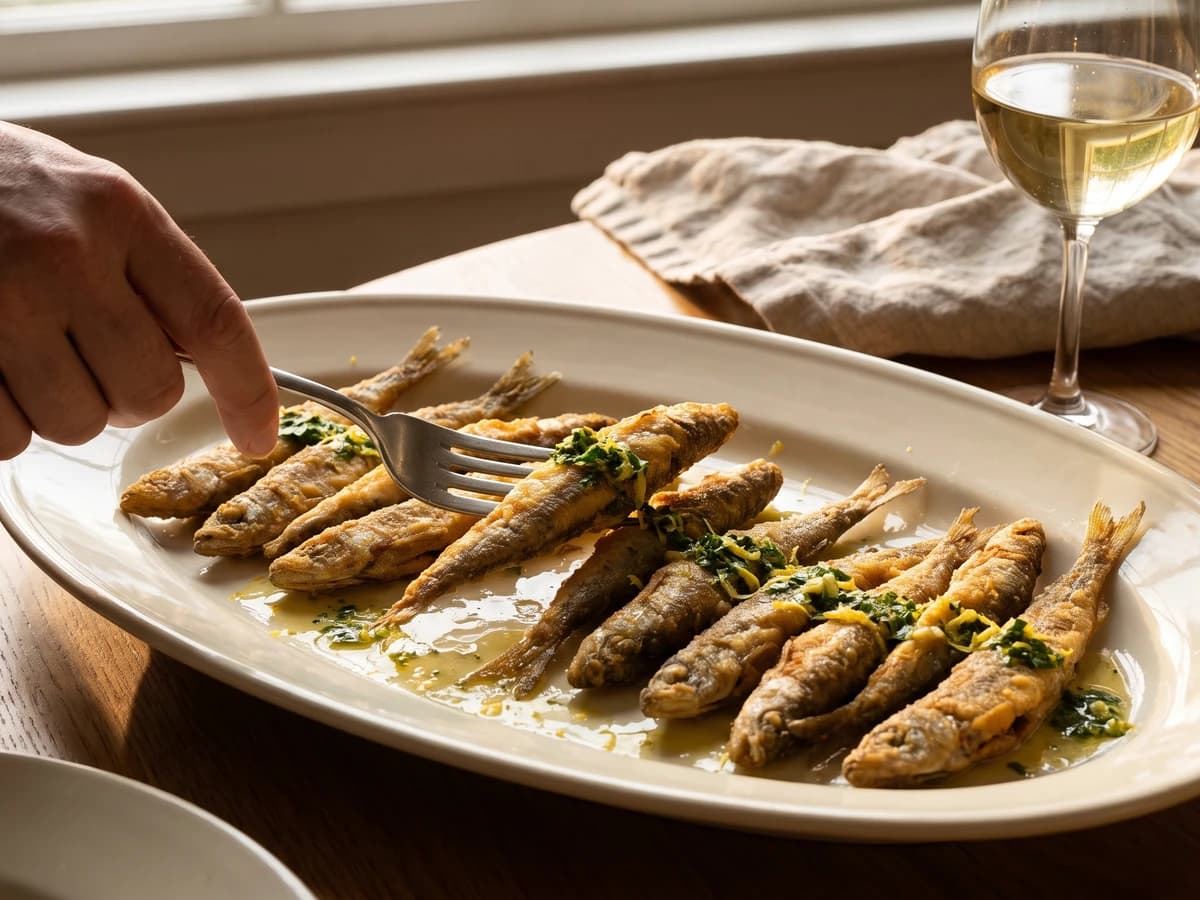
Éperlans à l’Anglaise turns small fish into a lesson in disciplined coating: boned smelts under a close, crisp crumb, pan-fried in clarified butter and finished with bright, half-melted maître d’hôtel butter.

Chef Juliette
Tiny smelts, shallot, mushrooms, white wine, gratin sauce, and fine bread raspings meet a fierce oven, where the fish must turn tender in the same breath the buttered crust bronzes.