
Chef Juliette
John Dory (St. Pierre)
John Dory has the delicacy of sole and the firmness of turbot. A light flouring, a quick butter sauté, and nut-brown beurre noisette show exactly why looks never mattered.
A cooking platform built around craft, culture, and the stories behind what we eat.

Created by Chef Juliette
Based on No. 811, Truite Saumonée (Salmon Trout), from Le Guide Culinaire (1907) by Auguste Escoffier
A whole salmon trout, butter-gold at the edges and moist along the bone, with white-wine pan juices mounted with cold butter. The lesson is proportion: smaller than salmon, it belongs whole at the table.
Truite Saumonée (salmon trout) teaches proportion before technique: this fish is smaller than salmon, so leave it whole. A darne is a thick cross-cut steak through the bone, sensible for a large salmon and wasteful here. Once you understand that size decides the cut, the rest is calm cooking.
The source entry gives no sauce, flavourings, or cooking formula because it stands as a gateway to the preparations that follow. Its professional kitchen could reach for a fish kettle, a stock never off the fire, a saucier, and a salamander whenever the chosen preparation required them. For one cook, one stove, one evening, I add a neutral classical frame: a hot oven cooks the whole fish evenly, while its white-wine roasting juices reduce in one small pan and become a butter emulsion. The brigade equipment is scaffolding and can go. Serving this smaller fish whole is the intent, and that stays.
The one step that matters is judging the flesh beside the backbone, not trusting the clock. Take the fish out while it is still moist and let the short rest finish the cooking; butter can rescue a lean sauce, but it cannot put moisture back into an overcooked trout.
Truite saumonée belongs to French fish-market language and to the river and lake tables of the Jura, Savoy, and Dauphiné, although no single region owns it. The name does not identify a salmon-trout hybrid or one fixed species; saumonée describes trout whose flesh has taken on a salmon colour, traditionally through a crustacean-rich diet and now often through carefully controlled feed. Because these trout generally reached the kitchen smaller than salmon, French cooks served them whole and reserved the darne, a cross-cut steak through the bone, for the larger fish.
Quantity
1 fish (2¾ to 3¼ lb / 1.25 to 1.5 kg)
scaled, gutted, and gills removed
Quantity
2 teaspoons (10 ml / 12 g)
Quantity
½ teaspoon (2.5 ml / 1 g)
Quantity
8 tablespoons (120 ml / 113 g)
2 tablespoons softened and 6 tablespoons cold and cubed
Quantity
2
thinly sliced
Quantity
1
half thinly sliced and half reserved for juicing
Quantity
1 small bunch
half kept as sprigs and half finely chopped
Quantity
¾ cup (180 ml / 180 g)
divided
Quantity
2 tablespoons (30 ml / 30 g)
| Ingredient | Quantity |
|---|---|
| whole salmon trout, head and tail onscaled, gutted, and gills removed | 1 fish (2¾ to 3¼ lb / 1.25 to 1.5 kg) |
| fine sea salt | 2 teaspoons (10 ml / 12 g) |
| finely ground white pepper | ½ teaspoon (2.5 ml / 1 g) |
| unsalted butter2 tablespoons softened and 6 tablespoons cold and cubed | 8 tablespoons (120 ml / 113 g) |
| medium shallotsthinly sliced | 2 |
| medium lemonhalf thinly sliced and half reserved for juicing | 1 |
| flat-leaf parsleyhalf kept as sprigs and half finely chopped | 1 small bunch |
| dry white winedivided | ¾ cup (180 ml / 180 g) |
| cold water (optional) | 2 tablespoons (30 ml / 30 g) |
Heat the oven to 450°F (230°C) with a rack in the centre. Run a fingertip against the grain of the skin and scrape away any scales the fishmonger missed, then rinse the cavity briefly and dry the fish thoroughly, inside and out. Season with the salt and white pepper, including the cavity. Fill the cavity loosely with the parsley sprigs and lemon slices; don't pack it tightly, or the thickest flesh will cook too slowly.
Spread the sliced shallots down the centre of a large rimmed metal roasting pan and lay the fish over them. Rub the softened butter over both sides of the trout, leaving the upper side facing up. Pour ½ cup (120 ml / 120 g) of the wine around the fish, not over it, so the butter remains on the skin. The shallots lift the fish from the bare metal and perfume the juices without becoming a separate garnish.
Roast for 20 minutes, then test through the thickest part behind the head, aiming the thermometer toward the backbone without touching bone. Continue for 3 to 8 minutes as needed, until the flesh reaches 140°F (60°C), looks just opaque beside the spine, and separates under light pressure. If the tail colours too quickly, cover only that thin end with a small piece of foil. Transfer the fish carefully to a warm oval platter and rest it for 5 to 8 minutes; verify that the thickest flesh reaches 145°F (63°C). If it doesn't, return the platter to the oven for 2 minutes and test again.
While the trout rests, scrape the shallots and every drop of roasting juice into a small heavy saucepan. Add the remaining ¼ cup (60 ml / 60 g) wine and the juice from the reserved lemon half. Boil briskly until the liquid reduces to about 3 tablespoons and tastes concentrated but not harsh, 3 to 5 minutes. If the roasting pan went dry, deglaze it with 1 tablespoon of the cold water and scrape up the butter-gold film before reducing. Ça se rattrape.
Take the saucepan off the heat. Make a beurre monté, a warm butter emulsion, by whisking in the cold butter a few cubes at a time, adding more only when the previous butter has disappeared. Return the pan to the lowest heat for a few seconds only if the butter refuses to soften; the sauce must never boil after mounting. If it separates into greasy streaks, put 1 teaspoon cold water in a clean pan and whisk the broken sauce into it gradually. Ça se rattrape. Taste and adjust the salt, pepper, and lemon.
Remove the spent parsley sprigs and lemon slices from the cavity. Spoon a little beurre monté around the fish, leaving the burnished skin visible, and finish with the chopped parsley. Present the trout whole. To serve, cut behind the head and along the top of the backbone, then lift the upper fillet away in generous portions. Remove the exposed skeleton from tail to head and serve the lower fillet. Pass the remaining sauce at the table. À table!
1 serving (about 240g)
Culinary guides, cultural storytelling, and the editorial depth that makes cooking meaningful.
Discover Culinary ExplorerChef Juliette
John Dory has the delicacy of sole and the firmness of turbot. A light flouring, a quick butter sauté, and nut-brown beurre noisette show exactly why looks never mattered.

Chef Juliette
Fresh haddock proves its delicacy in the meunière pan: a fine flour crust, moist pearly flakes, and beurre noisette sharpened with lemon and parsley, ready from one skillet in half an hour.
Chef Juliette
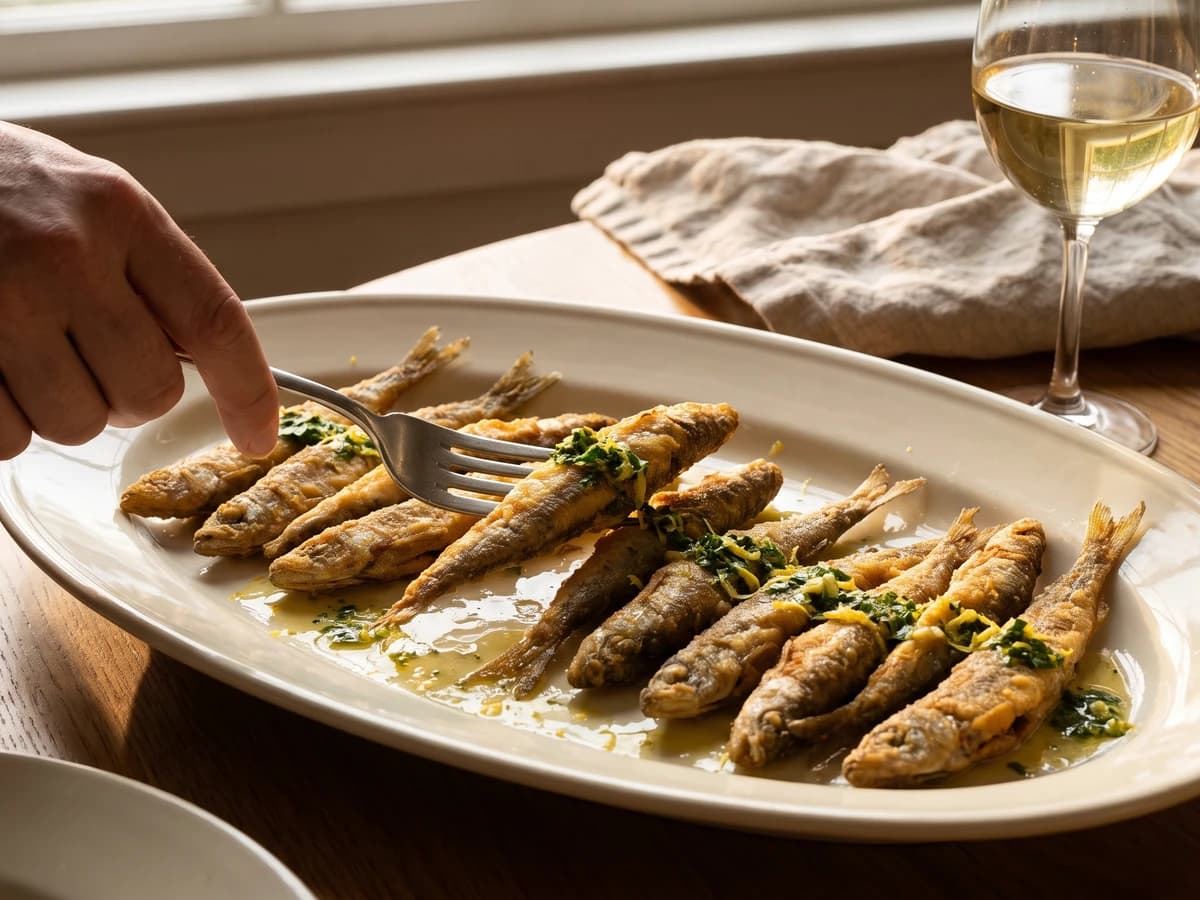
Éperlans à l’Anglaise turns small fish into a lesson in disciplined coating: boned smelts under a close, crisp crumb, pan-fried in clarified butter and finished with bright, half-melted maître d’hôtel butter.

Chef Juliette
Tiny smelts, shallot, mushrooms, white wine, gratin sauce, and fine bread raspings meet a fierce oven, where the fish must turn tender in the same breath the buttered crust bronzes.