
Chef Juliette
John Dory (St. Pierre)
John Dory has the delicacy of sole and the firmness of turbot. A light flouring, a quick butter sauté, and nut-brown beurre noisette show exactly why looks never mattered.
A cooking platform built around craft, culture, and the stories behind what we eat.
Created by Chef Juliette
Based on No. 784, Boiled Salmon, from Le Guide Culinaire (1907) by Auguste Escoffier
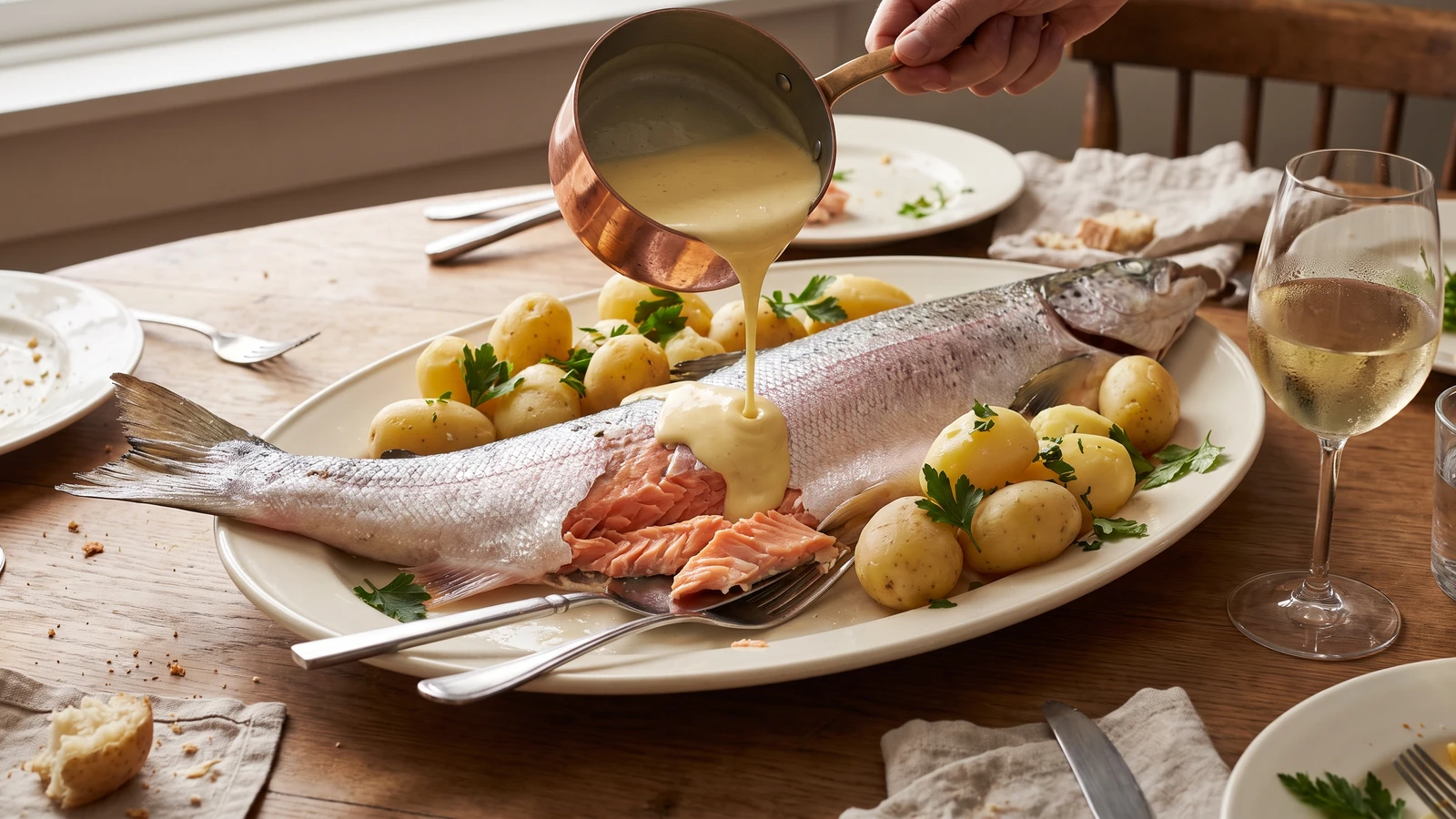
Saumon bouilli teaches the gentlest lesson in the fish canon: bring a whole salmon to the boil once, then let quiet heat finish it, juicy and intact, with Hollandaise beside it.
Saumon bouilli teaches a delicious contradiction: the salmon is called boiled, but it must never be allowed to boil in earnest. The court-bouillon reaches the boil once, then the fish finishes in quiet heat. That distinction is the dish. A rolling boil tightens the flesh and bursts the skin; a barely trembling bath leaves broad, juicy flakes and a whole fish fit for the center of the table.
The original service assumed a brigade-sized salmon, a long fish-kettle with its own drainer, court-bouillon ready on the range, and a saucier standing by with half a dozen sauces. For four people, we use a small dressed salmon in a close-fitting oval pan, lift it on a rack or cloth sling, and choose one prepared sauce to serve separately. The decorative napkin, the parade of sauces, and the enormous fish were service scaffolding. The cold start for a whole fish and the sub-boiling finish must stay. One cook, one stove, one evening.
Watch the court-bouillon as it approaches its first boil. The instant bubbles break fully across the surface, move the pan away from the heat and quiet the liquid. If it runs hard for a moment, add the reserved cold court-bouillon and bring the temperature down at once. Ça se rattrape, but only if you act before the salmon overcooks.
Saumon bouilli belongs chiefly to the formal bourgeois and classical dining tables of Paris, where a whole salmon in court-bouillon became a generous centerpiece with its sauce carried separately. The method also reflects salmon's place in the Atlantic river kitchens of Brittany, Normandy, and the Loire, where gentle liquid cooking suited a large fish better than fierce dry heat. Its English name misleads: in the French canon the liquor reaches the boil, but the salmon completes its cooking below it.
Quantity
1 fish (3 to 3½ pounds / 1.35 to 1.6 kg)
scaled, gutted, gills and fins removed, rinsed briefly and patted dry
Quantity
4 quarts (3.8 L / approximately 3.8 kg), used according to The Boiling of Fish in Salted Water (No. 776)
Quantity
2 pounds (900 g / about 8 medium)
peeled and cut into even 2-inch pieces
Quantity
1 tablespoon (15 ml / 18 g)
for the potato water
Quantity
1¼ cups (300 ml / approximately 300 g)
held warm
Quantity
1 loose cup (240 ml / 30 g)
washed and dried
| Ingredient | Quantity |
|---|---|
| small whole dressed salmonscaled, gutted, gills and fins removed, rinsed briefly and patted dry | 1 fish (3 to 3½ pounds / 1.35 to 1.6 kg) |
| cold prepared court-bouillon | 4 quarts (3.8 L / approximately 3.8 kg), used according to The Boiling of Fish in Salted Water (No. 776) |
| floury potatoespeeled and cut into even 2-inch pieces | 2 pounds (900 g / about 8 medium) |
| fine sea saltfor the potato water | 1 tablespoon (15 ml / 18 g) |
| prepared Hollandaise sauce, or prepared Nantua sauceheld warm | 1¼ cups (300 ml / approximately 300 g) |
| flat-leaf parsley leaves and small sprigswashed and dried | 1 loose cup (240 ml / 30 g) |
Choose a pan that holds the salmon without bending it and without leaving great lakes of empty space around it. Ask the fishmonger to trim the head or tail only if needed to make it fit. Lay the cleaned fish flat on the poacher rack; if your pan has no rack, settle it on a doubled length of clean unbleached muslin or cheesecloth, leaving enough cloth at both ends to serve as lifting handles. A snug vessel needs less court-bouillon and supports the fish as it cooks.
Put the potatoes in a saucepan, cover them with cold water, and add the salt. Bring them to a gentle simmer and cook for 15 to 20 minutes, until a knife enters without resistance but the pieces remain whole. Drain them well, return them to the dry pan, and shake over low heat for a minute so their surfaces turn floury. Keep them covered. Hold the prepared Hollandaise sauce or Nantua sauce according to its own recipe, ready to send to the table separately.
Set the salmon and its rack in the empty poaching pan. Pour over enough cold court-bouillon to cover the fish by about ½ inch, reserving 1 cup in the cold. Cover the pan and follow The Boiling of Fish in Salted Water (No. 776) for a whole fish: bring the liquid gradually toward the boil over medium heat. If the pan spans two burners, keep both low and rotate the pan halfway through so one end doesn't race ahead.
The instant bubbles break fully across the surface, uncover the pan, skim away any pale foam, and move the vessel off the heat. Lower the burner as far as it will go, then return the pan only when the liquid has quieted to 185 to 190°F (85 to 88°C), with no more than an occasional tremble. If it boiled hard and the skin began to split, add the reserved cold court-bouillon immediately and stop touching the fish. Ça se rattrape: the rack will hold it together, and the parsley and carving will disguise a small split. Continued boiling cannot be rescued.
Partly cover the pan and maintain that quiet heat, never a rolling boil. Begin checking after 10 minutes; a salmon of this size generally needs 12 to 20 minutes after the liquid first reaches the boil. The flesh at the thick shoulder should separate from the backbone with gentle pressure, and an instant-read thermometer inserted beside, not against, the bone should register 130 to 135°F (54 to 57°C). It will rise slightly while draining. For diners who require fully cooked fish, continue to 145°F (63°C). If the center is still underdone after lifting, lower the salmon back into 185°F (85°C) court-bouillon for 3 minutes, then check again.
Lift the rack or cloth sling slowly and let the salmon drain over the pan for 2 minutes. Transfer it to a large warmed oval platter, withdrawing the sling carefully so the skin remains intact. The old napkin-and-drainer presentation belonged to a larger service; a warm platter is its honest home equivalent. Arrange the dry, floury potatoes around the salmon and tuck the fresh parsley leaves and small sprigs along its sides.
Bring the prepared Hollandaise sauce or Nantua sauce to the table in a warm sauceboat rather than pouring it over the whole fish. Cut the upper fillet into broad portions and lift them from the backbone with a fish slice; when the top is served, remove the backbone and portion the lower fillet. Give each plate potatoes and sauce generously. À table!
1 serving (about 495g)
Culinary guides, cultural storytelling, and the editorial depth that makes cooking meaningful.
Discover Culinary ExplorerChef Juliette
John Dory has the delicacy of sole and the firmness of turbot. A light flouring, a quick butter sauté, and nut-brown beurre noisette show exactly why looks never mattered.

Chef Juliette
Fresh haddock proves its delicacy in the meunière pan: a fine flour crust, moist pearly flakes, and beurre noisette sharpened with lemon and parsley, ready from one skillet in half an hour.
Chef Juliette
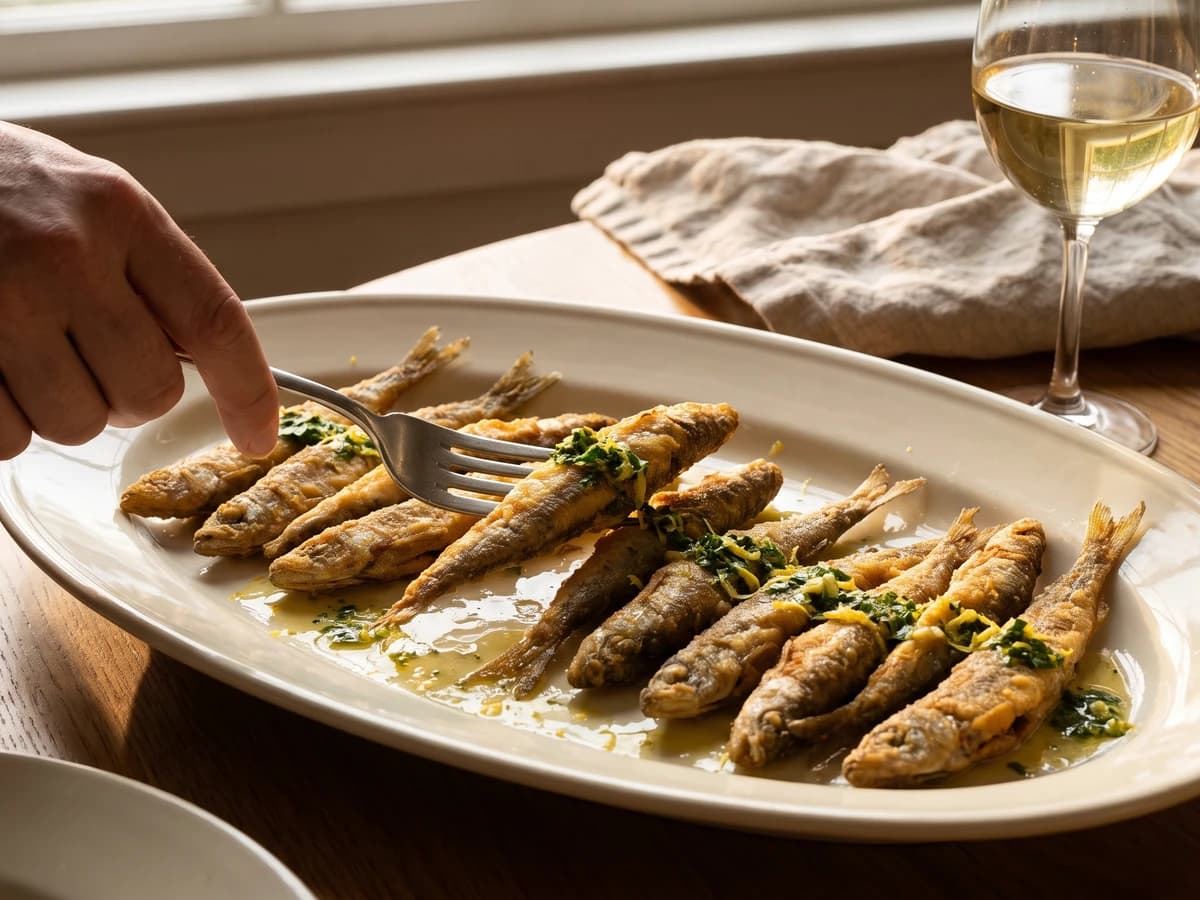
Éperlans à l’Anglaise turns small fish into a lesson in disciplined coating: boned smelts under a close, crisp crumb, pan-fried in clarified butter and finished with bright, half-melted maître d’hôtel butter.

Chef Juliette
Tiny smelts, shallot, mushrooms, white wine, gratin sauce, and fine bread raspings meet a fierce oven, where the fish must turn tender in the same breath the buttered crust bronzes.