
Chef Juliette
John Dory (St. Pierre)
John Dory has the delicacy of sole and the firmness of turbot. A light flouring, a quick butter sauté, and nut-brown beurre noisette show exactly why looks never mattered.
A cooking platform built around craft, culture, and the stories behind what we eat.
Created by Chef Juliette
Based on No. 783, The Crimping of Fish, from Le Guide Culinaire (1907) by Auguste Escoffier
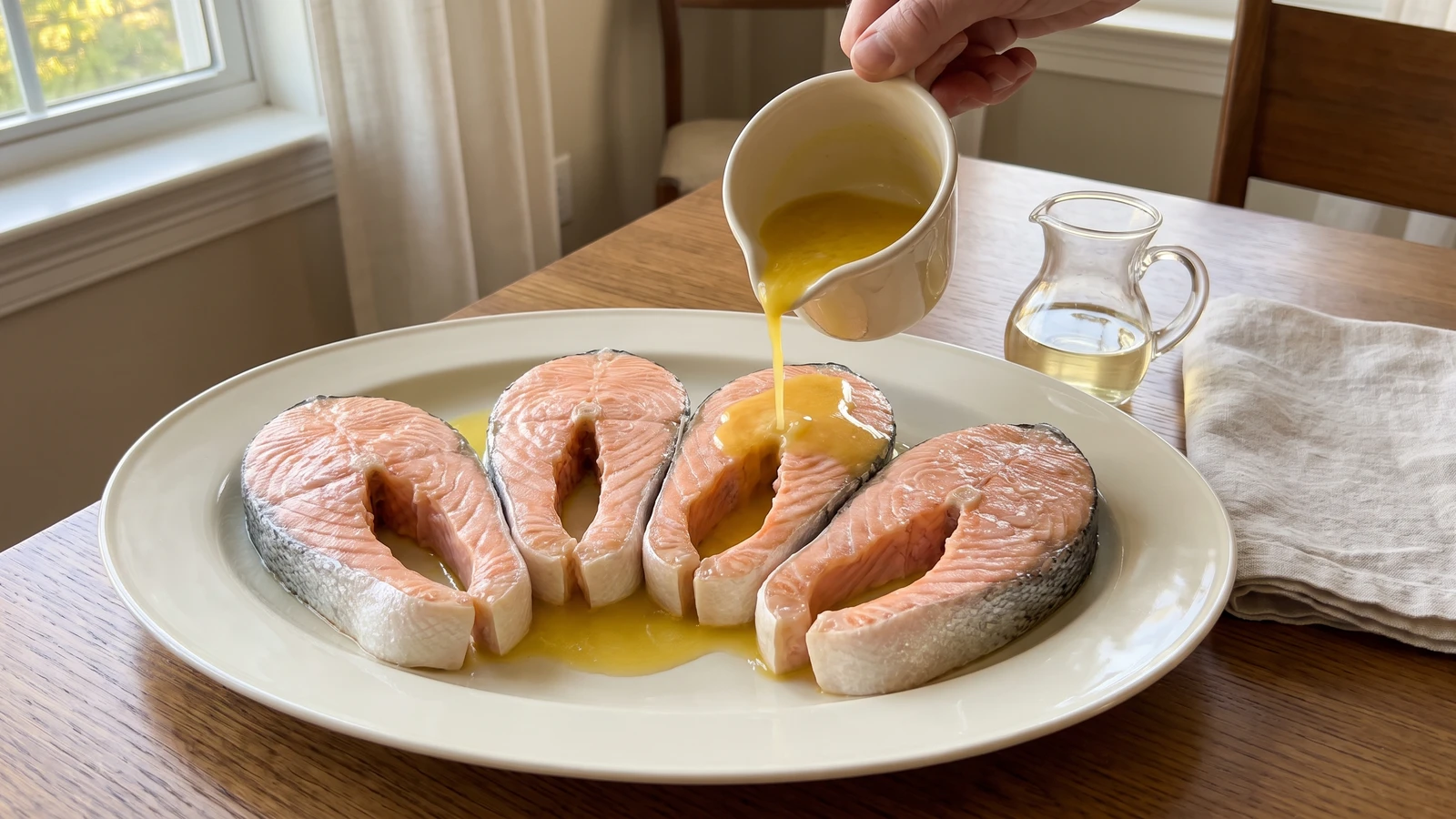
Poisson crimpé à l’anglaise turns exceptional freshness, an icy soak, and exact boiling into salmon with a clean, firm bite, served generously with beurre monté and its own cooking liquor.
Poisson crimpé à l’anglaise (English-style crimped salmon) teaches a severe but useful truth: crimping begins before the pan. The fish must be cut while its flesh can still contract, before rigor has passed, because an icy soak firms remarkable freshness but cannot put freshness back. That is the one true thing to know before you begin.
The source assumed fish coming straight from the water, a kettle large enough for a whole salmon, and a saucier ready with a suitable accompaniment. For one cook, one stove, one evening, the fishmonger cuts four thick steaks immediately after humane dispatch; those crosscuts are the source's own sliced-fish method and spare you the whole-fish kettle. A wide pot replaces it, an instant-read thermometer guards the final minute, and the source's freely chosen sauce becomes beurre monté made with the fish's cooking liquor and real butter. The dedicated kettle and brigade hands are scaffolding. Immediate cutting, the full icy soak, salted-water boiling, and the abrupt stop at doneness are the dish, and they stay.
Properly crimped salmon contracts into neat, firm flakes without becoming dry, its pale coral flesh glossed with butter and sharpened by a spoonful of clear, savory liquor. The last minute decides everything. Lift each steak the instant its center is cooked, because no sauce can return moisture once the fish has surrendered it.
Crimping belongs to English fish cookery, particularly the handling of salmon, fresh cod, haddock, and skate, and the French classical repertoire records it plainly as an English specialty. The physical effect comes from cutting extremely fresh fish and immersing it in very cold water, which intensifies muscular contraction; skate is first skinned on both faces and divided into large pieces. Generations of connoisseurs have disagreed about whether the result tastes better, but the canon is unequivocal about its cooking: salted water, followed by an immediate stop at the precise point of doneness.
Quantity
4 steaks, 2 pounds (900 g) total, each about 1½ inches (4 cm) thick
scaled and cut immediately after humane dispatch
Quantity
8 cups (1.9 liters / 1.9 kilograms)
for soaking
Quantity
4 cups (950 ml / 450 g)
Quantity
16 cups (3.8 liters / 3.8 kilograms)
for cooking
Quantity
2 tablespoons (30 ml / 36 g)
Quantity
¾ cup (180 ml / 170 g)
cut into small cubes
Quantity
1 tablespoon (15 ml / 15 g)
only if needed to rescue the beurre monté
| Ingredient | Quantity |
|---|---|
| bone-in, skin-on salmon steaksscaled and cut immediately after humane dispatch | 4 steaks, 2 pounds (900 g) total, each about 1½ inches (4 cm) thick |
| very cold waterfor soaking | 8 cups (1.9 liters / 1.9 kilograms) |
| ice cubes | 4 cups (950 ml / 450 g) |
| waterfor cooking | 16 cups (3.8 liters / 3.8 kilograms) |
| fine sea salt | 2 tablespoons (30 ml / 36 g) |
| cold unsalted buttercut into small cubes | ¾ cup (180 ml / 170 g) |
| cold water (optional)only if needed to rescue the beurre monté | 1 tablespoon (15 ml / 15 g) |
Arrange the freshly cut salmon steaks in one layer in a nonreactive bowl. Add the very cold water and enough ice to hold the bath below 40°F (4°C), then refrigerate for 1 hour. The flesh should tighten, the cut edges should draw inward, and the skin may curl slightly. Keep every piece submerged. If the bath warms, replace the melting ice immediately; if the fish shows no contraction after an hour, do not soak it longer because it will only become waterlogged. Drain it and continue as boiled salmon, knowing that true crimping required fresher fish.
While the fish completes its soak, combine the cooking water and sea salt in a wide 6 to 8-quart (5.7 to 7.6-liter) pot that can hold the steaks in one layer. Bring it to a full boil. Warm the serving platter and two sauceboats with hot water, then dry them thoroughly just before serving. Drain the salmon and discard every drop of the raw soaking water.
Lower the cold steaks into the boiling salted water with a broad perforated spatula. Cover only until the water returns to a boil, then uncover and reduce the heat enough to maintain quiet, steady bubbling rather than a violent roll. Begin checking after 6 minutes by inserting an instant-read thermometer sideways into the thickest flesh beside the bone. Lift each steak separately the instant it reaches 145°F (63°C), usually after 7 to 10 minutes. The flesh should be opaque at the bone and separate into moist, firm flakes. If the water begins rolling hard enough to split the fish, pull the pot off the heat at once and finish in the hot liquor off the flame, checking every 30 seconds.
Transfer the salmon to the warm platter and cover it loosely. Ladle 1 cup (240 ml) of clear cooking liquor into one warm sauceboat. Put another 3 tablespoons (45 ml) of the liquor in a small saucepan and bring it just to a simmer, then lower the heat completely. Whisk in the cold butter a few cubes at a time, allowing each addition to melt almost fully before adding the next. Keep the beurre monté warm beside the heat but never let it boil. If it separates into yellow fat and watery streaks, stop. Ça se rattrape: put the optional tablespoon of cold water in a clean pan and whisk the broken sauce into it one spoonful at a time until the emulsion returns.
Spoon enough beurre monté over the salmon to give each steak a generous gloss, then pour the remainder into the second warm sauceboat. Bring both boats to the table, the butter for richness and the clear fish liquor for spooning around the flesh exactly as the source directs. Serve immediately while the flakes remain moist and cleanly set. À table!
1 serving (about 205g)
Culinary guides, cultural storytelling, and the editorial depth that makes cooking meaningful.
Discover Culinary ExplorerChef Juliette
John Dory has the delicacy of sole and the firmness of turbot. A light flouring, a quick butter sauté, and nut-brown beurre noisette show exactly why looks never mattered.

Chef Juliette
Fresh haddock proves its delicacy in the meunière pan: a fine flour crust, moist pearly flakes, and beurre noisette sharpened with lemon and parsley, ready from one skillet in half an hour.
Chef Juliette
Éperlans à l’Anglaise turns small fish into a lesson in disciplined coating: boned smelts under a close, crisp crumb, pan-fried in clarified butter and finished with bright, half-melted maître d’hôtel butter.

Chef Juliette
Tiny smelts, shallot, mushrooms, white wine, gratin sauce, and fine bread raspings meet a fierce oven, where the fish must turn tender in the same breath the buttered crust bronzes.