
Chef Juliette
Bouillabaisse à la Marseillaise
Marseille's great fish stew, saffron-gold and garlic-scented, proves that a hard boil can be the careful choice: it binds olive oil into broth before the whole pot meets bread.
A cooking platform built around craft, culture, and the stories behind what we eat.

Created by Chef Juliette
Based on No. 774, Turtle, from Le Guide Culinaire (1907) by Auguste Escoffier
Consommé de tortue asks for patience, not pomp: a deep amber broth clarified until transparent, carrying tender turtle meat and a measured pour of dry sherry to the dinner table.
Consommé de tortue au Xérès (clarified turtle soup with sherry) teaches the sternest lesson in the soup pot: clarity comes from gentleness. The broth may be deep amber and intensely savory, but it must remain transparent enough to see the tender dice beneath it. Before touching a pan, know the one true thing: once the clarification raft rises, stirring stops and boiling is forbidden.
The original entry assumed a specialist firm to dress a whole turtle, a stockpot always working, and a saucier free to clarify great quantities in stages. A home kitchen needs none of that scaffolding. Use cleaned, inspected, legally sourced freshwater turtle, build the fond in an 8-quart pressure cooker, then clarify once with turtle meat and egg whites. The butchery, vessel, and quantity have changed because they belonged to the brigade and its supply chain; the extraction, clarification, and dry Xérès remain because they are the dish. One cook, one stove, one evening.
The raft is the step that matters. Start it cold, warm it slowly, and let it form its own lid over the broth. If it breaks, don't pour out the pot. Ça se rattrape, and the method gives you a second clarification.
Turtle soup is not a provincial French dish. It reached Parisian grand kitchens from London's banquet and maritime table, where Caribbean green turtle was turned into a rich clear soup, and French cooks fitted it to the consommé family with formal clarification and a finish of fortified wine. Specialist firms did the difficult dressing; the classical kitchen reserved most flesh for soup, with flippers occasionally braised au Madère, but the protected sea turtle tied to that history must never be sourced now, so legal, inspected freshwater turtle is the only responsible route.
Quantity
2½ pounds (1.13 kg)
Quantity
8 ounces (225 g)
kept raw and cold for clarification
Quantity
3 tablespoons (45 ml / 42 g)
Quantity
3 medium, about 3 cups (710 ml / 450 g)
diced and divided
Quantity
3 medium, about 2 cups (475 ml / 300 g)
diced and divided
Quantity
4 large stalks, about 1½ cups (355 ml / 200 g)
diced and divided
Quantity
1 small, about 1½ cups (355 ml / 180 g)
white and pale green parts sliced and rinsed
Quantity
2 tablespoons (30 ml / 34 g)
Quantity
14 cups (3.3 liters / 3.3 kg)
Quantity
1
Quantity
1 teaspoon (5 ml / 2 g)
Quantity
2 teaspoons (10 ml / 12 g), plus more to taste
Quantity
1 medium, about 1 cup (240 ml / 180 g)
seeded and chopped
Quantity
4 large, about ½ cup (120 ml / 120 g)
Quantity
2 large, about ¼ cup (60 ml / 60 g)
for rescuing a cloudy consommé
Quantity
½ cup (120 ml / 115 g)
divided
| Ingredient | Quantity |
|---|---|
| cleaned bone-in freshwater turtle meat from a licensed, legal supplier | 2½ pounds (1.13 kg) |
| cleaned boneless freshwater turtle meatkept raw and cold for clarification | 8 ounces (225 g) |
| unsalted butter | 3 tablespoons (45 ml / 42 g) |
| yellow onionsdiced and divided | 3 medium, about 3 cups (710 ml / 450 g) |
| carrotsdiced and divided | 3 medium, about 2 cups (475 ml / 300 g) |
| celerydiced and divided | 4 large stalks, about 1½ cups (355 ml / 200 g) |
| leekwhite and pale green parts sliced and rinsed | 1 small, about 1½ cups (355 ml / 180 g) |
| tomato paste | 2 tablespoons (30 ml / 34 g) |
| cold water | 14 cups (3.3 liters / 3.3 kg) |
| bouquet garni (parsley stems, thyme, and bay tied together) | 1 |
| black peppercorns | 1 teaspoon (5 ml / 2 g) |
| fine sea salt | 2 teaspoons (10 ml / 12 g), plus more to taste |
| ripe tomatoseeded and chopped | 1 medium, about 1 cup (240 ml / 180 g) |
| egg whites | 4 large, about ½ cup (120 ml / 120 g) |
| additional egg whites (optional)for rescuing a cloudy consommé | 2 large, about ¼ cup (60 ml / 60 g) |
| dry oloroso or amontillado sherrydivided | ½ cup (120 ml / 115 g) |
Keep the boneless clarification meat covered in the cold. Do not rinse either portion; splashing raw turtle around the sink spreads bacteria without improving the soup. Pat the bone-in pieces dry with paper towels and cut any very large pieces to about 2 inches. Reserve one-third of the diced onions, carrots, and celery in the cold for the clarification. Use a separate board and knife for the raw meat, then wash your hands and sanitize both before continuing.
Melt the butter in the uncovered pressure cooker over medium-high heat. Brown the bone-in turtle in small batches until each piece carries a deep bronze crust, moving it only after it releases easily. Set each batch aside. Lower the heat and add the unreserved onions, carrots, celery, and leek. Cook for 8 to 10 minutes, scraping often, until the vegetables soften and take color. Stir in the tomato paste for 2 minutes, then add 1 cup of the water and scrape up the fond, the browned deposit on the pot floor. That fond is the broth's backbone.
Return the browned turtle and its juices to the cooker. Add the remaining water, bouquet garni, peppercorns, and measured salt. Lock the lid, bring to high pressure, and cook for 60 minutes. Remove the cooker from the heat and let the pressure fall naturally for 20 minutes before opening. The meat must reach at least 165°F (74°C) and pull readily from the bones. If it remains tight, simmer it uncovered for another 20 to 30 minutes. Tough meat isn't a failure; it simply hasn't finished.
Lift the turtle onto a tray. Strain the broth through a fine sieve into a fat separator, discarding the spent vegetables, peppercorns, and bouquet garni. Let the meat cool only until it can be handled, then remove every bone carefully and dice 12 ounces (340 g) of the tender flesh into neat ½-inch pieces. Cover and refrigerate the dice. Remove the fat from the broth, then measure it into a clean pot. Reduce gently or add water as needed to obtain exactly 10 cups (2.4 liters). Set the pot in an ice bath and stir occasionally until the broth is no warmer than 70°F (21°C). A raft added to hot broth seizes before it can gather the impurities.
Finely mince the raw boneless turtle. Combine it in a bowl with the reserved onions, carrots, and celery, the chopped tomato, and the 4 egg whites, whisking only until the whites loosen. Stir this mixture into the cool broth. Place the pot over medium-low heat and stir slowly, scraping the bottom, as the broth warms. The proteins will gather into a thick grey-brown raft and rise to the surface. Once the raft closes over the broth, stop stirring. Open a 2-inch chimney in its center and hold the liquid at the barest tremble for 35 to 40 minutes, ladling a little broth through the chimney now and then. Never let it boil.
Dampen two layers of cheesecloth with cold water, wring them out, and use them to line a fine sieve over a clean heavy pot. Enlarge the chimney at one edge of the raft and ladle the clear broth through the cloth a little at a time. Do not tip the whole raft into the sieve, and never press it. Pressing forces every particle you just captured back into the consommé. If the first ladle carries sediment, change the cloth and pass that portion through again.
Bring the clarified broth to a gentle simmer and reduce it to 7½ cups (1.78 liters), skimming away any pale foam. Taste only after reducing, then adjust the salt. If it tightens too far or tastes too salty, loosen it with unsalted hot water until its balance returns. Warm the diced turtle in 1 cup of the consommé for 3 to 4 minutes, lift the meat into warmed soup bowls, and return the warming liquid to the pot through the fine sieve. Remove from the heat and stir in 6 tablespoons (90 ml) of the Xérès. The broth should taste of turtle first, sherry second.
Ladle the limpid amber consommé over the diced turtle without disturbing the bowls. Offer the remaining 2 tablespoons (30 ml) of Xérès at the table so each guest may add a few drops. No herb branch, no decorative flourish. Clarity, tenderness, and the scent of dry fortified wine are enough. À table!
1 serving (about 240g)
Culinary guides, cultural storytelling, and the editorial depth that makes cooking meaningful.
Discover Culinary ExplorerChef Juliette
Marseille's great fish stew, saffron-gold and garlic-scented, proves that a hard boil can be the careful choice: it binds olive oil into broth before the whole pot meets bread.

Chef Juliette
Waterzoi asks fresh, bone-in river fish to thicken its own buttery broth, with parsley root and pepper for company. No flour, no stockpot, just a brisk simmer watched closely.
Chef Juliette
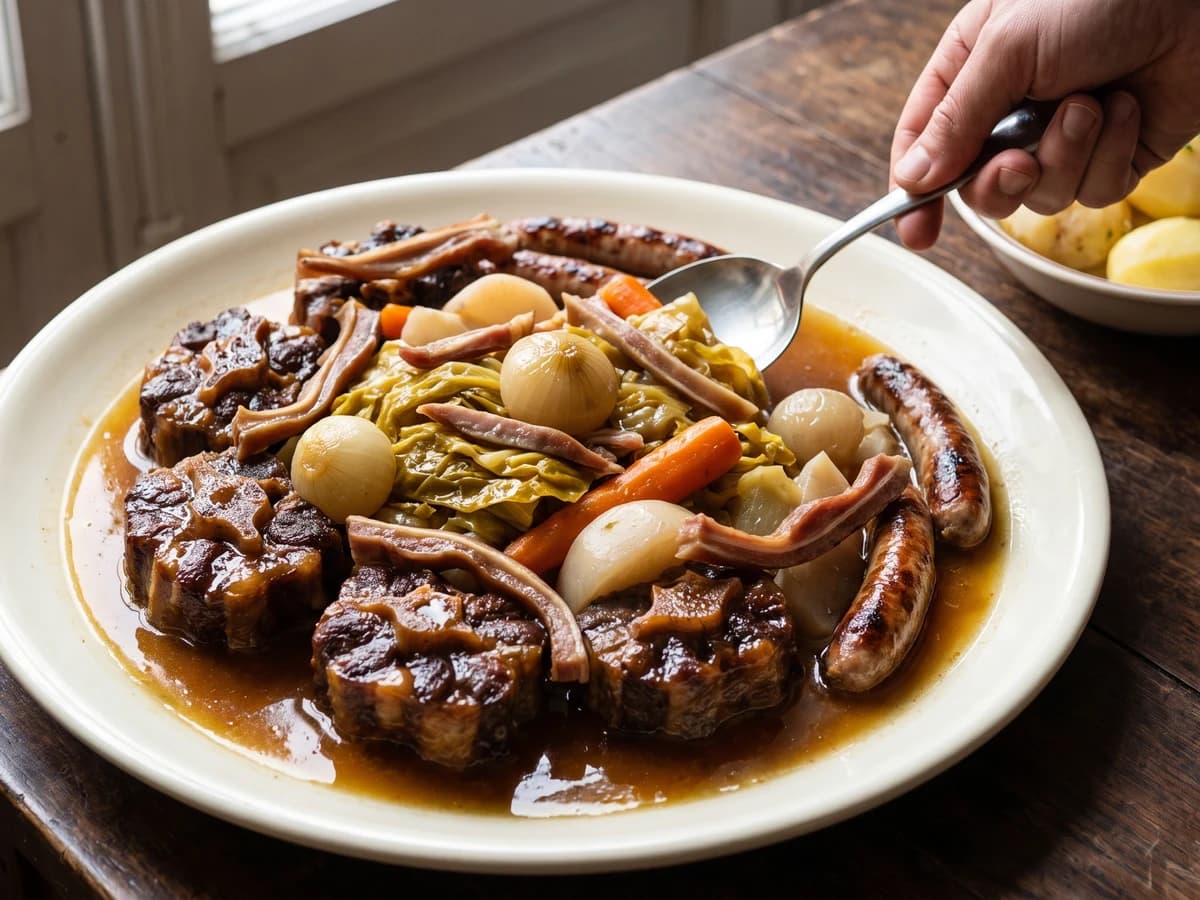
Queue de Bœuf en Hochepot gathers oxtail, pig's trotter and ear, cabbage, roots, and grilled chipolatas around a clear, gelatin-rich broth whose quiet simmer keeps every piece tender and distinct.

Chef Juliette
Beef shoulder larded with bacon, sharpened by red wine and vinegar, then sealed with garlic, vegetables, and dry lemon peel until the low oven turns it yielding and the gravy darkly glossy.