
Chef Juliette
John Dory (St. Pierre)
John Dory has the delicacy of sole and the firmness of turbot. A light flouring, a quick butter sauté, and nut-brown beurre noisette show exactly why looks never mattered.
A cooking platform built around craft, culture, and the stories behind what we eat.

Created by Chef Juliette
Based on No. 769, Nonat, from Le Guide Culinaire (1907) by Auguste Escoffier
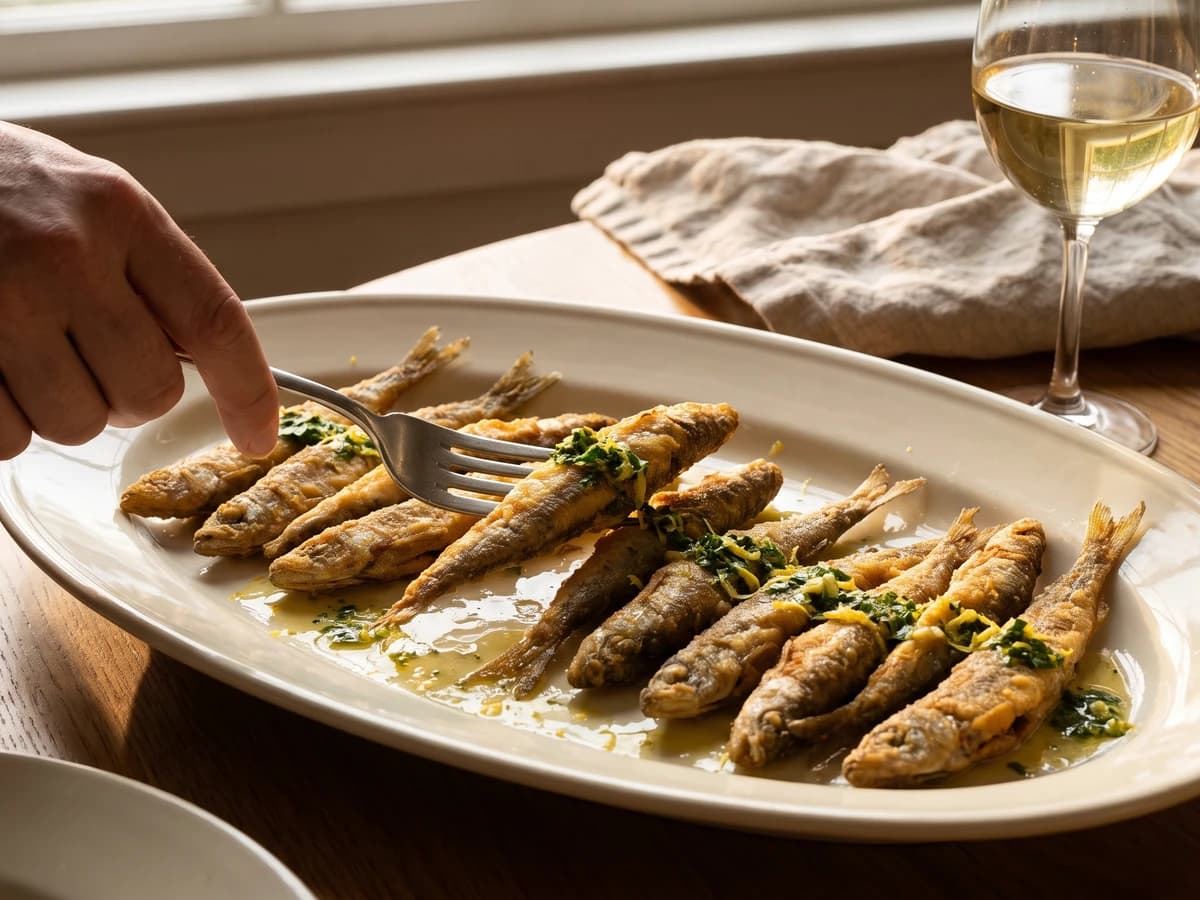
Nonat needs only flour, clean frying oil, and nerve: dry the little fish thoroughly, fry them uncrowded, and carry the golden tangle straight to the table while every tail is crisp.
Nonat (tiny Niçois fish) teaches the first law of friture, deep-frying: water is the enemy. Dry these little fish properly and the flour becomes a fine crisp veil; leave them damp and it turns pasty while the oil spits its objections. Fried well, Nonat arrives as a loose golden tangle, delicate enough to eat whole and generous enough to anchor a summer lunch.
The old formula is brief because its kitchen assumed baskets of minute fish, frying fat kept ready, and enough hands to dust and fry each order. This dish never required a saucier, a stockpot, or a salamander. Its brigade scaffolding was simply volume and a fryer held hot. At home, a heavy saucepan, a thermometer, and four small batches do the same work for four people. The book's replacement, whitebait, stays exactly as given when true nonat cannot be found. What changed is scale and equipment, not intent. One cook, one stove, one evening.
Drying is the step that decides Nonat. Blot every fish, flour only the batch about to be fried, and keep the oil hot enough that the coating sets at once. Everything after that moves quickly.
Nonat belongs to Nice and the Côte d'Azur, where minute, nearly transparent Mediterranean fish are eaten whole in friture, with no attempt to bone or fillet them. Classical French manuals carried the Niçois name into professional kitchens and directed English cooks to whitebait when the local catch could not be had, because it behaves similarly in flour and hot fat. The substitution concerns size and technique, not a claim that the two catches are the same species.
Quantity
about 5 cups (1.2 L / 1⅓ lb / 600 g)
left whole and thawed if frozen
Quantity
¾ cup (180 ml / 90 g)
Quantity
6 cups (1.4 L / 1.3 kg)
for frying
Quantity
1½ teaspoons (7.5 ml / 9 g)
Quantity
1
cut into wedges
| Ingredient | Quantity |
|---|---|
| nonat or very small whitebaitleft whole and thawed if frozen | about 5 cups (1.2 L / 1⅓ lb / 600 g) |
| all-purpose flour | ¾ cup (180 ml / 90 g) |
| refined olive oil or peanut oilfor frying | 6 cups (1.4 L / 1.3 kg) |
| fine sea salt | 1½ teaspoons (7.5 ml / 9 g) |
| lemon (optional)cut into wedges | 1 |
Drain the nonat thoroughly. Rinse them briefly only if they carry sand, then spread them between clean kitchen towels and blot with a gentle hand until the surfaces feel dry rather than slippery. Leave the fish whole, including heads and bones; at this size, that is the dish. Don't salt them yet, because salt draws moisture back to the surface.
Pour the oil into a 3-quart (2.8 L) heavy saucepan, leaving the vessel no more than half full. Clip on a thermometer and heat the oil over medium heat to 175 to 180°C (350 to 355°F). Set a wire rack over a rimmed tray beside the stove. Keep the pan handle turned inward and never leave hot oil unattended.
Divide the fish loosely into four batches. Put the flour in a wide bowl, add one batch of nonat, and turn them gently until every fish wears a thin, even coat. Shake them in a fine-mesh sieve to remove every loose pocket of flour. Flour only what will enter the oil immediately; if coated fish wait, their moisture turns the flour to paste.
Lower the floured fish carefully into the oil and stir once with a wide skimmer so they separate. Fry for 1½ to 2 minutes, maintaining 175 to 180°C (350 to 355°F), until the coating is pale gold and the fish feel crisp from head to tail. Lift them to the rack and let the oil recover before coating the next batch. If a batch emerges pale and flexible because the oil cooled, let it drain while the oil returns to 180°C (355°F), then refry it for 20 to 30 seconds. Ça se rattrape. If the fish darken before they crisp, the oil is too hot; lower the heat before the next batch.
Season each batch with a little of the sea salt while the coating is still hot, then heap all the nonat loosely on a warm platter. Serve at once, with lemon wedges if you want their brightness. No sauce is needed, and a heavy one would smother what you worked to preserve. Take the platter outdoors, pour a cold glass, and let everyone eat with their fingers. À table!
1 serving (about 150g)
Culinary guides, cultural storytelling, and the editorial depth that makes cooking meaningful.
Discover Culinary ExplorerChef Juliette
John Dory has the delicacy of sole and the firmness of turbot. A light flouring, a quick butter sauté, and nut-brown beurre noisette show exactly why looks never mattered.

Chef Juliette
Fresh haddock proves its delicacy in the meunière pan: a fine flour crust, moist pearly flakes, and beurre noisette sharpened with lemon and parsley, ready from one skillet in half an hour.
Chef Juliette
Éperlans à l’Anglaise turns small fish into a lesson in disciplined coating: boned smelts under a close, crisp crumb, pan-fried in clarified butter and finished with bright, half-melted maître d’hôtel butter.

Chef Juliette
Tiny smelts, shallot, mushrooms, white wine, gratin sauce, and fine bread raspings meet a fierce oven, where the fish must turn tender in the same breath the buttered crust bronzes.