
Chef Juliette
John Dory (St. Pierre)
John Dory has the delicacy of sole and the firmness of turbot. A light flouring, a quick butter sauté, and nut-brown beurre noisette show exactly why looks never mattered.
A cooking platform built around craft, culture, and the stories behind what we eat.

Created by Chef Juliette
Based on No. 756, Pike, from Le Guide Culinaire (1907) by Auguste Escoffier
Whole pike takes its blue-grey sheen beneath hot vinegar, poaches gently in court-bouillon, and reaches the table with a caper sauce mounted in cold butter, a river fish treated with discipline, not fuss.
Brochet au bleu, sauce aux câpres (whole pike in court-bouillon with caper sauce) teaches that freshness can be a technique. The blue-grey bloom is not decoration and not a sauce: hot vinegar meets the natural film on an unscaled, just-cleaned fish. Before you touch the pan, know this one thing. Don't scale, scrub, or rinse the pike, because once that film is gone, no amount of vinegar can call it back.
The original entry assumed a fish kettle, court-bouillon already at hand, and a saucier to finish the caper sauce while someone else watched the fish. It needs neither a salamander nor a stockpot never off the fire. A deep roasting pan, a fresh court-bouillon made in twenty minutes, and that same liquor thickened with a pale roux give the home cook the honest equivalent. The brigade scaffolding goes; the acid bloom, gentle poach, and real-butter sauce stay. One cook, one stove, one evening.
Done properly, the flesh lifts in moist ivory flakes and the sauce falls from the spoon in a glossy ribbon, bright with capers but still tasting first of fish and butter. Watch the poach, not the clock. The liquor must tremble without boiling; that gentle heat is the step that decides whether lean pike stays succulent or tightens.
Brochet holds a particular place in Lyonnais cooking, where pike from the Rhône-Saône waters and the nearby ponds of the Dombes passed into the city's quenelles. Its lean flesh and troublesome forked bones explain the preference for pounding and sieving it into forcemeat, a practical method that turned a difficult fish to silk. The wider classical repertoire did not confine pike to quenelles: larger fish were crimped or poached whole au bleu with parsley or caper sauce, while small pike went meunière or into the frying pan.
Quantity
1 fish, 2¾ to 3¼ pounds (1.25 to 1.5 kg)
gutted and gilled but unscaled and unwashed
Quantity
10 cups (2.4 L / 2.4 kg), plus up to 2 cups (475 ml / 475 g) if needed
Quantity
2 cups (475 ml / about 475 g)
Quantity
1 cup (240 ml / about 240 g)
divided
Quantity
1 medium, about 1½ cups (360 ml / 180 g)
thinly sliced
Quantity
1 large, about 1 cup (240 ml / 130 g)
thinly sliced
Quantity
1 large stalk, about ¾ cup (180 ml / 80 g)
thinly sliced
Quantity
1
Quantity
1 teaspoon (5 ml / 3 g)
lightly crushed
Quantity
1½ tablespoons (22 ml / 27 g)
Quantity
2 cups (475 ml / about 475 g)
reserved for the sauce
Quantity
6 tablespoons (90 ml / 85 g)
2 tablespoons for the roux; 4 tablespoons chilled and diced for finishing
Quantity
¼ cup (60 ml / 30 g)
Quantity
¼ cup (60 ml / 45 g)
drained and rinsed
Quantity
1 tablespoon (15 ml / 15 g)
Quantity
¼ teaspoon (1.25 ml / 0.6 g)
Quantity
2 tablespoons (30 ml / 8 g)
finely chopped
| Ingredient | Quantity |
|---|---|
| very fresh whole pikegutted and gilled but unscaled and unwashed | 1 fish, 2¾ to 3¼ pounds (1.25 to 1.5 kg) |
| cold water | 10 cups (2.4 L / 2.4 kg), plus up to 2 cups (475 ml / 475 g) if needed |
| dry white wine | 2 cups (475 ml / about 475 g) |
| white wine vinegardivided | 1 cup (240 ml / about 240 g) |
| yellow onionthinly sliced | 1 medium, about 1½ cups (360 ml / 180 g) |
| carrotthinly sliced | 1 large, about 1 cup (240 ml / 130 g) |
| celerythinly sliced | 1 large stalk, about ¾ cup (180 ml / 80 g) |
| bouquet garni of parsley stems, thyme, and bay leaf | 1 |
| black peppercornslightly crushed | 1 teaspoon (5 ml / 3 g) |
| fine sea salt | 1½ tablespoons (22 ml / 27 g) |
| strained court-bouillon from the quantity abovereserved for the sauce | 2 cups (475 ml / about 475 g) |
| unsalted butter2 tablespoons for the roux; 4 tablespoons chilled and diced for finishing | 6 tablespoons (90 ml / 85 g) |
| all-purpose flour | ¼ cup (60 ml / 30 g) |
| brined capersdrained and rinsed | ¼ cup (60 ml / 45 g) |
| fresh lemon juice | 1 tablespoon (15 ml / 15 g) |
| ground white pepper | ¼ teaspoon (1.25 ml / 0.6 g) |
| flat-leaf parsleyfinely chopped | 2 tablespoons (30 ml / 8 g) |
Ask the fishmonger to remove the gills and entrails through the shortest practical belly cut while leaving the head, tail, scales, skin, and natural surface film intact. Keep the fish cold. Do not rinse or wipe its exterior; clean only the cavity with a damp paper towel, taking care not to touch the skin more than necessary. Lay a double thickness of damp cheesecloth across a deep roasting pan, leaving enough overhang to form a lifting sling, and settle the pike on it. Wash your hands, knife, and board before handling anything else.
Combine the water, wine, ½ cup (120 ml / about 120 g) of the vinegar, onion, carrot, celery, bouquet garni, peppercorns, and salt in a large pot. Bring to a gentle simmer and cook uncovered for 20 minutes, until the liquor smells clearly of vegetables and wine and the vinegar has softened from sharp to brisk. Strain it, discard the aromatics, and reserve 2 cups (475 ml / about 475 g) for the sauce. Keep the remaining court-bouillon hot without letting it boil.
Make a roux, butter and flour cooked together: melt 2 tablespoons (30 ml / 28 g) of the butter in a saucepan over medium-low heat, stir in the flour, and cook for 2 minutes without letting it brown. Whisk in the reserved 2 cups of hot court-bouillon a little at a time, making each addition smooth before adding the next. Simmer gently for 6 to 8 minutes, whisking often, until the sauce lightly coats the back of a spoon. If it becomes lumpy, whisk firmly and pass it through a fine sieve. Cover and set it off the heat.
Heat the remaining ½ cup (120 ml / about 120 g) vinegar just to a simmer. Pour it slowly over the upper surface of the pike from close range, keeping the pan between you and the liquid so nothing splashes back. The skin should take on a blue-grey or silvery cast, sometimes vivid, sometimes subtle. If it stays olive-grey, don't add more acid; the natural film was lost before the fish reached you, and more vinegar will only sour it. Continue with confidence as brochet poché.
Heat the oven to 300°F (150°C). Pour the hot court-bouillon around the pike until it reaches halfway to two-thirds up its sides, adding some of the extra water only if the shape of your pan requires it. Cover first with parchment, then tightly with a lid or foil. Poach for 25 to 40 minutes, basting the exposed upper surface once or twice without scraping its skin. The liquor should tremble, never boil. If you find active bubbling, pull the pan from the oven, lower the heat to 275°F (135°C), and add ½ cup (120 ml / 120 g) cool water. Ça se rattrape if you catch it quickly. The fish is done when the thickest flesh just behind the head reaches 145°F (63°C) and separates from the backbone in moist flakes.
Use the cheesecloth sling to lift the pike onto a warm long platter, then cover it loosely with parchment while you finish the sauce. Bring the sauce base back to the barest simmer with the capers, lemon juice, and white pepper. Remove it from the heat and montez au beurre, whisk in the remaining 4 tablespoons (60 ml / 57 g) cold butter a few pieces at a time until the sauce is glossy and falls in a broad ribbon. Stir in the parsley. If the butter begins to separate into greasy beads, the pan is too hot; whisk in 1 tablespoon (15 ml / 15 g) cold poaching liquor off the heat. Ça se rattrape. If the sauce is too thick, loosen it with more poaching liquor, one spoonful at a time.
Spoon a little sauce around the pike, leaving enough blue-grey skin visible to show the au bleu. Cut along the backbone from behind the head toward the tail, then lift the upper flesh away in serving portions while keeping the knife close to the skeleton. Pike carries forked Y-bones above the ribs, so inspect every portion carefully before serving. Once the upper side is cleared, lift away the central skeleton and divide the lower fillet. Spoon the remaining sauce over each portion at the table. À table!
1 serving (about 295g)
Culinary guides, cultural storytelling, and the editorial depth that makes cooking meaningful.
Discover Culinary ExplorerChef Juliette
John Dory has the delicacy of sole and the firmness of turbot. A light flouring, a quick butter sauté, and nut-brown beurre noisette show exactly why looks never mattered.

Chef Juliette
Fresh haddock proves its delicacy in the meunière pan: a fine flour crust, moist pearly flakes, and beurre noisette sharpened with lemon and parsley, ready from one skillet in half an hour.
Chef Juliette
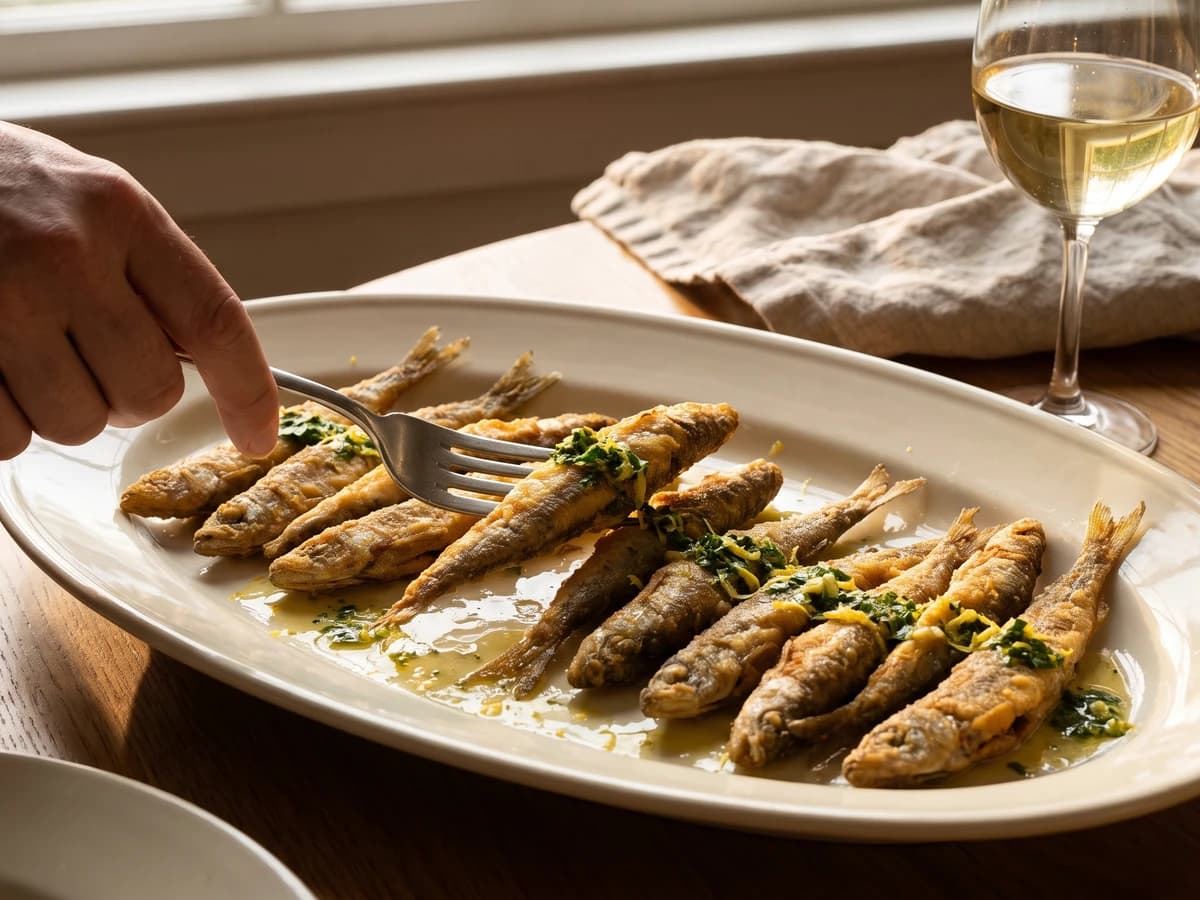
Éperlans à l’Anglaise turns small fish into a lesson in disciplined coating: boned smelts under a close, crisp crumb, pan-fried in clarified butter and finished with bright, half-melted maître d’hôtel butter.

Chef Juliette
Tiny smelts, shallot, mushrooms, white wine, gratin sauce, and fine bread raspings meet a fierce oven, where the fish must turn tender in the same breath the buttered crust bronzes.