
Chef Juliette
Bouillabaisse à la Marseillaise
Marseille's great fish stew, saffron-gold and garlic-scented, proves that a hard boil can be the careful choice: it binds olive oil into broth before the whole pot meets bread.
A cooking platform built around craft, culture, and the stories behind what we eat.

Created by Chef Juliette
Based on No. 752, Soupe aux Rognons, from Le Guide Culinaire (1907) by Auguste Escoffier
A brown roux gives this warming soup its body, briskly butter-seared kidney gives it character, and Madeira gives the final perfume. The lesson is timing: garnish at the last possible moment.
Soupe aux Rognons (kidney soup) teaches the discipline of keeping garnish and foundation apart until each is ready. The foundation is a roux brun (brown roux) loosened with good stock and simmered until smooth; the kidney is briskly tossed in butter and added only at service. Know one thing before you touch the pan: the kidney waits until the end.
The brigade formula assumed a stockpot never off the fire, a saucier tending the roux, a fine tamis, and enough service to justify separate holding pans. At home, use good unsalted stock, one heavy saucepan, a fine-mesh sieve, and a skillet for the last-minute garnish. I have brought the yield down to about two quarts; what changed is the volume, the stock source, and the sieve. The extra holding pans are scaffolding. The roux brun, separate kidney sear, and Madeira finish are the dish.
The finished soup should be chestnut-brown and lightly bound, with tender pieces of kidney under a glossy surface and Madeira rising at the first spoonful. Dry the kidney thoroughly and sear it in uncrowded batches; that last-minute toss in butter decides the dish.
Soupe aux rognons belongs to the Parisian classical dining room rather than a single provincial larder, drawing on the bourgeois table's practical affection for carefully prepared offal. Classical service transformed that thrift into precision: a roux-bound soup was held ready, while the kidney was cooked to order and Madeira added at the final moment. Despite its name, the kidney is not boiled into the broth; it remains a tender garnish, which is why the brisk toss in butter matters.
Quantity
6 tablespoons (90 ml / 85 g)
Quantity
2/3 cup (160 ml / 80 g)
Quantity
8 1/2 cups (2 liters / 2 kilograms)
cool or at room temperature
Quantity
1 small calf's kidney or 4 sheep's kidneys, about 1 pound (454 g) before trimming
membrane and white core removed, cut into large dice or thick slices
Quantity
2 tablespoons (30 ml / 28 g)
Quantity
1/3 cup (80 ml / 80 g)
Quantity
Up to 1 1/2 teaspoons (7.5 ml / 9 g)
Quantity
1/4 teaspoon (1.25 ml / 0.5 g)
| Ingredient | Quantity |
|---|---|
| unsalted butter for the roux | 6 tablespoons (90 ml / 85 g) |
| all-purpose flour | 2/3 cup (160 ml / 80 g) |
| good-quality unsalted veal or beef stockcool or at room temperature | 8 1/2 cups (2 liters / 2 kilograms) |
| calf's kidney or sheep's kidneysmembrane and white core removed, cut into large dice or thick slices | 1 small calf's kidney or 4 sheep's kidneys, about 1 pound (454 g) before trimming |
| unsalted butter for searing | 2 tablespoons (30 ml / 28 g) |
| medium-dry Madeira | 1/3 cup (80 ml / 80 g) |
| fine salt | Up to 1 1/2 teaspoons (7.5 ml / 9 g) |
| freshly ground white pepper | 1/4 teaspoon (1.25 ml / 0.5 g) |
Pull away the thin outer membrane from the kidney, separate the lobes if using calf's kidney, and cut out every firm white tube and piece of central fat. Cut the cleaned kidney into large dice about 3/4 inch (2 cm) across, or into thick slices. Blot it very dry and keep it chilled while the soup is made. Moisture prevents browning, while the white core remains tough however carefully you cook it.
Melt the 6 tablespoons of butter in a heavy saucepan over medium-low heat. Whisk in the flour, then cook for 15 to 20 minutes, stirring steadily across the floor and corners, until the roux is evenly chestnut-brown and smells of toasted hazelnuts. Patience is the soup here. A pale roux leaves a raw, floury taste; if you see black flecks or smell bitterness, begin again, because scorched flour cannot be hidden under stock or Madeira.
Take the saucepan off the heat. Reserve 1 cup of the stock, then whisk about 1 cup into the roux a little at a time, making a completely smooth, loose paste before adding the remaining stock in a steady stream. The roux may seize at first. Keep whisking. If lumps form, do not pour it out. Ça se rattrape: whisk vigorously off the heat or blend briefly with an immersion blender, then rely on the final straining to catch anything stubborn.
Return the saucepan to medium heat and bring the soup slowly to a bare simmer, whisking along the floor until it begins to thicken. Lower the heat and simmer gently for 35 minutes, stirring occasionally and skimming away surface foam. The finished base should lightly coat the back of a spoon and taste of stock and toasted roux, never raw flour. Pass it through a fine-mesh sieve into a clean saucepan, adjust the consistency with as much reserved stock as needed, and season cautiously with salt and white pepper. Hold it at the gentlest simmer.
Heat a wide skillet over medium-high heat and add the remaining 2 tablespoons of butter. When the foam subsides, add the kidney in two uncrowded batches and toss briskly until bronzed outside and just cooked through, about 3 to 4 minutes for dice or 45 to 60 seconds per side for slices. The center of the thickest piece should reach 160°F (71°C). Season only after searing. If the pan fills with grey liquid, lift the kidney out immediately, pour away the liquid, wipe and reheat the pan, then finish in smaller batches with a little of the remaining butter. Ça se rattrape.
Take the soup off the heat and stir in the Madeira. Taste once more for salt and white pepper, but do not boil after adding the wine or its perfume disappears. Divide the butter-seared kidney among warmed bowls, pour the soup over it, and serve at once. The kidney stays tender, the roux gives quiet body, and the Madeira arrives last. À table!
1 serving (about 240g)
Culinary guides, cultural storytelling, and the editorial depth that makes cooking meaningful.
Discover Culinary ExplorerChef Juliette
Marseille's great fish stew, saffron-gold and garlic-scented, proves that a hard boil can be the careful choice: it binds olive oil into broth before the whole pot meets bread.

Chef Juliette
Waterzoi asks fresh, bone-in river fish to thicken its own buttery broth, with parsley root and pepper for company. No flour, no stockpot, just a brisk simmer watched closely.
Chef Juliette
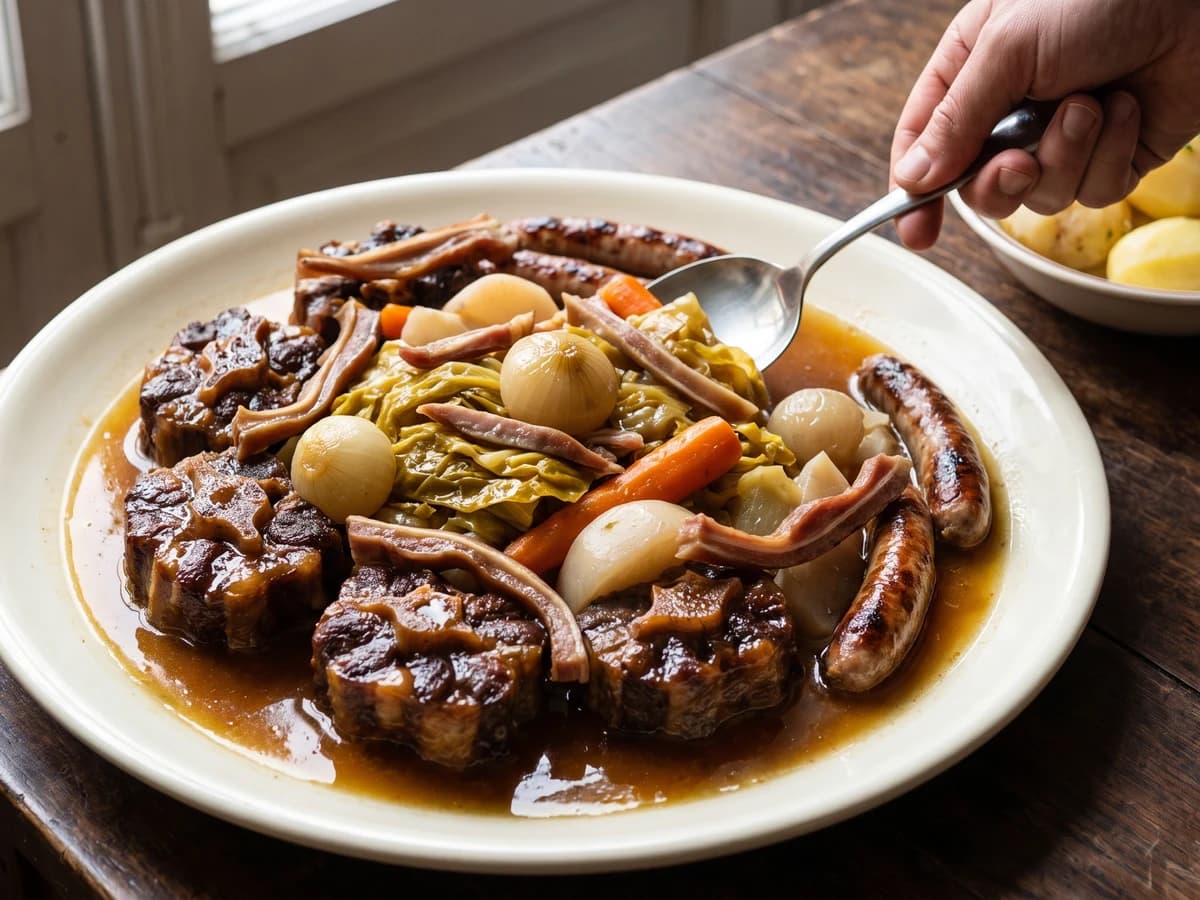
Queue de Bœuf en Hochepot gathers oxtail, pig's trotter and ear, cabbage, roots, and grilled chipolatas around a clear, gelatin-rich broth whose quiet simmer keeps every piece tender and distinct.

Chef Juliette
Beef shoulder larded with bacon, sharpened by red wine and vinegar, then sealed with garlic, vegetables, and dry lemon peel until the low oven turns it yielding and the gravy darkly glossy.