
Chef Juliette
Bouillabaisse à la Marseillaise
Marseille's great fish stew, saffron-gold and garlic-scented, proves that a hard boil can be the careful choice: it binds olive oil into broth before the whole pot meets bread.
A cooking platform built around craft, culture, and the stories behind what we eat.

Created by Chef Juliette
Based on No. 748, Mulligatawny Soup, from Le Guide Culinaire (1907) by Auguste Escoffier
A curried fowl soup made supple with cream, passed fine, and purified at a quiet simmer, with tender chicken in the tureen and rice à l'Indienne served properly apart.
Potage Mulligatawny (Anglo-Indian curried fowl soup) teaches control over spice: curry must warm in butter long enough to perfume the fat, never so fiercely that it turns bitter. That is the one true thing to know before you touch the pan. The finished soup should be smooth and clean-tasting, ochre from curry, softened rather than buried by cream, with tender chicken in the tureen and riz à l'Indienne beside it.
The original assumes a saucier on staff, white consommé never far from the fire, and a tammy ready for rubbing the soup perfectly fine. At home, prepared clear chicken stock, one heavy saucepan, and a sturdy fine-mesh sieve do that work honestly. The book's compact formula is doubled without changing its ratios to make about two quarts, and a young market chicken is poached in stages because its breast cooks before its legs. One cook, one stove, one evening.
The tammy and second pair of hands are brigade scaffolding; they can go. The fécule-and-curry base, its seven to eight minutes of cooking, and the twenty-minute despumation, the quiet skimming that purifies the soup, are the dish and must stay. Keep the curry pale and fragrant when it meets the butter. That brief moment decides the whole pot.
Mulligatawny's first home is the Tamil-speaking south of India, especially the Anglo-Indian table around Madras, and its name comes from milagu tannir, pepper water. A thin, peppery broth grew at that table into a substantial soup of fowl, curry seasoning, and rice, then passed into the French grand repertoire, where consommé, fécule, sieving, cream, and despumation gave it a classical finish. It belongs to no French region, and the misconception worth correcting is that the French formula invented the dish; it codified one Anglo-Indian branch of it.
Quantity
1 (about 4 lb / 1.8 kg)
jointed into 10 pieces
Quantity
1/2 cup (120 ml / 70 g)
cut into thin roundels
Quantity
1/2 cup (120 ml / 75 g)
cut into thin roundels
Quantity
12 sprigs (about 1/2 oz / 15 g)
Quantity
1/2 cup (120 ml / 50 g)
thinly sliced
Quantity
1/2 cup loosely packed (120 ml / 28 g)
Quantity
2 quarts (1.9 L / 1.9 kg)
Quantity
2 tablespoons (30 ml / 28 g)
Quantity
1 cup (240 ml / 160 g)
finely chopped
Quantity
1 tablespoon plus 1 teaspoon (20 ml / 16 g)
Quantity
2 teaspoons (10 ml / 4 g)
Quantity
1/2 cup (120 ml / 120 g)
divided
Quantity
Scant 2/3 cup (150 ml / 115 g)
Quantity
2 quarts (1.9 L / 1.9 kg)
Quantity
2 teaspoons (10 ml / 12 g), plus more only if needed
divided
| Ingredient | Quantity |
|---|---|
| medium whole chickenjointed into 10 pieces | 1 (about 4 lb / 1.8 kg) |
| carrotcut into thin roundels | 1/2 cup (120 ml / 70 g) |
| yellow onion for poachingcut into thin roundels | 1/2 cup (120 ml / 75 g) |
| flat-leaf parsley | 12 sprigs (about 1/2 oz / 15 g) |
| celery with tender leavesthinly sliced | 1/2 cup (120 ml / 50 g) |
| clean mushroom stems and parings | 1/2 cup loosely packed (120 ml / 28 g) |
| prepared white chicken consommé, or clear unsalted chicken stock | 2 quarts (1.9 L / 1.9 kg) |
| unsalted butter | 2 tablespoons (30 ml / 28 g) |
| yellow onion for the curried basefinely chopped | 1 cup (240 ml / 160 g) |
| fécule (potato starch) | 1 tablespoon plus 1 teaspoon (20 ml / 16 g) |
| mild curry powder | 2 teaspoons (10 ml / 4 g) |
| heavy creamdivided | 1/2 cup (120 ml / 120 g) |
| long-grain white rice | Scant 2/3 cup (150 ml / 115 g) |
| water for boiling the rice | 2 quarts (1.9 L / 1.9 kg) |
| fine sea saltdivided | 2 teaspoons (10 ml / 12 g), plus more only if needed |
Put the chicken pieces, carrot roundels, sliced onion, parsley, celery, mushroom parings, and consommé or stock into a heavy saucepan. Bring slowly to a boil, skimming away the grey foam as it rises, then lower the heat immediately so the liquid barely trembles. Remove the breast pieces once their thickest part reaches 165°F (74°C), usually after 25 to 30 minutes; continue cooking the legs and thighs until tender and safely cooked through, about 10 to 15 minutes longer. Cover the cooked pieces and keep them aside.
While the chicken cooks, rinse the rice until the water is nearly clear. Bring the measured water to a lively boil with 1 1/2 teaspoons of the salt, add the rice, and cook uncovered for 12 to 15 minutes, until tender but still distinct grain by grain. Drain very thoroughly, return it to the warm dry saucepan, and cover with a clean folded towel beneath the lid for 10 minutes. This is riz à l'Indienne, rice boiled in abundant salted water and drained dry. Keep it apart from the soup.
Pass the chicken cooking liquor through a fine-mesh sieve into a bowl without pressing the spent vegetables; pressure here clouds the liquor. Reserve 1/2 cup (120 ml) separately for the despumation. When the chicken is cool enough to handle, discard the skin and bones, then cut about 2 cups (480 ml / 300 g) of the meat into thin, neat slices. Save any remaining meat for another meal.
Wipe the saucepan clean and melt the butter over medium-low heat. Add the finely chopped onion and cook for 7 to 9 minutes, stirring often, until lightly golden and soft, never dark brown. Sprinkle the fécule and curry evenly over it and stir for 30 seconds, just until the butter smells fragrant. Gradually whisk in the strained cooking liquor, one ladle at a time. If the fécule gathers into beads, lift the pan from the heat and press them smooth against the side before adding more liquid; the final sieve catches any stragglers. Ça se rattrape.
Bring the curried soup to a full boil while stirring, then lower it immediately to a gentle simmer. Cook for exactly 7 to 8 minutes, stirring across the bottom from time to time so the fécule cannot catch. The soup should remain fluid, with only enough body to leave a light veil on a spoon.
Rub the soup through the fine-mesh sieve into a clean saucepan, pressing the softened onion through with the back of a ladle. Return it to the gentlest simmer for 20 minutes. Skim the fine foam from the surface as it gathers, adding a tablespoon of the reserved consommé or stock every 3 to 4 minutes to encourage the impurities upward. This despumation is quiet work: do not boil hard, stir the foam back in, or skim away the soup beneath it. Keep the last 2 tablespoons of reserved liquor for adjusting the consistency.
Whisk a ladleful of hot soup into 6 tablespoons (90 ml / 90 g) of the cream, then stir this mixture back into the saucepan over low heat. Do not let it boil. If the soup is thicker than a light cream soup should be, loosen it with the held-back liquor. If the cream shows tiny flecks after meeting excessive heat, remove the pan from the stove, whisk in the remaining 2 tablespoons of cold cream, and pass it once more through the sieve. Taste before adding the remaining salt; a properly seasoned consommé may need none.
Warm a soup tureen with hot water, then empty and dry it. Warm the sliced chicken briefly in a ladleful of soup, pour the finished Potage Mulligatawny into the tureen, and add the meat. Bring the riz à l'Indienne in a separate warm dish so each guest may add a spoonful without letting the rice swell in the pot and steal its clarity. À table!
1 serving (about 240g)
Culinary guides, cultural storytelling, and the editorial depth that makes cooking meaningful.
Discover Culinary ExplorerChef Juliette
Marseille's great fish stew, saffron-gold and garlic-scented, proves that a hard boil can be the careful choice: it binds olive oil into broth before the whole pot meets bread.

Chef Juliette
Waterzoi asks fresh, bone-in river fish to thicken its own buttery broth, with parsley root and pepper for company. No flour, no stockpot, just a brisk simmer watched closely.
Chef Juliette
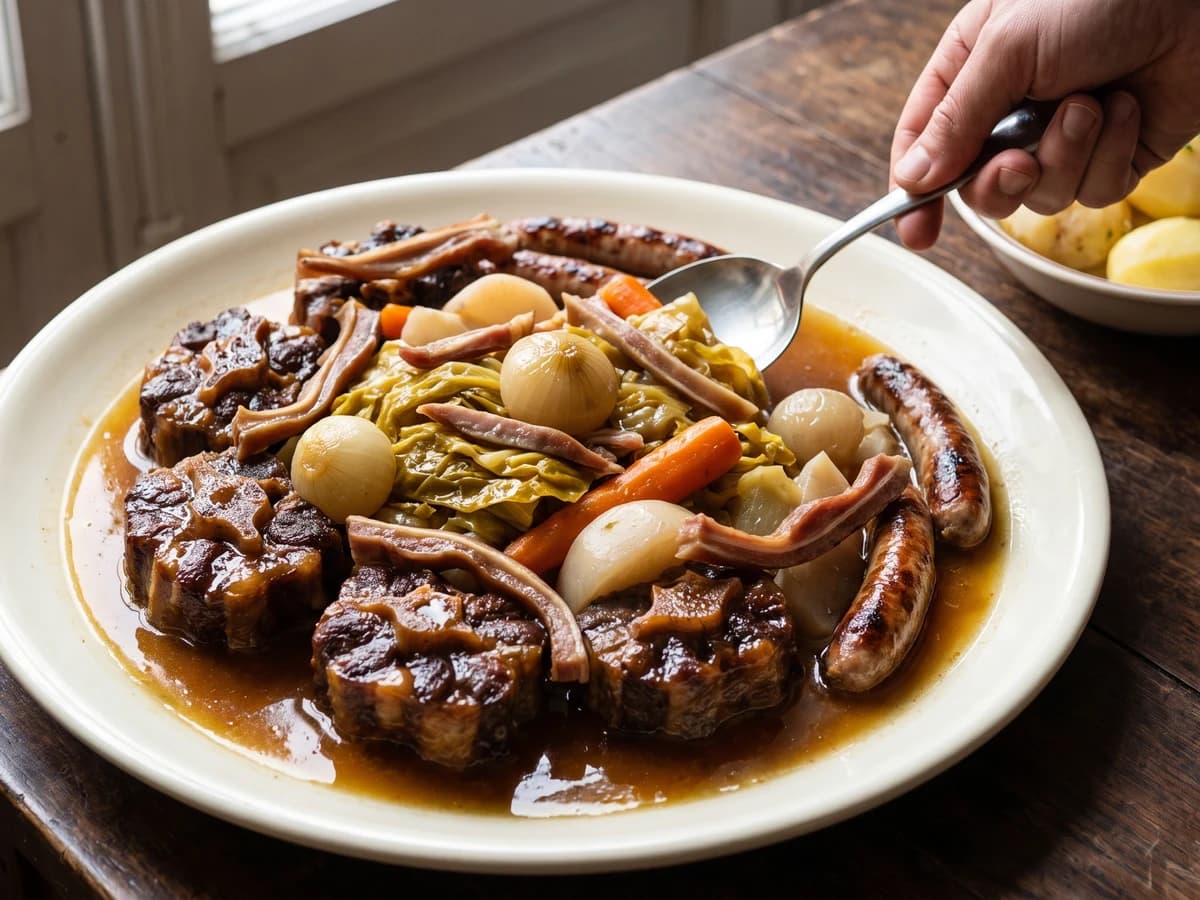
Queue de Bœuf en Hochepot gathers oxtail, pig's trotter and ear, cabbage, roots, and grilled chipolatas around a clear, gelatin-rich broth whose quiet simmer keeps every piece tender and distinct.

Chef Juliette
Beef shoulder larded with bacon, sharpened by red wine and vinegar, then sealed with garlic, vegetables, and dry lemon peel until the low oven turns it yielding and the gravy darkly glossy.