
Chef Juliette
Bouillabaisse à la Marseillaise
Marseille's great fish stew, saffron-gold and garlic-scented, proves that a hard boil can be the careful choice: it binds olive oil into broth before the whole pot meets bread.
A cooking platform built around craft, culture, and the stories behind what we eat.
Created by Chef Juliette
Based on No. 745, Soupe Julienne Darblay, from Le Guide Culinaire (1907) by Auguste Escoffier
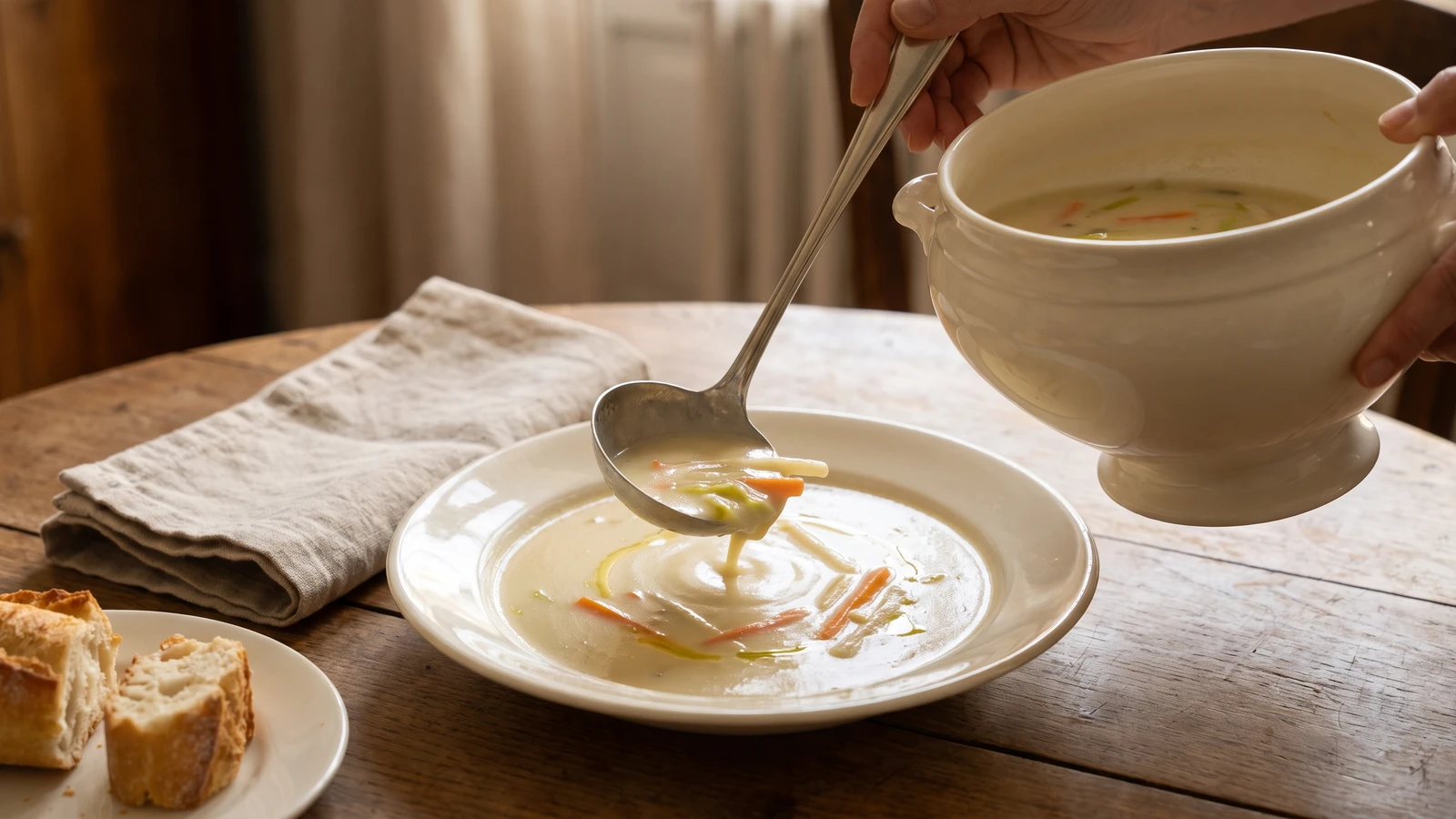
Soupe Julienne Darblay gives the spoon two textures: a smooth potato purée enriched with liaison and butter, then fine carrot, turnip, and leek cut julienne-fashion for a tender, distinct bite.
Soupe Julienne Darblay (potato purée soup with fine vegetable matchsticks) teaches a distinction the whole soup canon depends on: body and garnish do different work. The potato must disappear into a smooth, loose purée, while the julienne stays separate enough to meet the spoon. If you remember one thing before touching the pan, remember that contrast.
The formula assumed a saucier at the stove, white consommé never off the fire, and a tamis ready for purée. At home, a clean, gelatin-rich chicken stock stands in honestly for the consommé, and a potato ricer followed by a fine sieve does the tamis's work. I have multiplied the book's proportions evenly to give about two quarts; the extra stockpot and service mise en place are brigade scaffolding, but the separate julienne, the sieve, the liaison, and the final butter are the dish. One cook, one stove, one evening.
The liaison ordinaire (egg-yolk-and-cream binding) must never boil. Temper it slowly, keep the finished soup below a simmer, and it will turn satin-smooth around the vegetables. The one step that decides the finish is this gentle binding; rush it and the yolks fleck, but ça se rattrape, and the rescue is waiting in the method.
Soupe Julienne Darblay belongs to the Parisian classical repertoire, where Darblay signals a potato purée base and julienne names the matchstick cut of the vegetable garnish. It moved easily from grand-kitchen service to the bourgeois table because potato supplies the body without a roux, while consommé, liaison, and butter give the finish its polish. It is sometimes confused with vichyssoise, but Darblay is served hot, is stock-led rather than leek-led, and keeps its fine julienne visible in the bowl.
Quantity
4 small, about 3¼ cups (770 ml / 480 g)
peeled and quartered
Quantity
1 tablespoon (15 ml / 18 g), plus more as needed
for the potato water
Quantity
5¾ cups (1.36 L / 1.36 kg)
Quantity
2 tablespoons (30 ml / 24 g)
cut julienne-fashion
Quantity
2 tablespoons (30 ml / 28 g)
cut julienne-fashion
Quantity
1 tablespoon (15 ml / 8 g)
cut julienne-fashion and rinsed
Quantity
4, about 4 tablespoons (60 ml / 72 g)
Quantity
⅔ cup (160 ml / 160 g)
for the liaison
Quantity
2 tablespoons (30 ml / 30 g)
for rescuing the liaison
Quantity
4 tablespoons plus 2 teaspoons (70 ml / 67 g)
diced
| Ingredient | Quantity |
|---|---|
| floury potatoespeeled and quartered | 4 small, about 3¼ cups (770 ml / 480 g) |
| fine sea saltfor the potato water | 1 tablespoon (15 ml / 18 g), plus more as needed |
| white consommé, or clean gelatin-rich unsalted chicken stock | 5¾ cups (1.36 L / 1.36 kg) |
| carrotcut julienne-fashion | 2 tablespoons (30 ml / 24 g) |
| turnipcut julienne-fashion | 2 tablespoons (30 ml / 28 g) |
| white part of leekcut julienne-fashion and rinsed | 1 tablespoon (15 ml / 8 g) |
| large egg yolks | 4, about 4 tablespoons (60 ml / 72 g) |
| heavy creamfor the liaison | ⅔ cup (160 ml / 160 g) |
| cold heavy cream (optional)for rescuing the liaison | 2 tablespoons (30 ml / 30 g) |
| cold unsalted butterdiced | 4 tablespoons plus 2 teaspoons (70 ml / 67 g) |
Cut the carrot, turnip, and leek julienne-fashion, meaning fine match-shaped rods about 3 cm long and no thicker than 2 mm. Put the carrot and turnip in a small saucepan with ½ cup of the measured consommé, cover, and hold at a gentle simmer for 4 minutes. Add the leek and cook for another 2 to 3 minutes, until every strip is tender but still distinct beneath the teeth. Set the julienne aside in its cooking liquid.
Put the quartered potatoes in a saucepan and cover them generously with cold water. Add the measured salt, bring the water promptly to a boil, then maintain a brisk but controlled simmer for 12 to 16 minutes. They are ready when a knife passes through the centre without resistance. Drain them thoroughly and return them to the dry, warm pan for 1 minute, shaking gently, so the remaining surface moisture escapes.
While the potatoes are still hot, pass them through a ricer or food mill, then rub that purée through a fine-mesh sieve with a flexible scraper. The first tool supplies the force a brigade cook once provided; the second gives Darblay its proper smoothness and must stay. Never use a blender, because its blades work the potato starch into glue. If the potato cools and becomes stubborn, loosen it with two spoonfuls of hot consommé and continue.
Warm the remaining consommé in a clean saucepan. Put the sieved potato purée in a heavy 4-quart saucepan and whisk in one ladle of hot consommé until perfectly smooth. Continue ladle by ladle at first, then in a steady stream once the base is loose. Bring the soup only to a bare simmer and cook for 3 minutes, stirring across the pan floor. It should flow from the ladle in a broad, creamy ribbon, not sit like mashed potato. If it is too thick, add a little hot water; if it is thin, let it simmer briefly before the liaison goes in.
Tip the cooked julienne and its consommé into the potato base. Stir gently so the matchsticks remain intact, then heat for 2 minutes at the barest simmer. Taste a carrot strip and a turnip strip; both should yield easily while retaining their shape. This is the spoon work the name promises, so do not purée the garnish into the soup.
Whisk the egg yolks and ⅔ cup cream together in a heatproof bowl. Ladle in about 1 cup of hot soup very gradually, whisking without pause, then remove the soup saucepan from the heat and stir the tempered liaison back into it. Return the pan to the lowest heat and stir until the surface grows glossier and the soup reaches 72 to 75°C (162 to 167°F). Do not let it simmer. If yellow flecks appear, take the pan off the heat at once, strain the soup into a cool bowl, return the julienne caught by the sieve, and whisk in the optional cold cream. Ça se rattrape.
With the pan off the heat, monter au beurre, finishing the soup by whisking in the cold diced butter a few pieces at a time. Wait until each addition disappears before adding the next. The surface should carry a fine butter sheen without an oily rim. If the butter separates, whisk in a teaspoon of cold water until the soup comes back together. Taste for salt, ladle into warmed bowls, and serve at once. À table!
1 serving (about 245g)
Culinary guides, cultural storytelling, and the editorial depth that makes cooking meaningful.
Discover Culinary ExplorerChef Juliette
Marseille's great fish stew, saffron-gold and garlic-scented, proves that a hard boil can be the careful choice: it binds olive oil into broth before the whole pot meets bread.

Chef Juliette
Waterzoi asks fresh, bone-in river fish to thicken its own buttery broth, with parsley root and pepper for company. No flour, no stockpot, just a brisk simmer watched closely.
Chef Juliette
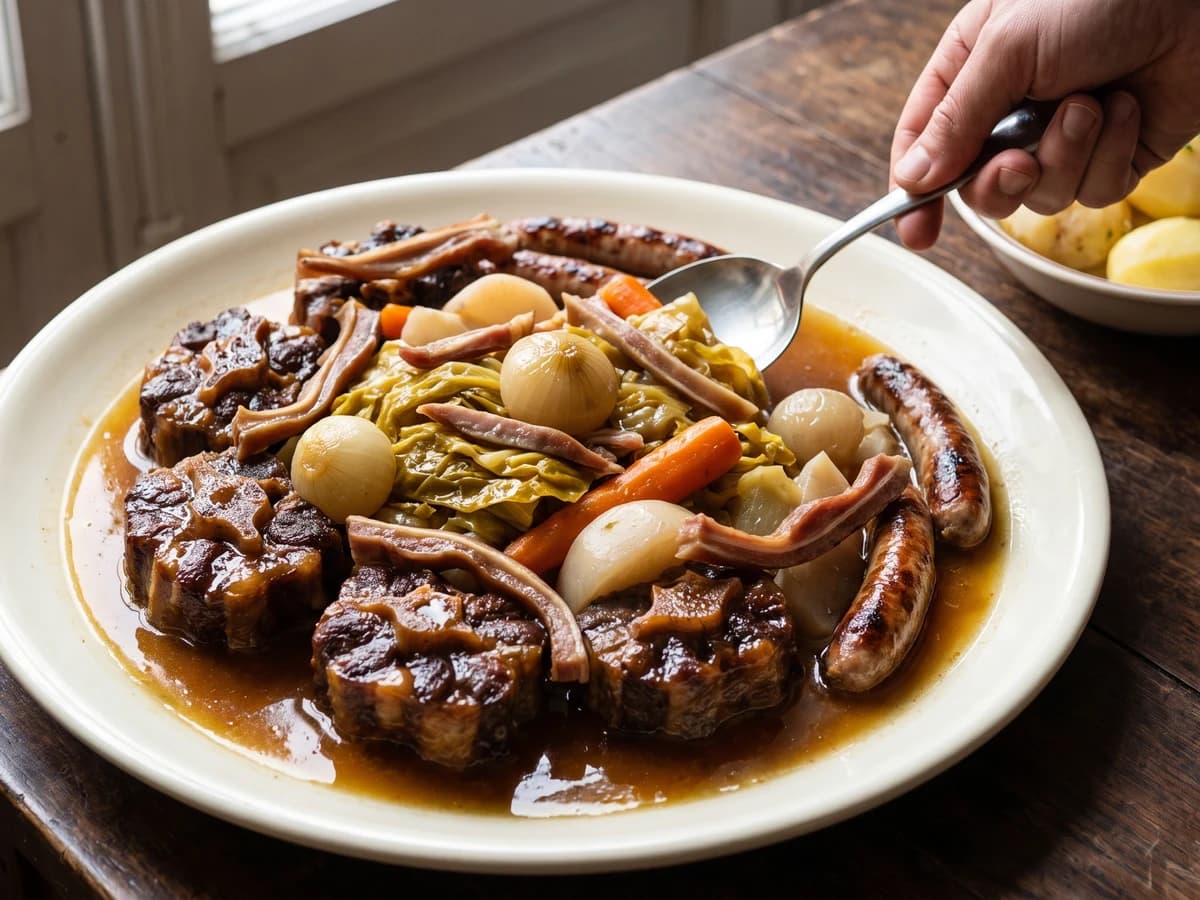
Queue de Bœuf en Hochepot gathers oxtail, pig's trotter and ear, cabbage, roots, and grilled chipolatas around a clear, gelatin-rich broth whose quiet simmer keeps every piece tender and distinct.

Chef Juliette
Beef shoulder larded with bacon, sharpened by red wine and vinegar, then sealed with garlic, vegetables, and dry lemon peel until the low oven turns it yielding and the gravy darkly glossy.