
Chef Juliette
Bouillabaisse à la Marseillaise
Marseille's great fish stew, saffron-gold and garlic-scented, proves that a hard boil can be the careful choice: it binds olive oil into broth before the whole pot meets bread.
A cooking platform built around craft, culture, and the stories behind what we eat.

Created by Chef Juliette
Based on No. 743, Cocky-Leeki Soup, from Le Guide Culinaire (1907) by Auguste Escoffier
Potage Cocky-Leeki makes clarity the whole lesson: chicken poached at a tremble in veal stock, pale leek julienne softened in butter, and fine meat returned with prunes waiting alongside.
Potage Cocky-Leeki (Cock-a-Leekie Soup) teaches the discipline of a clear broth. One true thing governs the pot before you touch it: the chicken must poach at a tremble, never a boil. Rough heat clouds the stock and tightens the meat before the leeks ever arrive.
Classical service assumed half a fowl, a stockpot of light veal stock never off the fire, and enough hands to strain the liquor, stew the leeks, and cut both garnishes julienne-fashion. This home batch keeps the source ratio exactly while replacing the awkward half bird with one small whole chicken, six leek whites, and three imperial pints of stock. A fine-mesh sieve replaces the stock station, and the separate holding pans go. That separation was brigade scaffolding; the gentle poach, careful straining, butter without coloration, and exact julienne are the dish. One cook, one stove, one evening.
The finished soup is amber-clear and quiet, with pale leek matchsticks, fine chicken, and a faint butter sheen. The prunes wait alongside so each guest chooses the sweet, dark counterpoint. Guard the first poach. Every good thing in the tureen depends on it.
Cock-a-leekie belongs to Scotland's farm and banquet tables, where fowl and leeks make the foundation and barley or rice may turn the broth into a fuller meal. When French classical kitchens brought Scottish and other international soups into their working canon, they refined this one into clear veal stock, butter-stewed leek whites, and a julienne of chicken. Prunes are traditional but debated, and this version follows the classical entry by stewing them separately rather than sweetening or darkening the broth.
Quantity
1, weighing 3½ to 4 lb (1.6 to 1.8 kg)
Quantity
7¼ cups (3 imperial pints / 1.7 L / 1.7 kg)
Quantity
1
peeled and halved
Quantity
1
peeled and cut into 3 pieces
Quantity
1
made with 2 parsley stems, 1 thyme sprig, and 1 bay leaf
Quantity
8
Quantity
6 medium, about 5 packed cups (1.18 L / 450 g) when cut
washed and cut julienne-fashion
Quantity
3 tablespoons (45 ml / 42 g)
Quantity
Up to 2 teaspoons (10 ml / 12 g)
divided
Quantity
¼ teaspoon (1.25 ml / 0.5 g)
Quantity
12
Quantity
1½ cups (360 ml / 360 g)
for stewing the prunes
| Ingredient | Quantity |
|---|---|
| small whole chicken | 1, weighing 3½ to 4 lb (1.6 to 1.8 kg) |
| light, clear veal stock | 7¼ cups (3 imperial pints / 1.7 L / 1.7 kg) |
| small yellow onionpeeled and halved | 1 |
| small carrotpeeled and cut into 3 pieces | 1 |
| small bouquet garnimade with 2 parsley stems, 1 thyme sprig, and 1 bay leaf | 1 |
| black peppercorns | 8 |
| leeks, white and palest green parts onlywashed and cut julienne-fashion | 6 medium, about 5 packed cups (1.18 L / 450 g) when cut |
| unsalted butter | 3 tablespoons (45 ml / 42 g) |
| fine sea saltdivided | Up to 2 teaspoons (10 ml / 12 g) |
| ground white pepper | ¼ teaspoon (1.25 ml / 0.5 g) |
| large pitted prunes (optional) | 12 |
| water (optional)for stewing the prunes | 1½ cups (360 ml / 360 g) |
Set the chicken breast-side down in a snug heavy pot and add the veal stock, onion, carrot, bouquet garni, and peppercorns. Bring the liquid up slowly over medium-low heat, skimming away the grey foam as it gathers. When the first lazy bubble breaks the surface, lower the heat until the broth barely trembles, partially cover, and poach for 60 to 75 minutes. The chicken is ready when the leg joint yields easily and the thickest part of the thigh reaches at least 165°F (74°C). If the pot breaks into a boil, take it off the heat at once and let it settle for 5 minutes before continuing over lower heat; ça se rattrape, and a second careful straining will restore much of the broth's clarity.
Lift the chicken onto a tray and leave it until cool enough to handle. Pour the cooking liquor carefully through a fine-mesh sieve into a clean bowl or saucepan. Do not press the aromatics against the sieve, because that forces their particles back into the clear broth. Let the liquid stand for 5 minutes, then skim off excess fat while leaving a few golden droplets for flavor. If the broth remains cloudy, pass it once more through a sieve lined with clean damp cheesecloth.
Split the leek whites lengthwise and wash carefully between every layer; grit hides where confidence cannot see it. Cut them into 2-inch (5 cm) sections, then cut each section julienne-fashion into match-shaped rods about ⅛ inch (3 mm) wide. Keep the strips even so they soften together and sit neatly on the spoon.
Melt the butter in the cleaned soup pot over low heat. Add the leek julienne with a small pinch of the salt, cover, and stew gently for 8 to 10 minutes, stirring twice, until supple and glossy but still completely pale. Coloration is not browning to celebrate here; it muddies the broth and changes its clean leek flavor. If the bottom begins to catch, spoon the pale leeks into a clean pan without scraping up the browned patch, add a ladle of strained broth, and continue. Ça se rattrape. Pour in the remaining cooking liquor and simmer at the gentlest tremble for 12 to 15 minutes, until the leeks are tender but retain their shape.
Remove the skin and bones from the chicken. Cut the meat julienne-fashion into fine strips about the same length as the leeks, rather than pulling it into coarse shreds. Once the leeks are tender, fold in enough chicken to make the soup generous without crowding out its broth. Warm for 3 to 4 minutes without boiling, then season gradually with the remaining salt and the white pepper. If the broth tastes heavy rather than clear and savory, skim the surface once more; do not dilute it before tasting for salt.
If using the prunes, place them in a small saucepan with the water and simmer gently for 10 to 12 minutes, until plump and tender but still whole. Add another spoonful of water if the pan dries before they soften. Transfer them with a little of their liquid to a separate serving bowl. Pour the Potage Cocky-Leeki into a warmed soup tureen and bring both dishes to the table, allowing each guest to add a prune or leave the clear broth untouched. À table!
1 serving (about 250g)
Culinary guides, cultural storytelling, and the editorial depth that makes cooking meaningful.
Discover Culinary ExplorerChef Juliette
Marseille's great fish stew, saffron-gold and garlic-scented, proves that a hard boil can be the careful choice: it binds olive oil into broth before the whole pot meets bread.

Chef Juliette
Waterzoi asks fresh, bone-in river fish to thicken its own buttery broth, with parsley root and pepper for company. No flour, no stockpot, just a brisk simmer watched closely.
Chef Juliette
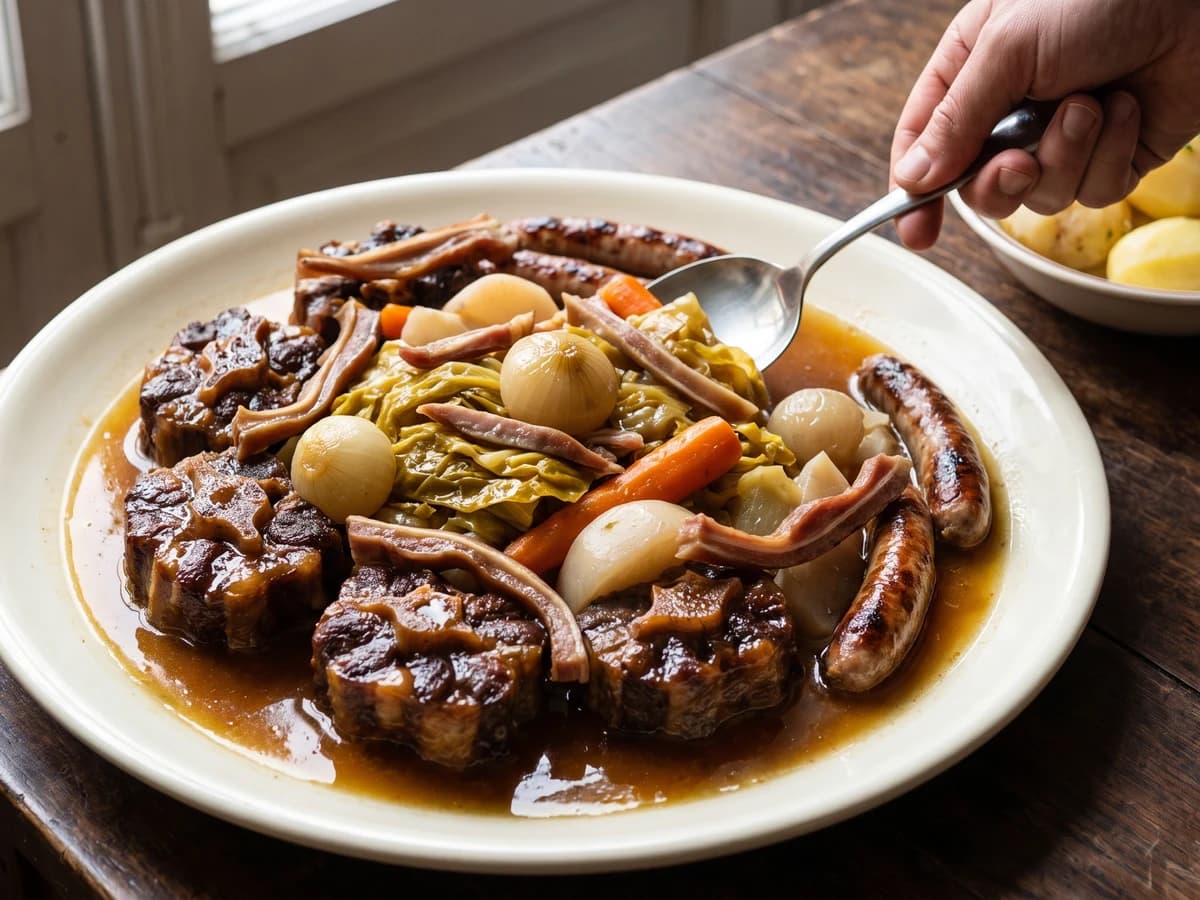
Queue de Bœuf en Hochepot gathers oxtail, pig's trotter and ear, cabbage, roots, and grilled chipolatas around a clear, gelatin-rich broth whose quiet simmer keeps every piece tender and distinct.

Chef Juliette
Beef shoulder larded with bacon, sharpened by red wine and vinegar, then sealed with garlic, vegetables, and dry lemon peel until the low oven turns it yielding and the gravy darkly glossy.