
Chef Juliette
Bouillabaisse à la Marseillaise
Marseille's great fish stew, saffron-gold and garlic-scented, proves that a hard boil can be the careful choice: it binds olive oil into broth before the whole pot meets bread.
A cooking platform built around craft, culture, and the stories behind what we eat.

Created by Chef Juliette
Based on No. 741, Soupe aux Abatis de Volaille à l’Anglaise, from Le Guide Culinaire (1907) by Auguste Escoffier
Soupe aux abatis turns the humblest parts of a bird into a clear, peppery supper, with browned necks, tender gizzards, rice, and butter-soft celery carrying every spoonful.
Soupe aux Abatis de Volaille à l’Anglaise (English-style poultry giblet soup) teaches the fundamental economy of the pot: brown what looks humble, simmer it slowly, and strain with care until thrift becomes a clear, peppery broth. The one true thing to know before touching the pan is that the browning must be honest. Pale abatis make pale soup, while scorched butter gives bitterness no sieve can remove.
The book’s kitchen assumed a saucier to mind the pan, white consommé never far from the fire, and another pair of hands to trim every cooked morsel. At home, use white consommé if you have it; otherwise, clean low-sodium chicken stock is the honest equivalent. The source’s faggot becomes a small bouquet garni tied with string, and a fine sieve does the work of repeated straining. Making a separate clarified consommé is brigade scaffolding, so it may go. Browning the abatis, simmering them for three hours, and finishing with rice and butter-fried celery are the dish, so they stay. One cook, one stove, one evening.
The finished soup is spare but generous: tender gizzard and poultry meat beneath an amber broth carrying the bronze depth of fond, little grains of rice, pale celery, and enough black pepper to wake the whole bowl. Watch the butter and give the abatis room to brown. That first color decides the soup before the long cooking begins.
Soupe aux Abatis de Volaille à l’Anglaise belongs to the French classical catalog of potages à l’anglaise, dishes through which grand kitchens translated English household thrift into their own exact grammar. For generations, English cooks made giblet soup from the neck, gizzard, and wings saved when a bird was dressed; the French version browned those parts, strengthened them with white consommé, then returned the trimmed meat with rice, celery, and assertive pepper. Despite its title, the dish belongs to no single French region, and it is not a liver soup: liver is deliberately absent because it would muddy and dominate the clear broth.
Quantity
3 necks, 4 gizzards, and 4 pinions, about 12 oz (340 g) total
Quantity
3 tbsp (45 ml / 43 g)
divided
Quantity
1½ tbsp (22 ml / 12 g)
Quantity
6 cups (1.42 L / 1.42 kg)
Quantity
3 cups (710 ml / 710 g)
Quantity
1
1 celery stalk, 2 parsley stems, 1 thyme sprig, and 1 bay leaf tied together
Quantity
1 tbsp (15 ml / 12 g)
rinsed
Quantity
2 tbsp (30 ml / 18 g)
finely minced
Quantity
1 tbsp (15 ml / 14 g)
Quantity
¾ tsp (4 ml / 1.7 g), plus more to taste
Quantity
only if needed
| Ingredient | Quantity |
|---|---|
| chicken necks, cleaned gizzards, and chicken pinions or outer wing sections | 3 necks, 4 gizzards, and 4 pinions, about 12 oz (340 g) total |
| unsalted butter for browningdivided | 3 tbsp (45 ml / 43 g) |
| all-purpose flour | 1½ tbsp (22 ml / 12 g) |
| white chicken consommé or clear low-sodium chicken stock | 6 cups (1.42 L / 1.42 kg) |
| water | 3 cups (710 ml / 710 g) |
| bouquet garni1 celery stalk, 2 parsley stems, 1 thyme sprig, and 1 bay leaf tied together | 1 |
| long-grain white ricerinsed | 1 tbsp (15 ml / 12 g) |
| pale inner celeryfinely minced | 2 tbsp (30 ml / 18 g) |
| unsalted butter for frying the celery | 1 tbsp (15 ml / 14 g) |
| freshly ground black pepper | ¾ tsp (4 ml / 1.7 g), plus more to taste |
| fine salt (optional) | only if needed |
Ask the butcher to cut each neck crosswise into three pieces, or do it on a nonslip board with a small cleaver. Never force a chef’s knife through bone. Quarter each cleaned gizzard and divide each pinion into two pieces through its joint. Pat everything thoroughly dry. Moisture turns the first minutes in the pot into a poach, and the soup needs a dark golden fond, the browned glaze on the pot floor.
Melt 2 tbsp of the browning butter in a heavy pot over medium heat. When its foam subsides, add the abatis in a single uncrowded layer, working in batches if necessary. Brown every cut face to a deep hazelnut color, turning only when each piece releases readily; add the remaining tablespoon of butter if the pot grows dry. If the butter threatens to blacken, lift the pot from the heat at once and lower the flame. Black specks taste bitter, so wipe out a scorched pot and resume with fresh butter rather than carrying that bitterness into three hours of broth.
Return all the browned abatis to the pot. Singer, dust them evenly with the flour, then stir over medium-low heat for 2 minutes, until the flour loses its raw smell and takes the faintest blond color. Pour in about one-third of the white consommé or clear stock while scraping every bit of fond from the bottom, then add the remaining consommé and the water. If the flour gathers into small lumps, whisk the liquid firmly and carry on; the broth will be strained later. Ça se rattrape.
Add the bouquet garni and bring the liquid just to a simmer. Lower the heat until the surface barely trembles, cover with the lid slightly ajar, and cook gently for 3 hours. Check occasionally and add a little boiling water if the pieces are no longer covered. A hard boil breaks fat and flour through the broth, leaving it cloudy and greasy. At three hours, a knife should pass easily through a gizzard quarter; if it still resists, give it another 20 to 30 minutes. Tough gizzard means unfinished cooking, not a failed soup.
Lift the abatis into a bowl and discard the bouquet garni. Strain the cooking liquor through a fine-mesh sieve into a clean pot without pressing the solids, then skim away any broad pools of fat. When the poultry is cool enough to handle, remove loose bones, cartilage, skin, and tough membrane. Keep the gizzard quarters and neat morsels of neck and pinion meat. Measure the strained liquor: reduce it gently if you have more than 8 cups, or add enough boiling water to restore it to about 8 cups if evaporation carried it too far.
Boil the rinsed rice in a small saucepan of water for 5 minutes, then drain it well. This parboiling washes away loose surface starch so the final broth stays clear. Meanwhile, melt the celery butter in a small pan over medium-low heat and fry the minced pale celery for 3 to 4 minutes, until supple and glossy but not browned. The celery should keep its fresh edge beneath the butter.
Put the trimmed abatis, parboiled rice, and butter-fried celery into the clean pot and pour over the strained liquor. Hold at a gentle simmer for 15 minutes, until the rice is tender but still distinct. Season strongly with black pepper, then taste before adding salt because consommé may already carry enough. If the rice has taken more broth than expected, loosen the soup with a little hot stock or water. Ça se rattrape. Ladle into deep bowls with the meat and rice shared generously among them. À table!
1 serving (about 240g)
Culinary guides, cultural storytelling, and the editorial depth that makes cooking meaningful.
Discover Culinary ExplorerChef Juliette
Marseille's great fish stew, saffron-gold and garlic-scented, proves that a hard boil can be the careful choice: it binds olive oil into broth before the whole pot meets bread.

Chef Juliette
Waterzoi asks fresh, bone-in river fish to thicken its own buttery broth, with parsley root and pepper for company. No flour, no stockpot, just a brisk simmer watched closely.
Chef Juliette
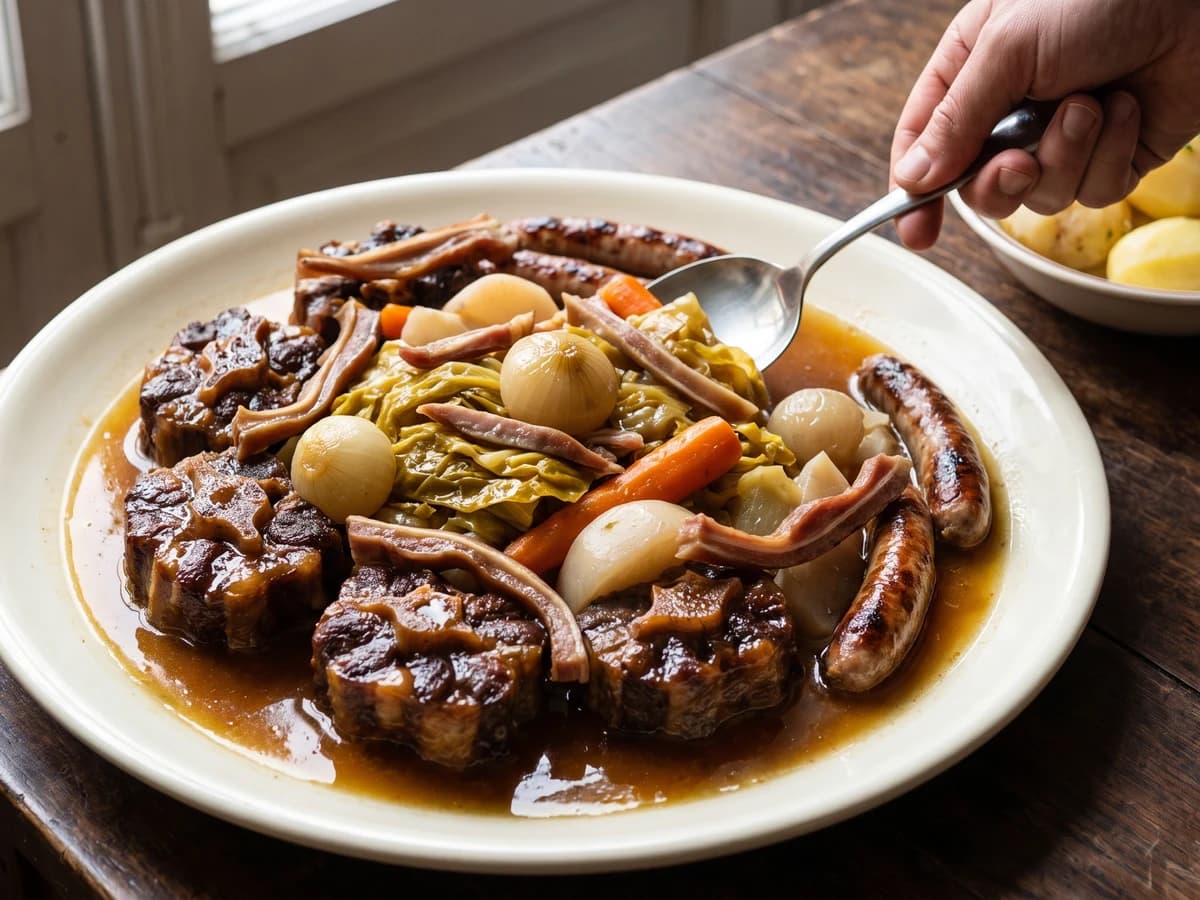
Queue de Bœuf en Hochepot gathers oxtail, pig's trotter and ear, cabbage, roots, and grilled chipolatas around a clear, gelatin-rich broth whose quiet simmer keeps every piece tender and distinct.

Chef Juliette
Beef shoulder larded with bacon, sharpened by red wine and vinegar, then sealed with garlic, vegetables, and dry lemon peel until the low oven turns it yielding and the gravy darkly glossy.