
Chef Juliette
Bouillabaisse à la Marseillaise
Marseille's great fish stew, saffron-gold and garlic-scented, proves that a hard boil can be the careful choice: it binds olive oil into broth before the whole pot meets bread.
A cooking platform built around craft, culture, and the stories behind what we eat.

Created by Chef Juliette
Based on No. 739, Potage Viviane, from Le Guide Culinaire (1907) by Auguste Escoffier
A pale chicken cream becomes Potage Viviane through restraint: a warm liaison for satin body, then precise dice of artichoke, carrot, and black truffle, each spoonful ivory, gold, and earth-dark.
Potage Viviane (silken chicken cream with artichoke, carrot, and truffle) teaches one quiet rule: a liaison, the egg-yolk-and-cream binding, gains satin body below the boil and turns grainy above it. Before you touch a pan, know this much: once the yolks enter, the soup must never boil.
The printed formula assumed Crème de Volaille Princesse (No. 713) already waiting, a saucier on staff, a stockpot never off the fire, and a tammy within reach. Your honest equivalent is the finished referenced soup prepared ahead, one heavy saucepan, one whisk, and a fine-mesh sieve kept nearby for rescue. Continuous hot holding and a procession of service pans are brigade scaffolding, so they go. The liaison and the fine artichoke, carrot, and truffle dice are the dish, so they stay. This home tureen makes about two quarts, with each garnish held to the book's exact measure of one tablespoon per quart. One cook, one stove, one evening.
The finished Viviane should be ivory and glossy, with tiny pale, orange, and black dice appearing in every spoonful, not a thick purée wearing decoration. Cook the carrot and artichoke tender without colour, then temper the liaison slowly. That tempering is the one step that decides the potage.
Potage Viviane belongs to the named potages of the classical Parisian dining room, where a master cream soup could become a distinct dish through its garnish and final liaison. It is not a regional farmhouse soup: the name identifies the precise fine dice of artichoke bottom, carrot, and truffle added to crème de volaille, each chosen for colour, tenderness, and perfume. That system let a grand kitchen work from a disciplined family of base preparations, and it translates neatly to the home table because the garnish, not a parade of extra processes, carries the identity.
Quantity
8 cups (1.9 L / about 1.95 kg) Crème de Volaille Princesse (No. 713)
prepared according to its own entry
Quantity
1 cup (240 ml / 240 g)
divided
Quantity
4
Quantity
2 tablespoons (30 ml / 28 g)
Quantity
2 tablespoons (30 ml / 25 g)
cut into fine 3 mm dice
Quantity
2 tablespoons (30 ml / 30 g)
cut into fine 3 mm dice
Quantity
2 tablespoons (30 ml / 20 g)
cut into fine 3 mm dice
Quantity
as needed
| Ingredient | Quantity |
|---|---|
| Crème de Volaille Princesseprepared according to its own entry | 8 cups (1.9 L / about 1.95 kg) Crème de Volaille Princesse (No. 713) |
| heavy creamdivided | 1 cup (240 ml / 240 g) |
| large egg yolks | 4 |
| unsalted butter | 2 tablespoons (30 ml / 28 g) |
| cooked artichoke bottomcut into fine 3 mm dice | 2 tablespoons (30 ml / 25 g) |
| peeled carrotcut into fine 3 mm dice | 2 tablespoons (30 ml / 30 g) |
| black trufflecut into fine 3 mm dice | 2 tablespoons (30 ml / 20 g) |
| fine sea salt and freshly ground white pepper | as needed |
Reserve 1/2 cup (120 ml) of the Crème de Volaille Princesse (No. 713), then place the remainder in a heavy 4-quart saucepan. The reference is a finished preparation, so leave its own method whole. Warm it over low heat, stirring across the bottom, until it reaches about 70°C (158°F) and shows only a faint movement at the edge. Do not let it bubble.
Melt the butter in a small covered skillet over low heat. Add the carrot dice first and cook for 3 minutes, stirring gently, then add the artichoke dice and a small pinch of salt. Cover and cook for another 4 to 6 minutes, until the carrot is tender but both vegetables still hold their square shape. They must soften without browning; if the butter begins to colour, lower the heat at once. Set the dice aside in their butter.
Whisk the egg yolks with 3/4 cup (180 ml / 180 g) of the heavy cream until completely smooth. Keep the remaining 1/4 cup (60 ml / 60 g) of cream cold. That reserve finishes the soup when all goes well and arrests the cooking if the liaison becomes too hot.
Take the warm soup off the heat. Whisk about 2 cups (475 ml) of it into the liaison, adding roughly 1/2 cup (120 ml) at a time so the yolks warm gradually. Pour the tempered liaison back into the saucepan while whisking, then return the pan to the lowest heat. Stir continuously until the soup lightly coats a spoon and reaches about 74°C (165°F). Never boil it. If the first tiny yellow grains appear, lift the pan off the heat, whisk in the reserved cold cream, and pass the soup through the fine-mesh sieve into a cool bowl. Ça se rattrape.
Remove the potage from the heat. Stir in the buttered carrot and artichoke dice with every drop of their butter, then fold in the truffle dice last so their perfume stays clear. If the cold cream was not needed for rescue, whisk it in now. Adjust the consistency with as much reserved warm soup as needed; Viviane should flow from the ladle in a smooth ribbon, not sit like custard. Taste for salt and white pepper.
Pour the potage into a warmed soupière or ladle it directly into warmed soup bowls, stirring the pot gently between servings so each receives artichoke, carrot, and truffle. Serve at once. The gloss, the precise dice, and the perfume of truffle are the finish, so add nothing else. À table!
1 serving (about 220g)
Culinary guides, cultural storytelling, and the editorial depth that makes cooking meaningful.
Discover Culinary ExplorerChef Juliette
Marseille's great fish stew, saffron-gold and garlic-scented, proves that a hard boil can be the careful choice: it binds olive oil into broth before the whole pot meets bread.

Chef Juliette
Waterzoi asks fresh, bone-in river fish to thicken its own buttery broth, with parsley root and pepper for company. No flour, no stockpot, just a brisk simmer watched closely.
Chef Juliette
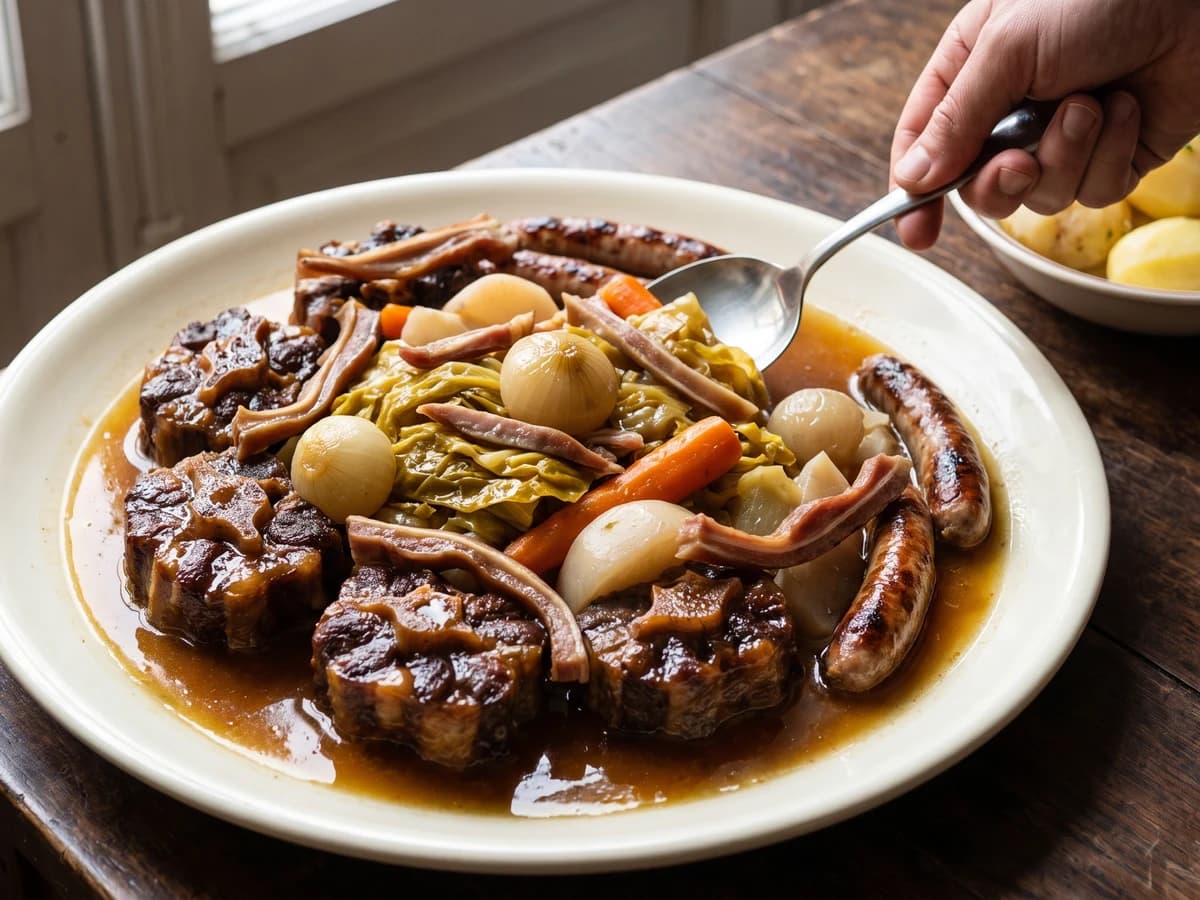
Queue de Bœuf en Hochepot gathers oxtail, pig's trotter and ear, cabbage, roots, and grilled chipolatas around a clear, gelatin-rich broth whose quiet simmer keeps every piece tender and distinct.

Chef Juliette
Beef shoulder larded with bacon, sharpened by red wine and vinegar, then sealed with garlic, vegetables, and dry lemon peel until the low oven turns it yielding and the gravy darkly glossy.