
Chef Juliette
Bouillabaisse à la Marseillaise
Marseille's great fish stew, saffron-gold and garlic-scented, proves that a hard boil can be the careful choice: it binds olive oil into broth before the whole pot meets bread.
A cooking platform built around craft, culture, and the stories behind what we eat.

Created by Chef Juliette
Based on No. 725, Potage aux Herbes, from Le Guide Culinaire (1907) by Auguste Escoffier
Potage aux Herbes gathers sorrel, watercress, chervil, and pimprenelle into one satin green bowl, thickened with potato and finished with Printanier herb butter and basil.
Potage aux Herbes (green herb soup) teaches one true thing before you touch the pan: tender herbs may collapse in butter, but they must never brown. Sorrel brings acidity, watercress its pepper, chervil its anise perfume, and young pimprenelle a cool cucumber note. Gentle heat keeps those voices distinct.
The old formula assumes a saucier with a tammy and Printanier butter with herbs already prepared by another station. A fine-mesh sieve replaces the tammy, the batch is fixed at about two quarts for one four-quart saucepan, and the two unstated amounts, stewing butter and young pimpernel, receive modest measures so you can repeat the result. Every stated proportion remains intact. The water is deliberate, not a missing stock; a stronger foundation would smother the garden. One cook, one stove, one evening.
The finished potage should be smooth and softly thick, green leaning naturally toward olive from the cooked sorrel, with a satin gleam from its butter. Watch the first pan closely: herbs collapsed without a trace of browning. That is the step that decides the dish.
Potage aux Herbes belongs to the French cuisine bourgeoise table rather than to one province, drawing its character from the household kitchen garden and whatever tender leaves were ready for cutting. Grand kitchens refined that garden soup with julienne sorrel, chervil pluches, passage through a tammy, and a finish of Printanier butter with herbs. Despite its place among cream soups, it contains no cream; potato supplies the body while butter provides the final gloss.
Quantity
3 tablespoons (45 ml / 43 g)
Quantity
3½ packed cups (830 ml / 75 g)
cut julienne-fashion
Quantity
1⅓ packed cups (315 ml / 38 g)
Quantity
2½ loosely packed cups (590 ml / 38 g)
divided
Quantity
¾ loosely packed cup (180 ml / 12 g)
Quantity
4¾ cups (1.14 L / 1.14 kg)
Quantity
2 teaspoons (10 ml / 12 g), plus more if needed
Quantity
4 medium (about 1½ lb / 680 g peeled weight)
peeled and quartered
Quantity
½ cup (120 ml / 113 g)
softened and ready as a finished component
Quantity
8 leaves (about 2 tablespoons / 3 g)
cut into fine shreds
Quantity
2 generous pinches (about 2 teaspoons / 1 g)
for finishing
| Ingredient | Quantity |
|---|---|
| unsalted butter | 3 tablespoons (45 ml / 43 g) |
| sorrel leavescut julienne-fashion | 3½ packed cups (830 ml / 75 g) |
| watercress leaves | 1⅓ packed cups (315 ml / 38 g) |
| chervil pluchesdivided | 2½ loosely packed cups (590 ml / 38 g) |
| young pimprenelle leaves, also sold as salad burnet | ¾ loosely packed cup (180 ml / 12 g) |
| water | 4¾ cups (1.14 L / 1.14 kg) |
| fine sea salt | 2 teaspoons (10 ml / 12 g), plus more if needed |
| floury potatoespeeled and quartered | 4 medium (about 1½ lb / 680 g peeled weight) |
| Printanier butter with herbssoftened and ready as a finished component | ½ cup (120 ml / 113 g) |
| sweet basil leavescut into fine shreds | 8 leaves (about 2 tablespoons / 3 g) |
| chervil pluchesfor finishing | 2 generous pinches (about 2 teaspoons / 1 g) |
Wash the herbs in cold water, lift them clear of any grit, and dry them well. Cut the sorrel julienne-fashion into fine match-shaped ribbons. Pick the chervil into pluches, the tender leaf shreds used for soups, reserving two generous pinches for the bowl. Keep the basil aside for the finish.
Melt the unsalted butter in the saucepan over medium-low heat. Add the sorrel, watercress, remaining chervil pluches, pimprenelle, and a pinch of the measured salt. Stew them gently for 6 to 8 minutes, turning often, until thoroughly collapsed but never browned. Sorrel naturally turns olive as it cooks, so judge by smell and the pan floor, not by emerald colour. If the butter begins to smell nutty or the pan goes dry, pull it from the heat and add 1 tablespoon of the measured water. Ça se rattrape.
Add the remaining water, the potatoes, and the rest of the salt. Bring the liquid to a gentle simmer, partially cover, and cook for 22 to 28 minutes. The potatoes are ready when a quarter collapses under light pressure from a spoon. Keep the simmer quiet; hard boiling bruises the herb perfume and breaks the potatoes apart before you can drain them.
Set a colander over a large heatproof bowl and drain the pot, preserving every drop of the cooking-liquor. Crush the hot potatoes and herbs together with a masher, then stir in the reserved liquor a ladleful at a time until you have a loose purée. Do not use a blender on the potatoes; its blades can turn their starch elastic and gluey. If a few lumps remain, the tammy will take care of them.
Set the tammy, here a sturdy fine-mesh sieve, over the cleaned saucepan. Rub the diluted purée through in batches with a flexible spatula or the back of a ladle, pressing until only dry herb fibres remain. Stir in the rest of the cooking-liquor. This passage is not brigade scaffolding to discard; it is the technique that turns potatoes and leaves into a proper potage.
Bring the strained soup just to one full boil, stirring across the bottom, then immediately remove it from the heat. If it is too thin, reduce it before adding the butter; if too thick, loosen it with a little hot water. Work the basil shreds into the softened Printanier butter with herbs, then monter au beurre, finish by whisking in that butter a spoonful at a time. Do not boil the soup again. If yellow droplets appear, the pot was too hot; whisk in 1 tablespoon cold water off the heat until the surface becomes smooth again. Ça se rattrape.
Taste for salt and ladle the potage into warm bowls or bring it to the table in a soupière. Scatter the reserved chervil pluches over the surface and serve at once, while the basil and butter remain fragrant. À table!
1 serving (about 245g)
Culinary guides, cultural storytelling, and the editorial depth that makes cooking meaningful.
Discover Culinary ExplorerChef Juliette
Marseille's great fish stew, saffron-gold and garlic-scented, proves that a hard boil can be the careful choice: it binds olive oil into broth before the whole pot meets bread.

Chef Juliette
Waterzoi asks fresh, bone-in river fish to thicken its own buttery broth, with parsley root and pepper for company. No flour, no stockpot, just a brisk simmer watched closely.
Chef Juliette
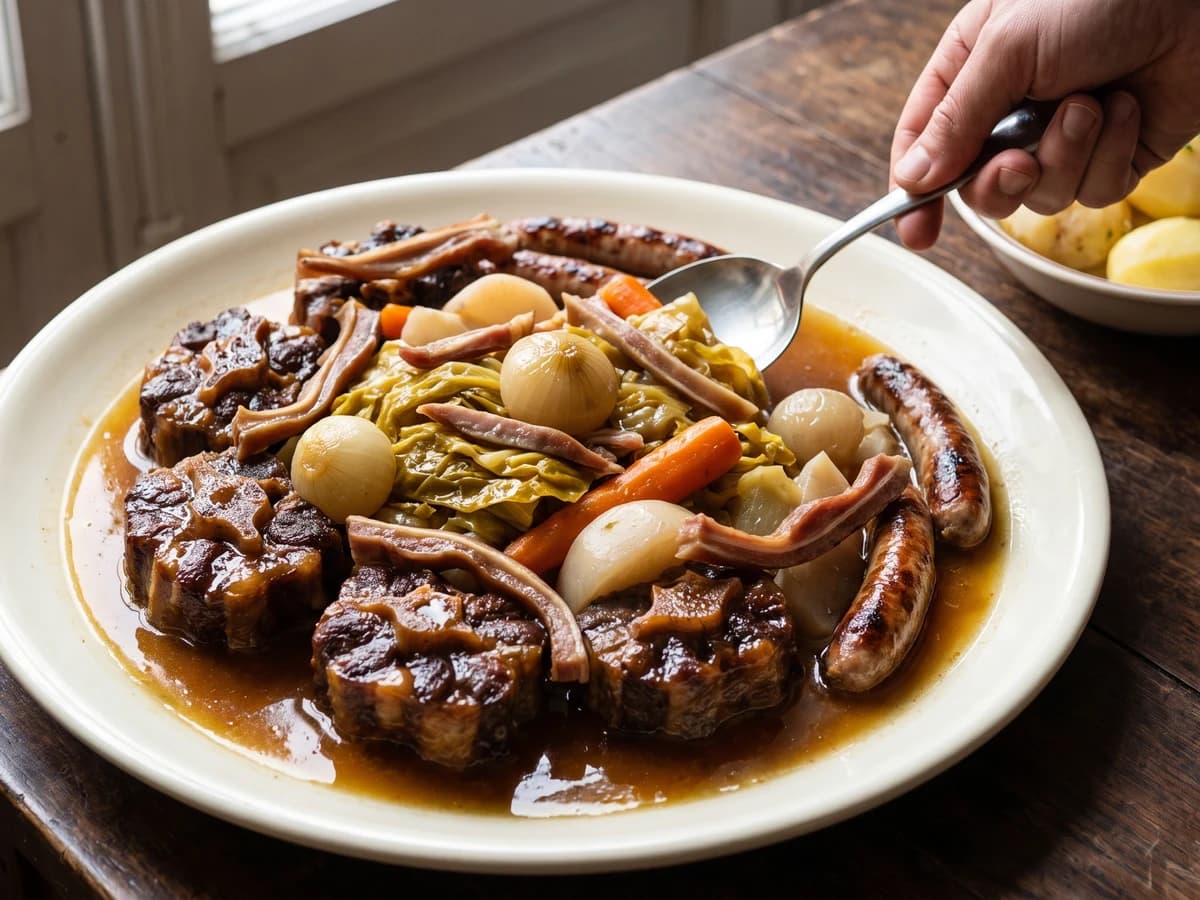
Queue de Bœuf en Hochepot gathers oxtail, pig's trotter and ear, cabbage, roots, and grilled chipolatas around a clear, gelatin-rich broth whose quiet simmer keeps every piece tender and distinct.

Chef Juliette
Beef shoulder larded with bacon, sharpened by red wine and vinegar, then sealed with garlic, vegetables, and dry lemon peel until the low oven turns it yielding and the gravy darkly glossy.