
Chef Juliette
Bouillabaisse à la Marseillaise
Marseille's great fish stew, saffron-gold and garlic-scented, proves that a hard boil can be the careful choice: it binds olive oil into broth before the whole pot meets bread.
A cooking platform built around craft, culture, and the stories behind what we eat.

Created by Chef Juliette
Based on No. 707, Crème de Maïs, otherwise Washington, from Le Guide Culinaire (1907) by Auguste Escoffier
A silken Crème de Maïs built on equal parts corn and thin béchamel, passed smooth, enriched with cream, then punctuated by whole kernels: sweet, plain, and precisely what Washington promises.
Crème de Maïs, dite Washington (cream of corn soup, called Washington) teaches a precise lesson: silk comes from passing, not from pouring in more cream. Corn skins remain rough after blending; the sieve is what turns sweet maize and Béchamel into a true crème.
The original entry assumed a saucier with thin Béchamel ready and a tammy waiting on the bench. Here the brigade batch is brought down to about two quarts, the Béchamel is made fresh in a saucepan, and an immersion blender with a sturdy fine-mesh sieve replaces the tammy. The gallons and dedicated hands were scaffolding. Equal measures of corn and Béchamel, the passing, the last-minute cream, and the whole-kernel garnish are the dish, so they remain exactly where they belong. One cook, one stove, one evening.
Expect a pale butter-gold soup, sweet but not sugary, with cream rounding the corn rather than hiding it. When you reach the sieve, take your time; the pressure of the ladle against that mesh decides the soup.
Crème de Maïs, dite Washington belongs to the Parisian classical table, where Washington served as a geographic menu-name for American maize rather than a claim that the soup came from a local Washington kitchen. Its method is wholly French: the principal ingredient is joined to thin Béchamel, rubbed through a tammy, enriched with cream, and garnished with a little of itself. The crop and name crossed the Atlantic, while the grand-kitchen cream-soup grammar gave them their place in the canon.
Quantity
4 cups (960 ml / 600 g)
divided
Quantity
1 tablespoon (15 ml / 18 g), plus more to finish
for the cooking water
Quantity
2½ tablespoons (37 ml / 35 g)
Quantity
¼ cup (60 ml / 30 g)
Quantity
3¾ cups (900 ml / 925 g)
warmed and divided
Quantity
1 cup (240 ml / 240 g)
| Ingredient | Quantity |
|---|---|
| corn kernels, fresh, frozen, or well-drained canneddivided | 4 cups (960 ml / 600 g) |
| fine sea saltfor the cooking water | 1 tablespoon (15 ml / 18 g), plus more to finish |
| unsalted butter | 2½ tablespoons (37 ml / 35 g) |
| all-purpose flour | ¼ cup (60 ml / 30 g) |
| whole milkwarmed and divided | 3¾ cups (900 ml / 925 g) |
| heavy cream | 1 cup (240 ml / 240 g) |
Bring a saucepan of water to a boil and season it with the measured salt. Add the corn and cook until tender but still distinctly sweet, about 4 minutes for fresh kernels, 3 minutes for frozen, or 1 minute merely to warm canned corn. Drain thoroughly. Reserve ½ cup (120 ml / about 75 g) of whole kernels for the garnish, then measure 3½ cups (840 ml / about 525 g) for the soup.
Melt the butter over medium-low heat in a heavy saucepan without letting it colour. Stir in the flour and cook this roux blanc (white roux) for 2 minutes, stirring constantly, until it smells gently of warm biscuits but remains pale. Whisk in 3½ cups (840 ml) of the warm milk gradually, beginning with small additions so the roux loosens without lumping. Bring it to the barest simmer and cook for 12 minutes, whisking often and scraping the corners. If it knots, take the pan off the heat and whisk firmly from the centre outward; any stubborn speck will be caught by the later sieve.
Stir the measured 3½ cups of corn into the 3½ cups of thin Béchamel. Hold the mixture at a gentle simmer for 8 to 10 minutes, stirring along the pan floor so the milk does not catch, until the grains yield completely beneath the spoon. Equal quantities keep the soup unmistakably of corn while giving it the body of a classical crème.
Blend directly in the saucepan with an immersion blender until no whole kernel shapes remain. Set a sturdy fine-mesh sieve over a clean bowl and pass the soup through in batches, pressing and rubbing it firmly with the back of a ladle. Continue until only dry, papery husks remain, then discard them. If the soup still feels gritty on the tongue, pass it once more. Ça se rattrape. More cream cannot disguise a skin that should have been removed.
Return the passed soup to the rinsed saucepan and heat it gently, stirring often. It should flow like light cream and leave a thin ivory coat on the spoon; if it is too thick, loosen it with the remaining warm milk, one spoonful at a time. Whisk in the heavy cream only when the soup is fully heated, then season carefully with salt. Do not let it boil hard after the cream goes in. If the milk catches on the pan floor, pour the soup immediately into a clean pan without scraping the scorched spot.
Warm the reserved whole kernels in a ladleful of soup. Spoon them into the serving tureen or divide them among warm bowls, then ladle the Crème de Maïs over them so a few golden grains remain visible at the surface. Serve at once. À table!
1 serving (about 230g)
Culinary guides, cultural storytelling, and the editorial depth that makes cooking meaningful.
Discover Culinary ExplorerChef Juliette
Marseille's great fish stew, saffron-gold and garlic-scented, proves that a hard boil can be the careful choice: it binds olive oil into broth before the whole pot meets bread.

Chef Juliette
Waterzoi asks fresh, bone-in river fish to thicken its own buttery broth, with parsley root and pepper for company. No flour, no stockpot, just a brisk simmer watched closely.
Chef Juliette
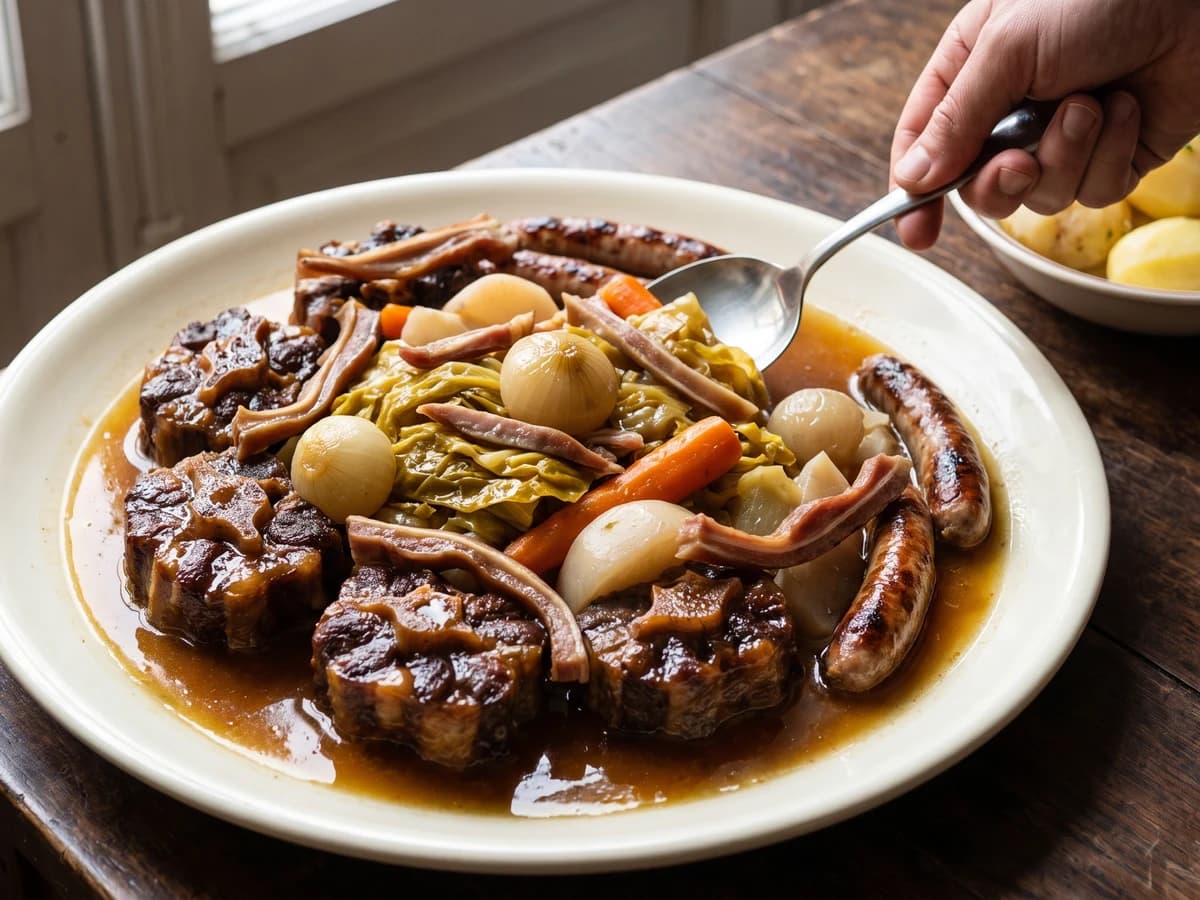
Queue de Bœuf en Hochepot gathers oxtail, pig's trotter and ear, cabbage, roots, and grilled chipolatas around a clear, gelatin-rich broth whose quiet simmer keeps every piece tender and distinct.

Chef Juliette
Beef shoulder larded with bacon, sharpened by red wine and vinegar, then sealed with garlic, vegetables, and dry lemon peel until the low oven turns it yielding and the gravy darkly glossy.