
Chef Juliette
Bouillabaisse à la Marseillaise
Marseille's great fish stew, saffron-gold and garlic-scented, proves that a hard boil can be the careful choice: it binds olive oil into broth before the whole pot meets bread.
A cooking platform built around craft, culture, and the stories behind what we eat.

Created by Chef Juliette
Based on No. 706, Crème de Laitues, otherwise Judic, from Le Guide Culinaire (1907) by Auguste Escoffier
A humble lettuce becomes a silken first course through butter, béchamel, consommé, and cream, with delicate chicken-forcemeat roundels and truffle proving that classical luxury begins with careful technique, not grand ingredients.
Crème de Laitues, dite Judic (cream of lettuce soup), teaches one true thing before you touch a pan: lettuce must lose its raw water before it can give a sauce any flavor. Parboil it, press it dry, then let butter carry it from green and grassy to tender and sweet. Skip that sequence and Béchamel merely hides wet lettuce; keep it and a humble leaf becomes a soup with real poise.
The original assumed a saucier on staff, white consommé never off the fire, a tammy for passing, and another pair of hands shaping the garnish. At home, prepared Béchamel, prepared white consommé, an immersion blender followed by a fine sieve, and one shallow skillet do the same work honestly. The separate garnish station and brigade volume are scaffolding and can go; the 3:2 Béchamel-to-consommé ratio, the butter stew, the passing, the cream finish, and the last-minute poached roundels are the dish and must stay. This batch holds those proportions in one two-quart pot: one cook, one stove, one evening.
Cisel means cutting the lettuce crosswise into narrow, chaff-like strips, so it softens evenly instead of leaving cords in the purée. Before the lettuce meets the butter, squeeze it until no water runs from your fist. That dry handful is the step that decides the soup.
Crème de laitues belongs to the Parisian grand-kitchen soup canon, where inexpensive leaves were refined by butter-stewing, binding, passing, and enrichment with cream. The title Judic honors Anna Judic, the Parisian singer and actress, and follows the kitchen custom of attaching public names to especially polished preparations. Its truffle-centered chicken-forcemeat roundels are not stray decoration: they mark the point at which a practical lettuce potage became a dinner-party soup while keeping the humble leaf at its center.
Quantity
2 medium heads (about 18 oz / 500 g before trimming)
Quantity
1 tablespoon (15 ml / 18 g)
divided
Quantity
4 tablespoons (60 ml / 57 g)
Quantity
3¾ cups (900 ml / 930 g)
Quantity
2½ cups (600 ml / 600 g)
Quantity
⅓ cup (80 ml / 85 g)
kept cold
Quantity
0.35 oz (10 g)
cut into 16 small pieces
Quantity
1 cup (240 ml / 240 g)
Quantity
¼ teaspoon (1 ml / 0.6 g)
| Ingredient | Quantity |
|---|---|
| butterhead lettuces | 2 medium heads (about 18 oz / 500 g before trimming) |
| fine saltdivided | 1 tablespoon (15 ml / 18 g) |
| unsalted butter | 4 tablespoons (60 ml / 57 g) |
| prepared Béchamel | 3¾ cups (900 ml / 930 g) |
| prepared white consommé | 2½ cups (600 ml / 600 g) |
| prepared fine chicken forcemeatkept cold | ⅓ cup (80 ml / 85 g) |
| fresh or whole preserved black trufflecut into 16 small pieces | 0.35 oz (10 g) |
| heavy cream | 1 cup (240 ml / 240 g) |
| finely ground white pepper | ¼ teaspoon (1 ml / 0.6 g) |
Remove and discard the toughest, greenest leaves, exactly as the source directs; they bring bitterness and a muddy color to a soup meant to remain delicate. Reserve eight broad, tender leaves for the garnish. Quarter the remaining lettuce lengthwise, remove the cores, then cut it cisel, crosswise into narrow strips about ¼ inch (6 mm) wide.
Bring a large pot of water to the boil and season it with most of the salt. Blanch the eight reserved leaves for 20 seconds, lift them into cold water, then lay them flat on a clean towel. Add the cisel lettuce to the boiling water and parboil it for 90 seconds, just until it collapses. Drain, cool briefly, then gather it in the towel and squeeze firmly until no water runs. If the bundle still feels heavy and sodden, open it, turn the lettuce, and squeeze again. Water left here follows the lettuce into the soup and weakens everything built afterward.
Melt the butter in a heavy 4-quart saucepan over medium-low heat. Add the squeezed lettuce and a small pinch of the remaining salt, cover, and stew gently for 5 minutes. Uncover and continue cooking for 8 to 10 minutes, stirring often, until the lettuce is completely tender and the pan is nearly dry without any browning. If liquid gathers around it, raise the heat briefly and keep the lettuce moving until the excess evaporates; if the butter begins to color, lower the heat at once. The lettuce should taste sweet and concentrated, not toasted.
Warm the prepared Béchamel in a clean saucepan over gentle heat, then fold in the butter-stewed lettuce. Hold the mixture at the barest simmer for 8 minutes, stirring along the bottom and into the corners so the flour-bound sauce cannot catch. This short cooking joins the lettuce to the Béchamel; simply blending the two while cold leaves the flavors sitting beside one another.
Blend the hot lettuce and Béchamel until no visible strips remain, keeping the blender head submerged. Press the purée through a sturdy fine-mesh sieve with the back of a ladle, scraping the smooth purée from the underside. This is the home equivalent of rubbing it through a tammy, and it must stay; blending makes the lettuce small, while passing makes the soup silken. If the mixture is too thick to move through the sieve, work in one or two spoonfuls of the measured consommé, no more.
Reserve ½ cup (120 ml / 120 g) of the white consommé for poaching the garnish. Whisk the remaining consommé gradually into the passed purée, keeping the mixture smooth after each addition, then heat it at a quiet simmer for 5 minutes. It should coat a spoon lightly rather than sit on it like sauce. If it is thin, reduce it gently now, before the cream enters; the measured poaching liquid and cream will loosen it further.
Pat the reserved blanched leaves completely dry and cut sixteen 1½-inch (4 cm) roundels. Spread each with a thin, even coating of cold chicken forcemeat, about ⅛ inch (3 mm) thick, and place one piece of truffle at its center. If the forcemeat slides instead of holding, chill the assembled roundels for 10 minutes; cold is the correction, not extra flour. Arrange them coated-side up in a shallow skillet, add the reserved consommé around them, cover, and poach at the gentlest quiver for 4 to 6 minutes, until the forcemeat is opaque and reaches 165°F (74°C). A boil will roughen the coating, so lift the skillet from the heat if the liquid becomes lively. Transfer the roundels with a slotted spoon and strain their poaching liquid back into the soup.
Bring the soup back to gentle heat and whisk in the cream. Season with the white pepper and as much of the remaining salt as it needs. Do not let it boil once the cream is in. If overheating makes the surface look grainy or dull, remove the pan from the heat, whisk in a spoonful of cold cream, blend briefly, and pass it once more. Ça se rattrape. Divide the soup among warm bowls and float two lettuce roundels on each, truffle centers facing up. À table!
1 serving (about 240g)
Culinary guides, cultural storytelling, and the editorial depth that makes cooking meaningful.
Discover Culinary ExplorerChef Juliette
Marseille's great fish stew, saffron-gold and garlic-scented, proves that a hard boil can be the careful choice: it binds olive oil into broth before the whole pot meets bread.

Chef Juliette
Waterzoi asks fresh, bone-in river fish to thicken its own buttery broth, with parsley root and pepper for company. No flour, no stockpot, just a brisk simmer watched closely.
Chef Juliette
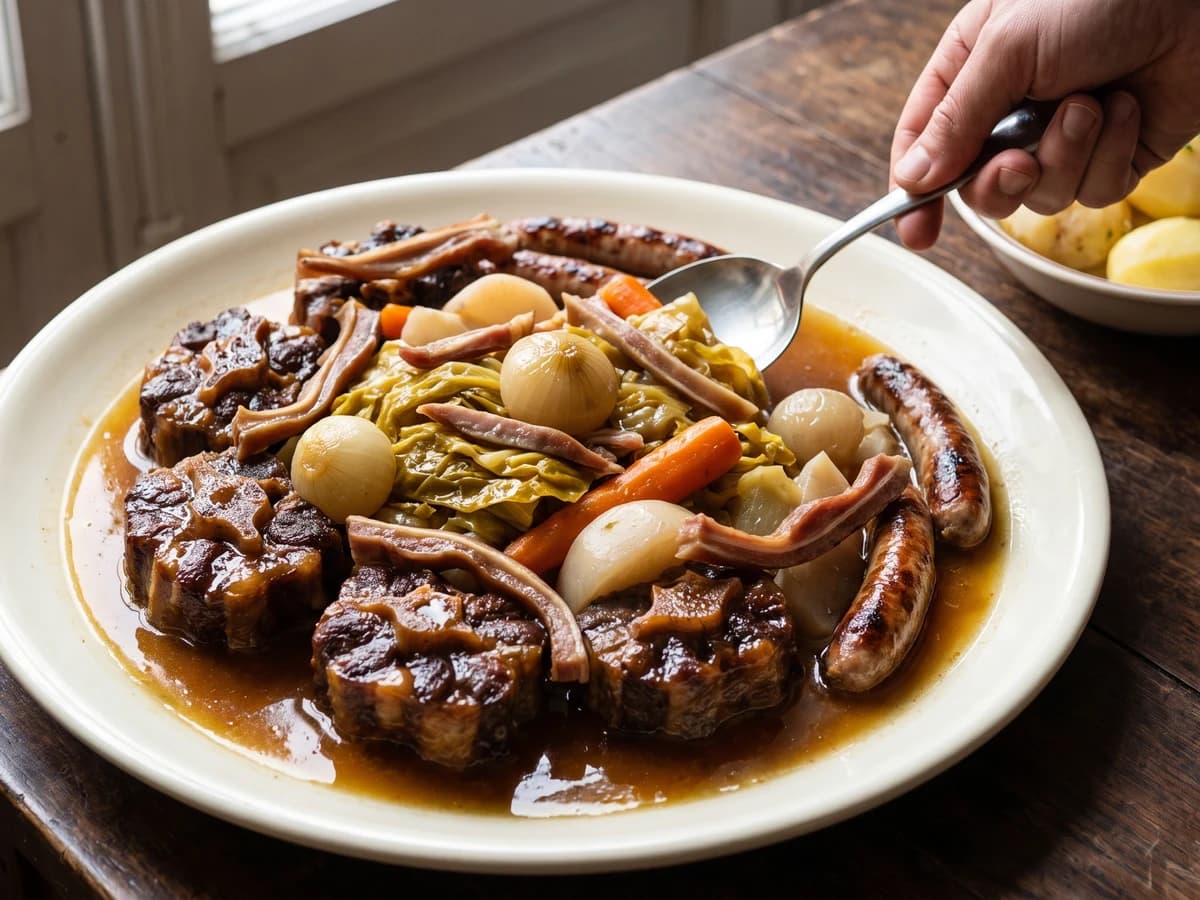
Queue de Bœuf en Hochepot gathers oxtail, pig's trotter and ear, cabbage, roots, and grilled chipolatas around a clear, gelatin-rich broth whose quiet simmer keeps every piece tender and distinct.

Chef Juliette
Beef shoulder larded with bacon, sharpened by red wine and vinegar, then sealed with garlic, vegetables, and dry lemon peel until the low oven turns it yielding and the gravy darkly glossy.