
Chef Juliette
Bouillabaisse à la Marseillaise
Marseille's great fish stew, saffron-gold and garlic-scented, proves that a hard boil can be the careful choice: it binds olive oil into broth before the whole pot meets bread.
A cooking platform built around craft, culture, and the stories behind what we eat.

Created by Chef Juliette
Based on No. 705, Crème d’Ignames, otherwise Brésilienne, from Le Guide Culinaire (1907) by Auguste Escoffier
Bake true yams in their skins, sieve the flesh while hot, then loosen it with milk and thin Béchamel. The reward is an ivory soup with quiet sweetness and a satin body.
Crème d’Ignames (true yam cream soup), otherwise Brésilienne, teaches a clear and useful principle: bake a starchy root when you want sweetness without water, then control its body with hot liquid. Here, igname means a true yam, dry and pale when cooked, not an orange sweet potato. Bake, don't boil. That is the one true thing to know before you touch a pan.
The original formula assumed a saucier with Béchamel (milk sauce thickened with a pale roux) ready, a pot of consommé never off the fire, and a tammy cloth for passing a brigade batch. Your home equivalents are one small pan of thin Béchamel, a sturdy fine-mesh sieve used twice, and good prepared consommé for poaching the pearls, all scaled to about two quarts. The separate sauce station and tammy are scaffolding; baking the yams in their skins, sieving the pulp while hot, preserving the two-to-one measure of boiling milk to thin Béchamel, and poaching the garnish in consommé are the dish and stay. One cook, one stove, one evening.
Finished, Brésilienne is ivory and quietly sweet, with translucent pearls carrying a savory whisper of consommé through the cream. It should pour with a satin body, never sit like mashed yam. Work swiftly from opened yam to sieve because the pulp firms as it cools; if it does, warm it gently and continue. The hot first pass is the step that decides the soup.
Crème d’Ignames belongs not to a French province but to the codified Parisian repertoire of crèmes, soups in which a puréed principal ingredient is carried by thin Béchamel and finished with cream. Its alternate name, Brésilienne, is reinforced by the garnish of perles du Brésil, tiny tapioca pearls poached in consommé, and does not make the preparation a Brazilian household soup. The revealing detail is the baking: the tropical tuber enters the French sauce system only after its sweetness and dry texture have been preserved in the skin.
Quantity
2¼ pounds (1 kg), usually 1 large tuber, to yield 1½ pounds (680 g) baked pulp
scrubbed
Quantity
1½ cups (355 ml / 365 g)
Quantity
1 tablespoon plus ½ teaspoon (17 ml / 16 g)
Quantity
1 tablespoon plus 1 teaspoon (20 ml / 11 g)
Quantity
3 cups (710 ml / 730 g)
heated just to boiling
Quantity
½ cup (120 ml / 120 g)
divided
Quantity
4 tablespoons (60 ml / 57 g)
diced
Quantity
1½ teaspoons (7.5 ml / 9 g), plus more if needed
Quantity
¼ teaspoon (1 ml / 0.5 g)
Quantity
2 tablespoons (30 ml / 24 g)
the modern equivalent of Brazilian pearls
Quantity
1½ cups (355 ml / 360 g)
for poaching the pearls
| Ingredient | Quantity |
|---|---|
| true white yamscrubbed | 2¼ pounds (1 kg), usually 1 large tuber, to yield 1½ pounds (680 g) baked pulp |
| whole milk for the thin Béchamel | 1½ cups (355 ml / 365 g) |
| unsalted butter for the thin Béchamel | 1 tablespoon plus ½ teaspoon (17 ml / 16 g) |
| all-purpose flour | 1 tablespoon plus 1 teaspoon (20 ml / 11 g) |
| whole milk for loosening the yam puréeheated just to boiling | 3 cups (710 ml / 730 g) |
| heavy creamdivided | ½ cup (120 ml / 120 g) |
| cold unsalted butterdiced | 4 tablespoons (60 ml / 57 g) |
| fine sea salt | 1½ teaspoons (7.5 ml / 9 g), plus more if needed |
| finely ground white pepper | ¼ teaspoon (1 ml / 0.5 g) |
| small white tapioca pearlsthe modern equivalent of Brazilian pearls | 2 tablespoons (30 ml / 24 g) |
| clear consomméfor poaching the pearls | 1½ cups (355 ml / 360 g) |
Heat the oven to 400°F (200°C). Prick the scrubbed yam in two or three places, leave the skin intact, and set it on a rimmed baking sheet. Bake for 60 to 90 minutes, depending on its thickness, until a thin knife passes through the center without meeting a chalky core. The skin may darken and the yam may surrender a little syrup at the punctures. That is exactly right. Boiling would fill the flesh with water and flatten its sweetness; baking is the dish, not a convenience.
During the yam's final 20 minutes, warm the 1½ cups milk in a small saucepan. Melt the 16 g butter in a second saucepan over low heat, whisk in the flour, and cook the pale roux for 2 minutes without letting it color. Add the warm milk in three additions, whisking each one smooth before the next, then hold the Béchamel at a bare simmer for 8 minutes. It should remain very fluid and only lightly veil a spoon. If small lumps form, pass the sauce through the fine-mesh sieve. If the bottom catches, pour the clean sauce into another pan immediately and leave every browned trace behind.
Bring the consommé to a gentle simmer in a small saucepan. Sprinkle in the tapioca pearls while stirring, then poach them gently until tender and nearly translucent, usually 15 to 20 minutes or according to their package. Stir often enough to keep them separate. Lift them out with a fine strainer and hold them in 2 tablespoons of the consommé so they remain moist; drain them just before serving.
As soon as the yam is tender, protect your hand with a folded towel and cut it lengthwise. Scoop out the flesh at once, weigh 1½ pounds (680 g), and press it through a sturdy fine-mesh sieve while it is still hot, using the back of a metal spoon or a flexible bowl scraper. Do not use a food processor, which works the starch into glue. If the pulp cools and becomes stubborn, set it in a covered heatproof bowl over barely simmering water until warm again. Ça se rattrape. Add no water.
Bring the 3 cups milk just to a boil. Put the sieved yam in a heavy 4-quart saucepan over low heat and whisk in the milk one ladle at a time, smoothing each addition before adding the next. The first ladle will make a stiff paste, then the purée will relax. Whisk in all the thin Béchamel and hold the soup at the barest tremble for 5 minutes, stirring along the pot floor. Do not boil it hard. The finished base should coat a spoon lightly and fall from it in an unbroken ribbon.
Pass the hot soup through the cleaned fine-mesh sieve into a clean saucepan, pressing gently and discarding any fibrous residue. This second pass is the honest home equivalent of the original tammy cloth, and it gives Brésilienne its characteristic fineness. If the soup still seems grainy, warm it and pass it once more. Blending harder only works the starch further.
Reserve 2 tablespoons of the cream, then whisk the remainder into the soup over low heat until the surface is glossy and the soup is thoroughly hot, without letting it boil. Remove the pan from the heat and whisk in the cold butter one piece at a time. Season with the salt and white pepper. If an oily ring appears, the pan was too hot: move it to a cool surface and whisk in the reserved cream a teaspoon at a time until the soup becomes smooth again. Divide the drained consommé-poached pearls among warmed bowls, ladle over the Brésilienne, and serve at once. À table!
1 serving (about 240g)
Culinary guides, cultural storytelling, and the editorial depth that makes cooking meaningful.
Discover Culinary ExplorerChef Juliette
Marseille's great fish stew, saffron-gold and garlic-scented, proves that a hard boil can be the careful choice: it binds olive oil into broth before the whole pot meets bread.

Chef Juliette
Waterzoi asks fresh, bone-in river fish to thicken its own buttery broth, with parsley root and pepper for company. No flour, no stockpot, just a brisk simmer watched closely.
Chef Juliette
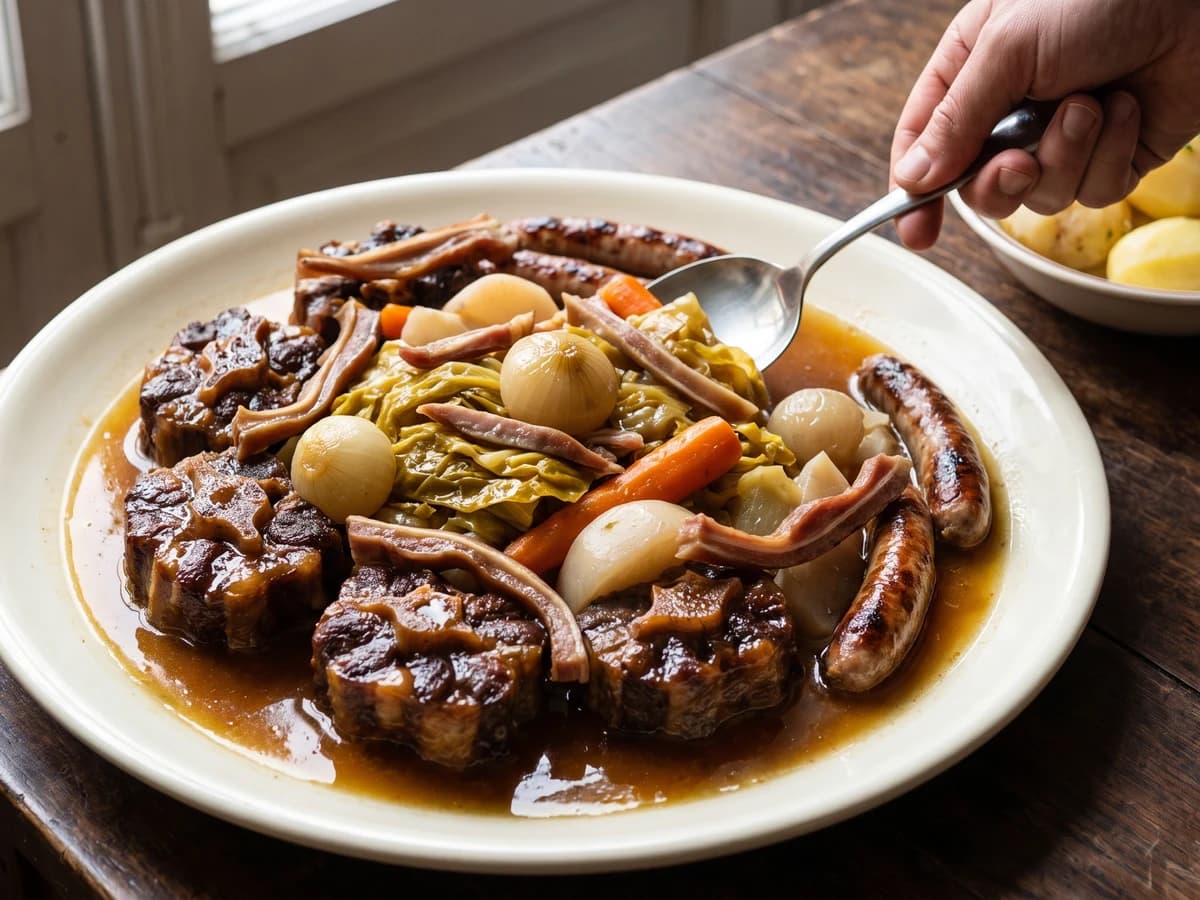
Queue de Bœuf en Hochepot gathers oxtail, pig's trotter and ear, cabbage, roots, and grilled chipolatas around a clear, gelatin-rich broth whose quiet simmer keeps every piece tender and distinct.

Chef Juliette
Beef shoulder larded with bacon, sharpened by red wine and vinegar, then sealed with garlic, vegetables, and dry lemon peel until the low oven turns it yielding and the gravy darkly glossy.