
Chef Juliette
Bouillabaisse à la Marseillaise
Marseille's great fish stew, saffron-gold and garlic-scented, proves that a hard boil can be the careful choice: it binds olive oil into broth before the whole pot meets bread.
A cooking platform built around craft, culture, and the stories behind what we eat.
Created by Chef Juliette
Based on No. 704, Crème de Fèves Nouvelles, from Le Guide Culinaire (1907) by Auguste Escoffier
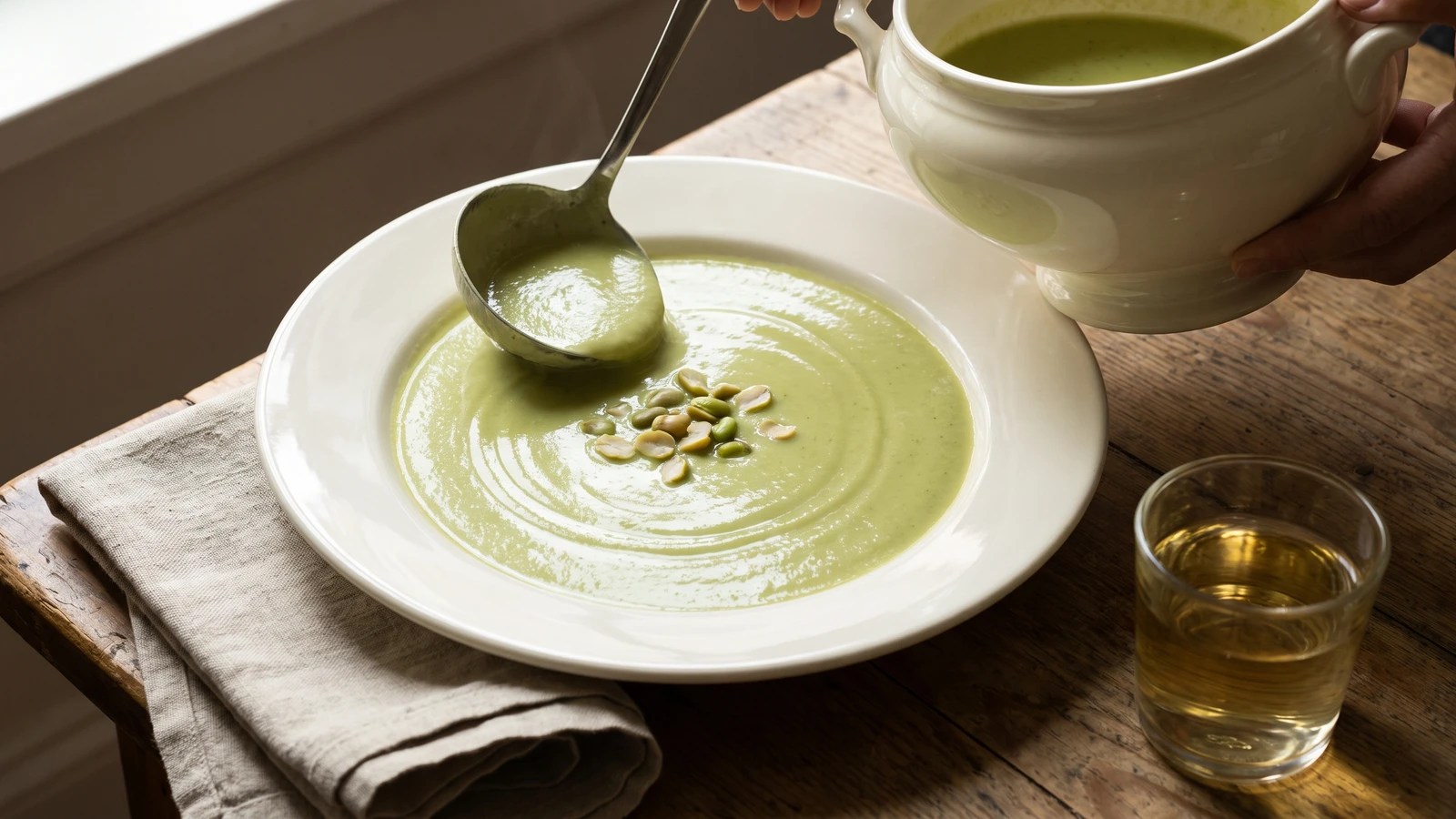
Young broad beans, savory, real Béchamel, and cream become a pale green soup of remarkable delicacy, with the smallest beans kept whole for a tender garnish and the sieve doing the essential work.
Crème de Fèves Nouvelles (cream of new broad beans) teaches that a cream soup is made smooth before it is made rich. The one true thing to know before touching a pan is this: broad beans wear two coverings, the pod and a pale inner skin, and both must go. Leave that second skin behind and no quantity of cream will give you delicacy.
The original entry assumed a saucier with Béchamel ready, white consommé never off the fire, and a tamis (drum sieve) broad enough for repeated service. The home answer is a measured batch of prepared Béchamel, the book's own whole-milk option instead of a separate consommé, and a sturdy fine-mesh sieve. The consommé and brigade-sized tamis are scaffolding; the real-butter Béchamel, ten-minute savory blanch, gentle finishing heat, and final sieving are the dish. The proportions remain intact, fitted to one 4-quart saucepan for about two quarts of soup. One cook, one stove, one evening.
At the table, the crème should be pale spring green, glossy without heaviness, and quietly peppery from the savory. The little split beans on top remind you what went into all that silk. Press the purée patiently through the sieve, because that is the step that decides the dish.
Crème de Fèves Nouvelles belongs to the classical Parisian repertoire of crèmes, a family of smooth soups built on Béchamel rather than merely decorated with cream. It carries an older pairing from French kitchen gardens into that formal system: young broad beans and savory, refined by gentle cooking and a tamis. From the grand kitchen it passed naturally to the bourgeois dinner table, while the permitted velouté preparation remained a neighboring classical branch rather than a correction.
Quantity
4½ pounds (2 kg), yielding about 3 cups (500 g) double-skinned beans
reserve the smallest ½ cup (75 g) for garnish
Quantity
4 quarts (3.8 L / 3.8 kg)
Quantity
2 tablespoons (30 ml / 36 g), plus up to ½ teaspoon (2.5 ml / 3 g) for final seasoning
divided
Quantity
2 large sprigs
Quantity
4¼ cups (1 L / about 1.05 kg)
Quantity
1⅔ cups (400 ml / 400 g)
Quantity
½ cup (120 ml / 120 g)
| Ingredient | Quantity |
|---|---|
| fresh young broad beans in their podsreserve the smallest ½ cup (75 g) for garnish | 4½ pounds (2 kg), yielding about 3 cups (500 g) double-skinned beans |
| water | 4 quarts (3.8 L / 3.8 kg) |
| fine sea saltdivided | 2 tablespoons (30 ml / 36 g), plus up to ½ teaspoon (2.5 ml / 3 g) for final seasoning |
| fresh summer savory | 2 large sprigs |
| prepared Béchamel made with whole milk and real butter | 4¼ cups (1 L / about 1.05 kg) |
| whole milk | 1⅔ cups (400 ml / 400 g) |
| heavy cream | ½ cup (120 ml / 120 g) |
Remove the broad beans from their pods. Nip the pale eye of each bean with a thumbnail or small knife, then squeeze gently so the green seed slips free of its leathery inner skin. Measure 2½ cups (425 g) for the soup. Reserve the smallest ½ cup (75 g) for garnish and split those beans lengthwise along their natural seam.
Bring the water and 2 tablespoons salt to a full boil. Add one sprig of savory and the split garnish beans, then parboil them for 60 to 90 seconds, just until tender but still distinct. Lift them out, rinse briefly under cold water, drain well, and discard the savory. Add the second sprig and the 2½ cups soup beans to the same boiling water. Cook for exactly 10 minutes, as the original directs, then drain without rinsing and discard the savory.
Warm the prepared Béchamel in a heavy saucepan over low heat, stirring across the bottom so its roux foundation cannot catch. Add the hot drained beans and cook gently for 8 to 12 minutes, stirring often, until a bean crushes completely against the side of the pan with no chalky center. Keep the bubbling lazy. If the Béchamel begins to catch, immediately transfer the unscorched mixture to a clean saucepan without scraping the browned floor; the soup can continue unharmed.
Remove the pan from the heat and purée the beans directly in the Béchamel with an immersion blender until no whole pieces remain. Press the hot purée through a sturdy fine-mesh sieve into a clean saucepan, working with a flexible scraper until only dry fibers remain. If the purée clogs the sieve and refuses to pass, the beans need more cooking, not more force. Return everything to the saucepan with a ladleful of the measured milk, cook gently for 5 minutes, then blend and sieve again. Ça se rattrape.
Whisk in the remaining whole milk gradually so the purée stays smooth, then heat over medium-low heat without allowing it to boil. The finished soup should coat a spoon lightly yet pour from it in an uninterrupted ribbon. If it remains too thick after all the milk is added, loosen it with warm milk one tablespoon at a time; if it is thin, hold it just below a simmer for a few minutes while stirring. Stop when the edge quivers and the surface gleams, about 170°F (77°C).
Remove the soup from the heat and stir in the heavy cream. Taste, then add up to ½ teaspoon salt only if the Béchamel and blanching water have not supplied enough. Divide the reserved split broad beans among warmed bowls and ladle the crème over and around them, keeping several visible at the center. Serve at once. À table!
1 serving (about 260g)
Culinary guides, cultural storytelling, and the editorial depth that makes cooking meaningful.
Discover Culinary ExplorerChef Juliette
Marseille's great fish stew, saffron-gold and garlic-scented, proves that a hard boil can be the careful choice: it binds olive oil into broth before the whole pot meets bread.

Chef Juliette
Waterzoi asks fresh, bone-in river fish to thicken its own buttery broth, with parsley root and pepper for company. No flour, no stockpot, just a brisk simmer watched closely.
Chef Juliette
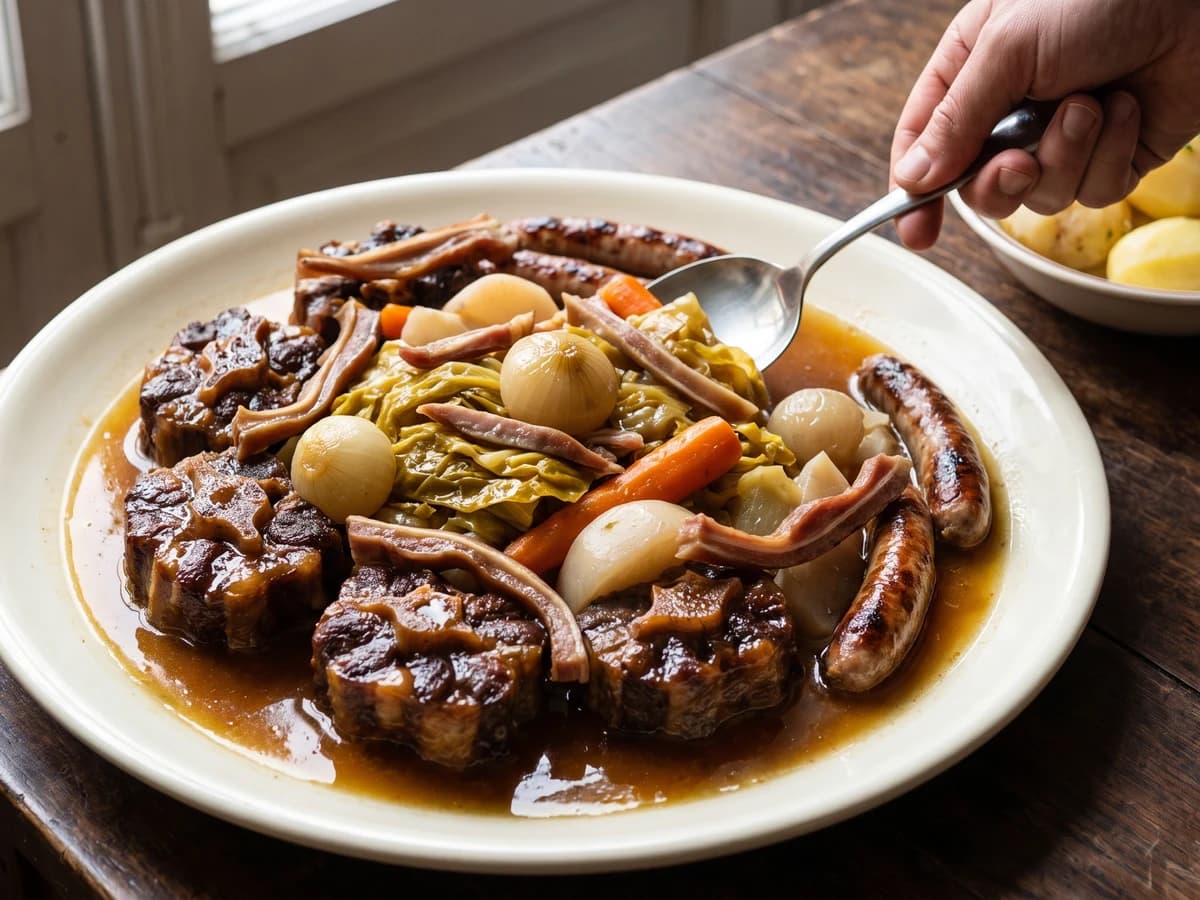
Queue de Bœuf en Hochepot gathers oxtail, pig's trotter and ear, cabbage, roots, and grilled chipolatas around a clear, gelatin-rich broth whose quiet simmer keeps every piece tender and distinct.

Chef Juliette
Beef shoulder larded with bacon, sharpened by red wine and vinegar, then sealed with garlic, vegetables, and dry lemon peel until the low oven turns it yielding and the gravy darkly glossy.