
Chef Juliette
Bouillabaisse à la Marseillaise
Marseille's great fish stew, saffron-gold and garlic-scented, proves that a hard boil can be the careful choice: it binds olive oil into broth before the whole pot meets bread.
A cooking platform built around craft, culture, and the stories behind what we eat.

Created by Chef Juliette
Based on No. 702, Crème de Chicorée de Bruxelles, otherwise Bruxelloise, from Le Guide Culinaire (1907) by Auguste Escoffier
Belgian endive, butter, lemon, Béchamel, and white consommé become an ivory Bruxelloise whose gentle sweetness still carries a clean bitter edge, finished with cream and its own tender julienne.
Crème de Chicorée de Bruxelles, dite Bruxelloise (Brussels endive cream soup), teaches the proper handling of bitterness: soften it with butter, lemon, and patient heat, but don't scrub it away. That clean final edge is what keeps the Béchamel and cream from turning the bowl dull. Before you touch a pan, know this one thing: the chicory must soften completely without taking color.
The original entry assumed a saucier at the range, finished Béchamel close by, white consommé never off the fire, and a tammy with another pair of hands to force the thick purée through it. At home, one heavy saucepan, an immersion blender, and a fine-mesh sieve replace that brigade scaffolding. The open-ended quantity of consommé becomes a measured range and an eight-cup target, so one cook has a clear stopping point. The proportions, flavorings, and sequence remain intact.
The tammy and spare hands can go. The thirty-minute butter-and-lemon étuvage, gentle covered stewing, and the final sieving must stay, because they are the dish. Done properly, the soup is ivory and glossy, sweet at first taste with the endive's elegant bitterness arriving behind the cream. Guard that pale étuvage above every other step.
Crème de Chicorée de Bruxelles carries the witloof, or chicon, of the market gardens around Brussels into the French classical family of cream soups. Its whiteness comes from forcing chicory roots away from light, not from a naturally pale lettuce, which keeps the leaves tender and their bitterness controlled. Classical kitchens named the soup Bruxelloise for its Belgian ingredient, then treated it through the French grammar of étuvage, Béchamel, sieving, white consommé, cream, and a julienne of the vegetable itself.
Quantity
1 lb (454 g), about 6 medium heads
trimmed and sliced for the soup
Quantity
6 oz (170 g), about 2 medium heads
reserved for cutting julienne-fashion
Quantity
4 tablespoons (60 ml / 56 g)
divided
Quantity
3 tablespoons (45 ml / 45 g)
from 1 medium lemon
Quantity
3 cups (710 ml / 745 g)
Quantity
2 to 3 cups (475 to 710 ml / 475 to 710 g)
heated and added as needed
Quantity
1 cup (240 ml / 240 g)
Quantity
to taste
Quantity
to taste
| Ingredient | Quantity |
|---|---|
| very fresh Belgian endivetrimmed and sliced for the soup | 1 lb (454 g), about 6 medium heads |
| Belgian endive for the garnishreserved for cutting julienne-fashion | 6 oz (170 g), about 2 medium heads |
| unsalted butterdivided | 4 tablespoons (60 ml / 56 g) |
| fresh lemon juicefrom 1 medium lemon | 3 tablespoons (45 ml / 45 g) |
| finished Béchamel | 3 cups (710 ml / 745 g) |
| finished white consomméheated and added as needed | 2 to 3 cups (475 to 710 ml / 475 to 710 g) |
| heavy cream, 35 to 40 percent milk fat | 1 cup (240 ml / 240 g) |
| fine sea salt | to taste |
| ground white pepper | to taste |
Remove any bruised outer leaves from the endive intended for the soup. Trim only the dry root ends, leaving the tender cores, then quarter the heads lengthwise and slice them crosswise about 1/4 inch (6 mm) thick. Rinse only if needed and dry thoroughly. Water clinging to the leaves dilutes the butter before the endive can absorb it.
Melt 3 tablespoons (45 ml / 42 g) of the butter in a heavy saucepan over low heat. Add the sliced endive, lemon juice, and a small pinch of salt, turning until every piece gleams. Press a parchment cartouche directly over the endive, cover the pan, and cook at the gentlest murmur for 30 minutes, stirring two or three times. The leaves will release liquid, collapse, and turn tender without browning. If the bottom begins to color, immediately move the uncolored endive to a clean pan, add 1 tablespoon of water, and leave the browned residue behind. Ça se rattrape, provided the endive hasn't taken on a scorched smell.
Fold the finished Béchamel into the softened endive and bring the mixture just to a bare simmer. Cook very slowly for 20 to 25 minutes, partly covered, scraping the pan floor every few minutes with a flat-edged spoon. The endive should yield completely when pressed against the side of the pan. Keep the bubbles lazy. A hard boil can scorch the milk-thickened base before the chicory is ready.
While the soup base finishes, cut the garnish endive julienne-fashion, into match-shaped rods about 1/8 inch (3 mm) wide and 1 1/2 inches (4 cm) long. Melt the remaining 1 tablespoon (15 ml / 14 g) butter in a small lidded pan, add the julienne and a pinch of salt, then cover and stew over low heat for 8 to 10 minutes. Stir once or twice and stop when the rods are tender but still hold their shape. Drain them thoroughly in a fine sieve and keep them covered.
Take the thick endive and Béchamel mixture off the heat and blend it carefully with an immersion blender until no visible pieces remain. Push the purée through a fine-mesh sieve into a clean bowl, working with the back of a ladle and scraping the smooth soup from the underside. The blender replaces the spare hands, not the sieve. Passing removes the chicory's fine threads and gives Bruxelloise its proper silk.
Return the passed base to the cleaned saucepan. Stir in 2 cups (475 ml / 475 g) of the heated white consommé a little at a time, then add as much of the final cup as needed to bring the base to 7 cups (1.65 liters). Heat gently and judge the texture from a warm spoon: it should coat lightly, then flow cleanly. If it is too thick, add more consommé; if it is too thin, reduce it at a bare simmer before adding the cream. Don't correct it with flour. The Béchamel has already done that work.
When the soup is ready to serve, lower the heat and whisk a ladleful of the hot base into the cream. Pour the warmed cream back into the saucepan, stirring constantly, then heat only until the soup is thoroughly hot. Do not boil it. Season with salt and white pepper after the Béchamel, consommé, and cream are united, since each brings its own seasoning. If the surface freckles from excessive heat, take the pan off the stove, blend briefly, and pass the soup once more with a spoonful of cold cream.
Warm a soupière or the individual soup bowls. Divide the well-drained endive julienne among them, keeping a few rods for the surface, then ladle in the Bruxelloise and finish with the remaining julienne. Serve at once while the soup is glossy and fluid. No herb garnish is needed; the endive names itself. À table!
1 serving (about 240g)
Culinary guides, cultural storytelling, and the editorial depth that makes cooking meaningful.
Discover Culinary ExplorerChef Juliette
Marseille's great fish stew, saffron-gold and garlic-scented, proves that a hard boil can be the careful choice: it binds olive oil into broth before the whole pot meets bread.

Chef Juliette
Waterzoi asks fresh, bone-in river fish to thicken its own buttery broth, with parsley root and pepper for company. No flour, no stockpot, just a brisk simmer watched closely.
Chef Juliette
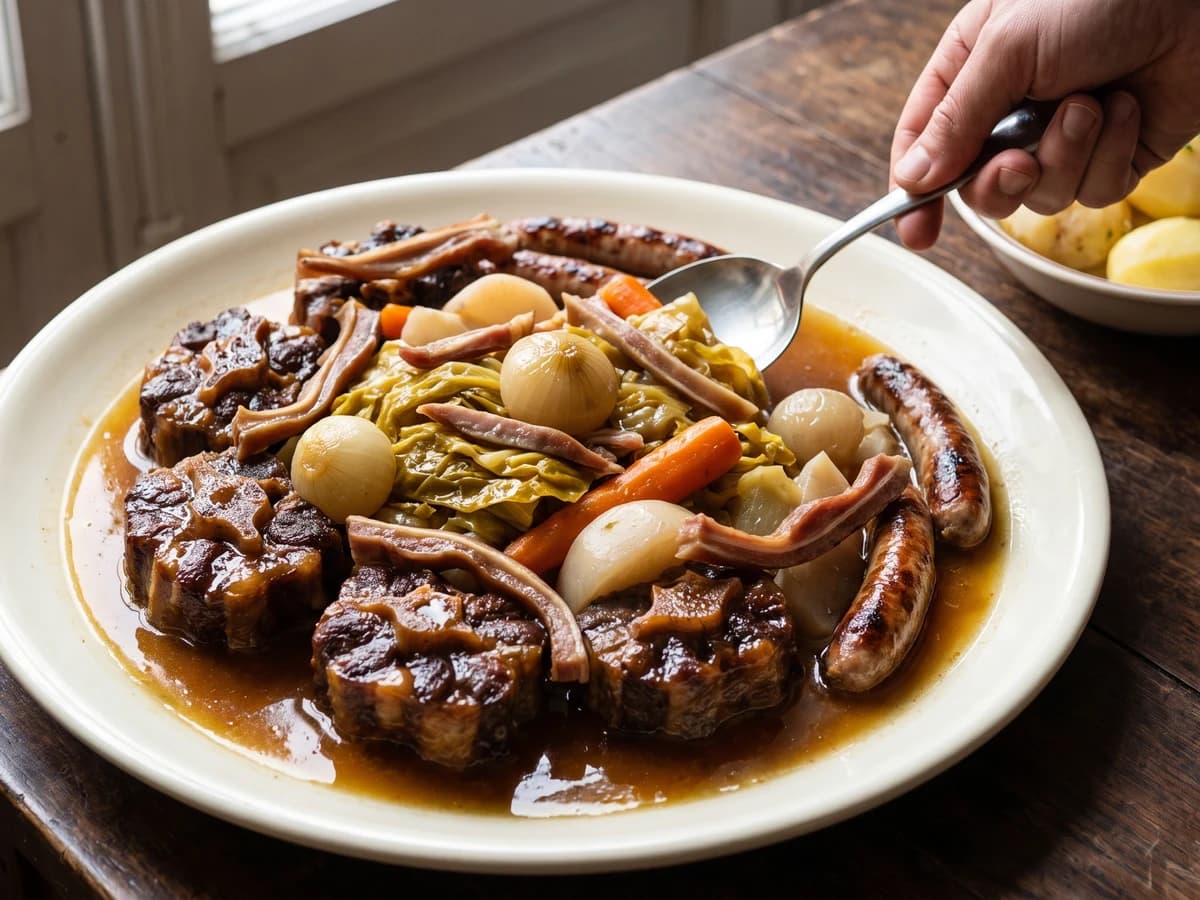
Queue de Bœuf en Hochepot gathers oxtail, pig's trotter and ear, cabbage, roots, and grilled chipolatas around a clear, gelatin-rich broth whose quiet simmer keeps every piece tender and distinct.

Chef Juliette
Beef shoulder larded with bacon, sharpened by red wine and vinegar, then sealed with garlic, vegetables, and dry lemon peel until the low oven turns it yielding and the gravy darkly glossy.