
Chef Juliette
Bouillabaisse à la Marseillaise
Marseille's great fish stew, saffron-gold and garlic-scented, proves that a hard boil can be the careful choice: it binds olive oil into broth before the whole pot meets bread.
A cooking platform built around craft, culture, and the stories behind what we eat.
Created by Chef Juliette
Based on No. 696, Crème d’Artichauts au Beurre de Noisette, from Le Guide Culinaire (1907) by Auguste Escoffier
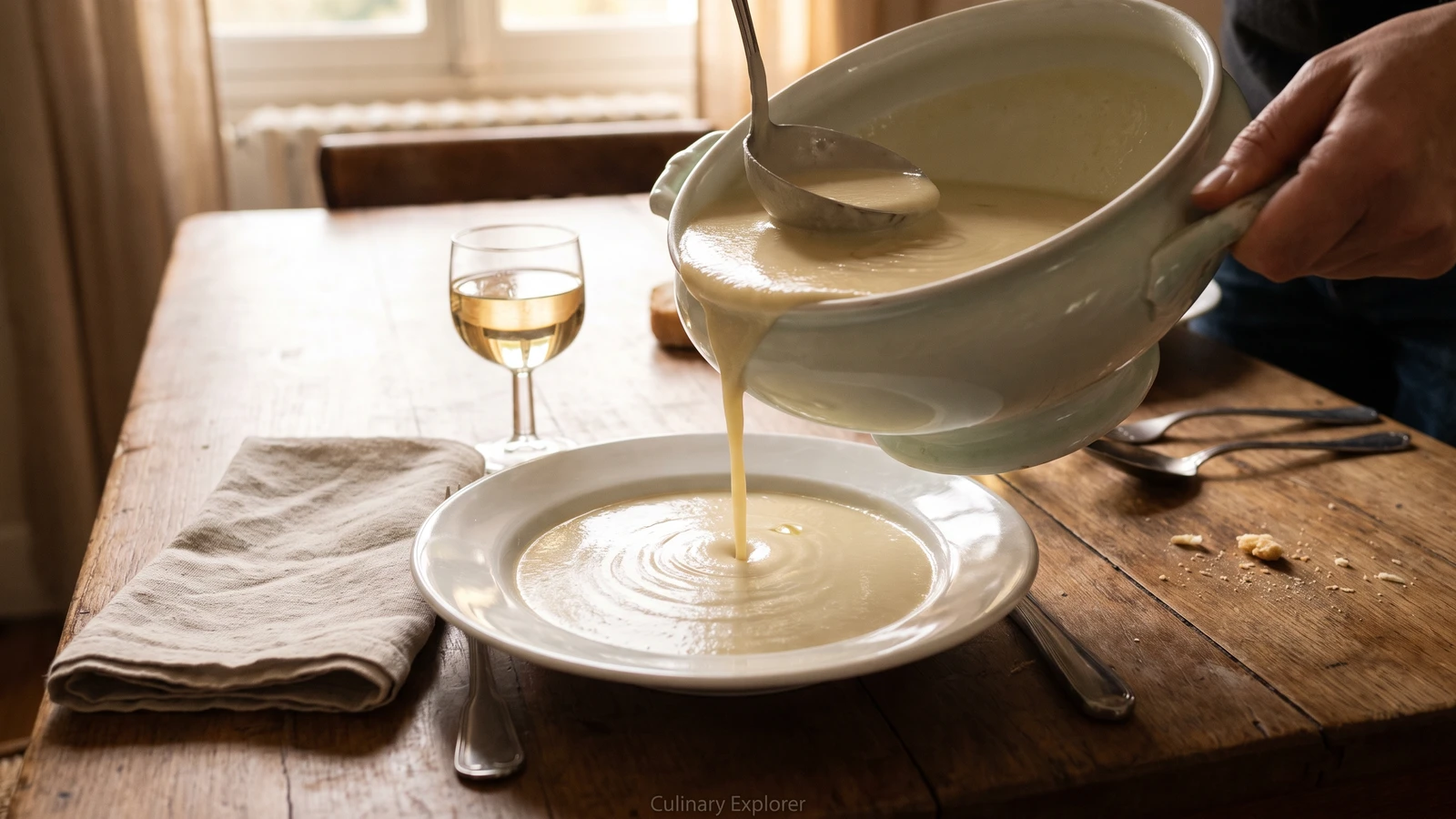
Crème d’Artichauts au Beurre de Noisette teaches the classical cream-soup ratio: pale Béchamel for body, artichoke for character, white consommé for ease, and real hazelnut butter whisked in at the last moment.
Crème d’Artichauts au Beurre de Noisette (artichoke cream with hazelnut butter) teaches the architecture of every classical crème: Béchamel supplies half the body, the vegetable supplies one quarter, and white consommé or milk supplies the last quarter before the final cream is added. The one true thing to know before touching a pan is that the Béchamel must carry the artichoke without smothering it. Respect that proportion and the soup tastes unmistakably of the vegetable, not merely of thickened milk.
The original kitchen assumed a saucier with Béchamel Sauce (No. 28) ready, white consommé never far from the fire, a mortar for pounding, and a tammy broad enough to sieve a service quantity. Here the finished components remain whole, exactly as the book keeps them: you reach for the Béchamel Sauce (No. 28) and Hazel-nut Butter (No. 155), while a food processor replaces the mortar and a fine-mesh sieve replaces the tammy. Those tools and brigade quantities were scaffolding, so they can change. The half-quarter-quarter structure, the sieving, and the last-minute finish are the dish, so they stay. One cook, one stove, one evening.
The finished crème should be pale ivory with the faint green cast of artichoke, satin-smooth and gently nutty, never brown and never heavy. Stew the minced bottoms in butter until tender and concentrated without letting them color. That quiet pan is the step that decides the soup.
This crème belongs to the classical potage course of the Parisian grand kitchen, where vegetable creams were organized as a family built on Béchamel and frequently appeared at the meatless Lenten table. Its refinement came from passing the entire preparation through a tammy, a practical method for removing every stubborn artichoke fibre before the soup traveled from grand service into bourgeois dining rooms. The title carries a useful distinction: beurre de noisette here contains actual toasted hazelnuts, while beurre noisette is butter cooked until it smells nutty.
Quantity
4 large, yielding about 1¾ cups (420 ml / 400 g) trimmed and parboiled bottoms
trimmed to the bottoms
Quantity
2 tablespoons (30 ml / 28 g)
Quantity
3½ cups (840 ml / 875 g) Béchamel Sauce (No. 28)
Quantity
1¾ cups (420 ml / 420 g)
Quantity
½ cup plus 1 tablespoon (135 ml / 135 g)
Quantity
2 tablespoons (30 ml / 28 g) Hazel-nut Butter (No. 155)
| Ingredient | Quantity |
|---|---|
| fresh globe artichokestrimmed to the bottoms | 4 large, yielding about 1¾ cups (420 ml / 400 g) trimmed and parboiled bottoms |
| unsalted butter | 2 tablespoons (30 ml / 28 g) |
| Béchamel Sauce, Lenten form without veal | 3½ cups (840 ml / 875 g) Béchamel Sauce (No. 28) |
| white consommé or whole milk | 1¾ cups (420 ml / 420 g) |
| very fresh heavy cream | ½ cup plus 1 tablespoon (135 ml / 135 g) |
| Hazel-nut Butter | 2 tablespoons (30 ml / 28 g) Hazel-nut Butter (No. 155) |
Pull away the tough outer leaves from each artichoke, cut off the remaining leaf cone, and pare away every dark green, fibrous patch until only the pale bottom remains. Trim the stem flush and scrape out the furry choke with a spoon. Drop each finished bottom directly into a pan of cool water while you work, then bring the water to a gentle simmer and parboil for 8 to 12 minutes. A knife should enter with some resistance because the bottoms will finish cooking in butter. Drain them thoroughly and blot them dry.
Mince the parboiled bottoms very finely. Melt the unsalted butter in a wide saucepan over medium-low heat, add the artichoke, and cook gently for 10 to 15 minutes, stirring often, until completely tender and no watery moisture remains. Keep the mixture pale. If the butter begins to color, lower the heat and stir in a tablespoon of water at once. Ça se rattrape. Continue until that water has evaporated and the artichoke smells concentrated and sweet.
Transfer the warm artichoke to a food processor and work it to a dense, even paste, scraping the bowl several times. This replaces the mortar, nothing more. Warm the Béchamel Sauce (No. 28) gently in the cleaned saucepan, fold in the pounded artichoke, and stir over low heat for 3 to 4 minutes, only until the two become completely uniform.
Set a fine-mesh sieve over a clean saucepan and press the mixture through with a flexible spatula or the back of a ladle, scraping the smooth purée from the underside into the pan. Discard the dry fibres left behind. Do not skip this because the artichoke looks smooth from the processor; its fine strings reveal themselves on the spoon. If the mixture resists the sieve, blend it briefly with one ladleful of the measured consommé or milk, then pass it again.
Whisk in the remaining white consommé or milk a little at a time, keeping the prescribed half-quarter-quarter balance intact. Set the pan over medium-low heat and warm the crème until glossy and fluid enough to fall from the ladle in a broad ribbon. It must not boil. A clear, lightly seasoned white chicken stock is the honest home equivalent for a white consommé kept constantly ready; whole milk gives the softer meatless version expressly allowed by the original.
Take the pan off the heat. Whisk in the very fresh cream, followed by the Hazel-nut Butter (No. 155), until the finish is fully dispersed and the surface shines without separate beads of fat. Taste and correct the seasoning only if the prepared Béchamel and consommé require it. If the crème boils or the butter separates, stop the heat, whisk in a tablespoon of cold cream, and blend briefly until smooth. Ça se rattrape. Pass it once more if necessary, ladle it immediately into warm bowls, and serve. À table!
1 serving (about 225g)
Culinary guides, cultural storytelling, and the editorial depth that makes cooking meaningful.
Discover Culinary ExplorerChef Juliette
Marseille's great fish stew, saffron-gold and garlic-scented, proves that a hard boil can be the careful choice: it binds olive oil into broth before the whole pot meets bread.

Chef Juliette
Waterzoi asks fresh, bone-in river fish to thicken its own buttery broth, with parsley root and pepper for company. No flour, no stockpot, just a brisk simmer watched closely.
Chef Juliette
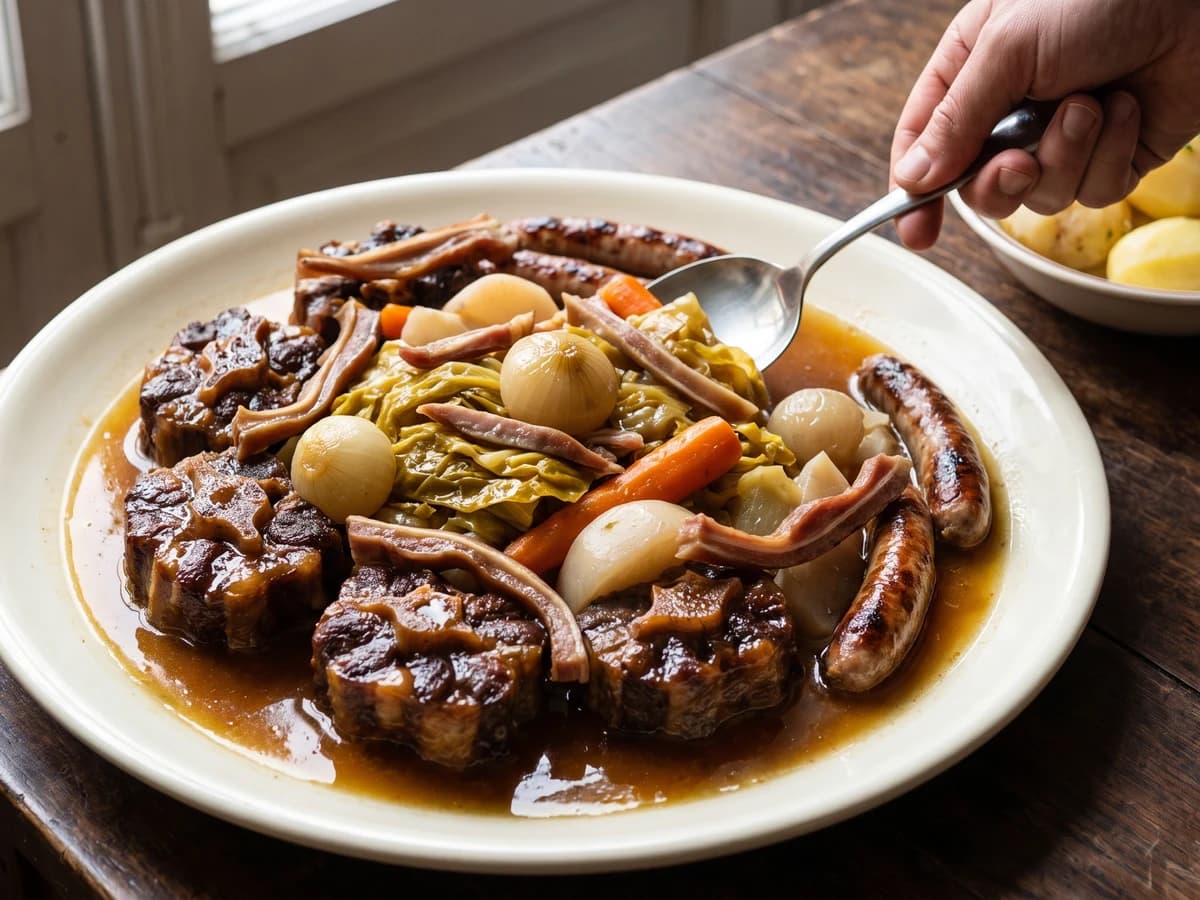
Queue de Bœuf en Hochepot gathers oxtail, pig's trotter and ear, cabbage, roots, and grilled chipolatas around a clear, gelatin-rich broth whose quiet simmer keeps every piece tender and distinct.

Chef Juliette
Beef shoulder larded with bacon, sharpened by red wine and vinegar, then sealed with garlic, vegetables, and dry lemon peel until the low oven turns it yielding and the gravy darkly glossy.