
Chef Juliette
Bouillabaisse à la Marseillaise
Marseille's great fish stew, saffron-gold and garlic-scented, proves that a hard boil can be the careful choice: it binds olive oil into broth before the whole pot meets bread.
A cooking platform built around craft, culture, and the stories behind what we eat.

Created by Chef Juliette
Based on No. 686, Velouté de Homard à l’Indienne, from Le Guide Culinaire (1907) by Auguste Escoffier
Lobster à l’Américaine becomes an ivory-coral velouté, with curry held just below command, abundant diced tail meat in each bowl, and buttery rice offered separately.
Velouté de Homard à l’Indienne (lobster velouté with curry) teaches a strict little lesson: an assertive spice can carry shellfish forward without becoming the subject. You should taste lobster first, then the warmth of curry spreading beneath it. Reverse that order and the dish loses its reason for being.
The formula begins with Homard à l’Américaine and proceeds as for the Cleveland velouté because it assumed a saucier on staff, a stockpot never off the fire, and those preparations already moving through the brigade. Your home equivalent is one cocotte for the lobster and one saucepan for the roux, with strong unsalted shellfish stock, poultry shears, a blender used only for the meat, and a fine sieve in place of the mortar and tamis. The brigade portions are reduced to about two quarts. One cook, one stove, one evening.
The separate production pots were scaffolding, so they can go. Browning the shells, reducing Cognac and wine with tomato, extracting the lobster gently, building a real roux, finishing with a cream-and-yolk liaison, reserving the tail generously, and sending the Riz à l’Indienne apart are the dish itself, so every one stays. Measure the curry before it touches the butter. You can deepen it later, but you cannot pull it back.
Velouté de Homard à l’Indienne belongs to the Parisian grand-kitchen repertoire, and in the classical sequence it is the Cleveland lobster velouté carried one measured step further with curry. The label à l’Indienne signals the French canon’s use of curry with rice, not a claim to represent any particular Indian regional table; diced tail meat and rice served apart keep the lobster’s identity clear. The familiar américaine versus armoricaine argument concerns the preparation’s name more than its working grammar of tomato, wine, Cognac, aromatics, and shellfish.
Quantity
2, about 1¼ pounds (570 g) each
Quantity
10 tablespoons (150 ml / 142 g)
divided
Quantity
2 tablespoons (30 ml / 28 g)
Quantity
1½ cups (360 ml / 225 g)
finely diced
Quantity
¾ cup (180 ml / 90 g)
finely diced
Quantity
½ cup (120 ml / 75 g)
finely chopped
Quantity
1 tablespoon (15 ml / 9 g)
minced
Quantity
2 to 2½ teaspoons (10 to 12.5 ml / 4 to 5 g)
divided
Quantity
3 tablespoons (45 ml / 50 g)
Quantity
1 cup (240 ml / 240 g)
crushed
Quantity
¼ cup (60 ml / 57 g)
Quantity
1½ cups (360 ml / 360 g)
Quantity
6 cups (1.44 L / 1.44 kg)
divided
Quantity
1
Quantity
½ cup (120 ml / 60 g)
Quantity
1½ cups (360 ml / 355 g)
divided
Quantity
3
Quantity
1 tablespoon (15 ml / 15 g)
Quantity
2½ teaspoons (12.5 ml / 15 g), plus more to taste
divided
Quantity
½ teaspoon (2.5 ml / 1 g)
Quantity
1 pinch
Quantity
2 tablespoons (30 ml / 24 g)
Quantity
4 cups (960 ml / 960 g)
| Ingredient | Quantity |
|---|---|
| live lobsters | 2, about 1¼ pounds (570 g) each |
| unsalted butterdivided | 10 tablespoons (150 ml / 142 g) |
| neutral oil | 2 tablespoons (30 ml / 28 g) |
| yellow onionfinely diced | 1½ cups (360 ml / 225 g) |
| carrotfinely diced | ¾ cup (180 ml / 90 g) |
| shallotsfinely chopped | ½ cup (120 ml / 75 g) |
| garlicminced | 1 tablespoon (15 ml / 9 g) |
| mild French curry powderdivided | 2 to 2½ teaspoons (10 to 12.5 ml / 4 to 5 g) |
| tomato paste | 3 tablespoons (45 ml / 50 g) |
| canned peeled tomatoescrushed | 1 cup (240 ml / 240 g) |
| Cognac | ¼ cup (60 ml / 57 g) |
| dry white wine | 1½ cups (360 ml / 360 g) |
| unsalted lobster, shellfish, or fish stockdivided | 6 cups (1.44 L / 1.44 kg) |
| bouquet garni | 1 |
| all-purpose flour | ½ cup (120 ml / 60 g) |
| heavy creamdivided | 1½ cups (360 ml / 355 g) |
| large egg yolks | 3 |
| fresh lemon juice | 1 tablespoon (15 ml / 15 g) |
| fine saltdivided | 2½ teaspoons (12.5 ml / 15 g), plus more to taste |
| ground white pepper | ½ teaspoon (2.5 ml / 1 g) |
| cayenne | 1 pinch |
| long-grain white rice for Riz à l’Indienne | 2 tablespoons (30 ml / 24 g) |
| water for cooking the rice | 4 cups (960 ml / 960 g) |
Ask the fishmonger to dispatch the lobsters immediately before you cook, or dispatch well-chilled lobsters firmly with a heavy chef’s knife. Separate the tails and claws, split the bodies, remove the head sacs and feathery gills, and cut each tail through the shell into three sections. Crack the claws without crushing them and pat every piece dry. Wet lobster spits in the fat and refuses to brown.
Saisir, sear briskly, is the first foundation. Heat 2 tablespoons of the butter with the oil in a heavy cocotte until the butter foams, then add the lobster in one uncrowded layer. Turn the pieces until the shells become brilliant red and lightly browned. Remove the tail sections after 4 to 5 minutes, when the meat is barely opaque, and give the claws another 2 to 3 minutes. Once cool enough to handle, extract all the meat. Cut the tail into generous ½-inch dice and keep it covered in the cold; reserve the claw and knuckle meat separately for the body of the velouté. Return every empty shell to the cocotte.
Add 1 tablespoon of butter, the onion, carrot, shallots, and ½ teaspoon of the salt to the cocotte. Cook over medium heat for 8 minutes, stirring and scraping the shell fond from the pot, until the vegetables soften without taking dark colour. Add the garlic, tomato paste, and 2 teaspoons of curry powder. Cook for 2 minutes, until the paste darkens slightly and the curry smells warm rather than dusty. If the spice catches and smells bitter, stop and lift the shells out. Wipe the pot and rebuild the vegetables with fresh butter and curry. Ça se rattrape, but burnt spice cannot be diluted into obedience.
Pull the cocotte off the heat and add the Cognac. Keep the lid beside you, return the pot to moderate heat, and ignite the Cognac with a long match only if you are comfortable doing so. Otherwise, boil it briskly until the sharp alcohol smell disappears; the flame is brigade spectacle, while the reduction is the part the dish needs. Add the wine and reduce it by half. Stir in the tomatoes, 5 cups of the stock, and the bouquet garni. Bring the shells back to a bare tremble and simmer uncovered for 25 minutes, pressing them occasionally with a sturdy potato masher. A hard boil makes the extraction coarse and can turn the shells bitter.
Discard the bouquet garni and strain the lobster liquor through a fine-mesh sieve into a bowl, pressing firmly on the shells and vegetables without grinding grit through the mesh. Blend the reserved claw and knuckle meat with 1 cup of the strained liquor until completely smooth, keeping the blender lid vented and covered with a towel. Pass this purée through the cleaned sieve and stir it into the remaining liquor. This is the honest home replacement for pounding meat and shells in a mortar and forcing them through a tamis.
Melt 4 tablespoons of butter in a clean saucepan. Stir in the flour and cook the roux blond, a pale butter-and-flour base, for 3 to 4 minutes without letting it brown. Whisk in the strained lobster liquor a ladleful at a time, making each addition smooth before the next. Hold the velouté at the gentlest simmer for 20 minutes, skimming the surface as needed, until it lightly naps the back of a spoon. If it becomes too thick, add some of the reserved stock; if it remains thin, simmer it a little longer now, before the liaison goes in.
While the velouté simmers, make the Riz à l’Indienne, rice boiled until dry and separate. Rinse the rice, then scatter it into the 4 cups of boiling water seasoned with 1 teaspoon of the salt. Boil uncovered until tender but still distinct, about 12 minutes. Drain thoroughly, return it to a warm dry saucepan for 2 minutes, and fold in 1 tablespoon of butter. Measure exactly 4 tablespoons of cooked rice into a small warmed serving dish and cover it. It goes to the table separately, as the source directs.
Reserve ¼ cup of the cold cream. Whisk the yolks with the remaining cream, then whisk in 2 cups of the hot velouté by slow degrees. Take the soup off its simmer and stir the tempered liaison, the egg-yolk-and-cream enrichment, back into it. Return the pan to very low heat and stir until the soup regains a delicate coating consistency, never letting it boil. If fine grains appear, remove it from the heat at once, whisk in the reserved cold cream, blend briefly, and pass it through the clean sieve. Ça se rattrape.
Season the velouté with the lemon juice, white pepper, cayenne, and enough of the remaining salt to make the lobster taste full. The curry should arrive second. If it is too quiet, melt 1 teaspoon of the remaining butter in a small pan, bloom the reserved ½ teaspoon curry for 20 seconds, and whisk it into the soup by teaspoons until the balance is right. Whisk in all remaining cold butter off the heat, then add enough reserved stock to bring the finished volume to about 2 quarts. Do not boil it again.
Put the diced tail meat into a small saucepan with a ladleful of velouté and warm it over the lowest heat for 1 to 2 minutes. Do not simmer it, or the abundant garnish becomes rubbery after all your care. Divide the lobster dice among warmed bowls and ladle the velouté over it. Send the covered dish of Riz à l’Indienne alongside with a small spoon, allowing each guest to add a little without thickening the entire soup. À table!
1 serving (about 240g)
Culinary guides, cultural storytelling, and the editorial depth that makes cooking meaningful.
Discover Culinary ExplorerChef Juliette
Marseille's great fish stew, saffron-gold and garlic-scented, proves that a hard boil can be the careful choice: it binds olive oil into broth before the whole pot meets bread.

Chef Juliette
Waterzoi asks fresh, bone-in river fish to thicken its own buttery broth, with parsley root and pepper for company. No flour, no stockpot, just a brisk simmer watched closely.
Chef Juliette
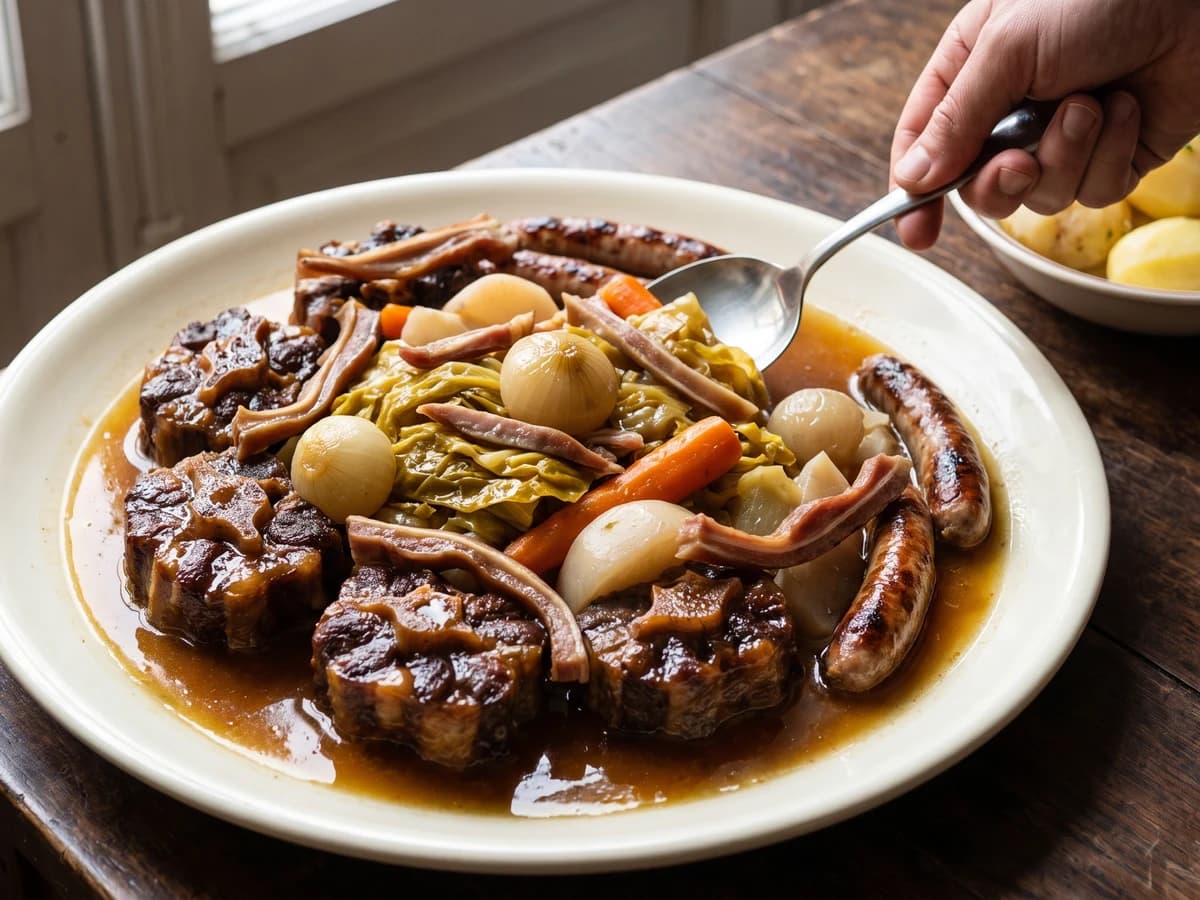
Queue de Bœuf en Hochepot gathers oxtail, pig's trotter and ear, cabbage, roots, and grilled chipolatas around a clear, gelatin-rich broth whose quiet simmer keeps every piece tender and distinct.

Chef Juliette
Beef shoulder larded with bacon, sharpened by red wine and vinegar, then sealed with garlic, vegetables, and dry lemon peel until the low oven turns it yielding and the gravy darkly glossy.