
Chef Juliette
Bouillabaisse à la Marseillaise
Marseille's great fish stew, saffron-gold and garlic-scented, proves that a hard boil can be the careful choice: it binds olive oil into broth before the whole pot meets bread.
A cooking platform built around craft, culture, and the stories behind what we eat.

Created by Chef Juliette
Based on No. 678, Velouté Dame-Blanche, from Le Guide Culinaire (1907) by Auguste Escoffier
Velouté Dame-Blanche is a lesson in pale flavor: clear poultry velouté deepened with hand-pressed almond milk, enriched with liaison and butter, then set with chicken dice and pearl quenelles.
Velouté Dame-Blanche (White Lady velouté) teaches that pale food must be built, not merely kept white. The one true thing to know before touching a pan is this: the liaison must never boil. Clear poultry velouté brings structure, freshly pressed almond milk brings a quiet fragrance, and cold butter gives the finished soup its fine gleam.
The original entry assumed a saucier, clear poultry velouté always ready, chilled chicken forcemeat at hand, and enough cooks to press almonds while someone else poached the garnish. The strong towel becomes a nut-milk bag, the mortar becomes a food processor, and the pint measure becomes about two quarts for eight first-course bowls. Those are changes of equipment and service scale. The almond pressing, last-minute pearl quenelles, liaison, and butter remain because they are the dish. One cook, one stove, one evening.
Once the yolks enter, keep the pan below a simmer and stir without interruption. That gentle finish decides whether the Dame-Blanche arrives ivory and silken or grainy, and it is the step that deserves your full attention.
Velouté Dame-Blanche belongs to the classical Parisian grand-kitchen potage repertoire, where composed soups were distinguished by their foundation, finishing liaison, and carefully chosen garnish. Its name describes its pale appearance rather than a regional dairy tradition: freshly pressed sweet-almond milk perfumes a poultry velouté, while chicken dice and pearl quenelles give it the formality of a dinner-table first course. As the formula passed into bourgeois home kitchens, the essential discipline remained unchanged: strain finely, enrich below the boil, and add the garnish at the last moment.
Quantity
6 cups (1.42 L / about 1.45 kg)
Quantity
24 almonds (about 1/4 cup / 30 g)
well washed and drained
Quantity
2/3 cup (160 ml / 160 g)
Quantity
4
Quantity
1 cup (240 ml / 238 g)
Quantity
4 tablespoons (60 ml / 57 g)
diced
Quantity
1/2 cup (120 ml / 120 g)
thoroughly chilled
Quantity
2 tablespoons (30 ml / 28 g)
cut into small even dice
Quantity
4 cups (950 ml / 950 g)
Quantity
1 teaspoon (5 ml / 6 g), divided, plus more only if needed
Quantity
1
Quantity
2 tablespoons (30 ml / 30 g)
| Ingredient | Quantity |
|---|---|
| prepared clear poultry velouté | 6 cups (1.42 L / about 1.45 kg) |
| blanched sweet almondswell washed and drained | 24 almonds (about 1/4 cup / 30 g) |
| cold fresh water | 2/3 cup (160 ml / 160 g) |
| large egg yolks | 4 |
| heavy cream | 1 cup (240 ml / 238 g) |
| cold unsalted butterdiced | 4 tablespoons (60 ml / 57 g) |
| prepared chicken forcemeatthoroughly chilled | 1/2 cup (120 ml / 120 g) |
| cooked white chicken breastcut into small even dice | 2 tablespoons (30 ml / 28 g) |
| water for poaching | 4 cups (950 ml / 950 g) |
| fine salt | 1 teaspoon (5 ml / 6 g), divided, plus more only if needed |
| large egg yolk for rescuing the liaison (optional) | 1 |
| cold heavy cream for rescuing the liaison (optional) | 2 tablespoons (30 ml / 30 g) |
Pulse the washed almonds in a small food processor until finely ground. Add the cold water little by little, processing until the almonds become a loose, milky paste. Scrape it into a dampened nut-milk bag or a double layer of strong cheesecloth set over a bowl, then twist and squeeze firmly. You should recover about 1/2 cup of fragrant white almond milk. Press until the pulp feels nearly dry; this extraction is the almond flavor of the dish, so commercial almond drink is not its equivalent.
Line a small tray with parchment and keep a cup of cold water nearby. Using two damp 1/2-teaspoon measuring spoons, pass small portions of the chilled chicken forcemeat between the spoons to make 24 smooth pearl quenelles. They need not be perfectly round, but they must be small and even so they poach at the same rate. If the forcemeat softens and begins sticking, return it to the cold for ten minutes. Do not stiffen it with flour.
Bring the poaching water and 3/4 teaspoon of the salt to a gentle tremble in a wide saucepan, then lower the heat so only an occasional bubble reaches the surface. Keep it there while you warm the soup. A hard boil batters the little quenelles and tightens their texture.
Pour the clear poultry velouté into a heavy 4-quart saucepan and bring it slowly to a bare simmer over medium-low heat, whisking occasionally across the bottom. Add the freshly pressed almond milk and hold the mixture just below a simmer for three minutes, long enough for the almond to settle into the poultry foundation. If a skin or small lump appears, whisk gently and pass the soup through a fine sieve. Keep the color pale and the heat restrained.
Slip the pearl quenelles into the barely trembling water in two batches. Poach for 3 to 4 minutes, turning them once, until they feel lightly springy and reach 165°F (74°C) at the center. Lift them carefully with a small slotted spoon and hold them on a warm plate. If the water begins boiling, pull the pan from the heat at once and let it settle before continuing; the quenelles will recover if caught early.
Whisk the four egg yolks with the cream in a heatproof bowl. Ladle in about 1 cup of hot soup in three additions, whisking constantly, until the bowl feels warm, then pour the tempered mixture back into the saucepan. Stir over very low heat until the velouté is nappant, lightly coating the back of a spoon, or registers about 170 to 175°F (77 to 79°C). Never let it boil. If the first grains appear, remove the pan from the heat, blend briefly, and strain. If the yolks curdle firmly, strain the soup into a clean pan, whisk the spare yolk with the cold cream, temper it with the strained soup, and return it to gentle heat. Ça se rattrape.
Take the pan completely off the heat. Whisk in the cold butter a few pieces at a time, letting each addition disappear before adding the next. Taste and add the remaining salt only if the poultry velouté needs it. If the soup has tightened too far, loosen it one tablespoon at a time with the hot quenelle-poaching water. Divide the chicken dice and three pearl quenelles among eight warmed soup bowls, then ladle the velouté around them and serve immediately. À table!
1 serving (about 235g)
Culinary guides, cultural storytelling, and the editorial depth that makes cooking meaningful.
Discover Culinary ExplorerChef Juliette
Marseille's great fish stew, saffron-gold and garlic-scented, proves that a hard boil can be the careful choice: it binds olive oil into broth before the whole pot meets bread.

Chef Juliette
Waterzoi asks fresh, bone-in river fish to thicken its own buttery broth, with parsley root and pepper for company. No flour, no stockpot, just a brisk simmer watched closely.
Chef Juliette
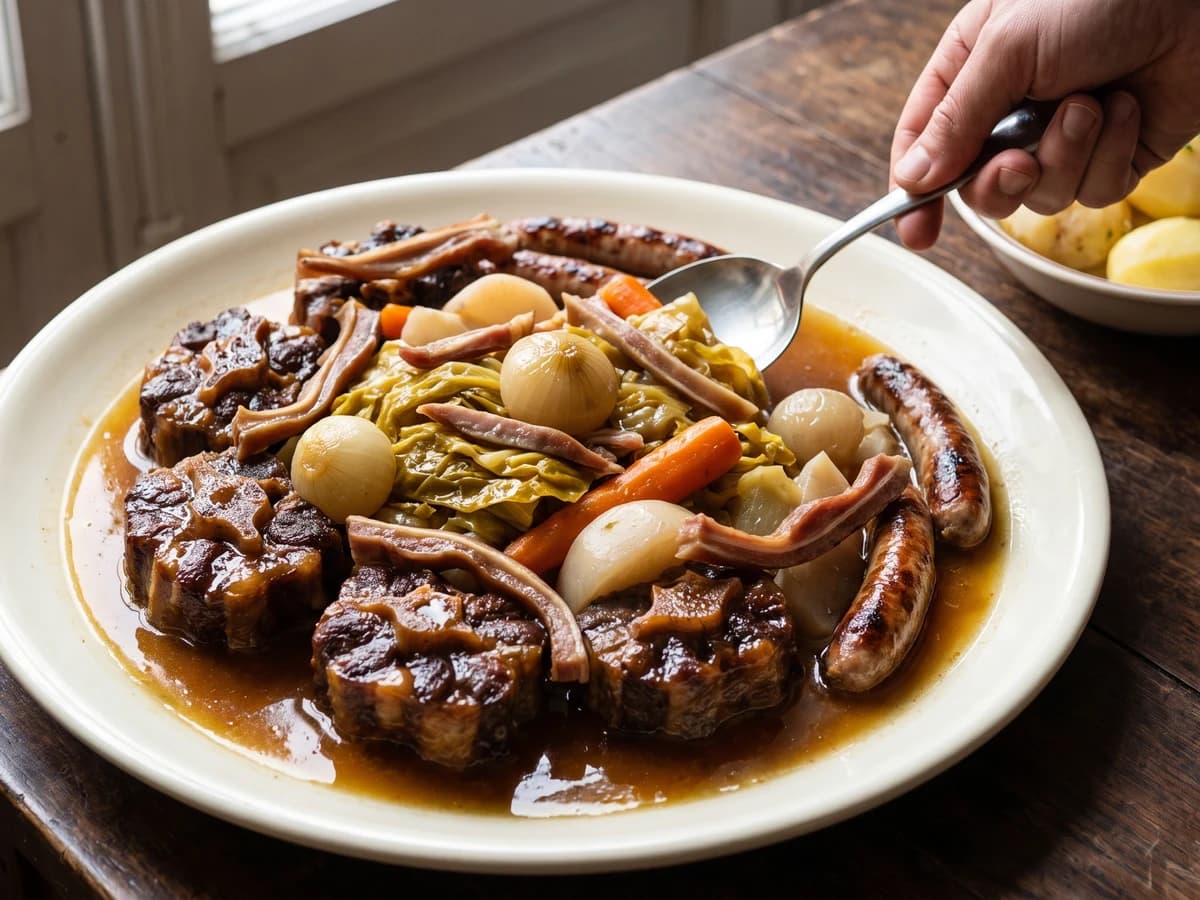
Queue de Bœuf en Hochepot gathers oxtail, pig's trotter and ear, cabbage, roots, and grilled chipolatas around a clear, gelatin-rich broth whose quiet simmer keeps every piece tender and distinct.

Chef Juliette
Beef shoulder larded with bacon, sharpened by red wine and vinegar, then sealed with garlic, vegetables, and dry lemon peel until the low oven turns it yielding and the gravy darkly glossy.