
Chef Juliette
Bouillabaisse à la Marseillaise
Marseille's great fish stew, saffron-gold and garlic-scented, proves that a hard boil can be the careful choice: it binds olive oil into broth before the whole pot meets bread.
A cooking platform built around craft, culture, and the stories behind what we eat.
Created by Chef Juliette
Based on No. 677, Velouté Cressonière, from Le Guide Culinaire (1907) by Auguste Escoffier
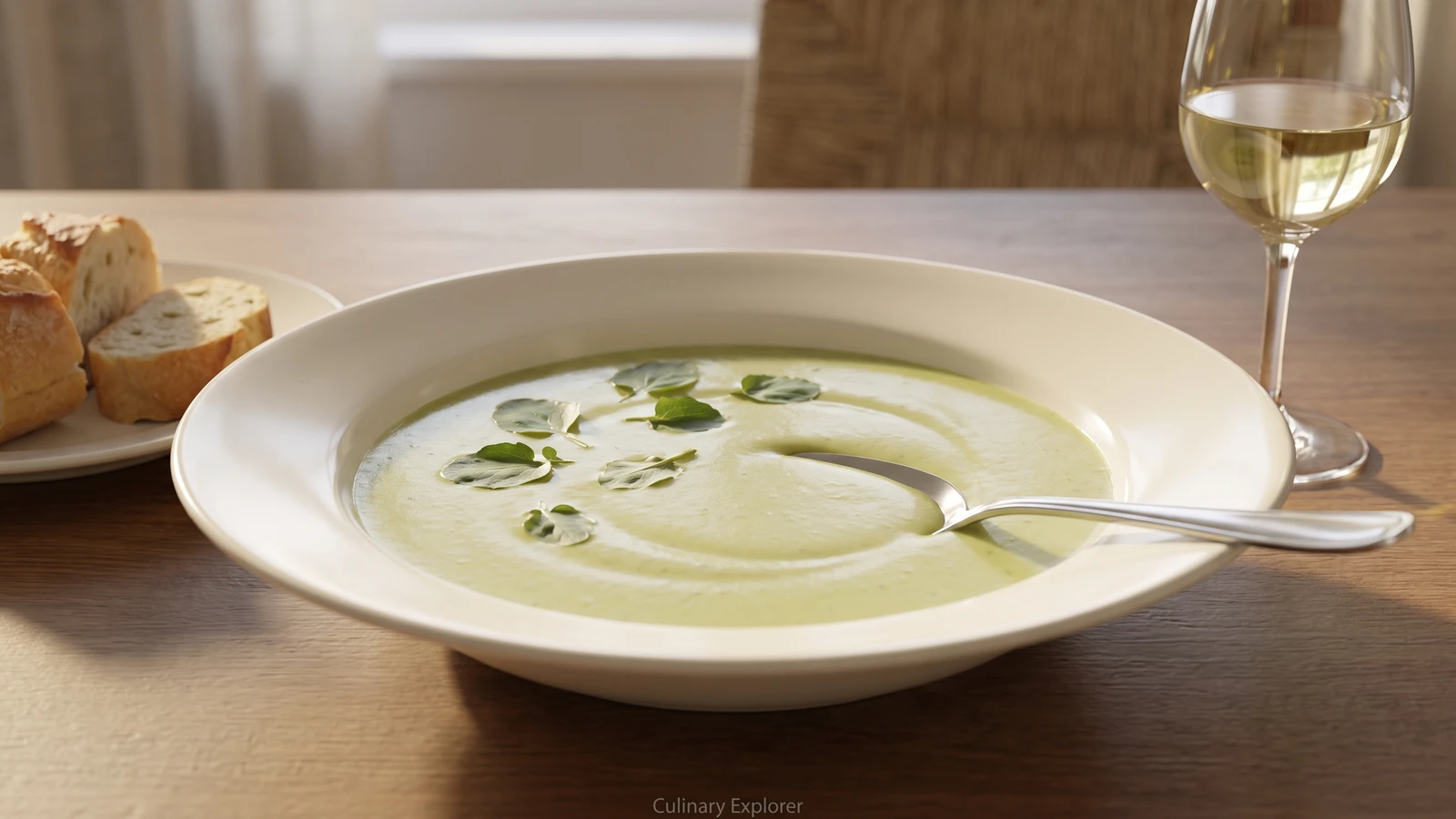
Peppery watercress folded through true velouté, sieved to silk, loosened with white consommé, then finished with liaison and butter: a pale green soup whose quiet richness depends on never letting it boil.
Velouté Cressonière (watercress velouté) teaches the difference between a puréed green soup and a true velouté. The leaves bring their peppery freshness, but the texture comes from the smooth velouté foundation and the liaison added at the end. The one true thing to know before touching the pan is this: once the yolks and cream enter, the soup must never boil.
The original formula assumed a saucier on staff, Ordinary Velouté and Ordinary White Consommé never far from the fire, and a tammy ready for the labor of rubbing the soup smooth. Here the same proportions become a home batch of about two quarts, made with those finished preparations, a blender, and a fine-mesh sieve. The large service pot and hand-rubbing are brigade scaffolding and can go. The slight parboil, the butter stew, the seven-to-eight-minute simmer, the sieving, and the last-minute liaison are the dish itself, so they stay. One cook, one stove, one evening.
The finished cressonnière should be pale herb green, glossy with butter, and smooth enough to leave no fibrous trace on the tongue. The whole leaves on top bring back the honest character of the cress. Before you begin, set out the yolk-and-cream liaison and remember the final command: gentle heat after it enters, never a boil.
Velouté Cressonière belongs to the Parisian classical table and the surrounding market gardens of Île-de-France, particularly the spring-fed cressonnières of Essonne that supplied peppery watercress to the capital. The soup moved from the market-garden pot into formal service by being joined to velouté and white consommé, strained through a tammy, and enriched at the last moment. It is not simply blended watercress soup: cressonnière names the watercress character, while velouté names the smooth foundation that gives the bowl its body.
Quantity
About 18 cups loosely packed (1⅓ pounds / 605 g)
thick stems discarded
Quantity
About 1⅛ cups loosely packed (1⅓ ounces / 38 g)
reserved for garnish
Quantity
4 tablespoons (¼ cup / 57 g)
for stewing
Quantity
2⅔ cups (630 ml / about 650 g)
Quantity
4 cups (950 ml / about 950 g)
Quantity
4
Quantity
¾ cup (180 ml / 180 g)
divided
Quantity
4 tablespoons (¼ cup / 57 g)
cut into small pieces
Quantity
only if needed
| Ingredient | Quantity |
|---|---|
| very fresh watercress leaves and tender tipsthick stems discarded | About 18 cups loosely packed (1⅓ pounds / 605 g) |
| small watercress leaves and tender tipsreserved for garnish | About 1⅛ cups loosely packed (1⅓ ounces / 38 g) |
| unsalted butterfor stewing | 4 tablespoons (¼ cup / 57 g) |
| Ordinary Velouté | 2⅔ cups (630 ml / about 650 g) |
| Ordinary White Consommé | 4 cups (950 ml / about 950 g) |
| large egg yolks | 4 |
| heavy creamdivided | ¾ cup (180 ml / 180 g) |
| cold unsalted buttercut into small pieces | 4 tablespoons (¼ cup / 57 g) |
| fine salt (optional) | only if needed |
Wash the main quantity of watercress in several changes of cold water, lifting the leaves out each time so the grit remains behind. Bring a large pot of water to a full boil and prepare a bowl of ice water. Working in batches, parboil the cress for 45 to 60 seconds, just until collapsed and brilliantly green, then transfer it immediately to the ice water. Drain, squeeze gently but thoroughly, and chop it roughly.
Return the water to a boil and parboil the reserved garnish leaves for three minutes, as the original formula directs. They will soften and deepen in color. Lift them into the ice water, drain them well, and spread them on a clean towel so they remain separate rather than gathering into a wet clump.
Melt the stewing butter in a heavy 4-quart saucepan over medium-low heat. Add the chopped watercress and stew it gently for 4 to 5 minutes, stirring often, until every leaf is coated and tender but nothing has browned. Butter, not margarine. The butter carries the peppery cress into the velouté, and browning would muddy both flavor and color.
Stir in the Ordinary Velouté and bring the mixture to the barest simmer. Cook for seven to eight minutes, stirring along the bottom and into the corners so the thick base cannot catch. If it does catch, don't scrape the scorched layer into the soup. Pour the clean portion immediately into another saucepan and continue there. Ça se rattrape.
Purée the mixture in batches until completely smooth, filling the blender no more than halfway and venting the lid beneath a folded towel. Pass the purée through a fine-mesh sieve into a clean saucepan, pressing with a ladle until only dry fibers remain. This blender-and-sieve combination is the honest home equivalent of rubbing the soup through a tammy; do not omit the sieve, because the watercress stems will otherwise announce themselves in every spoonful.
Whisk in the Ordinary White Consommé and bring the soup slowly back to a bare simmer. It should flow like light cream while leaving a delicate veil on the spoon. If it is thinner than that, simmer it for a few minutes now, before the liaison is added. Once the yolks enter, reduction is no longer available to you.
Reserve 2 tablespoons (30 ml / 30 g) of the cream, then whisk the remaining cream with the egg yolks in a heatproof bowl. Take the soup off the heat and slowly whisk two ladlefuls into this liaison, warming it without scrambling the yolks. Whisk the tempered liaison back into the saucepan, then stir over the lowest heat until the soup gains a little body, ideally between 165°F and 175°F (74°C and 79°C). Never let it boil. If small curds or graininess appear, pull the pan off the heat at once, whisk in the reserved cold cream, blend briefly, and pass the soup through the clean sieve. Ça se rattrape.
Keep the saucepan off the heat and whisk in the cold butter a few pieces at a time until fully melted and glossy. Taste before adding salt, since the finished velouté and consommé may already provide enough. Ladle into warmed bowls and divide the parboiled watercress leaves over the surface. Serve at once. À table!
1 serving (about 240g)
Culinary guides, cultural storytelling, and the editorial depth that makes cooking meaningful.
Discover Culinary ExplorerChef Juliette
Marseille's great fish stew, saffron-gold and garlic-scented, proves that a hard boil can be the careful choice: it binds olive oil into broth before the whole pot meets bread.

Chef Juliette
Waterzoi asks fresh, bone-in river fish to thicken its own buttery broth, with parsley root and pepper for company. No flour, no stockpot, just a brisk simmer watched closely.
Chef Juliette
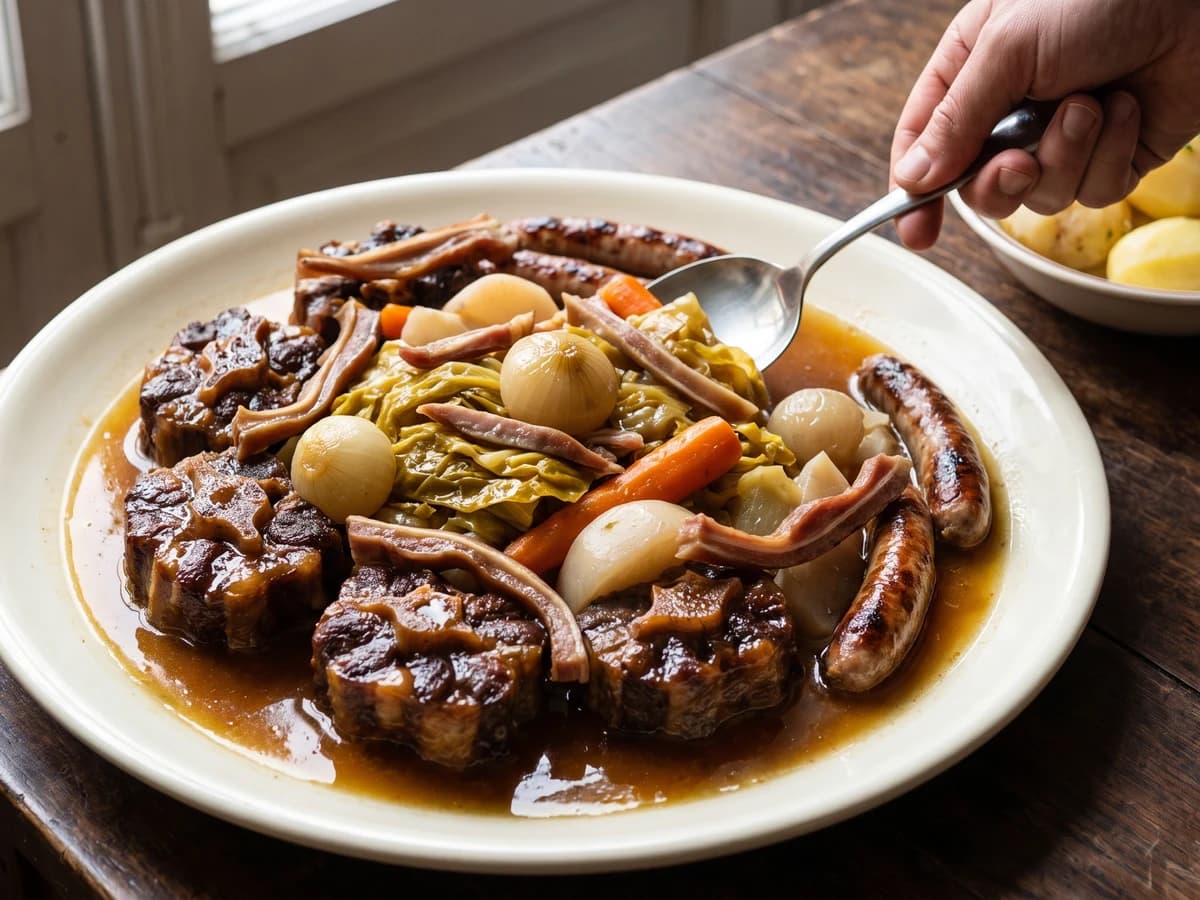
Queue de Bœuf en Hochepot gathers oxtail, pig's trotter and ear, cabbage, roots, and grilled chipolatas around a clear, gelatin-rich broth whose quiet simmer keeps every piece tender and distinct.

Chef Juliette
Beef shoulder larded with bacon, sharpened by red wine and vinegar, then sealed with garlic, vegetables, and dry lemon peel until the low oven turns it yielding and the gravy darkly glossy.