
Chef Juliette
Bouillabaisse à la Marseillaise
Marseille's great fish stew, saffron-gold and garlic-scented, proves that a hard boil can be the careful choice: it binds olive oil into broth before the whole pot meets bread.
A cooking platform built around craft, culture, and the stories behind what we eat.

Created by Chef Juliette
Based on No. 675, Velouté Comtesse, from Le Guide Culinaire (1907) by Auguste Escoffier
A pale, silken lesson in control: white asparagus cooked gently in velouté, passed fine, and bound off the heat with yolks and cream, while lettuce chiffonade and twelve tips keep every bowl legible.
Velouté Comtesse (white-asparagus soup bound with yolks and cream) teaches control at the quiet end of the stove. The one true thing is this: the liaison, an egg-yolk-and-cream binding, goes in last and below a simmer, because the moment it boils, silk turns to grain. Everything before that builds purity: white asparagus cooked gently in ordinary velouté, a roux-thickened white stock, passed fine, then loosened with white consommé.
The old formula assumed a saucier on staff, ordinary velouté ready, white consommé from a stockpot never off the fire, and a tammy wide enough for service. At home, make the velouté in the soup pan, use a clear, lightly seasoned chicken consommé, and replace the tammy with an immersion blender followed by a fine-mesh sieve. Separate pans and brigade volume were scaffolding, so they go. Gentle cooking, sieving, the liaison, and the twelve white tips are the dish, so they stay. One cook, one stove, one evening.
Keep those tips back. Their clean shape against the ivory soup, with the narrow green line of lettuce, tells the eye what the spoon is about to taste. Temper the liaison patiently and never let the finished soup boil again. That is the step that decides everything.
Velouté Comtesse belongs to the codified Parisian grand-kitchen repertoire of named potages, where a title fixed a base, finish, and garnish rather than pointing to a province. Its character is not simply cream of asparagus: white asparagus cooks in ordinary velouté, white consommé adjusts the body, and a liaison of yolks and cream supplies the final silk, while Chiffonade and twelve peeled tips make the preparation recognizable at table. As the soup passed into bourgeois dining rooms, it kept the fine sieve because that refinement removes the asparagus fibres rather than merely disguising them.
Quantity
1½ pounds (680 g)
peeled, with 12 small tips reserved
Quantity
4 tablespoons (60 ml / 56 g)
divided
Quantity
¼ cup (60 ml / 30 g)
Quantity
2 cups (480 ml / 480 g)
Quantity
1 cup (240 ml / 240 g)
Quantity
½ cup (120 ml / 120 g)
divided
Quantity
2 (about 36 g)
Quantity
1 tablespoon (15 ml / 5 g) Chiffonade (No. 215)
Quantity
1 teaspoon (5 ml / 6 g), plus more as needed
| Ingredient | Quantity |
|---|---|
| fresh white asparaguspeeled, with 12 small tips reserved | 1½ pounds (680 g) |
| unsalted butterdivided | 4 tablespoons (60 ml / 56 g) |
| plain flour | ¼ cup (60 ml / 30 g) |
| light unsalted chicken stock | 2 cups (480 ml / 480 g) |
| white consommé | 1 cup (240 ml / 240 g) |
| heavy creamdivided | ½ cup (120 ml / 120 g) |
| large egg yolks | 2 (about 36 g) |
| Chiffonade | 1 tablespoon (15 ml / 5 g) Chiffonade (No. 215) |
| fine salt | 1 teaspoon (5 ml / 6 g), plus more as needed |
Peel every spear from just below its tip to the base; white asparagus keeps a fibrous outer coat that no amount of elegant sieving can excuse. Trim away the woody ends. Cut off 12 neat tips, each about 1½ inches long, and use the point of a paring knife to lift away any tough papery scales without disturbing the buds. Cut the remaining stalks crosswise into 1-inch pieces.
Bring a saucepan of water to a boil and season it with part of the measured salt. Cook the reserved tips gently for 3 to 4 minutes, until a knife enters with slight resistance, then lift them onto a clean towel. Add the chopped stalks and parboil them for 4 minutes. Drain thoroughly. This first cooking removes their raw edge; the velouté will complete the cooking and carry their flavour.
Melt 2 tablespoons of the butter in a heavy 3-quart saucepan over low heat. Stir in the flour and cook this roux blanc, or white roux, for 2 minutes, stirring steadily and allowing no colour. Whisk in the chicken stock a little at a time, making each addition smooth before adding the next. Bring to a bare simmer and cook for 12 minutes, stirring often, until the ordinary velouté coats the back of a spoon without tasting of raw flour. If it lumps, take it off the heat and whisk firmly, then pass it through the sieve. Ça se rattrape.
Add the parboiled stalk pieces to the ordinary velouté. Hold the pan at the gentlest simmer for 15 to 20 minutes, stirring along the bottom every few minutes, until the asparagus crushes readily against the side of the pan. Do not boil hard. Fierce heat reduces the base before the fibres soften, leaving a thick soup with a raw, woody taste.
Blend the soup in the pan with an immersion blender until no pieces remain. Set a fine-mesh sieve over a clean saucepan and press the soup through with a ladle or flexible spatula, working patiently, then discard the dry fibres left behind. The blender replaces the brigade's first pass, but the sieve replaces the tammy and must stay. It is what turns cooked asparagus into a true velouté rather than a fibrous purée.
Stir the white consommé into the sieved soup and heat it gently until the first small bubbles appear at the edge. Simmer for 3 minutes, then taste and correct the salt. The soup should pour in a broad ribbon, neither stand like sauce nor run like broth. Remove the pan from the heat before preparing the liaison.
Whisk the egg yolks with all but 2 tablespoons of the cream in a heatproof bowl. Add about 1 cup of the hot soup in four small additions, whisking continuously, then pour the tempered liaison back into the saucepan. Set it over the lowest heat and stir constantly for 2 to 4 minutes, just until the soup gains a delicate body and coats the spoon. It must not bubble. At the first sign of graininess, pull the pan from the heat, whisk in the reserved cold cream, blend briefly, and pass the soup through a clean fine-mesh sieve. Ça se rattrape, provided you catch it before a hard boil.
Keep the pan off the heat and whisk in the remaining 2 tablespoons of cold butter, a small piece at a time, until the surface shines. Place the Chiffonade (No. 215) in a warmed soup tureen or divide it among six warmed bowls. Ladle in the Velouté Comtesse and arrange the 12 reserved asparagus tips on top, two per bowl, keeping them visible rather than stirring them under. Serve at once. À table!
1 serving (about 275g)
Culinary guides, cultural storytelling, and the editorial depth that makes cooking meaningful.
Discover Culinary ExplorerChef Juliette
Marseille's great fish stew, saffron-gold and garlic-scented, proves that a hard boil can be the careful choice: it binds olive oil into broth before the whole pot meets bread.

Chef Juliette
Waterzoi asks fresh, bone-in river fish to thicken its own buttery broth, with parsley root and pepper for company. No flour, no stockpot, just a brisk simmer watched closely.
Chef Juliette
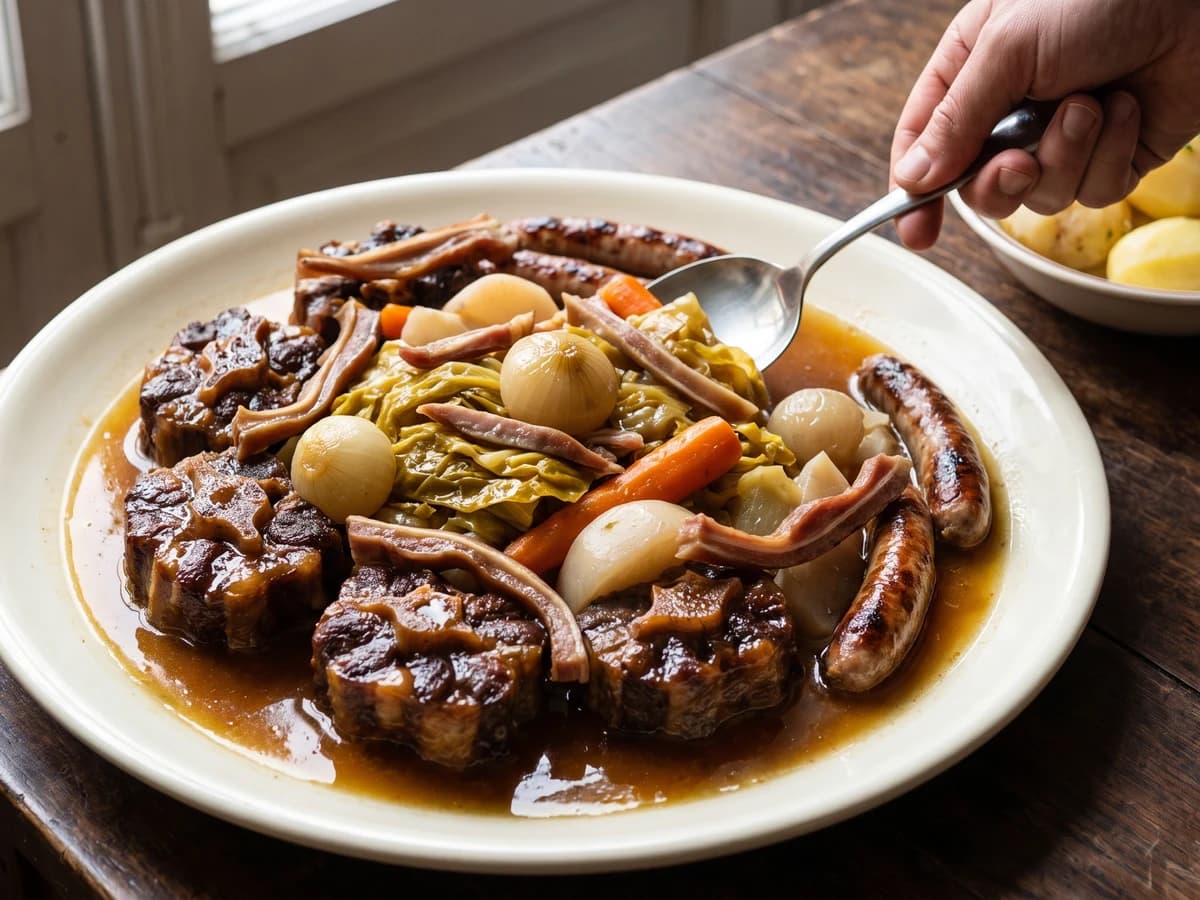
Queue de Bœuf en Hochepot gathers oxtail, pig's trotter and ear, cabbage, roots, and grilled chipolatas around a clear, gelatin-rich broth whose quiet simmer keeps every piece tender and distinct.

Chef Juliette
Beef shoulder larded with bacon, sharpened by red wine and vinegar, then sealed with garlic, vegetables, and dry lemon peel until the low oven turns it yielding and the gravy darkly glossy.