
Chef Juliette
Bouillabaisse à la Marseillaise
Marseille's great fish stew, saffron-gold and garlic-scented, proves that a hard boil can be the careful choice: it binds olive oil into broth before the whole pot meets bread.
A cooking platform built around craft, culture, and the stories behind what we eat.

Created by Chef Juliette
Based on No. 656, Potage Marcilly, from Le Guide Culinaire (1907) by Auguste Escoffier
Two silken purées, pea green and chicken ivory, meet only when the tureen is ready, then pearl tapioca and twenty-four tiny quenelles turn disciplined separation into an exceptionally graceful first course.
Potage Marcilly (pea and chicken purée soup) teaches separation. Its one true rule is simple: finish the green pea purée and ivory chicken purée independently, measure equal volumes, then unite them only when the tureen is warm and the guests are seated. That last-minute marriage preserves the pea's color, the chicken's clean savor, and the silk of both.
The brigade entry assumed a saucier holding two purées, a stockpot never off the fire, and another cook shaping the garnish. There is no salamander to replace here; the luxury was hands and ready stock, not equipment. Your honest equivalent is two saucepans, a blender, prepared chicken stock and consommé, frozen petits pois picked at their sweetest, and a small food processor for the farce mousseline (cream-lightened chicken forcemeat). I have scaled the formula to two quarts: four tablespoons of perles du Japon (small pearl tapioca) and twenty-four chicken quenelles. The multiple hands were scaffolding. The equal halves, exact garnish, and last-minute mixing are the dish. One cook, one stove, one evening.
Finished, Potage Marcilly is pale green and glossy, with translucent pearls and tender white quenelles appearing in each spoonful. Guard one moment above all: bring both purées to the same flowing consistency before they meet. If one is thick and the other loose, adjust them separately with stock or gentle reduction. Ça se rattrape.
Potage Marcilly belongs to the named potages of the Parisian classical kitchen rather than to a securely documented regional household tradition. The formula preserves its method more clearly than its dedication: equal pea and chicken purées held apart until service, then garnished with twelve pearl-shaped chicken quenelles and two tablespoons of perles du Japon per quart. Perles du Japon are tapioca pearls, not a Japanese seasoning, a French pantry garnish valued for translucent tenderness in consommés and delicate soups.
Quantity
1 lb (454 g)
kept very cold; reserve 3½ oz (100 g) for quenelles and cut the remainder into 1-inch pieces
Quantity
7 cups (1.68 liters / 1.68 kg)
divided
Quantity
4 cups (960 ml / 960 g)
for poaching and holding the garnishes
Quantity
4 cups (960 ml / 560 g)
kept frozen until cooking
Quantity
⅓ cup (80 ml / 65 g)
unrinsed
Quantity
1½ cups (360 ml / 360 g)
divided and kept cold where noted
Quantity
5 tablespoons (75 ml / 70 g)
divided; keep 2 tablespoons cold for finishing
Quantity
½ egg white (15 g)
Quantity
¼ cup (60 ml / 40 g)
not instant
Quantity
2 teaspoons (10 ml / 12 g), plus more as needed
divided
Quantity
½ teaspoon (2.5 ml / 1 g)
divided
| Ingredient | Quantity |
|---|---|
| boneless, skinless chicken breastkept very cold; reserve 3½ oz (100 g) for quenelles and cut the remainder into 1-inch pieces | 1 lb (454 g) |
| unsalted chicken stockdivided | 7 cups (1.68 liters / 1.68 kg) |
| clear chicken consomméfor poaching and holding the garnishes | 4 cups (960 ml / 960 g) |
| frozen petits poiskept frozen until cooking | 4 cups (960 ml / 560 g) |
| white short-grain riceunrinsed | ⅓ cup (80 ml / 65 g) |
| heavy creamdivided and kept cold where noted | 1½ cups (360 ml / 360 g) |
| unsalted butterdivided; keep 2 tablespoons cold for finishing | 5 tablespoons (75 ml / 70 g) |
| large egg white | ½ egg white (15 g) |
| perles du Japon, small pearl tapiocanot instant | ¼ cup (60 ml / 40 g) |
| fine saltdivided | 2 teaspoons (10 ml / 12 g), plus more as needed |
| ground white pepperdivided | ½ teaspoon (2.5 ml / 1 g) |
Chill the food-processor bowl and blade for 10 minutes. Dice the reserved 3½ ounces of raw chicken and process it with ¼ teaspoon of the salt and a pinch of white pepper until smooth and tacky. Add the egg white, process until absorbed, then pour in ⅓ cup of the cold cream in a thin thread while the machine runs. Stop as soon as the forcemeat is smooth. Scrape it into a cold bowl, cover, and chill for 20 minutes. Wash the processor, blade, and work surface thoroughly after handling the raw chicken.
Bring the consommé to a bare simmer in a small saucepan. Rain in the perles du Japon while stirring, then cook gently for 18 to 25 minutes, stirring often, until the pearls are translucent with no more than a pinprick of white at their centers. Lift them into a small bowl with a fine-mesh skimmer and moisten them with 2 tablespoons of the consommé. Reserve the remaining consommé for the quenelles. If the pearls clump while waiting, loosen them gently with another spoonful of warm consommé rather than rinsing away their flavor.
Return the reserved consommé to a bare tremble. Dip two teaspoons into it, then use them to shape one rounded teaspoon of cold farce mousseline into a small pearl. Poach this first quenelle for 4 to 5 minutes and cut it open; it should be tender, evenly white, and cooked to 165°F (74°C). Shape and poach 24 quenelles in small batches, keeping the liquid below a boil, then hold them in a shallow bowl under a little warm consommé.
Bring 4 cups of the chicken stock to the gentlest simmer in a 4-quart saucepan. Add the remaining chicken and poach without boiling for 8 to 12 minutes, until the thickest piece reaches 165°F (74°C). Lift the chicken onto a plate. Add the rice to the same stock and simmer for 25 to 30 minutes, stirring occasionally, until the grains are swollen and collapsing. The rice is the classical body of this purée; it thickens without imposing the floury taste of a hurried roux.
Return the cooked chicken to the rice and stock. Add ½ cup of the cream and 1 tablespoon of the butter, then blend in batches until completely smooth, venting the blender lid safely. Press the purée through a fine-mesh sieve into a clean saucepan. Measure it and adjust with reserved chicken stock to exactly 4 cups. If it is too loose, simmer it gently until reduced; if too thick, add stock by the spoonful. Season with salt and white pepper. If it feels grainy, blend longer and strain again. Do not add more rice.
Melt 1 tablespoon of the butter in a second saucepan without letting it color. Add the frozen petits pois and stir for 1 minute, then add 1½ cups of chicken stock and a small pinch of salt. Simmer only until the peas are tender and vividly green, about 5 to 7 minutes. Blend at once with ½ cup of the cream and another tablespoon of butter, then press through the cleaned fine-mesh sieve. Adjust with stock to exactly 4 cups and season with salt and white pepper.
Warm the chicken and pea purées in separate saucepans over low heat. Bring each to the same flowing consistency, thick enough to coat a spoon in a thin, even veil but loose enough to pour freely. Adjust either one with stock, and taste them separately before making the final salt correction. Warm a 2-quart soup tureen with hot water, dry it, then place the drained tapioca pearls and all 24 quenelles inside. Keeping the purées apart until this moment is not service theater. It is the structure of Potage Marcilly.
Pour the equal measures of hot pea and chicken purée together and whisk gently just until the color is even. Take the pan off the heat and whisk in the remaining 2 tablespoons of cold butter to give the soup its final gloss. Do not boil it after mixing. If the surface turns flecked or oily, remove it from the heat and blend in 1 tablespoon of the reserved cold cream. Ça se rattrape. Pour the soup over the garnishes in the warm tureen and serve immediately, allowing three quenelles per starter portion. À table!
1 serving (about 245g)
Culinary guides, cultural storytelling, and the editorial depth that makes cooking meaningful.
Discover Culinary ExplorerChef Juliette
Marseille's great fish stew, saffron-gold and garlic-scented, proves that a hard boil can be the careful choice: it binds olive oil into broth before the whole pot meets bread.

Chef Juliette
Waterzoi asks fresh, bone-in river fish to thicken its own buttery broth, with parsley root and pepper for company. No flour, no stockpot, just a brisk simmer watched closely.
Chef Juliette
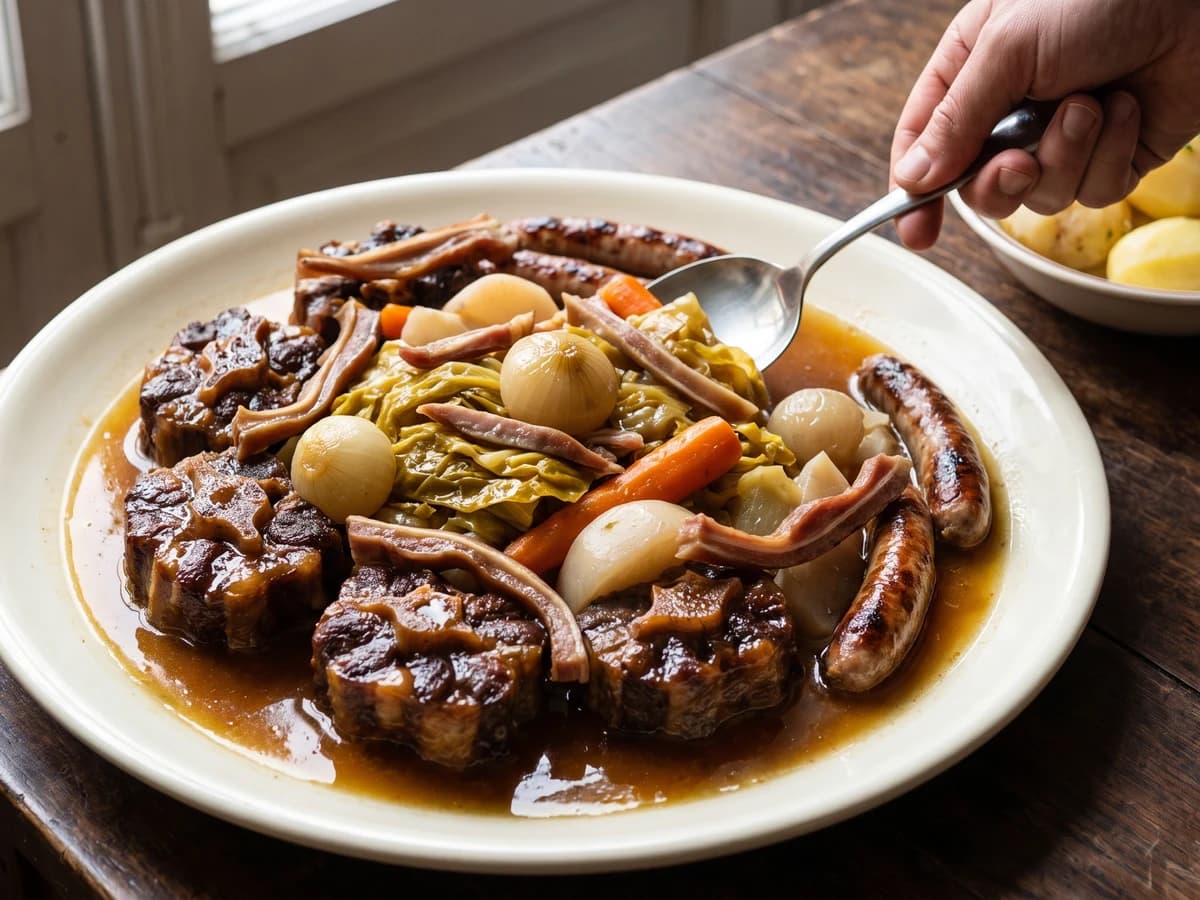
Queue de Bœuf en Hochepot gathers oxtail, pig's trotter and ear, cabbage, roots, and grilled chipolatas around a clear, gelatin-rich broth whose quiet simmer keeps every piece tender and distinct.

Chef Juliette
Beef shoulder larded with bacon, sharpened by red wine and vinegar, then sealed with garlic, vegetables, and dry lemon peel until the low oven turns it yielding and the gravy darkly glossy.