
Chef Juliette
Bouillabaisse à la Marseillaise
Marseille's great fish stew, saffron-gold and garlic-scented, proves that a hard boil can be the careful choice: it binds olive oil into broth before the whole pot meets bread.
A cooking platform built around craft, culture, and the stories behind what we eat.

Created by Chef Juliette
Based on No. 651, Potage Camélia, from Le Guide Culinaire (1907) by Auguste Escoffier
Potage Camélia turns a silken pea purée into supper with two precise juliennes, pale leek and white chicken, folded through at the last moment so each keeps its shape, colour, and character.
Potage Camélia (silken pea soup with leek and chicken julienne) teaches one true thing: the garnish is not decoration. Potage Lamballe supplies the smooth pea-purée foundation, but the Camélia appears only when equal measures of pale leek and white chicken are cut julienne, a fine matchstick cut, then slipped into the soup without losing themselves.
The original entry assumed a saucier had Potage Lamballe waiting, a stockpot never off the fire, and enough hands to cut garnishes for many quarts. At home, prepare the Lamballe as its own finished recipe, reheat two quarts in one heavy saucepan, and add exactly two tablespoons of each julienne. Separate service pans were brigade scaffolding and can go. The proportion, the fine cutting, and the last-minute finish are the dish and must stay. One cook, one stove, one evening.
The finished soup should be satin-smooth and pea-green, crossed with fine ivory threads that remain tender but recognizable on the spoon. Cut the leek and chicken evenly, then fold them in only after the base is fully hot. That final restraint decides the potage.
Potage Camélia belongs to the formal Parisian table's family of named purée soups, in which a familiar foundation acquired a new identity through a precise garnish. Here Potage Lamballe, the pea-purée model, receives equal spoonfuls of leek white and white chicken cut julienne-fashion; despite the flower name, camellia petals and perfume have no place in the bowl. The formula shows how the classical kitchen worked by families: master the base, then finish it with intent.
Quantity
8 cups (1.9 L / about 2 kg)
Quantity
2 tablespoons (30 ml / 12 g)
cut julienne-fashion into fine matchsticks
Quantity
2 tablespoons (30 ml / 18 g)
cut into matching fine julienne
| Ingredient | Quantity |
|---|---|
| fully prepared Potage Lamballe | 8 cups (1.9 L / about 2 kg) |
| leek whitecut julienne-fashion into fine matchsticks | 2 tablespoons (30 ml / 12 g) |
| cooked white chicken meatcut into matching fine julienne | 2 tablespoons (30 ml / 18 g) |
Cut the leek white into 2.5 cm lengths, separate and rinse the layers, then stack them flat and slice them into matchsticks about 1 mm wide. Chill the cooked chicken until firm and cut it to the same length and thickness. Measure each garnish after cutting: two level tablespoons of leek and two of chicken for this two-quart pot. Matching cuts cook and warm at the same pace, which is why julienne-fashion matters here.
Bring a small saucepan of water to a gentle boil. Add the leek julienne and blanch for 30 to 45 seconds, just until flexible and free of raw bite while every matchstick still holds its shape. Drain immediately, cool under cold water, and dry thoroughly. If it slumps into threads, it has gone too far; reserve it for another soup and blanch a fresh spoonful. Ça se rattrape.
Place the fully prepared Potage Lamballe in a heavy saucepan and warm it over medium-low heat, stirring frequently across the bottom, until it reaches a bare simmer. Do not boil it hard. A pea purée catches readily and loses its fresh colour under rough heat. If the bottom begins to catch, stop stirring and pour the unscorched soup into a clean pan without scraping the darkened layer.
Lower the heat and slip the leek and chicken juliennes into the hot Potage Lamballe whole. Fold them through with two or three slow turns of a spoon, then warm for about 2 minutes, only until the chicken is hot at its centre. Do not whisk and do not leave the garnish simmering; rough stirring frays the chicken, while prolonged heat makes the leek disappear into the purée. One tablespoon of each garnish per quart is the book's proportion, and generosity here would blur the dish rather than improve it.
Taste the potage and correct the seasoning only if warming has muted it. Ladle it into warmed soup plates or carry it to the table in a warmed soupière, distributing the leek and chicken evenly among the portions. Add no stray herbs or decorative flourishes. The distinct white juliennes against the smooth pea base are the finish. À table!
1 serving (about 255g)
Culinary guides, cultural storytelling, and the editorial depth that makes cooking meaningful.
Discover Culinary ExplorerChef Juliette
Marseille's great fish stew, saffron-gold and garlic-scented, proves that a hard boil can be the careful choice: it binds olive oil into broth before the whole pot meets bread.

Chef Juliette
Waterzoi asks fresh, bone-in river fish to thicken its own buttery broth, with parsley root and pepper for company. No flour, no stockpot, just a brisk simmer watched closely.
Chef Juliette
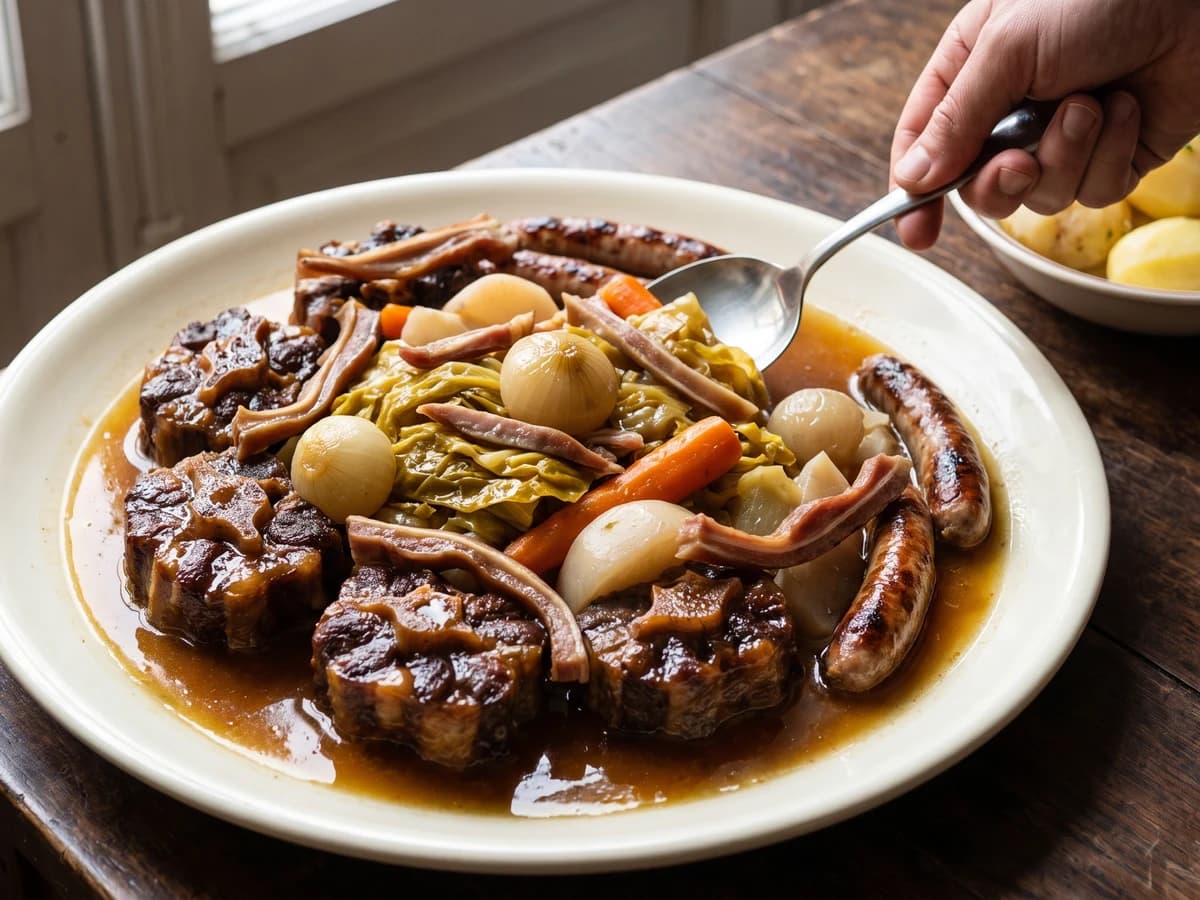
Queue de Bœuf en Hochepot gathers oxtail, pig's trotter and ear, cabbage, roots, and grilled chipolatas around a clear, gelatin-rich broth whose quiet simmer keeps every piece tender and distinct.

Chef Juliette
Beef shoulder larded with bacon, sharpened by red wine and vinegar, then sealed with garlic, vegetables, and dry lemon peel until the low oven turns it yielding and the gravy darkly glossy.