
Chef Juliette
Bouillabaisse à la Marseillaise
Marseille's great fish stew, saffron-gold and garlic-scented, proves that a hard boil can be the careful choice: it binds olive oil into broth before the whole pot meets bread.
A cooking platform built around craft, culture, and the stories behind what we eat.

Created by Chef Juliette
Based on No. 644, Purée d’Oseille et de Semoule à la Crème, from Le Guide Culinaire (1907) by Auguste Escoffier
Sorrel’s bright acidity teaches the balance: butter, milk, semolina, and a careful liaison become a silken cream soup that stays lively, provided the pot never boils after the yolks go in.
Purée d’Oseille et de Semoule à la Crème (creamed sorrel and semolina soup) teaches one true thing: richness must support the sorrel, not smother it. The leaf supplies the bright, almost lemony edge that keeps milk, butter, and semolina awake. Cook it properly and the soup is smooth and generous, but every spoonful still has a little snap.
The compact source entry assumes the preceding method is already in the cook’s hands, with a saucier watching the milk, a tamis, the fine drum sieve, close by, and a pot sized for service. Here the finished quantity becomes about two quarts. An immersion blender replaces the brigade’s first laborious passing, while the final fine sieve stays because that texture is the dish. The specified three ounces of semolina stay too. Multiple passes are scaffolding and can go; butter-softened sorrel, the grain’s full cooking, and the egg-and-cream liaison cannot. One cook, one stove, one evening.
The finished purée should be pale olive rather than bright green, glossy at the surface, and just thick enough to cling lightly to a spoon. The one step that decides it is the liaison: temper it gently, then never let the soup boil after the yolks go in.
Purée d’oseille belongs to the Parisian cuisine bourgeoise and the classical potage repertoire, drawing on the kitchen-garden sorrel soups cooked across northern and central France. Formal kitchens paired the leaf with rice, flour, or semolina to turn its sharp cooking liquor into a smooth first course, then enriched it with a liaison of yolks and cream. Purée here describes the act of passing the soup to perfect smoothness, not a preparation made solely from vegetables.
Quantity
8 loosely packed cups (1.9 L / 225 g)
washed, tough stems removed, and spun very dry
Quantity
¼ cup (60 ml / 57 g)
Quantity
7 cups (1.65 L / 1.70 kg)
divided
Quantity
½ cup (120 ml / 85 g; 3 oz)
Quantity
4 large yolks (about ¼ cup / 70 g)
Quantity
1 cup (240 ml / 240 g)
Quantity
2 teaspoons (10 ml / 12 g), plus more to taste
divided
Quantity
¼ teaspoon (1.25 ml / 0.6 g)
| Ingredient | Quantity |
|---|---|
| fresh sorrel leaveswashed, tough stems removed, and spun very dry | 8 loosely packed cups (1.9 L / 225 g) |
| unsalted butter | ¼ cup (60 ml / 57 g) |
| whole milkdivided | 7 cups (1.65 L / 1.70 kg) |
| fine wheat semolina | ½ cup (120 ml / 85 g; 3 oz) |
| large egg yolks | 4 large yolks (about ¼ cup / 70 g) |
| heavy cream | 1 cup (240 ml / 240 g) |
| fine sea saltdivided | 2 teaspoons (10 ml / 12 g), plus more to taste |
| finely ground white pepper | ¼ teaspoon (1.25 ml / 0.6 g) |
Wash the sorrel in several changes of cold water, strip away any tough central stems, and spin the leaves thoroughly dry. Grit survives a sieve more stubbornly than one would like, and wet leaves dilute the butter before they can soften properly. Reserve 1 cup (240 ml) of the milk for adjusting the finished purée.
Melt the butter in a heavy 4-quart saucepan over medium-low heat. Add the sorrel and ½ teaspoon of the salt, then suer, meaning sweat without browning, for 6 to 8 minutes, turning the leaves until they collapse and their excess moisture cooks away. The color will change from green to olive almost at once. It looks alarming, but it is exactly right. If the butter begins to brown or the leaves catch, add a spoonful of the measured milk and lower the heat.
Pour 6 cups (1.4 L) of the milk into the sorrel gradually, stirring to lift every buttery trace from the pan. Bring it only to a bare simmer. Rain in the semolina in a thin, steady stream while whisking constantly, then reduce the heat and cook for 18 to 20 minutes, stirring across the pot floor often. The grains must swell completely and lose every sandy edge. If the semolina forms lumps, pull the pan off the heat and whisk vigorously before continuing. Ça se rattrape, and the puréeing will catch any stubborn little ones.
Remove the pan from the heat and blend directly in the pot until the sorrel and semolina are completely uniform. Press the soup through a fine-mesh sieve into a clean bowl, working it through with the back of a ladle and discarding only the fibrous residue. The blender is the honest home equivalent for the brigade’s first passing; the sieve remains because it removes the last sorrel threads and gives the purée its silken finish. Return it to the rinsed saucepan and stir in enough reserved milk to make a flowing soup, slightly looser than the consistency you want at the table.
Whisk the egg yolks and cream together in a heatproof bowl until smooth. Warm the purée until it is very hot but not boiling, then take the pan off the heat. Whisk two ladlefuls of hot soup slowly into the cream mixture, followed by another ladleful, then pour this tempered liaison back into the saucepan while stirring. Set the pan over low heat and stir for 3 to 5 minutes, until the soup lightly coats the spoon and reaches about 175°F (80°C). Never boil it. If fine curds appear, remove the pan immediately, blend in 2 tablespoons of cold reserved milk, and pass the soup once more. Ça se rattrape.
Season with the remaining salt and the white pepper, tasting carefully because milk absorbs more salt than expected. The first impression should be the tartness of sorrel, followed by the roundness of cream, with no raw graininess from the semolina. If the purée has tightened, loosen it with the last of the milk over the gentlest heat. Ladle it into warmed bowls and serve immediately. À table!
1 serving (about 250g)
Culinary guides, cultural storytelling, and the editorial depth that makes cooking meaningful.
Discover Culinary ExplorerChef Juliette
Marseille's great fish stew, saffron-gold and garlic-scented, proves that a hard boil can be the careful choice: it binds olive oil into broth before the whole pot meets bread.

Chef Juliette
Waterzoi asks fresh, bone-in river fish to thicken its own buttery broth, with parsley root and pepper for company. No flour, no stockpot, just a brisk simmer watched closely.
Chef Juliette
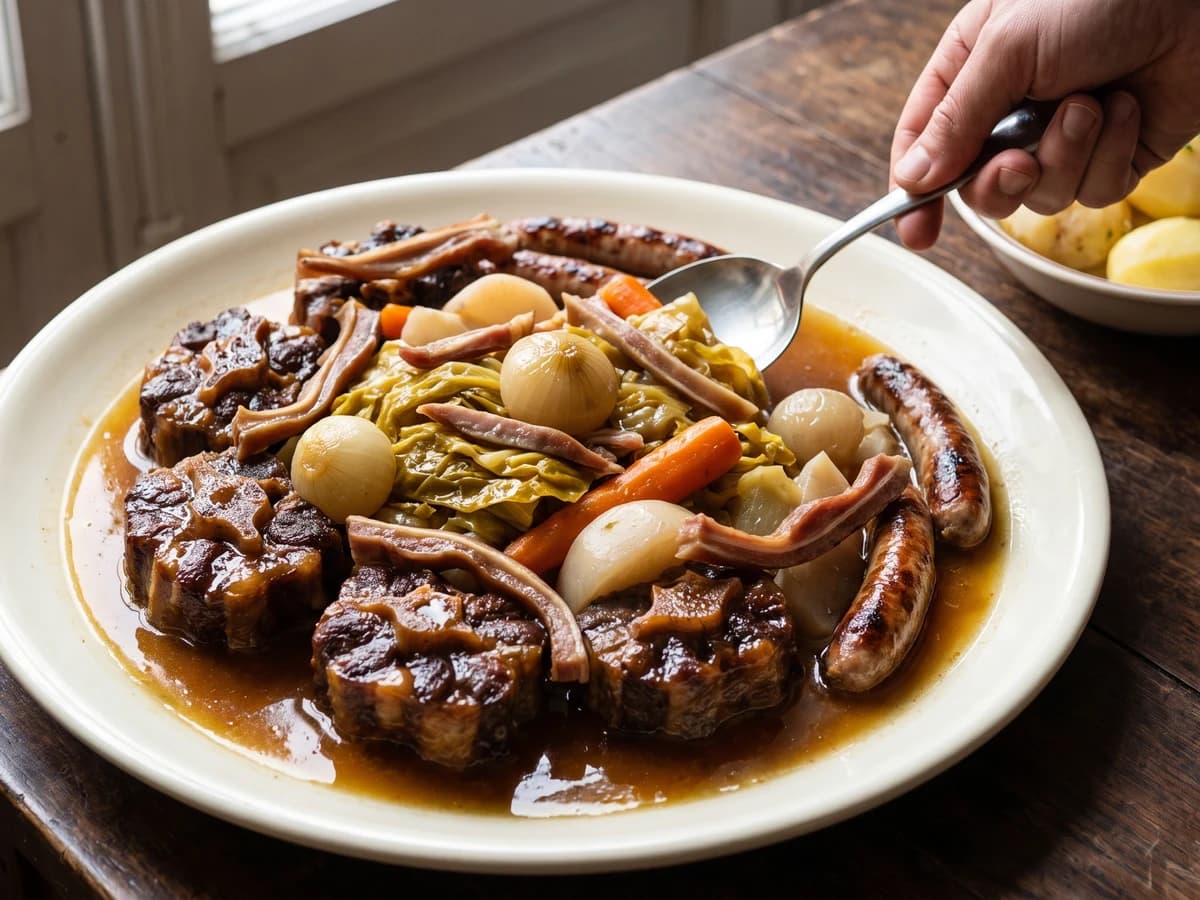
Queue de Bœuf en Hochepot gathers oxtail, pig's trotter and ear, cabbage, roots, and grilled chipolatas around a clear, gelatin-rich broth whose quiet simmer keeps every piece tender and distinct.

Chef Juliette
Beef shoulder larded with bacon, sharpened by red wine and vinegar, then sealed with garlic, vegetables, and dry lemon peel until the low oven turns it yielding and the gravy darkly glossy.